
FINANCE
India Quietly Pays the Iran War’s Biggest Economic Price
While Washington and Tehran trade strikes, India’s rupee, Sensex and oil import bill are quietly absorbing the Iran war’s biggest economic hit.

Brent crude broke back above $100 a barrel on Thursday, its highest price since May, after Yemen’s Houthi rebels struck two Saudi oil tankers in the Red Sea. The attack opened a second front in a war that has run since late February, and Mumbai’s Sensex spent Friday sliding through its fifth straight losing session.
Washington, Tehran, Tel Aviv and Riyadh dominate the headlines. The bill for their war is landing hardest on a country that isn’t fighting it. India buys more than nine of every ten barrels of crude it burns from someone else, and this week that dependence is showing up in its currency, its markets and its central bank’s shrinking room to maneuver.
Dalal Street’s Fifth Straight Losing Session
The numbers moved fast once the tankers caught fire. The BSE Sensex closed Thursday at 76,391.39, down 363.66 points, while the NSE Nifty 50 fell 126.65 points to settle at 23,869.60, BusinessToday reported. The declines came as the U.S. military carried out its twelfth consecutive night of strikes on Iran and Brent surged more than 5% intraday.
The rupee weakened to 96.54 against the dollar that same session. “The Indian rupee pulled off a sharp U-turn, erasing its early morning gains,” said Dilip Parmar, a senior research analyst at HDFC Securities, pointing to surging crude prices and capital flight.
By Friday the slide had stretched to a fifth consecutive session. The Sensex opened near 75,708, the Nifty slipped below 23,900, and Brent held above $100.67 a barrel, its first close above that mark since late May.
| Metric | Latest Reading | Context |
|---|---|---|
| Brent crude | $100.67/barrel (Friday) | First close above $100 since late May |
| BSE Sensex | 76,391.39 (Thursday close) | Down 363.66 points, fourth losing session |
| NSE Nifty 50 | 23,869.60 (Thursday close) | Down 126.65 points |
| Rupee | 96.54 per dollar (Thursday) | Near record low against the dollar |
| Crude basket, pre war baseline | $67 to $71/barrel (April to July 2025) | Level before the conflict began |
Vinod Nair, head of research at Geojit Investments, said crude “approaching the $100/bbl amid concerns over further disruptions to global energy supplies” had left investor sentiment subdued as traders reassessed inflation risk and corporate margins.
India is seeing a March 2026 like sell off in its markets as the surging oil prices transmit an inflationary potential and a supply disruption as well as margin compression to an oil importing country like India.
Ajay Bagga, a market and banking expert, made that comparison to describe Friday’s rout, noting traders were selling first and calculating the damage later.
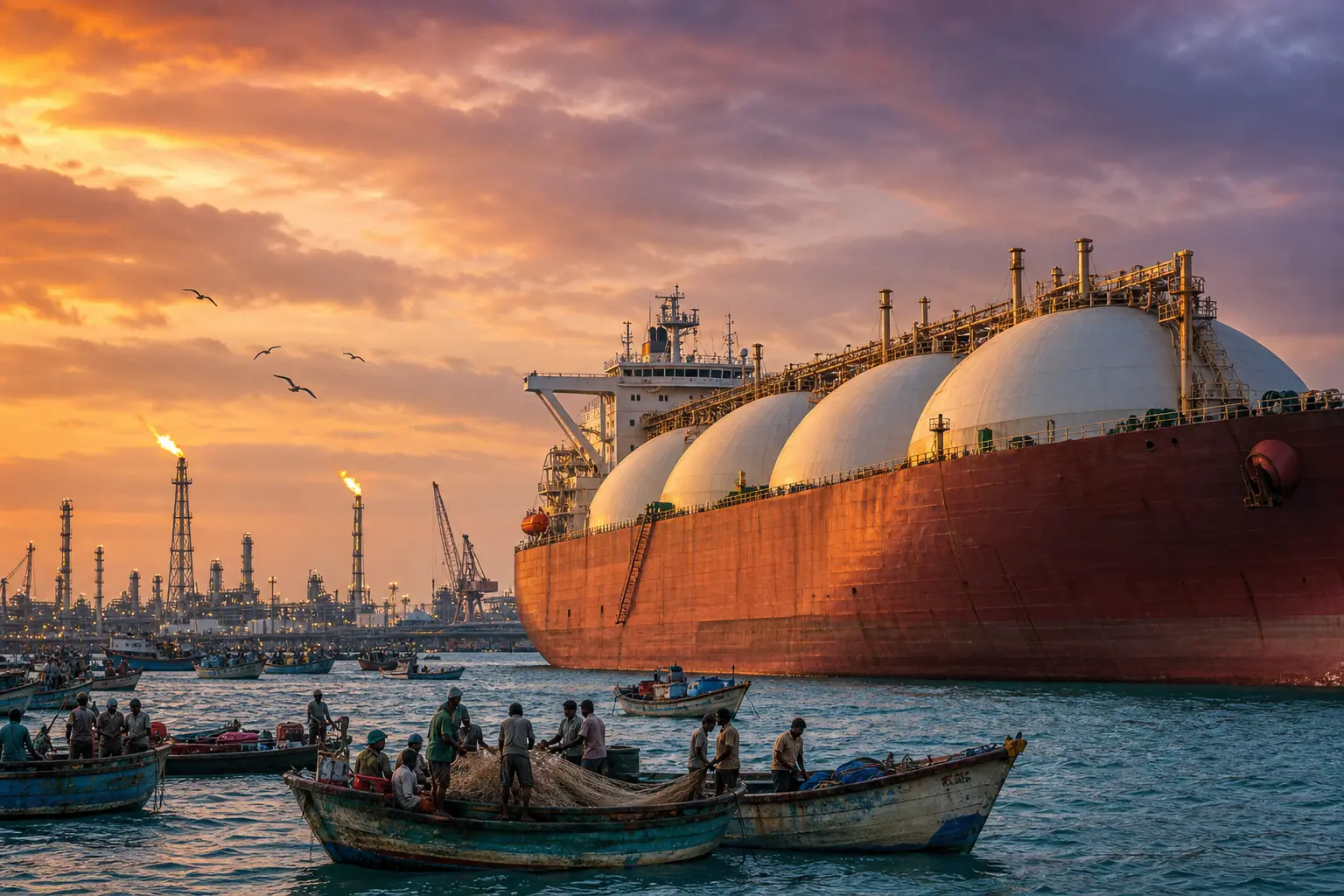
A Dependency That Has Climbed Past Ninety Percent
The mechanism is simple even if the numbers are not. Crude prices rise globally, and India pays more for nearly all the fuel that runs its economy. The country’s crude import dependence exceeded 90% in FY26, up from 55% in FY1999, according to a report published this month by EY India.
Domestic output has moved the wrong way. Production eased to 26 million metric tons in FY26 from a peak of 35.9 million metric tons in FY12, even as consumption of petroleum products climbed to 243.2 million metric tons, the EY report found. Refining capacity has not been the weak link. India still runs 23 refineries at above nameplate capacity, hitting 102.9% utilization in FY24, per government trade data.
- Import share: India accounted for roughly 12 to 13% of global crude oil imports in FY2024-25, according to OPEC figures cited in government trade data.
- Chokepoint exposure: about 40% of crude, 60% of LNG and 90% of LPG imports arrive from the Middle East through the Strait of Hormuz.
- Aviation toll: Indian carriers had cancelled roughly 26,000 international flights by July 20 because of airspace restrictions tied to the war.
- Monthly shock: the country’s oil and gas import bill rose 53% in April alone compared with March, before this week’s fresh spike.
Each line item feeds the same conclusion. There is very little slack left in the system to absorb another leg up in prices.
India’s Oil Bill Jumps Sixty Percent in a Single Quarter
The petroleum ministry’s own provisional numbers, released this month, show the value of India’s crude imports climbing sharply in the first quarter of the 2026-27 fiscal year, which began in April. The soaring bill threatens government finances directly, not just household budgets at the pump.
- 60%: the rise in India’s crude oil import bill for the April to June quarter of fiscal 2026-27, provisional petroleum ministry data showed.
- $70 billion: the potential increase in India’s annual energy import bill if elevated prices persist through the year, based on Economic Times estimates.
- $65 billion: HSBC’s earlier projection for India’s balance of payments gap this fiscal year, before the RBI’s own countermeasures.
- 140 billion rupees (roughly $1.45 billion): the tax revenue New Delhi forgoes every month by holding down fuel prices.
HSBC now expects that $65 billion gap to improve by around $30 billion following the RBI’s measures, which would still leave a shortfall of roughly $35 billion by that math, well above the $25.2 billion, or 0.6% of GDP, recorded the previous fiscal year.
What Happens When Two Chokepoints Close at Once
Roughly 40% of India’s crude, 60% of its liquefied natural gas and 90% of its LPG travel through the Strait of Hormuz from the Middle East. A Houthi blockade in the Red Sea adds a second squeeze on many of the same tanker routes, threatening higher freight rates and insurance premiums on top of the crude price itself.
Indian airlines had already cancelled roughly 26,000 international flights by July 20 because of airspace restrictions tied to the war, Civil Aviation Minister Murlidhar Mohol told the Lok Sabha this week. Diversions and delays have piled on top of the cancellations, he said, as carriers absorb both higher fuel costs and longer routes.
Weeks before the war broke out, the Institute of South Asian Studies at the National University of Singapore urged India to diversify crude purchases toward the United States, Australia and Canada, warning that the calm around $67 to $71 a barrel through mid-2025 would not last if the Iranian standoff intensified. It did not.
Trump separately said this week that frozen Iranian assets held by the United States would now cover damages to any ships or cargo hit in the conflict, a policy that does nothing to lower the price Indian refiners pay at the dock.
The Rate Cut That Keeps Slipping Away
The war has cornered India’s central bank. The rupee has tumbled to record lows since the fighting began in late February, Business Standard reported, and the Reserve Bank of India has resisted using interest rates to defend the currency even with the repo rate parked at 5.25%.
India is not alone in that bind. The U.S. Federal Reserve trimmed its expected 2026 rate cuts from four to one after oil hit $115 a barrel earlier this year, and the Bank of England held its rate at 3.75% after months of expecting to cut. “The risks to the inflation outlook are to the upside,” European Central Bank President Christine Lagarde said Thursday, after the ECB held its deposit rate unchanged.
Indian lenders are already feeling the squeeze in their own numbers. Axis Bank, one of the country’s largest private lenders, this quarter reported profit jumped 23% even as provisions fell and margins slipped, a sign that the higher for longer rate backdrop is already reshaping bank balance sheets. That pressure is exactly why a rate cut India’s banks have been counting on keeps getting pushed further out, with the oil shock leaving the inflation math unfavorable each time the central bank meets.
New Delhi’s Quiet Workarounds
Authorities have leaned on tools short of interest rates. They have curbed gold imports, urged citizens to limit foreign travel and cut fuel taxes to keep pump prices in check, Bloomberg reported, even as record foreign outflows hit local stocks. Petrol and diesel prices have risen less than 10% since the war began, versus more than 50% in some other Asian oil importing economies, though that relief is squeezing the exchequer harder every month it continues.
Refiners have also rerouted supply. About 70% of crude imports now arrive via paths outside the Strait of Hormuz, up from roughly 55% before the war, as tankers hug the Omani coast or take longer routes to avoid Iranian waters.
The diplomatic posture has stayed just as quiet. Where Pakistan’s foreign office spokesman, Tahir Andrabi, has publicly vowed swift retaliation for any strike on Pakistani flagged vessels, India’s response has stayed almost entirely inside the finance ministry and the RBI’s boardroom, an exercise in economic damage control rather than a diplomatic one.
Trump said Thursday he was still weighing whether to widen the campaign against Iran beyond the twelve nights of strikes already carried out. Brent held above $100 heading into the weekend, and Mumbai’s traders had one more session left to get through before finding out which way it would break.

-
 TECH1 year ago
Where Garmin Watches are Made and How They are Assembled
-

 AUTO3 months ago
Tesla’s Roadster Is ‘a Few Weeks Away,’ Says Its Chief Designer
-
 NEWS10 years ago
Samsung Releases Galaxy Note7 TV Ad as Reddit AMA Leaks Specs
-
 NEWS10 years ago
Android 7.0 Nougat Rolls Out To Nexus Devices With New Emoji, Features
-
 FINANCE9 years ago
Cardano Price Surges as ADA Enters the Crypto Top Ten List
-
 NEWS10 years ago
Pre-Order the First Camera Made for Facebook Live Streaming Video
-
 FINANCE1 year ago
Binance Suspends Trading and Withdrawals for a System Upgrade
-
 FINANCE9 years ago
RChain Price Jumps Nearly 150% to a New All-Time High of $2.03