BUSINESS
Iran Mines the Hormuz Lane America Still Escorts
Iran says mines burned two unnamed Hormuz tankers on the southern escort lane. UKMTO has not backed the last pair, and oil is near $110.

Iran’s Revolutionary Guards said Tuesday that mines their sailors planted set two oil tankers ablaze in the southern Strait of Hormuz. The statement on Sepah News named neither ship, flag, owner nor crew.
Both tankers, the Islamic Revolutionary Guard Corps said, were “violating” traffic on an “illegal crossing point” close to Oman, the same dark southern lane U.S. warships have been using to push crude out of the Gulf.
Two Tankers Burned, and Nobody Named Them
The Guards’ Tuesday notice was the latest in a four-day run of mine stories that all sound the same. A ship goes quiet, takes the southern track, hits a mine, and catches fire in the engine room. Then it vanishes from the public record.
On Friday and Saturday the IRGC Navy said two oil tankers, each carrying about 2 million barrels of crude, caught fire after striking mines. On Sunday it described a third blast and an engine-room fire. Tuesday’s pair brought the week’s mine claims to five. Not one vessel has been identified.
No flag state, insurer, owner or salvage team has confirmed those ships. A burning very large crude carrier is hard to hide. Brokers watch them, coastal states have to report pollution, and tugs show up on satellite. None of that public trail has appeared for the ships Tehran says are on fire.
WHAT WE KNOW
- The claim: The IRGC Navy said two violating oil tankers were set ablaze and halted by mines at an illegal southern crossing on Tuesday.
- The pattern: Friday, Saturday and Sunday brought three earlier mine claims, all on the unauthorised southern route with tracking switched off, and all unnamed.
- The documented attacks: UK Maritime Trade Operations logged 12 attacks in the week to October 16, 10 of them in Hormuz, mostly as unknown projectiles rather than mines.
WHAT IS UNCONFIRMED
- The ships: No registry, owner, insurer or crew has named the Tuesday pair or the three that preceded them.
- The mines: The Joint Maritime Information Center, publishing through UKMTO, said there is no substantiation to these claims for the two supertankers announced on October 17.
- The cargo: The 2 million-barrel loads were stated only for the Saturday pair and have not been checked by a tracker or a flag state.
Iranian Foreign Minister Abbas Araghchi on Monday again blamed Washington for insecurity in the strait. The Guards are using the same week to argue that the southern shortcut is closed, whether or not a named tanker is actually burning.
The Southern Lane Iran Calls Illegal
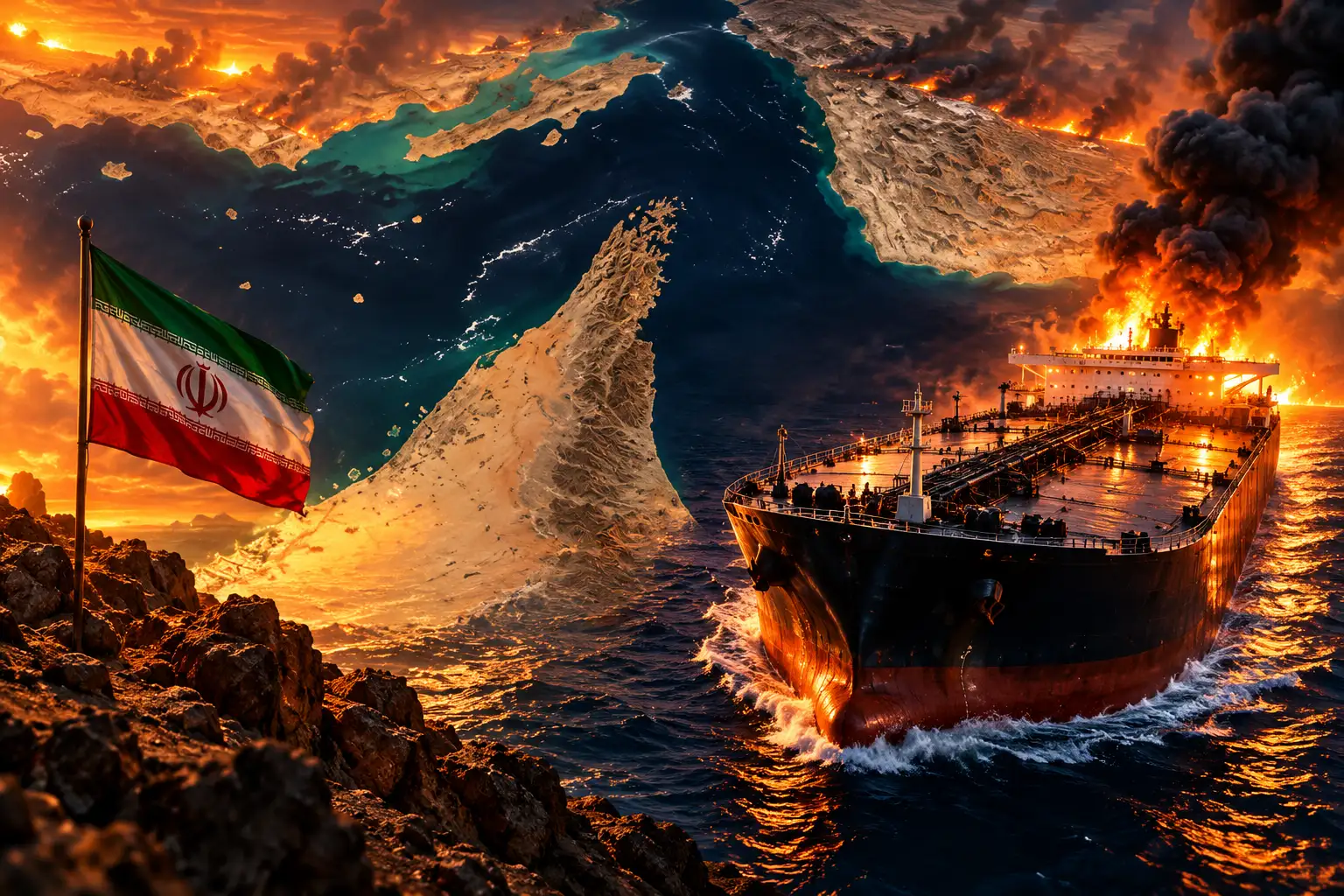
At its narrowest the strait is 21 nautical miles wide. The peacetime traffic scheme runs two lanes through Omani water, each about 2 miles across. That geometry is why captains hug Oman when they want to stay out of Iranian guns.
Since U.S. and Israeli strikes on February 28 killed Supreme Leader Ayatollah Ali Khamenei and opened the war, Iran has demanded that every ship take a permit and a route Tehran approves. Washington answered with escorts along the Omani shore and a habit of running dark, transponders off, so Iranian patrols get less of a firing solution.
Analytics firm Windward identified 12 vessels struck in the recent attacks, 11 of them tankers. All were moving through the southern channel near Oman with AIS off. That is now the IRGC’s definition of a violator: south, silent, and unlicensed.
United Against Nuclear Iran, which tracks the blockade from satellite and AIS, said U.S.-facilitated transits averaged 27.67 ships a day from October 15 to 17, 83 crossings in 72 hours. Live AIS, which only sees ships that are broadcasting, showed about 0.4 commercial crossings a day over the past week against 84.8 before the crisis, with 3 visible passages on Tuesday. The gap between those two counts is the dark lane. It is also the lane Iran says it has mined.
Why Engine-Room Fires Keep Getting Called Mines
A moored mine in a traffic lane is a blunt weapon. It does not pick the engine room. The IRGC’s own notices keep putting the blast in the stern, which is how a guided missile or a loitering round behaves when someone is aiming at propulsion.
Two violating oil tankers were set ablaze and halted due to the explosion of mines planted by the brave sailors of the IRGC Navy at an illegal crossing point in the southern part of the Strait of Hormuz.
Islamic Revolutionary Guard Corps, statement on Sepah News
U.S. Central Command has been saying the same thing in plainer language. On August 31 it rejected an IRGC report that a supertanker had hit two mines in the southern lane, saying no vessel had struck a mine in the strait and calling the story an attempt to intimidate shipping. On October 15 it said a ship Iran blamed on a mine had been hit by an IRGC projectile, and that the primary transit routes were free of mines.
The named wreck cuts against the unnamed ones. Singapore said the container ship GFS Pride was hit by unknown projectiles; it caught fire on October 13 and sank on October 14 while being towed. The Guards had called that a mine too. Flag states talk when they lose a ship. They have not talked about Tuesday’s pair.
THE WEEK’S MINE NOTICES
- October 16: IRGC Navy says a violating tanker hits a mine on an unauthorised Hormuz route and catches fire.
- October 17: A second tanker, said to be carrying about 2 million barrels, explodes and is left immobilised; JMIC later finds no substantiation for the two-supertanker story.
- October 18: A third tanker, tracking off, is said to hit a mine in the southern strait with a fire in the engine room.
- October 20: Sepah News says two more violating oil tankers are set ablaze and halted at an illegal southern crossing; the Guards also claim an MQ-9 shot down over the waterway.
UKMTO has admitted it is struggling to count real attacks because most hit ships no longer report them. That fog helps both stories. It lets Iran announce mines it does not have to prove, and it lets Washington say the lanes are clear of mines while projectiles still find hulls.
Oil Flows Fell to 8.5 Million Barrels a Day
Ship-tracker Kpler put crude moving through the region at about 8.5 million barrels a day over the last seven days, down from more than 20 million the week before. The U.S. Energy Information Administration had the peacetime strait at 20 million barrels a day in 2024, about 20 percent of global petroleum liquids use.
Brent traded near $110 a barrel on Tuesday after touching $110.70 on Monday, the highest since May 20. Monday’s settlement was $109.55. The tape is pricing the risk of a closed strait, not a confirmed VLCC on fire.
HORMUZ FLOWS AND TRAFFIC
| Measure | Latest | Baseline |
|---|---|---|
| Oil through the region (Kpler, 7-day) | 8.5 million b/d | More than 20 million b/d the prior week |
| Peacetime oil (EIA, 2024) | – | 20 million b/d, ~20% of world use |
| AIS-visible commercial crossings | 0.4 a day, past week | 84.8 a day before the crisis |
| U.S.-facilitated transits | 27.67 a day, Oct 15 to 17 | 2,638 in 120 monitored days |
| IMO-recorded maritime incidents | 114 | 24 seafarer deaths |
Those rows are different clocks, not one scoreboard. AIS misses dark ships. Navy counts include them. Kpler’s 8.5 million barrels is a bad week after a good one, which is why the price jumped even though some cargo is still moving under escort.
JMIC counted 254 transits in the week to October 14, 125 outbound and 129 inbound, about 70 percent below pre-conflict traffic. October’s U.S.-assisted total through the 17th was 505 crossings in 17 days. The strait is not empty. It is rationed, expensive, and shot at.
A Blockade on Iranian Ports, a Permit for Hormuz
Two closures now sit on the same water. Iran wants every hull to take its permit. The United States, since July 14, has run a naval blockade on Iranian ports so Tehran cannot sell its own crude while it squeezes everyone else’s.
United Against Nuclear Iran said that as of October 17 U.S. forces had redirected 138 commercial vessels trying to run that blockade, disabled four, boarded two, and destroyed 10 tankers linked to the Guards. No tanker laden with Iranian crude has got out of the Gulf of Oman past U.S. enforcement since July 12. Fifty-three oil-laden tankers were sitting along Iran’s coast on October 19.
THE TWO CLOSURES
- Iran on Hormuz: Ships must take a Tehran permit; the southern Omani lane is called unauthorised and, in IRGC notices, mined.
- The United States on Iranian ports: The July 14 blockade has turned back 138 hulls and destroyed Iranian oil tankers tied to the Guards’ export network.
- The human cost: The International Maritime Organization has recorded 114 commercial incidents around the Gulf, the strait and the Gulf of Oman, and 24 seafarer deaths.
- The waiting room: About 672 commercial ships were stationary in the region on Tuesday, a parked fleet that is not yet a sailing one.
CENTCOM’s public line is that the United States and its partners control the strait. Iran’s line is that the strait stays shut until its terms are met. Both can point at traffic they count and ignore traffic they do not. The market, at $110, is not taking either claim at face value.
Who Still Owns Passage Off Oman?
Every “illegal crossing” in this week’s notices sits on or against Oman’s water. The peacetime lanes were drawn through the Musandam Peninsula’s side of the strait, not Iran’s. That is why the escort corridor exists, and why Iran has spent months trying to kill it in both law and practice.
Muscat has talked with Tehran about a temporary joint corridor and mine-clearing. Iranian diplomats have described an arrangement whose Gulf entrance would sit in Iranian water, which would give Tehran a veto at the mouth of the only remaining path. The IRGC Navy has already rejected an Omani safe-passage plan along the southern half of the strait, calling it unsafe, which in this war is a threat dressed as a safety notice.
HOW TEHRAN LABELS A VIOLATOR
- The route: Any transit on the southern track close to Oman, which Iran calls unauthorised even though the old traffic scheme ran there.
- The transponder: AIS, radar or positioning switched off, which the Guards now say will be treated as hostile.
- The permit: No clearance from Iranian authorities, the condition Tehran has demanded since it declared the waterway closed after February 28.
Oman did not lay the mines, if mines they are, and it did not send the escorts. Its coast is where both experiments meet. A claimed mine on that lane, even without a named victim, is meant to scare masters back toward Iranian process, or back to anchor.
Another Reaper, Still Unconfirmed
In the same Tuesday round the Guards said a U.S. MQ-9 drone was intercepted and destroyed in the skies over the strait in the early hours, using an Aerospace Force air-defence system. The U.S. military did not immediately confirm it.
The Islamic Revolution Guards Corps (IRGC) has announced the downing of yet another enemy MQ-9 drone over the strategic Strait of Hormuz.https://t.co/bGIrRBXHIy pic.twitter.com/aF1BSBdeai
— IRNA News Agency ☫ (@IrnaEnglish) October 20, 2026
A Congressional Research Service report has put U.S. aircraft and drone losses and damage since February 28 at 81 airframes, with replacement costs of $1.9 billion to $3.3 billion. Those figures are the documented war in the air. Tuesday’s Reaper, like Tuesday’s tankers, still sits in the IRGC’s account until Washington or wreckage says otherwise.
It is day 235 of the Hormuz crisis, counted from the February 28 strikes. The IRGC confirmed a closure on March 2. A June lull raised transits, then collapsed when the United States reimposed the port blockade on July 14. The southern escort lane was the workaround. The mine notices are the reply.
Five unnamed tankers in IRGC copy do not equal five confirmed wrecks. Real projectiles are still hitting real ships, and 24 seafarers are already dead. The second cost of the dark Omani lane is that Iran can now close it in a statement, and Brent will move, long before anyone produces a hull number.
About 672 commercial ships were still sitting in the region on Tuesday, and only 3 were crossing on AIS. Iran has not named the two it says it burned. Neither has anyone else.
Disclaimer: This article is news reporting and analysis of military claims, shipping data and oil-market prices. It is informational only and is not investment advice, a trading recommendation, or a forecast of crude, freight or equity prices. Readers who may act on oil or shipping exposure should consult a licensed financial adviser or commodities broker before making decisions. Figures, vessel statuses and threat levels reflect the named official statements and datasets available on October 20, 2026, and can change as UKMTO, flag states or the U.S. military issue new notices.

Bulk Scotch Still Faces Full Duty After India’s UK Deal

Typhoon Champi Loops Off Taiwan and Still Injures 527

PM Modi Opens Chinmaya’s AI Guru and Asks for Unity

Mahim Police Hold a JeM Suspect on Enmity Charges

Gold Falls Below $4,000 as Hormuz Oil Hits $117

The iPhone 18 Pro Max Splits Apple’s Fall in Two

OpenAI Calls GPT-6 Astra AGI Then Locks Its Exploits

Clancy Juror Says the Holdout Never Cited Evidence

Trump Claims Hormuz Control as Oil Holds Near $96

Russia Closes the Goethe-Institut Berlin Tried to Save

 NEWS2 months ago
The iPhone 18 Pro Max Splits Apple’s Fall in Two
- NEWS2 months ago
OpenAI Calls GPT-6 Astra AGI Then Locks Its Exploits
- NEWS1 month ago
Clancy Juror Says the Holdout Never Cited Evidence
- BUSINESS2 months ago
Trump Claims Hormuz Control as Oil Holds Near $96
- LIFESTYLE2 months ago
Russia Closes the Goethe-Institut Berlin Tried to Save
- AUTO2 months ago
Volkswagen’s Job Cuts Leave Four Plants Without Cars
- NEWS2 months ago
Dyson Puts Nurovi Robots on Sale Without the UV Flagship
- NEWS2 months ago
The Lincoln’s 286-Day War Cruise Ends at a Thai Pier