BUSINESS
Cost-of-Living Protests Across Europe Feed a Different Politics
Youth marched over rent and schools, then burning halls and 2,397 French arrests were recast as collapse, just as Spain and Serbia head to the polls.

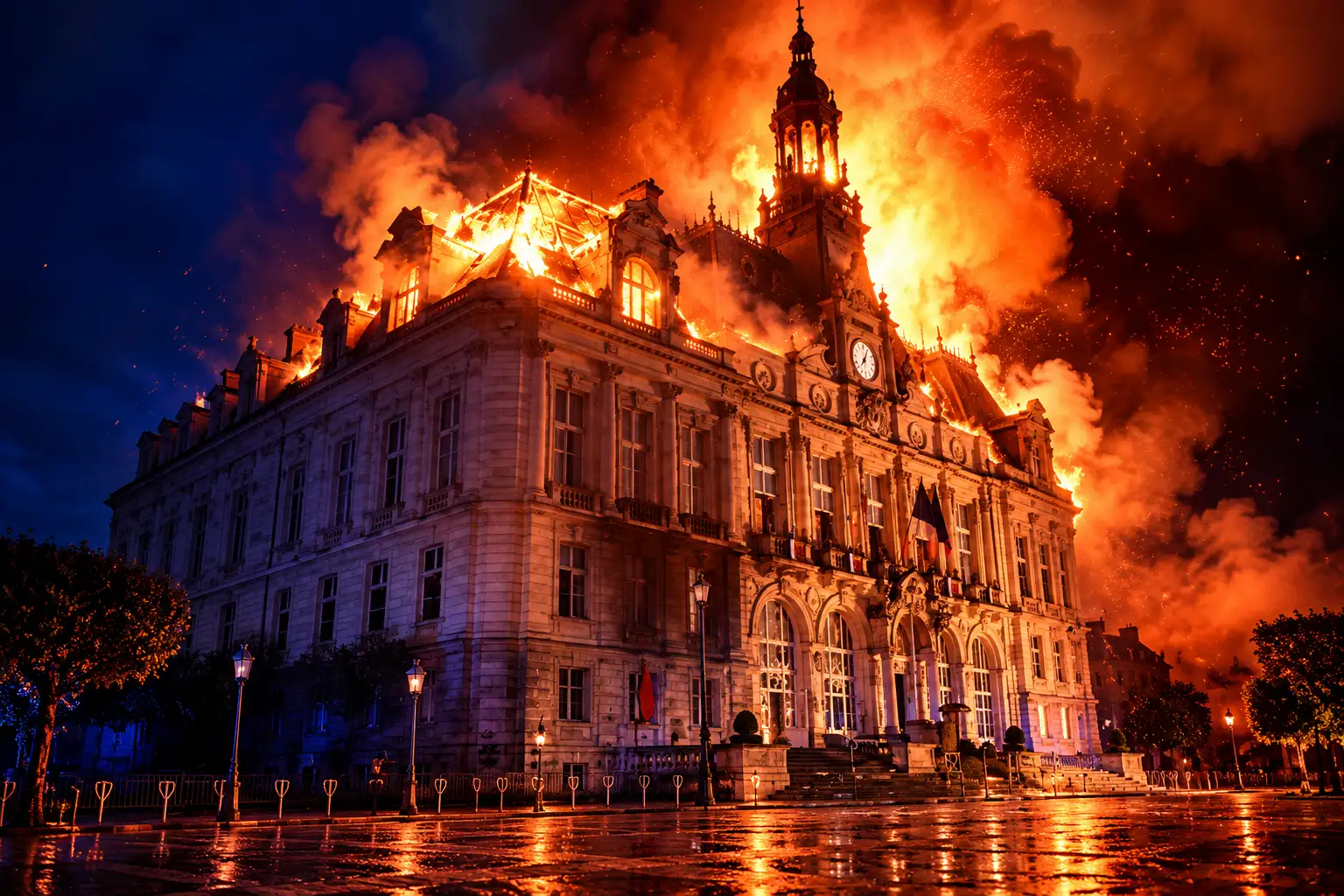
France’s Interior Ministry logged 2,397 arrests after Saturday’s cost-of-living marches, a tally that now travels farther than the school and rent demands that filled the streets. By Sunday evening it also counted 997 police and gendarmes injured. Limoges lost the roof of its 1883 city hall to fire.
Donald Trump wrote that migrants had “taken over France” and that the borders must close, fast. French police have not blamed immigrants. The people who started this autumn’s marches asked for teachers, payable rent and public services, and those demands are already losing the picture war.
A Burned City Hall Travels Faster Than a Rent Ledger
Saturday’s turnout was large even before the fires. The Interior Ministry put the national crowd at 550,000, including 110,000 in Paris. The CGT union put it at 800,000. Hundreds of thousands walked without burning anything. A smaller, mostly male and often masked fringe looted shops, hit officers and attacked public buildings in Paris, Marseille, Lyon, Bordeaux and Limoges.
The marches grew out of high-school blockades that began in September over staff shortages and buildings students call dilapidated, especially in poorer districts. Sophie Vénétitay, a teachers’ union leader, said public education is in a catastrophic state after 10 years of Emmanuel Macron. A 19-year-old protester in Paris who gave her name as Lola said pupils were being hurt for asking for more teachers and decent classrooms, and that fuel and living costs had pulled other people in. Unions and older Yellow Vest networks joined once students paused for a fall break.
Justice Ministry figures published on Oct. 9, before Saturday’s spike, already showed more than 6,800 people taken into custody since mid-September, about 86 percent of them minors. The movement is young. The images that left France on Saturday were not of a classroom.
THE INTERIOR TALLY FROM SATURDAY
- National crowd: 550,000 people, Interior Ministry; the CGT’s count was 800,000.
- Paris crowd: 110,000, Interior Ministry, with 855 arrests in the capital.
- Force on the street: 60,000 police and gendarmes deployed, 5,000 of them in Paris, after an earlier 10,000 figure was corrected.
- Limoges hall: an 1883 listed civic building, 143 years old, largely destroyed after the roof came down.
Interior Minister Laurent Nuñez said on Monday that police had “lost control.” He offered to resign. Macron refused, told him to explain failures in planning and intelligence, and ordered new methods for dealing with looters. Prime Minister Sébastien Lecornu said he wanted very limited, local curfews, would not rule out a state of emergency if needed, and had no plan to cancel Paris Saint-Germain’s Champions League match against Barcelona on Tuesday night. Marseille banned gatherings from noon to 8 p.m. on Monday. Students blocked the Louvre that day, and unions said the museum stayed shut.
Looking at these images, we have all asked ourselves, what was going through their minds? How can French people do this to France?
Emmanuel Macron, President of France, Sunday night address to the French
In that Sunday night address to the French, Macron split marchers with “legitimate” worries from “factious” ultra-left groups joined by offenders. He said people who looted would pay for the damage, and that those who sought to bring down the Republic would be held accountable. He also told the prime minister to gather students, teachers, unions, local officials and lawmakers around concrete proposals. The distinction is the government’s. The clip that moves is still a city hall on fire.
Spanish Pay Still Cannot Cover a One-Bed
Spain’s quarrel is easier to put on a spreadsheet, which is why it has already forced a national vote. The Spanish Youth Council’s emancipation study found that advertised rent averaged €1,176 a month against a young worker’s net pay of about €1,190, or 98.7 percent of a young paycheck. Andrea Henry, the council’s president, said moving out now means becoming poorer. The share of 16- to 29-year-olds living away from parents fell to 14.5 percent, the lowest in the council’s records, and the estimated age for leaving home is 30.2.
THE HOUSING MATH THE MARCHES ARE ABOUT
| Measure | Figure | Who published it |
|---|---|---|
| Mean advertised rent | €1,176 a month | Spanish Youth Council |
| Young worker’s net pay | About €1,190 a month | Spanish Youth Council |
| Rent as a share of that pay | 98.7% | Spanish Youth Council |
| Share of 16- to 29-year-olds living independently | 14.5% | Spanish Youth Council |
| Poverty rate among young renters, before and after housing | 25.9%, then 43% | Spanish Youth Council |
| Legal minimum wage, 2026 | €1,221 a month in 14 payments ($1,370); €17,094 a year | Royal Decree 126/2026 |
Room listings have jumped 85.4 percent since 2022, and a median room still costs €400. The council says even that route fails the usual 30 percent affordability test. Madrid and Barcelona sit at the top of the official rental price reference map, which is why tent camps spread from Puerta del Sol to other cities and why similar camps appeared in Lisbon and Porto.
An 87-Year-Old Eviction Reached Parliament
The spark had a name. Maricarmen Abascal, 87, was carried out of her Madrid flat on a stretcher on Sept. 23 after a property firm pushed the rent toward about €1,650 a month, against the roughly €440 to €500 she had been paying. She had lived in the building since 1956. She died on Oct. 7 in hospital, after a deal to return at about €500 a month, capped at 30 percent of her income. She never went back.
Pedro Sánchez’s minority government rushed two housing decrees, including a pause on evictions of vulnerable tenants. The Popular Party, Vox and Junts voted them down. Sánchez called a snap election on Oct. 5 for Nov. 29 and then re-approved tougher decrees, including a later ban on so-called vulture-fund purchases and €10 billion for a “Tu Casa” scheme. A general strike, the first in 14 years, is set for November. Madrid teachers had already walked out over pay. Housing is no longer a side issue that can be parked until summer 2027, when the vote had been due.
Most of my paycheck goes to the rent. My roommate struggles to make ends meet just like I do. This is my reality and the reality of most of us living in this city.
Diana Manzanares, 20, waitress, Puerta del Sol encampment
María Silvestre, a sociology professor at the University of Deusto, said young people feel disappointed with the social model and a lack of control, and that when specific cases pile up, a spark can push them into the street. Maricarmen was that spark. The ballot is now the test of whether the spark still means rent when it is counted.
Meloni Labels the Milan Looting as Chaos
Italy’s “Italia in Piazza” marches asked for work, health care, schools, housing and wages that keep up with prices. Government data put Italian inflation at 4.2 percent in September, above the eurozone’s 3.8 percent. About 5,000 people turned out in Milan. In Turin, Bologna and Milan the peaceful core broke when masked groups threw stones and fireworks, looted stores including Decathlon, Arc’teryx and a Vodafone shop, and wrecked a carabinieri car. Police answered with tear gas and water cannon.
Milan police said they detained 271 young people on Sunday. Of those taken to stations, 32 were arrested, including 23 minors and 13 foreign nationals, and 28 more were reported to prosecutors. A Saturday police report listed 28 arrests in northern cities. Fourteen members of the security forces were injured. The 13 foreign nationals sit among the 32 formal arrests, not among the 271 detainees, and they do not describe a march that was called over wages and services.
Giorgia Meloni, who faces voters in 2027, said demonstrating is a right and laying cities to waste is not. She accused “hooligans” of using the protest to sow chaos and called a Monday security meeting. Milan’s centre-left mayor, Giuseppe Sala, said the reasons were understandable and the violence was not. A newly formed “Oct. 17 Movement” has now called a standing appointment: every Saturday at 3 p.m., starting in Milan. The CGIL union has called a general strike for Nov. 20. Meloni can police the looting. She still has to answer the prices that put 5,000 people in the square before the windows came out.
Flamingos, Kushner’s Coast and a Court on Fire
Albania’s quarrel did not begin as a cost-of-living march. It began on the coast. Activists spent the summer opposing a luxury tourism plan linked to Jared Kushner’s Affinity Partners on Sazan Island and in the Vjosa-Narta wetland, flamingo habitat near Vlora. After private guards attacked protesters near a fenced beach on May 30, the “Flamingo” nightly marches in Tirana hardened into a campaign against Prime Minister Edi Rama, in office since 2013 and now in a fourth term. Albanian media put the June 20 crowd above 250,000, the largest since the end of communism. The slogan hits both chiefs: Rama in jail, Berisha in jail.
High-school and university students joined in mid-October over fees, books and jobs, and the tone changed. On Oct. 14, authorities reported 35 people detained, 23 police officers and six others hurt, and damage to four ministry buildings. Protesters later set fire to the Supreme Court and to the entrance of the Bank of Albania. Rama said participants had been “ideologized and radicalized” by antifa, a label U.S. President Donald Trump has used as a terrorist designation at home. He offered to talk about education costs and drew a line at attacks on institutions. He has not resigned.
WHAT THE FLAMINGO LISTS STILL WANT
- The government: Rama and his cabinet out.
- The caretakers: a 12-month non-partisan transitional government.
- The rules: constitutional and electoral changes, including a two-term lifetime limit for prime minister.
- The land laws: repeal of disputed statutes on strategic investment, protected areas, heritage and mountain development.
- The bargain: a new social contract, plus the health, school and pension protections named on the movement’s site.
The coastal project is the hidden stake that the wider European riot footage does not carry. A government hunting foreign tourism money approved a large resort in a protected wetland. The bird became the mascot. The students then fused that fight to corruption, fees and work. Rama’s antifa line, like Trump’s migrant line in France, points at a militant style and away from the file that started the crowd.
Who Banks the Pictures of the Fire?
Right-wing politicians moved on the footage while the original demands were still on homemade signs. Marine Le Pen accused Jean-Luc Mélenchon, who walked in Paris, of legitimizing violence. Jordan Bardella, who leads her National Rally, called the smashers “professionals of chaos” and said the far left was discrediting fair social claims. Benoît Payan, the left-wing mayor of Marseille, called the vandals “useful idiots of the far right.” That is the conversion in one phrase, from a local official watching his own streets.
Macron is term-limited and France elects his replacement in 2027. National Rally already treats disorder as proof that the centre cannot hold. Mélenchon’s camp is stuck defending the school protests that preceded the looting. The loudest foreign argument, on American timelines especially, barely mentions teacher shortages or a Spanish rent share of 98.7 percent. It treats burning halls as a border story and a civilizational one. Trump’s migrant post landed on a movement the French interior ministry has not tied to immigration.
The conversion has a cost for the people who marched. A burned hall invites curfews, bans on gatherings and a state-of-emergency debate. It does not staff a lycée or cap a lease. Meloni can condemn hooligans without raising pay. Rama can denounce antifa without moving the resort. Sánchez at least put housing on a ballot, after parliament had already killed his first try.
Two Ballots Will Price the Same Week of Smoke
The calendar is now doing work the pictures will not. Serbia votes on Oct. 25. Spain votes on Nov. 29. Italy has a standing Saturday crowd and a Nov. 20 strike. France has local curfews and a 2027 presidential field that will run on law and order whether or not anyone funds the schools.
THE DATES THAT STILL HAVE TO BE COUNTED
- Sept. 23, 2026: Maricarmen Abascal is evicted in Madrid, the act that set off Spain’s housing camps.
- Oct. 5, 2026: Pedro Sánchez calls a snap general election for Nov. 29 after housing decrees fall in parliament.
- Oct. 7, 2026: Abascal dies in hospital; thousands walk from Puerta del Sol to her former home.
- Oct. 17, 2026: France’s national day of marches ends with the Limoges hall in flames; Milan, Turin and Bologna clash the same afternoon.
- Oct. 18, 2026: Macron speaks; Albania’s protests mark a sixth straight day after students joined Flamingo.
- Oct. 19, 2026: Nuñez says police lost control and is kept in post; Milan police give the 271-detainee figure; Meloni holds a security meeting.
- Oct. 25, 2026: Serbia elects a 250-seat assembly, 126 needed to govern, with Aleksandar Vučić’s United Serbia list against a Student List born after the Novi Sad station collapse that killed 16 people on Nov. 1, 2024.
Vučić stepped down as president on Sept. 27 to run as prime minister. The student list, which grew out of almost two years of anti-corruption protests, is competitive enough that the result is not a formality, which is why the Oct. 25 parliamentary field in Serbia is being watched as a youth vote rather than a routine extension of the ruling party. Polls still disagree on the gap, so the only honest line before ballot night is that it is close enough to matter.
Spain’s vote is the cleaner test of the original demand. Sánchez wants a larger progressive majority with housing at the centre. The parties that killed the decrees will argue order, migration and his other troubles. If Nov. 29 becomes a referendum on tents in Sol, the rent ledger gets a count. If it becomes a referendum on fatigue with Sánchez, the tents were a prelude to someone else’s campaign.
Italy’s next appointment is more modest and easier to miss: Saturday, 3 p.m. France’s next argument will be over curfews, damaged shops and whether Macron’s round table produces anything a lycée can spend. Albania’s students are still in the square with a flamingo and a court that has already burned. The living-cost file is specific, local and numbered. The pictures are simple, and they are being spent by people who did not write the signs.

Bulk Scotch Still Faces Full Duty After India’s UK Deal

Typhoon Champi Loops Off Taiwan and Still Injures 527

PM Modi Opens Chinmaya’s AI Guru and Asks for Unity

Mahim Police Hold a JeM Suspect on Enmity Charges

Gold Falls Below $4,000 as Hormuz Oil Hits $117

The iPhone 18 Pro Max Splits Apple’s Fall in Two

OpenAI Calls GPT-6 Astra AGI Then Locks Its Exploits

Clancy Juror Says the Holdout Never Cited Evidence

Trump Claims Hormuz Control as Oil Holds Near $96

Russia Closes the Goethe-Institut Berlin Tried to Save

 NEWS2 months ago
The iPhone 18 Pro Max Splits Apple’s Fall in Two
- NEWS2 months ago
OpenAI Calls GPT-6 Astra AGI Then Locks Its Exploits
- NEWS1 month ago
Clancy Juror Says the Holdout Never Cited Evidence
- BUSINESS2 months ago
Trump Claims Hormuz Control as Oil Holds Near $96
- LIFESTYLE2 months ago
Russia Closes the Goethe-Institut Berlin Tried to Save
- AUTO2 months ago
Volkswagen’s Job Cuts Leave Four Plants Without Cars
- NEWS2 months ago
Dyson Puts Nurovi Robots on Sale Without the UV Flagship
- NEWS2 months ago
The Lincoln’s 286-Day War Cruise Ends at a Thai Pier