BUSINESS
India-New Zealand FTA Opens Visas Before the Fruit Quotas
The India-New Zealand FTA is live, but apple and kiwifruit quotas stay at zero until 2027, while a 5,000-person work cap opens with no residence path.

India’s free trade agreement with New Zealand took effect on October 20, 2026, cutting tariffs to zero on every Indian export line. The apple and kiwifruit quotas that dominated the farm fight stay at zero until 2027.
New Delhi is selling 100% duty-free access, a 5,000-person work cap, and a $20 billion investment pledge. Wellington is selling a billion extra customers. The paperwork that went live is narrower than both speeches.
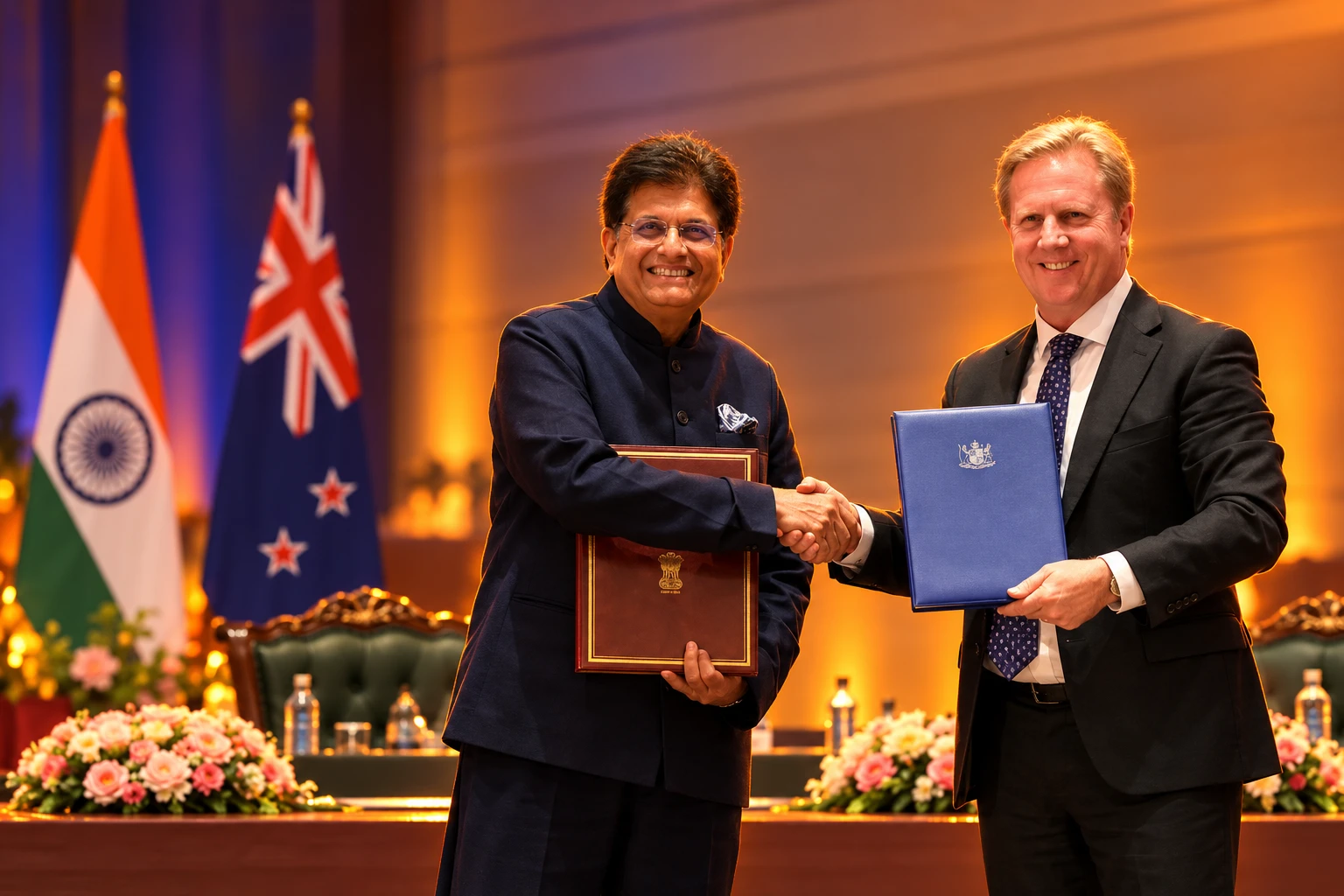
Commerce and Industry Minister Piyush Goyal and New Zealand Trade Minister Todd McClay marked the start in a virtual joint announcement on October 19, a day after India’s Directorate General of Foreign Trade published the fruit quotas. Goyal put the in-force post on X the next morning.
The India-New Zealand FTA comes into force today! 🇮🇳🇳🇿
A new chapter of opportunities begins!#IndiaNewZealandFTA pic.twitter.com/hZqTC00t09
— Piyush Goyal (@PiyushGoyal) October 20, 2026
No Preferential Fruit Until the 2027 Season
DGFT Public Notice No. 33/2026-27, dated October 17, sets Year 1 as October 20 to December 31, 2026. It allocates no apple quota and no kiwifruit quota in that stub year. Preferential fruit cannot use a window that has already closed.
Apples may move at the lower 25% duty only from April 1 to August 31, and only from Year 2, which starts January 1, 2027. Kiwifruit at zero duty is limited to April 1 to October 15. Year 1 begins after both of those windows have ended, so the first lower-duty fruit season is 2027, not this harvest.
THE TRQ CALENDAR
| Product | Year 1 (to 31 Dec 2026) | Year 2 | Later cap | In-quota duty and floor | Import window |
|---|---|---|---|---|---|
| Apples | Nil | 35,000 tonnes | 45,000 tonnes from Year 6 | 25% at CIF of at least $1.25 per kg | 1 April to 31 August |
| Kiwifruit | Nil | 8,000 tonnes | 15,000 tonnes from Year 6 | 0% at CIF of at least $1.80 per kg | 1 April to 15 October |
| MPI-certified mānuka honey | 40 tonnes | 200 tonnes | 200 tonnes from Year 2 | Concessional, CIF $20 to under $30 per kg | Year-round |
| Albumins | 200 tonnes | 1,500 tonnes | 3,000 tonnes from Year 5 | 11% | Year-round |
Outside the apple quota the 50% duty remains. New Zealand must issue export certificates, DGFT then writes electronic authorisations, and unused quota lapses. The notice also ties apple, kiwifruit and honey quotas to agriculture productivity action plans under a Joint Agriculture Productivity Council, so orchard access is a bargain for training, not an open door.
Danielle Adsett, chief executive of New Zealand Apples and Pears, said exporters would likely exceed the Year 2 volume next season. India imported 31,392.6 tonnes of New Zealand apples against 519,651.8 tonnes of total apple imports, so the later 45,000-tonne cap is larger than recent New Zealand sales and still a slice of the import market. Brigid Crawford, a Te Puke kiwifruit grower, called the expertise swap the Indian side of the deal, arguing much of India’s new planting sits far from ports and will not ship into the same cities.
How Many Work Visas the FTA Creates
The people chapter is live on October 20. New Zealand’s temporary employment entry schedule for Indian workers caps holders at 5,000 at any one time, not 5,000 a year. When a visa ends, the slot reopens. Stay is up to three years and cannot be extended. After those three years the holder must spend three years outside New Zealand before using the annex again.
The ceiling splits into 4,400 skilled places drawn from shortage occupations and 600 places in occupations the annex calls iconic to India. Applicants need a genuine job offer from an accredited employer. The annex states that temporary employment entry means work on a fixed-term contract “without the intent to establish permanent residence,” and that nothing in the annex applies to citizenship, nationality, residence or permanent employment.
THE 5,000-PERSON TEE CEILING
| Occupation group | Places at any one time | Bar that most applicants will hit first |
|---|---|---|
| Software engineers, programmers, ICT project managers | 1,000 | Bachelor’s plus five years’ professional experience |
| Civil, mechanical, structural, environmental engineers | 1,000 | Washington Accord degree or NZ professional registration |
| Construction and building project managers | 700 | Listed NZQCF construction qualifications |
| Registered nurses | 900 | NZ registration and three years’ experience |
| Physiotherapists | 300 | NZ registration and three years’ experience |
| Primary and secondary teachers | 500 | Teaching Council registration and a practising certificate |
| Indian chefs | 250 | Two-year cuisine qualification plus two years’ work |
| AYUSH practitioners | 200 | Ministry of Ayush degree plus four years’ practice |
| Yoga instructors | 100 | Bachelor’s in yoga; IELTS 5 in listening and speaking |
| Music teachers | 50 | Tertiary music qualification plus two years’ teaching |
Skilled occupations need IELTS 6.5 or an equivalent test New Zealand recognises. Yoga instructors and chefs can sit at IELTS 5 in listening and speaking. Immigration New Zealand opened a paper route, form INZ 1402, for the India Iconic Work Visa and India Skilled Work Visa, and the form warns that time on either visa counts toward a person’s maximum continuous stay in New Zealand. The skilled list is due for review every five years by the Committee on Trade in Services.
A working holiday scheme of up to 1,000 visas a year for Indian citizens aged 18 to 30 is due within two years, not on October 20. Students face no numerical cap. In-study work is set at 20 hours a week, STEM bachelor’s and master’s graduates can seek up to three years of post-study work, and doctoral graduates can seek up to four years from November 16, 2026. Intra-company transferees can stay up to three years, contractual service providers up to 12 months, and business visitors up to 90 days in a 12-month period. Those tracks sit outside the 5,000 cap, which is why a 5,000 headline understates the mobility chapter even as the employment visas themselves stay tightly bounded.
Sheep Meat and Logs Move First
Goods that do not wait for 2027 are the ones already in the pipeline. New Zealand’s trade ministry says more than half of New Zealand exports to India, 57% by value, enter duty-free from day one, including sheep meat, wool, coal and more than 95% of forestry shipments. Over time 82% of current exports are to go duty-free, with sharp cuts on a further 13%, so 95% of current exports sit inside some preference. The average tariff on those exports is put at 3%, with estimated savings of NZ$43 million on day one, rising to NZ$62 million on current trade.
WHAT OPENED ON OCTOBER 20
- Sheep meat: A 33% Indian tariff comes off immediately, which Federated Farmers meat and wool chair Richard Dawkins said gives exporters another market if other destinations take a hit.
- Logs and wood: Forest Owners Association president Dean Witehira said log sellers were already taking calls from Indian buyers who have leaned on China.
- Honey and albumins: Year-round quotas of 40 tonnes of certified mānuka honey and 200 tonnes of albumins run in the stub year.
- Indian jewellery out of Mumbai: SEEPZ-SEZ flagged the first gems and jewellery lots from Jewelex India, Zenstar Jewellery, Elegant Collection and Unidesign Jewellery, cutting New Zealand duties that had been as high as 5% on those goods.
Wine still crawls. NZ Winegrowers’ Anishka Jelicich said Indian tariffs were among the highest her members face, and the cut runs from 150% to 25-50% over 10 years, with full removal by 2036. Twenty New Zealand wineries were due in Mumbai to show bottles to a market that bought slightly under NZ$300,000 of New Zealand wine in 2025.
On the Indian side the duty cut is across all of New Zealand’s tariff lines from entry into force, the first Indian FTA to do that on day one. Commerce officials said that removes a pre-FTA peak of up to 10% on Indian shipments. Textiles, apparel, leather, footwear, pharmaceuticals, engineering goods, marine products, processed foods, and gems and jewellery are the lines New Delhi named. Indian pharma and device firms also gain a faster door: New Zealand will take inspection approvals from the US FDA, EMA, UK MHRA and Health Canada.
New Zealand’s Average Tariff Was Already 2.3%
Merchandise trade was $1.298 billion in 2024-25, with Indian exports of $711.08 million and imports of $587.15 million. Both governments want two-way goods and services trade of NZ$7 billion, about ₹35,000 crore, by 2030. New Zealand imported $47.5 billion of goods in 2025, and India was 1.9% of that bill. A 10% tariff coming off a 1.9% supplier does not rewrite a freight map overnight.
New Zealand’s average import tariff is only 2.3%, compared with India’s 16.2%, and 58.3% of New Zealand’s tariff lines are already duty-free.
Ajay Srivastava, founder, Global Trade Research Initiative
Srivastava, a former Indian Trade Service officer, has argued that the structure is the point of the bargain. Indian exporters already had wide access in a low-tariff market; the new 100% cut still helps lines that faced about 10%, including textiles, ceramics and auto components. When India cuts a high tariff, the partner’s price move inside India is larger than India’s price move inside New Zealand. India opened 70% of its tariff lines, covering about 95% of current bilateral trade value, and parked 29.97% of lines on an exclusion list. New Zealand’s goods win is real on wood, meat and wool. It is still a preference into a protected farm market, not a mirror of what India received on day one.
India also locked most-favoured-nation treatment across about 139 services sub-sectors and access in about 118 sectors, including IT, construction, tourism and professional services, plus a first dedicated opening for health and traditional medicine covering Ayurveda, yoga and other AYUSH systems. For a relationship in which travel, education and IT already do more work than containers, that chapter is where volume can show up before orchards do.
Fonterra Leaves Without Core Dairy Access
Dairy, sugar, edible oils, onions, chickpeas, peas, corn, almonds, gems of a different kind in the metals list, copper, aluminium, and arms stay off India’s concession schedule, along with other farm lines New Delhi calls sensitive. Animal flesh is out except for the sheep meat that Dawkins flagged. That is the political core of the deal in India, and it is the hole in it for New Zealand’s largest export industry.
It was disappointing that the negotiations were unable to secure any significant new core dairy opportunities into the Indian dairy market.
Fonterra, company statement
What New Zealand did get on dairy is a seven-year phase-out of a 33% tariff on bulk infant formula and other dairy-based food preparations, the albumin quota at 11%, and duty-free entry for ingredients that Indian plants import and then re-export. India has also said that if it later offers dairy access to comparable countries, it will consult New Zealand on similar treatment, and the whole FTA is due for a one-year review. Milk, cheese and butter do not ride those clauses.
New Zealand First opposed the pact. Labour and ACT voted for the implementing bill, with Labour recording reservations on investment and migration. Prime Minister Christopher Luxon, on October 20, told his own audience that “Kiwi businesses can reach over a billion more customers with significantly reduced tariffs,” then asked for a party vote at an election set for November 7, 2026. Replies under that post treated the mobility chapter as a wage, housing and hospital risk, not as an apple quota. The argument in Wellington is already about people. The fruit fight is calendared for April.
The Investment Clock Runs for 15 Years
New Zealand’s written promise is to facilitate USD 20 billion of investment into India over 15 years, aimed at agriculture, manufacturing, infrastructure and start-ups under Make in India. It is a facilitation target, not cash on October 20. The commerce ministry said the pact includes a framework to deal with shortfalls. Goyal told the October 19 event that labour-heavy lines, textiles, leather, footwear, gems and jewellery, would feel the duty cut first, with engineering goods, processed foods, ceramics, automobiles and auto components on the same list.
India’s Department of Commerce called this the seventh FTA brought into force in five years. Talks that failed between 2010 and 2015, after 10 rounds, were relaunched on March 16, 2025, closed on December 22, 2025, signed at Bharat Mandapam on April 27, 2026, legislated in Wellington on September 16, and ratified on September 21. Prime Minister Narendra Modi’s visit to New Zealand in July 2026, the first by an Indian prime minister in four decades, sat in the middle of that legal run.
THE OPENING BALANCE
- Goods trade, 2024-25: $1.298 billion, with Indian exports $711.08 million and imports $587.15 million.
- 2030 target: NZ$7 billion in two-way goods and services, about ₹35,000 crore.
- Investment pledge: $20 billion of facilitated inflows over 15 years.
- Day-one NZ tariff savings: NZ$43 million on current trade, rising to NZ$62 million as remaining cuts land.
Customs on the Indian side has committed to release all goods within 48 hours, and to try for 24 hours on perishable cargo and express consignments. That clock will matter more to kiwifruit in April 2027 than to a jewellery lot leaving SEEPZ on October 20. The next apple window opens on April 1, 2027. Until then the live instruments are a 5,000-person work cap, a 40-tonne honey quota, sheep meat at zero, and a 15-year investment ledger that has not yet posted its first dollar.
Frequently Asked Questions
Do India-New Zealand FTA Work Visas Lead to Residence?
No. Annex 8L says the route is a fixed-term job without intent to settle, and that the annex does not cover citizenship, nationality, residence or permanent jobs. The first India Skilled or Iconic visa must be filed from outside New Zealand on paper form INZ 1402, and time on those visas counts toward New Zealand’s maximum continuous stay on other work visas, so three years on the FTA route can shorten the clock on an Accredited Employer Work Visa rather than feed a residence file.
When Do New Zealand Apple and Kiwifruit Quotas Open?
Calendar Year 2 begins January 1, 2027, which is when the first apple quota of 35,000 tonnes and the first kiwifruit quota of 8,000 tonnes become available. Apples can enter only from April 1 to August 31 at 25% duty if CIF is at least $1.25 per kg; kiwifruit can enter from April 1 to October 15 at zero duty if CIF is at least $1.80 per kg. DGFT stops issuing authorisations once a year’s quota is used, and unused quota cannot be carried into the next year.
What Dairy Access Did New Zealand Receive?
Core lines of milk, cheese and butter stay outside the deal. New Zealand received a seven-year phase-out of a 33% tariff on bulk infant formula and related food preparations, a quota for albumins that starts at 200 tonnes in Year 1 and rises to 3,000 tonnes from Year 5 at 11% duty, and duty-free entry for dairy ingredients that Indian factories import and then re-export. If India later opens dairy to comparable partners, it has committed to consult New Zealand on similar treatment.
When Does the Working Holiday Visa for Indians Start?
New Zealand is to put in place, within two years of October 20, 2026, up to 1,000 multiple-entry working holiday visas a year for Indian citizens aged 18 to 30, each for 12 months. That scheme is a side commitment, not a visa window on day one, and it is separate from the 5,000 Temporary Employment Entry places already open to listed occupations.
What Work Rights Do Indian Students Get in New Zealand?
There is no numerical cap on Indian students under the FTA. They are guaranteed 20 hours of work a week during study. STEM bachelor’s and master’s graduates can seek post-study work rights of up to three years, and doctoral graduates can seek up to four years, with the four-year PhD route opening on November 16, 2026. Those student rights are uncapped, which is why they sit beside the 5,000 TEE ceiling rather than inside it.
Disclaimer: This article is news reporting and analysis of a government trade pact and is for information only. It is not investment, immigration, customs or legal advice, and it does not recommend any visa filing, import programme, or capital allocation. Anyone weighing a shipment, a work visa, or an investment should speak with a licensed customs broker, an immigration adviser authorised in the relevant country, or a qualified investment professional before acting. Figures, quota windows and visa rules are those published by Indian and New Zealand authorities around October 20, 2026, and they can be amended by later notices.

Bulk Scotch Still Faces Full Duty After India’s UK Deal

Typhoon Champi Loops Off Taiwan and Still Injures 527

PM Modi Opens Chinmaya’s AI Guru and Asks for Unity

Mahim Police Hold a JeM Suspect on Enmity Charges

Gold Falls Below $4,000 as Hormuz Oil Hits $117

The iPhone 18 Pro Max Splits Apple’s Fall in Two

OpenAI Calls GPT-6 Astra AGI Then Locks Its Exploits

Clancy Juror Says the Holdout Never Cited Evidence

Trump Claims Hormuz Control as Oil Holds Near $96

Russia Closes the Goethe-Institut Berlin Tried to Save

 NEWS2 months ago
The iPhone 18 Pro Max Splits Apple’s Fall in Two
- NEWS2 months ago
OpenAI Calls GPT-6 Astra AGI Then Locks Its Exploits
- NEWS1 month ago
Clancy Juror Says the Holdout Never Cited Evidence
- BUSINESS2 months ago
Trump Claims Hormuz Control as Oil Holds Near $96
- LIFESTYLE2 months ago
Russia Closes the Goethe-Institut Berlin Tried to Save
- AUTO2 months ago
Volkswagen’s Job Cuts Leave Four Plants Without Cars
- NEWS2 months ago
Dyson Puts Nurovi Robots on Sale Without the UV Flagship
- NEWS2 months ago
The Lincoln’s 286-Day War Cruise Ends at a Thai Pier