BUSINESS
Canada Bets on a December Trade Deal With India
Anita Anand is in New Delhi backing a year-end Canada-India CEPA, a wager Ottawa needs as it tries to double trade beyond the United States.

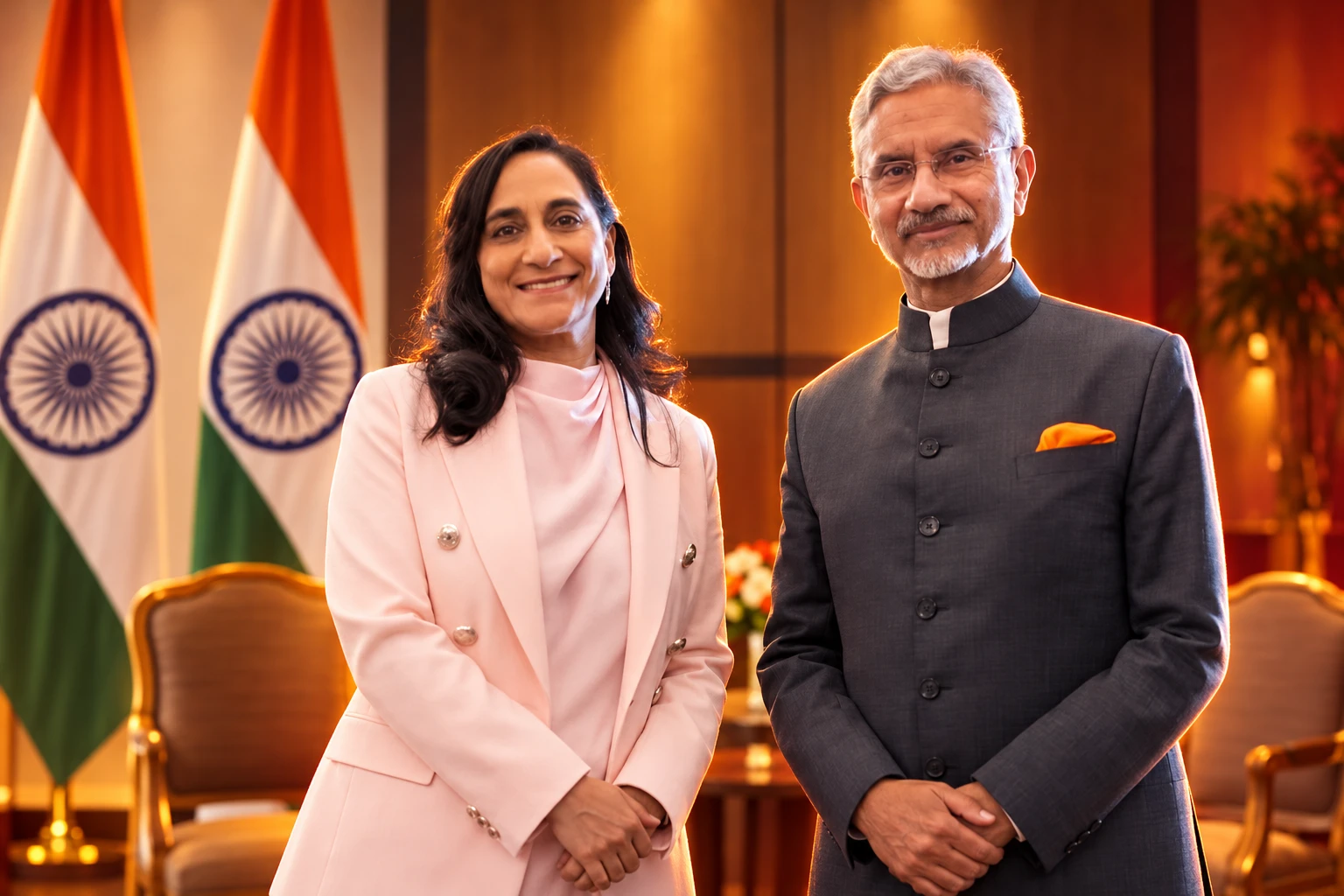
Canadian Foreign Minister Anita Anand arrived in New Delhi on October 13 with a public bet: finish a Canada-India trade deal before the year ends. She is due to sit with External Affairs Minister S. Jaishankar on October 14, and the two already appeared together at the Bloomberg New Economy Forum in the capital.
The clock is Ottawa’s. India is the market Canada wants as it tries to double exports beyond the United States over the next decade, and Anand has put that aim in writing, tying a Comprehensive Economic Partnership Agreement to Prime Minister Narendra Modi’s expected trip to Canada in December.
Anand Puts a Year-End Clock on the India File
Global Affairs Canada listed her swing as October 13 to 16, India then the United Arab Emirates. In Delhi she was booked to push the bilateral roadmap on trade, energy, people-to-people ties, and security and defence, billed as the 11th meeting with Jaishankar since September 2025. That pace is the policy. The two ministers have been in almost constant contact since the relationship began to thaw.
On October 14, Jaishankar posted that he was in conversation with Anand, former Australian prime minister Kevin Rudd and former UK prime minister Rishi Sunak on a New Delhi forum panel about middle powers. The staging matches the argument Anand is selling: Canada as a country that can pick partners when old ones get expensive.
In conversation with FM Canada @AnitaAnandMP, former Australia PM @MrKRudd and former UK PM @RishiSunak at the @BBGNewEconomy Forum, New Delhi. https://t.co/hz22gCLip9
— Dr. S. Jaishankar (@DrSJaishankar) October 14, 2026
Before she landed, Anand wrote that Canada and India are “natural partners” bound by democratic politics and people-to-people ties, and that India is a “partner of choice” as Ottawa builds what she called strategic autonomy. She said that autonomy is not isolation. It is diversification, and the CEPA is the instrument.
Canada is committed to concluding a mutually beneficial CEPA by the end of this year, when Prime Minister Narendra Modi visits our country.
Anita Anand, Minister of Foreign Affairs of Canada
She also flagged talks on a General Security of Information Agreement and a thicker defence track, plus a Canada-India Talent and Innovation Strategy with 13 new university partnerships. Those files are the quieter half of the wager. The loud half is the tariff text.
I’m travelling to India and the United Arab Emirates to strengthen Canada’s relationships with two important partners. At a time of global uncertainty, expanding trade, attracting investment and building closer security ties are essential to our future prosperity.
I look forward…
— Anita Anand (@AnitaAnandMP) October 13, 2026
Nearly 300 Delegates for a $30.4 Billion Trade Base
Trade Minister Maninder Sidhu is in the country at the same time, leading the Team Canada Trade Mission from October 12 to 17, with stops in Mumbai and Bengaluru. Global Affairs called it the largest Canadian trade delegation to India in over 30 years, with nearly 300 business delegates from aerospace and space, clean technology, information and communications, life sciences and agri-food.
Sidhu’s own target, stated in the mission release, is to double two-way trade with India to $70 billion a year by 2030. That is more than double the stock Canada recorded for 2025.
THE 2025 BASE AGAINST THE 2030 TARGET
| Measure | Figure | Year |
|---|---|---|
| Two-way goods and services | C$30.4 billion | 2025 |
| Stated two-way trade goal | C$70 billion a year | 2030 |
| Canadian direct investment in India | C$11.4 billion | 2025 |
| Indian direct investment in Canada | C$9.7 billion | 2025 |
| Canadian pension and asset-manager exposure to India | about C$108 billion | 2025 |
The C$70 billion goal is 2.3 times the 2025 goods-and-services total, which is why Ottawa can say “more than double” without stretching the arithmetic. The money already in the relationship is heavier in capital than in shipments. Export Development Canada’s exposure figure, and the two direct-investment stocks, dwarf the annual goods-and-services flow.
THE PEOPLE INSIDE THE TRADE
- Indian firms in Canada: Multinational enterprises from India employed 37,902 people through affiliates in Canada in 2024.
- Canadian firms in India: Canadian multinationals employed 68,941 people through affiliates in India in 2024.
- Diaspora: The March visit materials put Canadians of Indian origin at over 1.8 million.
- Mission size: Nearly 300 Canadian delegates, the largest such trip to India in over 30 years.
On October 13 in Delhi, Sidhu said he had held his tenth meeting with Commerce and Industry Minister Piyush Goyal and that they had discussed a “balanced” CEPA. He also met Air India’s chief commercial officer, Nipun Aggarwal, on aircraft orders, aerospace work and more flights, arguing that people and cargo have to move faster if two-way trade is to go from about C$30 billion to C$70 billion. Five negotiating rounds are now complete. The fifth ran in Ottawa from October 5 to 9, after the fourth closed in New Delhi on September 18.
The United States Problem Behind the India Push
Canada’s official line does not hide the geography of the bet. The same Sidhu release says Canada is aiming to double exports to markets beyond the United States over the next decade, and that the India target sits inside that job. Anand’s own essay used colder language, a more dangerous and divided world, and a need to reinforce ties with small states, middle powers and large nations.
Prime Minister Mark Carney made the India file a governing project after he took office. On March 2, 2026, in New Delhi, on the first bilateral visit by a Canadian prime minister since 2018, he and Modi said the two countries would conclude a new Comprehensive Economic Partnership Agreement this year, after chief negotiators met and signed terms of reference. Formal talks had resumed in November 2025, following a Modi-Carney meeting at the G7 in Kananaskis in June 2025.
India is the fastest-growing major economy and a powerhouse of global commerce and technology. In a rapidly changing world, Canada and India are transforming their economies to be more diversified, more independent, and more resilient.
Mark Carney, Prime Minister of Canada, New Delhi, March 2, 2026
On October 13, Carney said he had spoken that morning with Modi to build on momentum across trade, energy, defence and security, finance, and people-to-people ties. The Canadian readout, as relayed by his office, also welcomed Sidhu’s mission and Anand’s Delhi stop. Modi called the conversation warm and productive and said the two sides would work toward concrete outcomes.
A CEPA with India will not replace the United States as Canada’s main market. It is not built to. It is built to prove that Ottawa can open another large door on a deadline, and to give Canadian energy, food, minerals and aircraft a second big customer if American terms keep shifting. That is why a year-end date is useful politics even if the legal text is still being argued in November.
The domestic audience is not uniformly on board. Replies under Carney’s note about the Modi call treated India as a social fight, not a commercial one, and demanded that Canada put the United States first. The wager in Delhi is being sold to exporters. A slice of Canadian politics still wants a different map.
Farm Access Is the Chapter That Breaks Deadlines
Goods trade is the thin part of the relationship, which is why farm access carries so much weight in the room. Canada wants predictable, long-term sales of pulses into India, a market that has moved duties on and off with little notice. Farm groups have asked for commitments that cannot be reversed in a season. India, which guards its growers, has been looking at tools such as tariff-rate quotas rather than a clean opening.
Potash sits beside pulses. It is one of Canada’s staple exports to India, and New Delhi wants secure fertiliser supply. Visas sit on India’s side of the ledger: enough room for professionals and workers to move. Each government has also pointed at the other’s technical rules, packing and labelling, and sanitary standards as brakes on trade.
WHAT IS STILL OPEN IN THE CEPA TEXT
- Pulses: Canada, the world’s largest pulse exporter, wants enforceable access; India has changed duties often and may prefer quotas to a permanent cut.
- Potash and farm inputs: India wants reliable fertiliser supply from a country that can ship it.
- Visas: India is pressing for more room for workers and professionals, a people-to-people demand with commercial teeth.
- Standards: Both sides call the other’s technical and sanitary rules a non-tariff wall, including fumigation on pulses and biotech approvals for canola.
- Supply management: Canadian consultations showed a strong consensus on full protection for supply-managed agricultural sectors, which limits what Ottawa can put on the table in dairy and poultry.
Those are the chapters that usually survive until the last weekend of a trade negotiation. Officials have already signalled that another round, or two, may be needed in November, and that political cover from the two prime ministers may be required to close gaps the negotiators cannot. Sidhu has said talks are always tough. He has not claimed the farm file is done.
Security Talks Now Run Beside the Trade Clock
The 2023 rupture is not a closed case. Then-prime minister Justin Trudeau told Parliament in September 2023 that Canadian agencies were pursuing a potential link between Indian government agents and the June 2023 killing of Hardeep Singh Nijjar in British Columbia. New Delhi called the charge absurd. Talks on a trade pact, already stop-start since 2010 and paused after a 2022 restart, were frozen again. In October 2024 the two sides expelled diplomats, and India recalled its high commissioner.
India’s present high commissioner in Ottawa, Dinesh K. Patnaik, has spent October pressing a different point: the Khalistan problem, he said, is in Canada, not in India, and a small extremist set should not be allowed to wreck a decades-old relationship. On the Nijjar file he asked a direct question, almost three years after Trudeau spoke in Parliament: where is the evidence? If Canada has it, he said, India is ready to act.
The calendar still throws up tests. India’s Ministry of External Affairs condemned plans by Sikhs for Justice for a so-called Khalistan referendum in Edmonton on October 18, four days after Anand’s Delhi panel. That vote does not bind either government. It does remind both that the political temperature at home can spike while ministers are toasting a roadmap.
THE ROAD BACK FROM THE 2023 RUPTURE
- June 2023: Hardeep Singh Nijjar is killed in British Columbia.
- September 2023: Trudeau alleges a potential Indian-government link; New Delhi rejects it; trade talks stop.
- October 2024: Reciprocal diplomat expulsions, including India’s recall of its high commissioner.
- June 2025: Modi and Carney meet at the G7 in Kananaskis.
- November 2025: Formal CEPA talks resume.
- March 2, 2026: Carney visits Mumbai and New Delhi, first Canadian prime minister in India since 2018, and both leaders lock a year-end CEPA aim.
- February 2026: A shared Security Work Plan is concluded, then reviewed in later NSA talks.
- October 5-7, 2026: National Security Adviser Ajit Doval meets David Morrison, Carney’s senior diplomatic adviser, in New Delhi, the third NSA-level security dialogue since September 2025.
The Doval-Morrison statement dwelt on organised crime, terrorism and violent extremism, trafficking, cybercrime, extortion and extradition. It also recorded “growing potential” for a real defence relationship and welcomed the CEPA talks. That is the bargain underneath Anand’s visit: trade moves faster if the security channel stays open, and the security channel stays open if ministers keep showing up.
A $2.6 Billion Uranium Sale Leads the Energy Track
Some of the commercial work is already running ahead of the tariff schedule. In March the two governments announced a Strategic Energy Partnership covering LNG, LPG, uranium, solar and hydrogen. The hard contract in that package was a C$2.6 billion deal between India and Saskatoon-based Cameco to supply nearly 22 million pounds of uranium from 2027 to 2035.
They also signed memorandums on critical minerals, said Canada intended to join the International Solar Alliance, and upgraded Canada to full membership in the Global Biofuels Alliance. The Canadian Space Agency and the Indian Space Research Organisation agreed to work on Earth observation and to look at space exploration and quantum. HCL Technologies said it would expand in Canada and raise its workforce there by 75% by 2030.
Carney’s March trip produced five MOUs and more than 10 commercial agreements the PMO valued at over C$5.5 billion. In May, Goyal took to Canada what Ottawa called the largest trade delegation India has ever sent anywhere. Sidhu is now returning the visit at similar scale. The pattern is deliberate: keep business in the room so a missed clause in November does not empty the relationship.
Energy is also where India’s demand and Canada’s supply actually match. The March materials said India’s energy use is rising faster than anywhere, equal to China and Southeast Asia combined, and described Canada as an energy and farm power with a critical-minerals bench. Sidhu has pointed at LNG Canada’s second phase and at a claim that Canada will sit among the top five LNG exporters within five years. Those barrels and cargoes do not need a full CEPA to move. They do need political cover after three years of freeze.
A December Visit With Unfinished Legal Text
Carney said in September, on the UN General Assembly sidelines, that Modi would visit Canada around the December G20, which is set for December 14-15 in Miami. Anand has now written the CEPA into that stop. Indian High Commissioner Patnaik has gone further, saying talks could be wrapped up as early as November so a signing is possible during the visit. That is the political design. It is not yet a closed legal text.
WHAT WE KNOW
- The deadline: Both governments have said they want CEPA negotiations concluded in 2026, and Anand has tied that finish to Modi’s Canada visit.
- The rounds: Five negotiating rounds are complete; a further November round is expected.
- The mission: Sidhu’s nearly 300-delegate trip runs through October 17.
- The side tracks: NSA talks, a Security Work Plan, energy MOUs and a Cameco uranium contract are already in motion.
WHAT IS UNCONFIRMED
- A signed treaty in December: No public chapter scorecard shows the farm, visa and standards fights as closed.
- Modi’s exact Canadian dates: The visit is expected around the Miami G20, not locked as a public itinerary.
- GSOIA and defence: Anand says those talks are under way; they are not a finished pact.
India can live without a December signing. Its goods trade with Canada is small beside its other partners, and New Delhi is running several large talks at once. Canada is the party that put a date on the invitation, sent the 300-person mission, and sent its foreign minister to write the pledge in an Indian paper. That is what a wager looks like when one side needs a result to show that diversification is more than a speech.
Anand leaves India for the UAE after October 16. Sidhu’s delegates pack up on October 17. Negotiators are expected back in November. Modi’s Canada stop sits on the winter calendar, and the Edmonton vote sits on October 18. The bet is on the record. The remaining chapters are not.

Bulk Scotch Still Faces Full Duty After India’s UK Deal

Typhoon Champi Loops Off Taiwan and Still Injures 527

PM Modi Opens Chinmaya’s AI Guru and Asks for Unity

Mahim Police Hold a JeM Suspect on Enmity Charges

Gold Falls Below $4,000 as Hormuz Oil Hits $117

The iPhone 18 Pro Max Splits Apple’s Fall in Two

OpenAI Calls GPT-6 Astra AGI Then Locks Its Exploits

Clancy Juror Says the Holdout Never Cited Evidence

Trump Claims Hormuz Control as Oil Holds Near $96

Russia Closes the Goethe-Institut Berlin Tried to Save

 NEWS2 months ago
The iPhone 18 Pro Max Splits Apple’s Fall in Two
- NEWS2 months ago
OpenAI Calls GPT-6 Astra AGI Then Locks Its Exploits
- NEWS1 month ago
Clancy Juror Says the Holdout Never Cited Evidence
- BUSINESS2 months ago
Trump Claims Hormuz Control as Oil Holds Near $96
- LIFESTYLE2 months ago
Russia Closes the Goethe-Institut Berlin Tried to Save
- AUTO2 months ago
Volkswagen’s Job Cuts Leave Four Plants Without Cars
- NEWS2 months ago
Dyson Puts Nurovi Robots on Sale Without the UV Flagship
- NEWS2 months ago
The Lincoln’s 286-Day War Cruise Ends at a Thai Pier