BUSINESS
Rajnath Singh Uses the SCO Trade Table as a Charge Sheet
Rajnath Singh told the SCO war cannot answer war, then pressed Pakistan on terror and China on borders in Dushanbe.

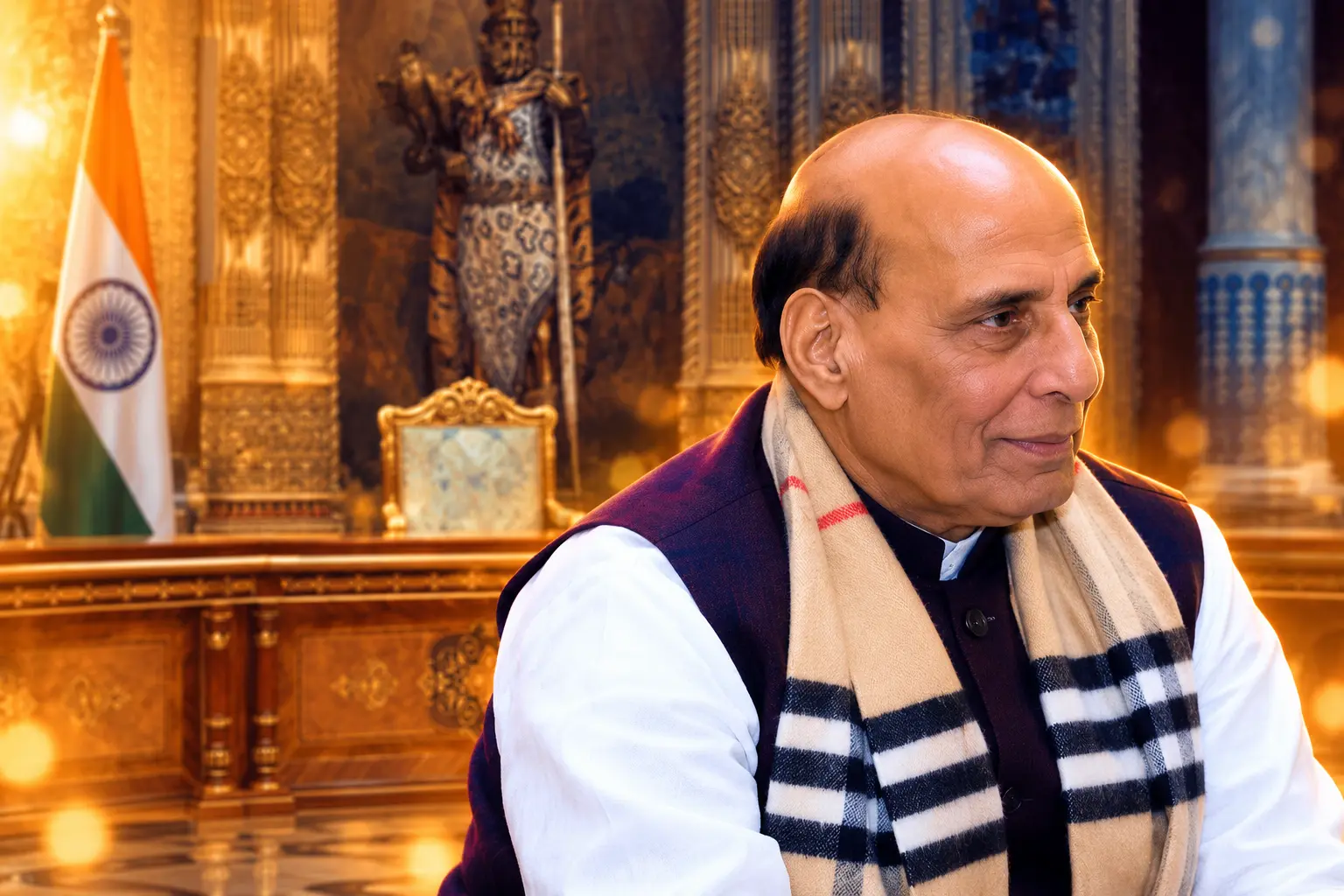
Defence Minister Rajnath Singh told the Shanghai Cooperation Organisation in Dushanbe on October 20 that war can never be the answer to war. Pakistan’s Deputy Prime Minister Ishaq Dar sat at the same table.
Five days earlier, the same minister had warned in New Delhi that another attack from Pakistan would bring a stronger Indian response. In Tajikistan he put that tension into a trade meeting, then spent the rest of the speech on terror finance, borders, and customs paperwork.
Ishaq Dar Sat at the Same Table
The session was the 25th meeting of the SCO Council of Heads of Government, the grouping’s economic council, held in Dushanbe on October 19 and 20. Singh was on a two-day official visit to represent India. Dar, who is also Pakistan’s foreign minister, was in the chair as Singh spoke.
The peace line was brief. “When conflicts are being seen at various places across the world today, the solution to these conflicts is possible only through dialogue. War can never be the answer to war. This will result only in endless war. So, India believes in conflict resolution through dialogue and diplomacy,” Singh said.
The Ministry of Defence handout that followed did not lead with that sentence. It led with terrorism, and with a warning that connectivity projects which ignore borders will not last. Singh asked SCO states to dismantle the entire ecosystem of terrorism, and he did it with the Regional Anti-Terrorist Structure’s director, Ularbek Sharsheev, in the hall.
Terrorism results in the loss of innocent lives and disrupts investment and commerce. It radicalises societies and deprives youth of the opportunities they rightfully deserve. There can be no justification for terrorism, no double standards in addressing it, and no place for those who finance, support, or provide safe havens to terrorists.
Rajnath Singh, Defence Minister of India, SCO Council of Heads of Government, Dushanbe
He posted a video of the same point from his own account after the session.
Terrorism, peace और development के लिए गंभीर खतरा है। यह निर्दोष लोगों की जान लेने के साथ-साथ investment, commerce और युवाओं के भविष्य को भी प्रभावित करता है। Terrorism के खिलाफ न कोई दोहरा मापदंड हो सकता है, न कोई justification। इसके पूरे ecosystem को सामूहिक रूप से समाप्त करना… pic.twitter.com/HVfOvRrxTn
— Rajnath Singh (@rajnathsingh) October 20, 2026
He also asked for tighter work against drug trafficking and organised crime, arguing those trades eat into peace, commerce and investment. None of that required him to name Pakistan. Dar’s seat did the naming.
Five Days Earlier He Warned of a Bigger Strike
On October 15 in New Delhi, speaking at the Times Network National Defence Conclave, Singh said India’s wish for peace should never be mistaken for weakness. He said any further terrorist activity originating from Pakistan would invite an even stronger Indian response.
He walked through the file India now treats as doctrine: surgical strikes after the 2016 Uri attack, the 2019 Balakot airstrikes after Pulwama, and Operation Sindoor in 2025 after the Pahalgam killings. The through-line was that Delhi no longer stops at a complaint.
The Dushanbe line and the New Delhi line are one policy spoken in two rooms. In the conclave he was talking to a domestic defence audience. In the SCO chamber he was talking to a club that includes Pakistan, China and Russia, and he reached for dialogue first. The charge that followed was the same one he has carried for years: no money, no support, no shelter, and no separate rulebook for anyone at the table.
That is why the peace sentence travelled and the handout did not rest on it. India still wants the clip about war. It also wants the sentence about safe havens read into an SCO record that rarely turns such sentences into action.
Most Members Sent a Head of Government
The council is built for prime ministers. China sent Premier Li Qiang. Russia sent Prime Minister Mikhail Mishustin. Belarus, Kazakhstan, Uzbekistan and host Tajikistan also sent the head of government. India sent its defence minister. Pakistan sent Dar. Iran sent First Vice President Mohammad Reza Aref. Kyrgyzstan sent Deputy Prime Minister Daniyar Amangeldiev.
WHO SAT FOR THE 10 MEMBERS
| Member | Delegate | Office |
|---|---|---|
| China | Li Qiang | Premier |
| Russia | Mikhail Mishustin | Prime Minister |
| Belarus | Alexander Turchin | Prime Minister |
| Kazakhstan | Olzhas Bektenov | Prime Minister |
| Uzbekistan | Abdulla Aripov | Prime Minister |
| Tajikistan | Qohir Rosulzoda | Prime Minister |
| India | Rajnath Singh | Defence Minister |
| Pakistan | Ishaq Dar | Deputy Prime Minister |
| Iran | Mohammad Reza Aref | First Vice President |
| Kyrgyzstan | Daniyar Amangeldiev | Deputy Prime Minister |
Six of the 10 seats were filled by a prime minister or premier. Four were not. SCO Secretary-General Nurlan Yermekbayev sat with them. Tajik President Emomali Rahmon received the delegations at the Palace of the Nation before the working session.
Li Qiang used his turn to push dialogue over confrontation and to back a thicker web of transport routes, including Arctic shipping and the Trans-Caspian corridor. Singh used his turn to say projects that skip consent and territorial integrity will not stand. The two men were in the same meeting. They were not in the same argument.
Why India Did Not Send Its Prime Minister
This council is the SCO’s second-highest body, and it is supposed to move trade, budgets and practical work, not grand strategy. India has been a full member since 2017. It still does not treat this particular table as a prime-ministerial appointment.
The previous meeting was in Moscow on November 18, 2025. External Affairs Minister S. Jaishankar went then. This year the file moved to the defence ministry. The pattern is consistent even if the face changes: Delhi stays in the room, declines to decorate it with the top of the government, and spends its speaking time on security conditions that China and Pakistan would rather keep off an economic agenda.
Singh said as much in institutional language. “India believes that the SCO must remain efficient and steadfast in its adherence to the principles of sovereign equality, consensus, and mutual respect. A greater number of institutions does not necessarily translate into greater achievements,” he said. New bodies, he added, should meet a clear need, avoid copies of existing shops, and deliver something member states can use.
That is a dry way of telling a 25-year-old organisation it is collecting plaques. He welcomed the Bishkek decisions, taken at the SCO summit in August and September, to make the Universal Centre in Tashkent and the Anti-Drug Centre in Dushanbe permanent. He also said they will only matter if they coordinate and finish the job.
Singh Said Connectivity Has to Respect Borders
Prime Minister Narendra Modi had already set India’s three-word brief at Bishkek: security, connectivity, opportunity. Singh repeated it, then applied it to roads and ports. He said the International North-South Transport Corridor and Chabahar Port can tie Central Asia to wider markets. He then drew a line that every person in the hall could read onto Chinese corridor politics without hearing the words Belt and Road.
“Connectivity must be based on consultation and respect for the sovereignty and territorial integrity of all countries,” he said. Projects that skip those tests, he added, will not be sustainable. He had already met Iran’s First Vice President on the sidelines, the partner India needs if Chabahar is going to carry more than talking points.
He wanted the conversation to leave the tarmac. Physical links, he said, are not enough if cargo still dies in paperwork.
THE TRADE FIXES HE PUT ON THE TABLE
- Customs: Faster clearance, with simpler procedures at the border.
- Standards: Mutual recognition, so goods are not tested twice.
- Payments: Reliable systems that traders can trust across the bloc.
- Freight: Predictable movement, plus digital documents and shared logistics tools to cut the cost of doing business.
India, he said, is ready to share what it has learned on those nuts and bolts, including a symposium in Mumbai earlier in October on financing infrastructure in Central Asia and the first SCO Asian Economic Dialogue. He backed the Action Plan for 2026-2030 under the Programme of Multilateral Trade and Economic Cooperation, and he tied its worth to actual market access, not another communique.
He measured success in people, not in new secretariats: work for the young, markets for firms, tools for farmers and small businesses, and more contact among societies. Digital public infrastructure, he said, has already changed how India delivers services and opens bank accounts. He invited every member to the first SCO Civilisational Dialogue Forum, which India will host by the end of 2026.
Sideline Talks With Tajikistan and Iran
The bilateral calls were shorter than the plenary and closer to work India can actually do. On October 19 he sat with Tajik Defence Minister Emomali Sobirzoda and talked training and capacity, the slow material of a defence relationship that does not need a 10-flag backdrop. On October 20 he opened the council day with Tajik Prime Minister Qohir Rosulzoda and then saw Aref.
THE TWO DAYS IN DUSHANBE
- October 15, 2026: In New Delhi, Singh warns that another Pakistan-origin attack will bring a stronger Indian response.
- October 19, 2026: He arrives for the two-day visit and holds a defence meeting with Emomali Sobirzoda on training and capacity.
- October 20, 2026: He addresses the council, meets Rosulzoda and Aref, and the heads of delegation adopt the joint communique.
- By the end of 2026: India hosts the first SCO Civilisational Dialogue Forum and asks every member to attend.
With Rosulzoda he dwelt on civilisational ties with Tajikistan and on people-to-people contact, the language Delhi uses when it wants Central Asia to hear India rather than only China. He pointed to the reclining Buddha at Ajina Tepe in southern Tajikistan as a reminder that monks and traders once moved the other way, from India into the region, long before this council existed.
After the session he called the atmosphere warm and cordial and said India had restated its commitment to regional peace, sustainable development and lasting stability. That is the sentence written for the group photograph. The sentences written for Dar and for Li Qiang were the ones about havens and borders.
What the Council Signed Before It Rose
The heads of delegation adopted a joint communique. It took in the SCO budget for 2027, a set of financial and administrative decisions, and the PMTEC Action Plan for 2026-2030. Those are the instruments an economic council is built to pass. They are also instruments that do not, on the public record released in New Delhi, bind anyone on terror finance or on who may build a road across a disputed line.
WHAT LEFT THE ROOM ON PAPER
- The 2027 budget: Passed with the other financial and staff decisions of the organisation.
- The 2026-2030 trade plan: Adopted as the next working sheet for multilateral commerce among members.
- The terror paragraph: Spoken by Singh, posted by him, and left as a national statement rather than a council act.
He said the SCO’s worth should be judged by what it delivers to people across the region, and that consensus is idle until it turns into work. On October 20 the council proved it can still pass a budget and a trade timetable. Singh proved India will keep using the floor to put Pakistan on a terror charge and to tell corridor builders that sovereignty is not optional. The two proofs sat in the same hall. Only one of them was signed.

Bulk Scotch Still Faces Full Duty After India’s UK Deal

Typhoon Champi Loops Off Taiwan and Still Injures 527

PM Modi Opens Chinmaya’s AI Guru and Asks for Unity

Mahim Police Hold a JeM Suspect on Enmity Charges

Gold Falls Below $4,000 as Hormuz Oil Hits $117

The iPhone 18 Pro Max Splits Apple’s Fall in Two

OpenAI Calls GPT-6 Astra AGI Then Locks Its Exploits

Clancy Juror Says the Holdout Never Cited Evidence

Trump Claims Hormuz Control as Oil Holds Near $96

Russia Closes the Goethe-Institut Berlin Tried to Save

 NEWS2 months ago
The iPhone 18 Pro Max Splits Apple’s Fall in Two
- NEWS2 months ago
OpenAI Calls GPT-6 Astra AGI Then Locks Its Exploits
- NEWS1 month ago
Clancy Juror Says the Holdout Never Cited Evidence
- BUSINESS2 months ago
Trump Claims Hormuz Control as Oil Holds Near $96
- LIFESTYLE2 months ago
Russia Closes the Goethe-Institut Berlin Tried to Save
- AUTO2 months ago
Volkswagen’s Job Cuts Leave Four Plants Without Cars
- NEWS2 months ago
Dyson Puts Nurovi Robots on Sale Without the UV Flagship
- NEWS2 months ago
The Lincoln’s 286-Day War Cruise Ends at a Thai Pier