
NEWS
Modi Pushes SCO Terror Vision on Uzbekistan Kyrgyzstan Swing
Prime Minister Modi departs for Uzbekistan and the SCO summit in Bishkek seeking security connectivity gains and deeper Central Asia partnerships beyond the.

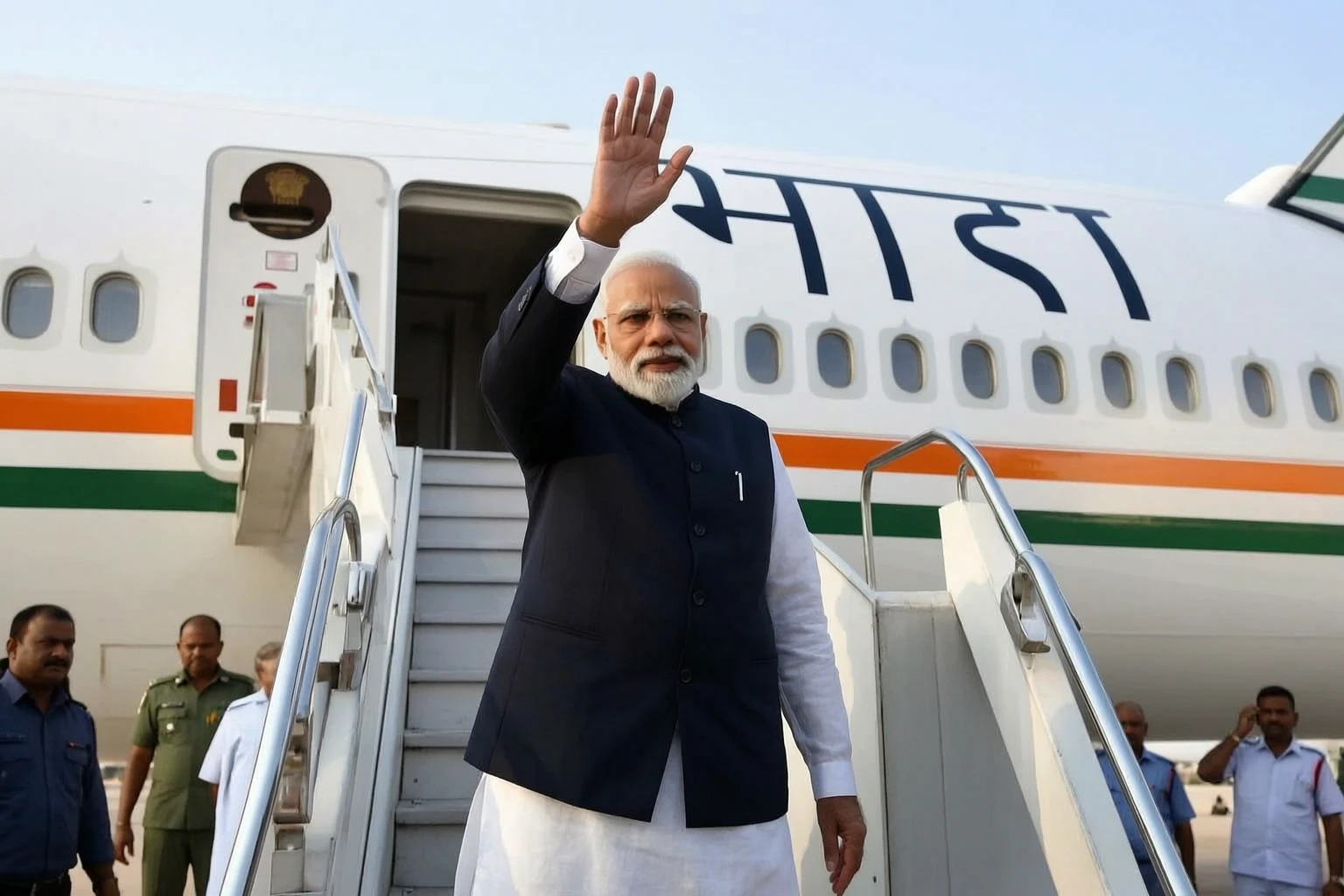
Prime Minister Narendra Modi departed New Delhi on Saturday for a four-day visit to Uzbekistan and Kyrgyzstan, saying he aims to advance India’s vision for a Shanghai Cooperation Organisation region free from terrorism, separatism and extremism. The trip runs from 29 August to 1 September 2026 and pairs a bilateral state visit to Tashkent with the 26th SCO Summit in Bishkek that marks the organisation’s 25th anniversary.
In his departure statement Modi framed the outing around security, connectivity and opportunity while noting recent gains in the India-Uzbekistan Strategic Partnership. He will meet President Shavkat Mirziyoyev, pay respects at the Shastri Memorial and the Mahatma Gandhi Centre, then fly to Bishkek for summit sessions, bilateral meetings with fellow SCO leaders and the opening of the 6th World Nomad Games.
The dual format is deliberate. Bilateral work in Tashkent can move trade, defence and education files that do not require consensus among ten members. The Bishkek leg then places those same themes inside the wider SCO conversation on terrorism, corridors and development finance.
Four Days Across Tashkent and Bishkek
According to the official schedule released by the Prime Minister’s Office, Modi undertakes a state visit to Tashkent on 29-30 August at the invitation of President Mirziyoyev. This is his fourth trip to Uzbekistan. Delegation-level talks will review trade and investment, defence, digital connectivity, energy, education and people-to-people ties, and align Viksit Bharat 2047 with Uzbekistan’s 2030 development vision.
From Tashkent he travels to Bishkek at the invitation of President Sadyr Zhaparov for the SCO Summit on 31 August-1 September. India has been a full member since 2017. Modi will address the leaders, hold side meetings and attend the World Nomad Games opening, described as a celebration of Central Asian living heritage that India respects.
MEA Secretary (West) Sibi George briefed that the summit programme includes a welcome dinner on 31 August and the plenary the next day. The theme under Kyrgyz chairmanship is “25 Years of the SCO: Together Towards Sustainable Peace, Development and Prosperity.”
- 29-30 August: State visit to Tashkent, talks with President Mirziyoyev, memorial and cultural stops
- 31 August: Arrival in Bishkek, welcome dinner, opening contacts with SCO counterparts
- 1 September: Summit plenary, further bilaterals, opening of the 6th World Nomad Games, departure
The sequence keeps the bilateral and multilateral tracks distinct yet close enough for messages from one capital to inform meetings in the other within the same working week.
Uzbekistan Trade Still Below Potential
India ranks among Uzbekistan’s top ten trading partners, yet volumes remain modest relative to geography and shared interests. Embassy figures show two-way trade reached bilateral trade of USD 1.32 billion in 2025, up sharply from earlier years.
| Year | Uzbek Exports to India ($ m) | Imports from India ($ m) | Total Trade ($ m) |
|---|---|---|---|
| 2020 | 423 | 19.7 | 442.6 |
| 2021 | 460.6 | 29.9 | 490.5 |
| 2022 | 654.9 | 35.6 | 690.5 |
| 2023 | 648.5 | 108.1 | 756.6 |
| 2024 | 853.6 | 126.8 | 980.4 |
| 2025 | 1153.1 | 164.6 | 1317.7 |
The table shows a steady climb from under $450 million in 2020 to more than $1.3 billion in 2025. Uzbek exports still dominate the ledger, but Indian shipments have risen from a very low base, especially after 2022. That imbalance is one reason both sides now talk about faster growth rather than simple continuity.
Indian investments stand at roughly $451 million, concentrated in pharmaceuticals, healthcare, education and residential projects. Four Indian universities operate in the country: Amity in Tashkent, Sharda in Andijan, Sambhram in Jizzakh and Acharya in Bukhara. About 16,300 Indian students study there, mostly medicine, and Indian tourist arrivals hit 80,800 in 2025.
Both sides have set a goal of doubling trade in three years and discussed a possible $2 billion target sooner. Priority sectors flagged in recent business forums and the June 2026 Intergovernmental Commission include:
- Pharmaceuticals, medical devices and healthcare
- Critical minerals and mining
- Digital public infrastructure, IT and AI
- Agriculture, food processing and textiles
- Energy, including renewables and possible nuclear cooperation
Indian Ambassador Smita Pant said ahead of the visit that long-term critical mineral supply arrangements are on the table given Uzbekistan’s resource base and India’s requirements. A bilateral investment treaty signed last year is meant to raise investor confidence.
If the doubling goal holds, the 2025 baseline of roughly $1.32 billion becomes the reference point for the next three years. The $2 billion figure discussed as an earlier stretch target would require the same momentum visible in the 2023-2025 jump, when total trade nearly doubled in two steps. Minerals, pharma and digital infrastructure are the files most often named as capable of carrying that weight.
Security Connectivity Opportunity Remains the Frame
Modi has repeated the same three-pillar formula at successive SCO gatherings. At the 25th summit in Tianjin he described India’s vision as built on three key pillars of Security Connectivity Opportunity. The same language appears in the departure statement for Bishkek.
I look forward to advancing India’s vision for the region, anchored in Security, Connectivity and Opportunity, and to working with fellow members for a region free from the scourge of terrorism, separatism and extremism, which continue to threaten peace and stability in our neighbourhood and beyond.
Narendra Modi, departure statement, 29 August 2026
The SCO was founded to counter those “three evils.” India has used the forum consistently to press collective action against terrorism while keeping the grouping’s economic and connectivity tracks open. The Bishkek meeting is expected to advance work on an International Centre for Combating Organised Crime, cyber cooperation and possibly an SCO Development Bank.
Each pillar does different work. Security keeps the original mandate visible and lets India insist that definitions of terrorism cover groups active against it. Connectivity turns the conversation toward ports, corridors and digital links that reduce dependence on any single route. Opportunity covers trade, investment, education and the people-to-people layer already visible in the student and tourist numbers.
Repeating the formula from Tianjin to Bishkek signals continuity rather than a fresh doctrine. It also gives Indian negotiators a short checklist against which draft SCO language can be tested in real time.
The Geography Problem and India’s Workarounds
Direct overland access from India to Central Asia is blocked by Pakistan. That structural fact forces New Delhi to build longer multimodal routes. Chabahar Port in Iran and the International North-South Transport Corridor remain the practical answers.
MEA officials reiterated before the trip that Chabahar is a key component of connectivity with Central Asia. India has operated the Shahid Beheshti terminal since 2018 and holds a 10-year contract signed in 2024. Kyrgyz Ambassador Askar Beshimov publicly backed both INSTC and Chabahar as corridors that shrink the distance between landlocked Central Asia and Indian markets.
At the same time China is advancing its own rail projects, including the China-Kyrgyzstan-Uzbekistan line. India’s second-order interest lies in ensuring Central Asian states retain alternative options that do not run solely through Chinese or Pakistani territory. Side meetings in Bishkek and the Tashkent bilateral give New Delhi simultaneous channels to Russia, Iran, the Central Asian republics and China without choosing a single camp.
- Chabahar terminal operations under Indian management since 2018
- Ten-year contract for Shahid Beheshti signed in 2024
- INSTC as the wider north-south frame linking Indian ports to Iranian and Central Asian nodes
- Public Kyrgyz support for both Chabahar and INSTC as distance-reducing options
The workaround logic is straightforward. If the shortest land path stays closed, longer sea-and-rail combinations must carry commercial and strategic weight. Every public endorsement from a Central Asian partner strengthens the case that those combinations are not Indian projects alone.
Defence Drills and Cultural Threads
Security cooperation with Uzbekistan already has a working rhythm. The joint military exercise DUSTLIK has reached its seventh edition, held in Uzbekistan in April 2026. A Joint Working Group on defence met for the sixth time in August 2026. Counter-terrorism JWGs and NSA-level India-Central Asia meetings continue.
- Students: roughly 16,300 Indians, mainly medical
- Tourists 2025: 80,800 Indians to Uzbekistan
- Investments: about $451 million
- Exercises: DUSTLIK series ongoing since establishment of defence JWG in 2019
Cultural markers receive deliberate attention. Modi will visit the Shastri Memorial and the Mahatma Gandhi Centre at Tashkent State University of Oriental Studies. Indian cinema, yoga and Hindi programmes retain strong followings. The Lal Bahadur Shastri Centre for Indian Culture runs large yoga and Kathak classes.
The defence calendar and the cultural calendar reinforce each other. Regular drills and working-group meetings build habit among uniformed and security officials. Memorial visits, university centres and performing-arts programmes keep a wider public layer warm between summits. Together they reduce the risk that the relationship rests only on occasional leader-level encounters.
What the Bishkek Room Contains
Leaders expected include Chinese President Xi Jinping, Russian President Vladimir Putin and others from the 10-member SCO. Pakistan and Iran also sit at the table. For India the summit is less about a single joint statement and more about the parallel bilaterals it enables: energy and defence with Russia, cautious border and economic management with China, connectivity with Iran and Central Asia, and consistent pressure on terrorism definitions that include groups active against India.
Observers on X noted the multi-door quality of the trip. One thread framed Central Asia as moving from extended neighbourhood into strategic neighbourhood precisely because Eurasia’s centre of gravity is shifting and India cannot watch from the sidelines. The practical test will be whether the minerals discussions, trade facilitation steps and corridor work produce measurable follow-through after the cameras leave Bishkek.
The room’s value lies in density. In two days an Indian leader can touch the Russia energy and defence track, the China border and trade track, the Iran corridor track and the Central Asian minerals and connectivity track without separate long-haul journeys. That compression is why the summit format still matters even when consensus documents stay general.
The SCO Anniversary Shapes the Agenda
Kyrgyz chairmanship has cast the Bishkek meeting as a 25-year marker under the banner “Together Towards Sustainable Peace, Development and Prosperity.” Anniversaries invite stock-taking. They also create space for institutional proposals that might stall in an ordinary year.
India’s full membership dates only to 2017, so the longer arc belongs to the organisation rather than to New Delhi’s tenure inside it. Even so, the three evils language that founded the SCO remains the reference point India cites when it argues for collective action on terrorism, separatism and extremism.
Expected files on organised crime, cyber cooperation and a possible SCO Development Bank fit the anniversary frame. A crime centre and cyber work extend the security pillar into newer domains. A development bank, if it advances, would give the opportunity pillar a financing arm that members have discussed without yet locking in design.
| Track | Anniversary-linked focus |
|---|---|
| Security | International Centre for Combating Organised Crime, cyber cooperation |
| Connectivity | Corridor language tied to INSTC and related routes |
| Opportunity | Possible SCO Development Bank and trade facilitation |
How far any of those files move will show whether the 25-year theme produces machinery or only communiqué language. India will measure success by the terrorism definitions that survive drafting and by any concrete step on corridors or minerals that outlasts the summit week.
World Nomad Games Carry a Parallel Signal
Modi also attends the opening of the 6th World Nomad Games, a cultural event that lets India signal respect for the region’s living traditions while the hard security and economic talks proceed in parallel. The Games sit beside the summit rather than inside its negotiating sessions, yet the scheduling is intentional.
India already sustains cultural infrastructure in Uzbekistan through the Shastri and Gandhi centres, yoga and Kathak classes, and the four university campuses. Presence at the Nomad Games opening extends that posture into a Kyrgyz-hosted, region-wide showcase. It costs little in negotiating capital and widens the public audience beyond officials who read joint statements.
For a visitor whose core messages remain security, connectivity and opportunity, the cultural stop softens the edges without diluting them. It also mirrors the people-to-people numbers already on the books: tens of thousands of students and tourists who encounter Central Asia outside formal diplomacy.
The visit ends 1 September. Outcomes on specific agreements will emerge from the Tashkent joint statements and the SCO documents that follow. Trade targets, mineral supply talks, corridor language and any institutional steps on crime or development finance will supply the first evidence of whether the four-day swing moved files or only restated familiar pillars.

-
 TECH1 year ago
Where Garmin Watches are Made and How They are Assembled
-
 AUTO3 months ago
Tesla’s Roadster Is ‘a Few Weeks Away,’ Says Its Chief Designer
-
 NEWS10 years ago
Samsung Releases Galaxy Note7 TV Ad as Reddit AMA Leaks Specs
-
 NEWS10 years ago
Android 7.0 Nougat Rolls Out To Nexus Devices With New Emoji, Features
-
 FINANCE9 years ago
Cardano Price Surges as ADA Enters the Crypto Top Ten List
-
 NEWS10 years ago
Pre-Order the First Camera Made for Facebook Live Streaming Video
-
 FINANCE1 year ago
Binance Suspends Trading and Withdrawals for a System Upgrade
-
 FINANCE9 years ago
RChain Price Jumps Nearly 150% to a New All-Time High of $2.03