
BUSINESS
Canada US Tariff Match Leaves Jobs and Supply Chains Exposed
Canada matches US 50% tariffs dollar for dollar on $27.6 billion in goods from September 8, with 87,200 Canadian jobs at risk while US household costs stay.

Canada will impose matching counter-tariffs of 15, 25 and 50 percent on $27.6 billion of US-origin goods starting at 12:01 a.m. on September 8, after trade talks with Washington collapsed and US Section 338 duties of 50 percent on a similar value of Canadian exports took effect August 22.
Prime Minister Mark Carney’s government framed the response as dollar-for-dollar and rate-for-rate. Direct US household costs from the Canada round alone sit near $3 according to Yale’s Budget Lab, yet models already put tens of thousands of Canadian jobs in play and keep auto parts and building-material costs under pressure.
The Matching Tariffs Take Effect Next Week
Finance Minister François-Philippe Champagne announced the package on August 25. Canada’s countermeasures cover products drawn from the same lists the US targeted under Section 338 and Section 232, with rates locked to the US level on each item.
The official backgrounder lists 629 tariff items covering dairy steel furniture and more after a revision that dropped seafood. Steel and aluminum products that had sat at 25 percent now move to 50 percent. Furniture, clothing and apparel also face 50 percent. Appliances and many cheeses sit at 25 percent. Milk powders and whey run at 50 percent.
| Product group | Counter-tariff rate |
|---|---|
| Steel and aluminum | 50 percent (up from 25) |
| Furniture, clothing and apparel | 50 percent |
| Milk powders and whey | 50 percent |
| Appliances and many cheeses | 25 percent |
Goods already in transit on September 8 escape the new surtax. Existing Canadian counter-tariffs on certain US vehicles stay in place. Remission requests remain available for exceptional relief.
On the US side, the White House fact sheet set out three proclamations under Section 338 of the Tariff Act of 1930. They impose Section 338 50 percent duties on Canadian goods ranging from wine and hockey sticks to cement, without USMCA origin exemptions. Energy, potash, Section 232 goods, fish and critical minerals stay out. The duties took effect August 22 after a short suspension for talks that failed.
The timing gap matters for firms on both sides of the border. US duties have already been collecting for more than two weeks before the Canadian list activates. That lag leaves Canadian exporters absorbing the first wave while importers of US goods still clear shipments under the old schedule until September 8.
Why Ottawa Picked Fungible Goods
Bradley Saunders, North America economist at Capital Economics, told the BBC that Carney’s list intentionally targets items Canadians can replace at home. Hair-care products, carpets, cutlery, washing machines and furniture fall into that category. The aim is to minimise direct hits on Canadian households by shifting demand to domestic suppliers.
Paper products including toilet paper and tissues appear on the Canadian list. High-engagement posts on X immediately zeroed in on US toilet-paper prices, treating the category as the first visible consumer sting even if volumes prove modest. Saunders’s fungible logic still holds: substitution is easier here than for specialised auto parts or energy.
The Budget Lab at Yale expects only marginal US increases in furnishings and household equipment from lumber and materials tariffs already in the system. John Iselin, associate director there, put the Canada-specific household cost at about $3 on average. Folded into Trump’s wider tariff programme, especially with China, the figure climbs near $1,000 for a typical family.
That gap between the Canada-only figure and the wider programme total explains Ottawa’s product choices. By leaning on goods with ready domestic substitutes, the counter-list aims to keep the shelf-price channel narrow even as the job channel widens.
87,200 Jobs Spread Across Provinces
University of Calgary economist Trevor Tombe modelled the labour hit from the new US 50 percent duties on roughly $28 billion of Canadian goods. He estimates 87,200 jobs at risk: about 52,000 directly at exporters and 35,000 at suppliers and service firms such as trucking and wholesale.
| Province | Jobs at risk (est.) | Notes |
|---|---|---|
| Ontario | 36,000 | Largest share; machinery, electronics, auto supply |
| Quebec | 18,000 | Textiles, furniture, manufacturing |
| British Columbia | 11,000 | Wood products, higher effective rate rise |
| Alberta | 9,000 | Mostly indirect services despite low direct export hit |
Tombe wrote that the average tariff rate on Canadian exports rises only about 2.5 percentage points overall, yet Ontario and Quebec exporters face roughly five-point increases and British Columbia about seven. National unemployment could move from 6.4 percent to 6.8 percent if displaced workers stay in the labour force. He stressed the figure is model output, not a forecast of certain layoffs; firms that treat the duties as temporary may absorb costs instead.
The Canadian Labour Congress separately notes 1.1 million workers in industries directly exposed, 232,000 of them unionised. Forest products alone employ nearly 200,000 and have pressed Ottawa for more domestic wood use in federal housing programmes.
The provincial spread shows how an export shock travels. Alberta’s estimated hit is mostly indirect even with a low direct export exposure, because trucking, wholesale and services move with the volume of goods that cross the border elsewhere.
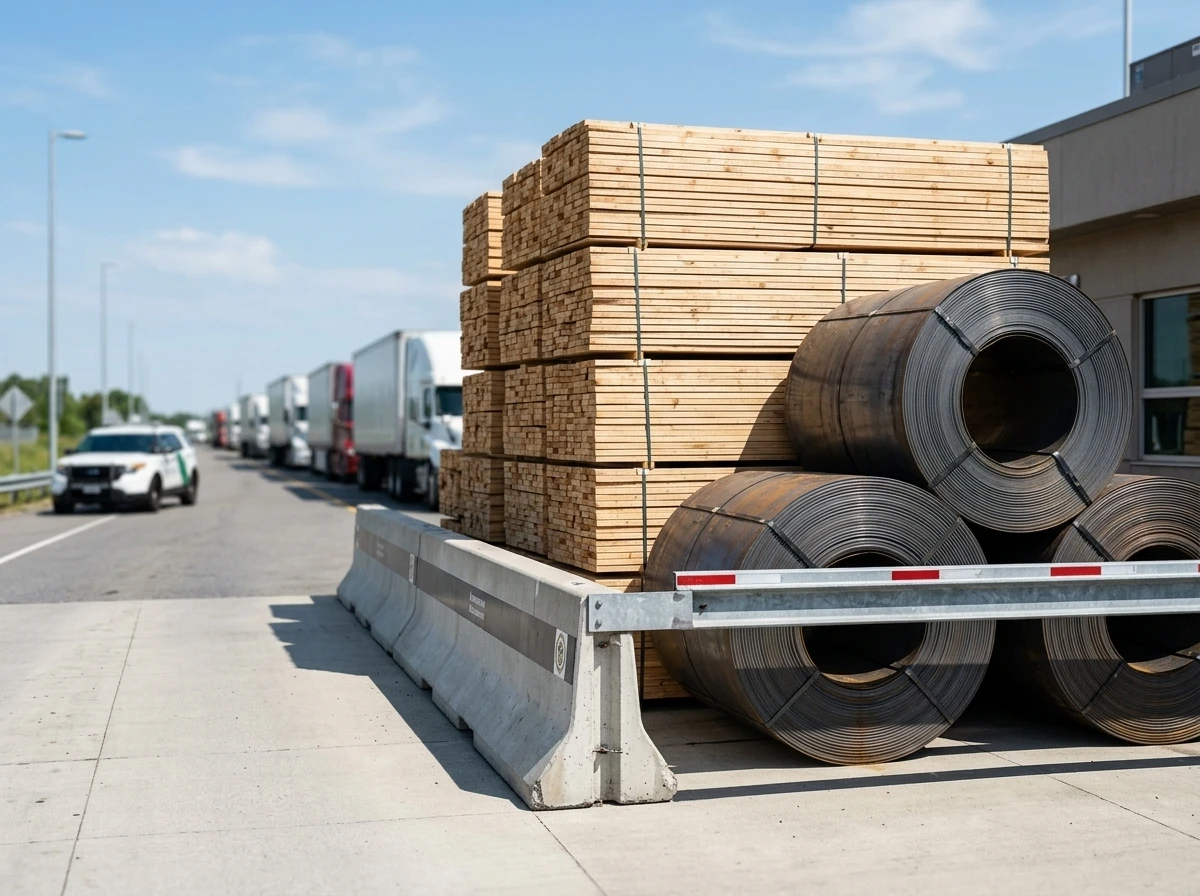
Lumber Disputes Stretch Back Decades
Softwood lumber has been a running dispute since the early 1980s. US producers argue Canadian stumpage fees on crown land act as a subsidy. Canada rejects the claim. The cycle of petitions, duties, temporary agreements and expirations is well documented in congressional research.
- Early 1980s: The softwood lumber dispute takes hold as a recurring bilateral fight over stumpage and alleged subsidy.
- 2006: A Softwood Lumber Agreement takes effect, pausing the latest duty round.
- 2015: The agreement expires and anti-dumping and countervailing duties return.
- 2024: The US imports $23 billion of wood products, nearly half from Canada.
- Summer 2025: Combined duty rates average around 35 percent before later Section 232 layers.
Additional Section 232 measures later added further layers. Bill Owens, chairman of the National Association of Home Builders, has urged exemptions for building materials because of the housing affordability crisis. “Building material tariffs heighten market uncertainty, strain supply chains and increase construction costs,” he said. The Forest Products Association of Canada says the duties raise costs on both sides of the border. For deeper background on the long-running fight see the decades of softwood lumber dispute history compiled for Congress.
Each turn of the cycle raises the same cost pass-through question for builders. When duties stack on wood already moving in high volume, the pressure shows up in quoted package prices long before any new housing starts data.
Autos and Homes Carry the Longer Drag
Cars, trucks and parts form one of the densest cross-border supply chains. Trump has threatened to raise tariffs on Canadian vehicles and parts from 25 percent to 50 percent starting January 1, 2027. Bernard Yaros, lead economist at Oxford Economics, told the BBC that earlier tariffs were largely absorbed by dealerships, but the cushion is wearing thin. A 50 percent hit would feed into consumer prices more readily and could accelerate a shift toward luxury vehicles, SUVs and pickups while tightening used-car supply.
Yaros later noted the threatened auto duties alone could trim 0.1 percentage point from US GDP growth next year once retaliation is factored in, with Michigan, Ohio and Indiana most exposed. Michigan alone takes about 22 percent of US intermediate auto imports from Canada. Honda has already paused an $11 billion EV and battery plan in Canada and said a new North American assembly plant decision hinges on the fate of the continental trade pact.
Canada has kept a 25 percent import tax on certain American vehicles since last year but has not matched the 50 percent threat so far. Carney has warned that US proposals would dismantle the Canadian auto sector while noting Canada is the largest foreign buyer of US-made vehicles.
If these tariffs take effect and remain in place, I estimate that nearly 90,000 jobs across Canada could be lost.
Trevor Tombe, University of Calgary economist, The Hub analysis
Construction faces parallel pressure. Higher steel, aluminum and wood costs can pass into new-home prices. NAHB members had already budgeted thousands of dollars in tariff-driven material increases per single-family build before the latest round.
The auto and housing channels differ in speed. A parts tariff can idle a line within a model year. A lumber or steel surcharge filters into bids and closings over several quarters. Both still lengthen the drag beyond the September 8 list itself.
How Matching Duties Shape the Next Round
Ottawa’s dollar-for-dollar and rate-for-rate frame ties the Canadian list to the US Section 338 package in both value and scale. The $27.6 billion Canadian counter-tariff envelope sits against a similar value of Canadian exports already under the US 50 percent duties that took effect August 22.
Rates of 15, 25 and 50 percent mirror the US structure item by item rather than applying a single blanket surcharge. That design keeps the response proportionate on paper while still covering 629 tariff items after the seafood revision.
Remission requests and the in-transit exemption give firms limited relief valves. They do not change the headline match. Existing Canadian counter-tariffs on certain US vehicles also stay in place, so the September 8 list stacks onto measures already running instead of replacing them.
The practical effect is a locked pair of tariff walls until one side reopens talks. With energy, potash, fish and critical minerals left out of the US proclamations, the pressure concentrates on the manufactured and consumer goods both governments chose to list.
Support Package and What Stays Unsettled
Alongside the tariffs, Ottawa rolled out a $7.5 billion support package details on top of nearly $25 billion already deployed since earlier US measures. The new money includes:
- $1.5 billion extra through the Regional Tariff Response Initiative for small and medium enterprises via regional development agencies
- $500 million liquidity under the Business Development Bank of Canada’s Pivot to Grow programme, plus lower revenue thresholds for applicants
- $2 billion Canada Strong Diversification Fund for shovel-ready capital projects at tariff-hit firms
- $3.5 billion Rapid Response Supports for workers, including EI flexibilities, training and a Worker Retention and Retraining Program
Champagne said the counter-tariffs and supports will “protect workers, farmers, families, and businesses as we build a stronger, more resilient, and more diversified Canadian economy.” Industry Minister Mélanie Joly and Jobs Minister Patty Hajdu echoed the focus on domestic capacity.
Alcohol remains a political flashpoint. Many provinces banned US wine and spirits last year; exports dropped more than 70 percent according to the US industry. Carney had asked provinces to restore shelves during talks. With negotiations dead, bans are expected to tighten again. Saskatchewan has announced its own 50 percent charge on US booze from September 8; Alberta still sells American product for now.
Both Canada and Mexico want the USMCA extended another 16 years. The US has said it will not renew the pact in its current form. Tariffs already in force and the open auto threat reduce the chance of early talks, leaving cross-border firms without a clear multi-year horizon. Saunders of Capital Economics notes the bigger household impact may arrive through job losses rather than shelf prices: a furniture maker in British Columbia facing 50 percent duties on US sales can shut down faster than a consumer notices a fridge surcharge.
The USMCA Horizon Stays Clouded
Extension talks now run against two hard dates already set in policy. The Canadian list activates September 8. The threatened jump in vehicle and parts tariffs is pencilled for January 1, 2027. Neither date waits on a USMCA outcome.
Canada and Mexico still seek a 16-year extension. Washington has ruled out renewal in the pact’s current form. That gap leaves assemblers, parts makers and wood exporters planning capital without a settled continental rulebook.
Honda’s paused $11 billion EV and battery plan in Canada shows how fast investment freezes when the assembly-plant decision is tied to the trade pact’s fate. Michigan’s 22 percent share of US intermediate auto imports from Canada underlines the same exposure on the US side.
Until talks resume, the support package and the matching tariffs are the main tools in force. The September 8 Canadian list and the August 22 US duties are now locked in. The January 2027 auto threat and the USMCA clock remain the larger open variables.

-
 TECH1 year ago
Where Garmin Watches are Made and How They are Assembled
-

 AUTO3 months ago
Tesla’s Roadster Is ‘a Few Weeks Away,’ Says Its Chief Designer
-
 NEWS10 years ago
Samsung Releases Galaxy Note7 TV Ad as Reddit AMA Leaks Specs
-
 NEWS10 years ago
Android 7.0 Nougat Rolls Out To Nexus Devices With New Emoji, Features
-
 FINANCE9 years ago
Cardano Price Surges as ADA Enters the Crypto Top Ten List
-
 NEWS10 years ago
Pre-Order the First Camera Made for Facebook Live Streaming Video
-
 FINANCE1 year ago
Binance Suspends Trading and Withdrawals for a System Upgrade
-
 FINANCE9 years ago
RChain Price Jumps Nearly 150% to a New All-Time High of $2.03