NEWS
OpenAI Cuts Cursor Models After SpaceX $60 Billion Buy
OpenAI will stop supplying models to SpaceX-owned Cursor on November 12, citing prior ToS violations by X and xAI and protecting its upcoming Astra release.

OpenAI notified SpaceX on August 28 that it will wind down the contract supplying its AI models to Cursor, setting a proposed shutoff date of November 12, 2026. The coding tool, built by Anysphere, became part of Elon Musk’s SpaceX earlier this month in a deal valued at $60 billion.
OpenAI said it cannot be confident SpaceX will stay inside its terms of service, pointing to earlier breaches by Musk companies. Cursor co-founder Michael Truell, now a SpaceX executive, said the sides are talking and that OpenAI models make up about 5 percent of Cursor traffic.
The notice turns a quiet commercial relationship into a public test of how frontier labs police ownership changes. Cursor still runs other model backends, yet the cutoff lands on teams that tuned agents and completions around OpenAI behavior for years. The calendar, the traffic share, and the prior contract record now set the stakes for every side.
OpenAI Sets a November 12 Cutoff for Cursor
The company published the decision the same day it messaged SpaceX. It is giving the longest notice its custom contract allows after a change of control. Future models, including the upcoming Astra system, will not go to Cursor at all.
OpenAI stressed respect for the Cursor team after nearly four years of work together. “We know that the people most affected by this decision are the developers who rely on OpenAI models in Cursor,” the post stated. It promised extra support during the switch.
In its own ending our partnership with Cursor post on X, OpenAI repeated the November 12 date and the developer focus. The post drew millions of views within hours.
That long notice window is deliberate. It gives enterprise buyers time to re-map agents, rewrite prompt packs, and retrain staff who treat OpenAI completions as the default. The hard stop on Astra signals that the freeze is not limited to today’s models; the next capability tier stays off the SpaceX-owned editor from day one.
- Notice date: August 28, 2026
- Proposed model cutoff: November 12, 2026
- Partnership length: nearly four years
- OpenAI share of Cursor traffic: about 5 percent, per Truell
The Change-of-Control Clause SpaceX Triggered
SpaceX announced the all-stock purchase of Anysphere in June and closed it around August 14-15. The merger filing listed an implied equity value of Cursor of $60.0 billion. Cursor shares converted into SpaceX Class A stock; the coding tool moved under a new SpaceXAI unit.
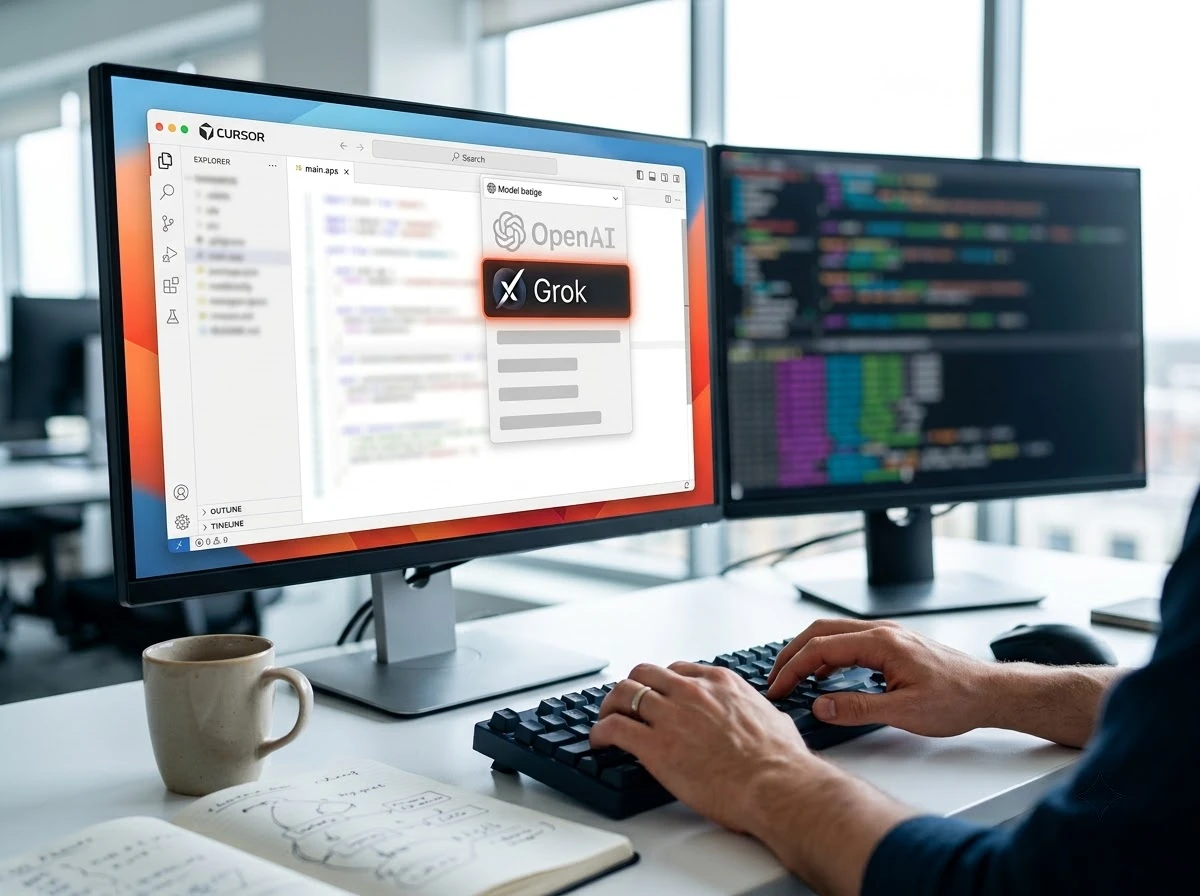
Cursor already offered Grok models from SpaceXAI as first-party options alongside OpenAI, Anthropic and Google models. The acquisition gave Cursor access to SpaceX’s large GPU clusters, including the Memphis Colossus system. OpenAI’s custom deal with Cursor contained a limited window to cancel after any ownership shift. That window is now open.
Truell posted that Cursor was one of OpenAI’s earliest users and had treated the platform as neutral infrastructure. He said the team is speaking with OpenAI to seek a path forward.
The clause worked as designed. Once Anysphere became a SpaceX unit, the buyer and the model supplier stood on opposite sides of a competitive line. OpenAI did not need a fresh breach by Cursor itself; the ownership change alone unlocked the exit. Talks may continue, but the contractual right to wind down is already in force.
Folding Cursor into SpaceXAI also joined session data, GPU supply, and model training under one roof. That vertical stack is valuable for SpaceX. It is also the precise condition that made OpenAI unwilling to keep shipping frontier weights into the product.
Musk Companies and the Contract Record
OpenAI built its case on two prior episodes. After Musk took over Twitter (now X and part of SpaceX), the platform broke OpenAI’s contract terms, the company said, along with agreements held by others. Earlier this year, during Musk’s lawsuit against OpenAI, he admitted under oath that xAI had violated OpenAI’s terms.
Those terms bar using model outputs to train competing systems. In the April trial, Musk acknowledged that xAI had xAI distilled technology from OpenAI in part to train its own models. Distillation feeds a larger model’s answers into a smaller one, cutting training cost. OpenAI views it as a direct ToS breach.
- 2023 onward: X breaches OpenAI contract terms after Musk acquisition, per OpenAI.
- April 2026: Musk admits under oath that xAI distilled OpenAI outputs for training.
- June 16, 2026: SpaceX signs $60 billion all-stock merger for Anysphere/Cursor.
- Mid-August 2026: Acquisition closes; Cursor folds into SpaceXAI.
- August 28, 2026: OpenAI serves notice of wind-down, November 12 cutoff.
xAI itself is now inside the SpaceX structure. OpenAI said large partners normally require bespoke contracts that lock in safety and compliance at scale. The Cursor agreement already contained the change-of-control exit; OpenAI is using it.
The pattern OpenAI cites is cumulative. First came the X-era contract disputes, then the sworn distillation admission, then the purchase that placed Cursor beside xAI and the Colossus clusters. Each step reduced OpenAI’s willingness to treat the coding tool as ordinary distribution. The change-of-control clause let the lab act on that history without waiting for a new incident inside Cursor.
What Cursor Users Face in the Transition
Most Cursor users already route requests across several providers. OpenAI’s slice is small in traffic terms, yet many workflows are tuned to its completion style, context handling and agent behavior. A silent drift in quality after November can cost more than an outright outage.
Developers on X quickly listed practical steps: audit prompts that assume OpenAI quirks, keep a warm Anthropic or Google fallback, and test Grok Build and other first-party options already inside Cursor. Some called the move sour grapes after Musk’s failed lawsuit. Others treated it as proof that single-provider stacks are fragile once ownership changes.
| Model Source | Status Before Notice | Expected After Nov 12 |
|---|---|---|
| OpenAI frontier models | Direct access via Cursor | Direct access ends; no new models including Astra |
| SpaceXAI / Grok | First-party option | Primary and expanding |
| Anthropic Claude | Available | Remains available |
| Google models | Available | Remains available |
Cursor’s own revenue run-rate had reached roughly $2.6 billion annualized before the deal, with strong enterprise growth. Losing one high-end backend will not sink the product, but teams that standardized on OpenAI inside the editor will need to re-validate agents and completion quality.
- Map every internal tool that hard-codes OpenAI model IDs or response formats.
- Run side-by-side tests of Grok, Claude and Gemini on the same long-context coding tasks before the cutoff.
- Update documentation and onboarding so new hires do not assume OpenAI remains the default.
- Watch for any temporary OpenAI support channels the company promised for the transition.
The five percent traffic figure can mislead. A minority share still anchors high-value agent loops, long-context refactors, and enterprise playbooks written against one completion style. Quality gaps show up as slower reviews and brittle automations, not as a red error banner. That is why the developer checklists appeared within hours of the notice.
Grok Moves to the Front of the Queue
SpaceX closed the deal in part to feed developer session data into its own models and to give Cursor the largest GPU fleet available. Grok versions improved after training on Cursor data, according to earlier Musk comments. The coding tool now sits inside the same corporate wall as the compute and the model lab.
That integration is the upside SpaceX bought. The downside is exactly what OpenAI is enforcing: once a frontier lab sees a former customer become a direct competitor under one owner, the supply contract becomes optional. Cursor still carries Anthropic and Google, so the multi-model surface stays open for now.
With OpenAI outbound after November 12, Grok becomes the path of least resistance for teams that want tight coupling to Cursor’s first-party stack. Anthropic and Google remain available as external checks on quality and as hedges if Grok behavior diverges on specific tasks. The product stays multi-model; the balance of power inside that mix shifts.
We are making this choice because we cannot be confident that SpaceX will use our technology within our terms of service, based on our experience with Elon Musk’s companies violating contracts.
OpenAI, official blog post, August 28, 2026
Safety Rules Tighten Around Frontier Models
OpenAI tied the decision to rising capability and accountability. Astra, its next major system, will face tighter deployment rules. The company will not ship it into an environment it cannot trust to honor the same terms that apply to smaller partners.
The broader pattern is clear across the industry. Change-of-control clauses, once quiet boilerplate, are now live weapons when rival founders own the buyer. Providers that once competed for distribution inside popular IDEs are deciding which customers remain safe at scale.
Musk’s lawsuit against OpenAI ended with a jury finding he had sued too late. The personal history between Altman and Musk is long and public. This cutoff is the operational follow-through: models stay inside the circle of partners OpenAI believes will follow the rules.
Astra’s exclusion is the sharp edge of that policy. If the next system is more capable, the cost of a terms breach rises with it. OpenAI is drawing the line before the weights ship rather than after another dispute over distillation or downstream training use.
The Acquisition Timeline Locks the Stakes
The dates already on the public record show how fast the relationship flipped from supplier to blocked channel. SpaceX signed the all-stock merger in June, closed in mid-August, and received OpenAI’s wind-down notice on August 28. The proposed cutoff lands on November 12, the outer edge of the contract’s change-of-control window.
| Milestone | Date | Effect on OpenAI Access |
|---|---|---|
| Merger signed | June 16, 2026 | Change-of-control path opens once deal closes |
| Acquisition closes | Around August 14-15, 2026 | Cursor enters SpaceXAI; exit window live |
| OpenAI notice | August 28, 2026 | Wind-down starts; longest allowed notice begins |
| Model cutoff | November 12, 2026 | Frontier access ends; Astra never ships to Cursor |
Compressed timelines leave little room for a full renegotiation. Truell’s team is still speaking with OpenAI, yet the notice already reflects OpenAI’s reading of the X disputes, the April distillation admission, and the new common ownership with xAI. Unless those talks reverse the decision, the calendar above is the operating plan.
For buyers, the sequence is a case study in contract design. A clause that looked routine at signing became the mechanism that removed a frontier backend after a single ownership change. Other IDE and agent vendors will read the same dates when they next renew large model deals.
Enterprise Workflows Absorb the Provider Shift
Cursor’s roughly $2.6 billion annualized run-rate before the deal rested in part on enterprise teams that standardized tooling inside the editor. Those teams now face a bounded migration, not a product shutdown. OpenAI is about 5 percent of traffic, Anthropic and Google stay on the menu, and Grok is already first-party.
The work is still real. Agents hard-coded to OpenAI model IDs, evaluation suites tuned to one completion style, and onboarding docs that name a single default all need updates before mid-November. OpenAI’s promised extra support during the switch may cover temporary access questions, but it will not rewrite internal playbooks.
- Traffic share at risk: about 5 percent, per Truell, concentrated in tuned workflows.
- Backends that remain: SpaceXAI Grok, Anthropic Claude, Google models.
- Revenue base: roughly $2.6 billion annualized pre-deal, with enterprise growth intact.
- Hard stop: no Astra and no further OpenAI frontier models after November 12.
Enterprises that already multi-home across providers will treat the cutoff as a forced failover drill. Teams that bet on one stack will spend the notice window on side-by-side tests and documentation clean-up. The product survives either way; the cost lands on process debt built during the nearly four-year OpenAI partnership.
Cursor users have until mid-November to lock in alternatives. Truell’s team is still talking with OpenAI. Unless those talks reverse the notice, the November 12 date stands as the day OpenAI models leave the SpaceX-owned editor.

-
 TECH1 year ago
Where Garmin Watches are Made and How They are Assembled
-
 AUTO3 months ago
Tesla’s Roadster Is ‘a Few Weeks Away,’ Says Its Chief Designer
-
 NEWS10 years ago
Samsung Releases Galaxy Note7 TV Ad as Reddit AMA Leaks Specs
-
 NEWS10 years ago
Android 7.0 Nougat Rolls Out To Nexus Devices With New Emoji, Features
-
 FINANCE9 years ago
Cardano Price Surges as ADA Enters the Crypto Top Ten List
-
 NEWS10 years ago
Pre-Order the First Camera Made for Facebook Live Streaming Video
-
 FINANCE1 year ago
Binance Suspends Trading and Withdrawals for a System Upgrade
-
 FINANCE9 years ago
RChain Price Jumps Nearly 150% to a New All-Time High of $2.03