
BUSINESS
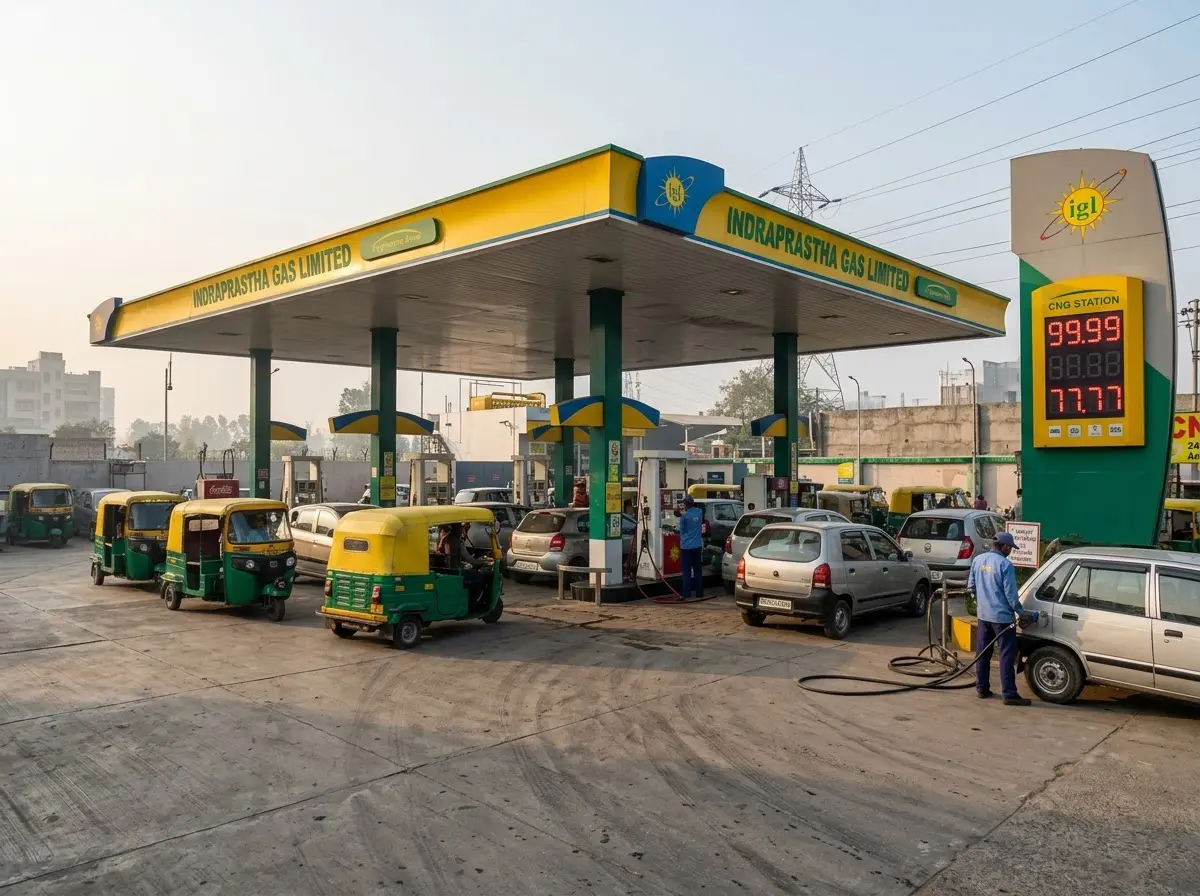
IGL CNG Hike Transfers LNG Shock Onto Delhi Fleets
IGL raises CNG ₹3.89 to ₹86.98/kg as LNG near doubles on Hormuz disruption; the second hit lands on NCR autos.

Indraprastha Gas Ltd raised compressed natural gas prices by ₹3.89 per kg across its network from 6 a.m. on 29 August 2026, lifting the Delhi retail rate to ₹86.98 per kg. The move is the fifth increase since the West Asia conflict began and follows a cumulative ₹6 rise in four steps from mid-May.
IGL linked the step to elevated spot LNG costs after cargoes through the Strait of Hormuz stayed disrupted. The company said the revision only partly offsets higher input expenses while keeping supplies reliable.
New Rates Stretch From Delhi to Kanpur
The increase applies uniformly by ₹3.89 at every IGL station, yet final pump prices differ by state taxes and local costs. Delhi lands at the lowest among major NCR points.
| City / Area | New CNG Price (₹/kg) |
|---|---|
| NCT of Delhi | 86.98 |
| Noida / Greater Noida / Gautam Budh Nagar | 95.59 |
| Ghaziabad | 95.59 |
| Gurugram | 92.01 |
| Meerut / Muzaffarnagar / Shamli | 95.47 |
| Rewari | 91.59 |
| Karnal | 91.32 |
| Kanpur / Hamirpur / Fatehpur | 98.31 |
| Ajmer / Pali / Rajsamand | 96.33 |
Earlier in May the Delhi price sat at ₹77.09. Four small steps took it to ₹83.09 before Friday’s larger jump. IGL serves the capital plus a wide ring of Haryana, Uttar Pradesh and Rajasthan markets.
Spot LNG Nearly Doubled on Hormuz and Winter Race
IGL’s statement pointed to re-escalation that has kept LNG tankers from moving freely through the Strait of Hormuz. Global prices have nearly doubled versus the pre-crisis stretch. Europe’s drive to refill storage ahead of winter added further pull.
Asian JKM spot LNG rose from around USD 10.99 per MMBTU to USD 23.41, a climb of roughly 113 percent in the period IGL referenced. Traders saw the marker hit Asian spot LNG jumped to $23.388 on 28 August after QatarEnergy extended force majeure notices into October and early November.
- Europe storage: barely 63 percent full versus a five-year average near 80 percent.
- Qatar cargoes: term deliveries largely absent since the conflict opened; oil has found ship-to-ship workarounds that LNG cannot use.
- India exposure: a growing share of CNG volumes now comes from expensive spot cargoes as demand outruns domestic APM supplies.
A Centre for Research on Energy and Clean Air tally found Asian LNG averaged 75% above pre-war expectations across March-August 2026. That premium has fed directly into the cost basket for city-gas firms.
Autos, Taxis and Buses Feel the Operating Hit First
Delhi-NCR runs one of India’s densest CNG fleets. Auto-rickshaws, app cabs, many private cars and a large share of public buses all draw from the same pumps. Each ₹3.89 step raises the daily fuel bill for drivers who already work thin margins.
An auto-rickshaw driver interviewed after the announcement said the fuel is imported and used by cars, bikes and buses alike, so everyone feels it. He added that passengers themselves often agree to a little extra fare once they hear gas has gone up.
It is a matter of happiness. CNG is coming from outside; it is not produced in our own country. And it is not just used by auto-rickshaws cars, bikes and buses also run on it. So, the price hike affects everyone….We tell the passengers that the gas prices have increased, and they themselves pay a little extra fare….
Auto-rickshaw driver, Delhi, IANS video
On X, reactions clustered around the same point: the fifth hike of the year lands on the daily commute and small commercial operators. One widely shared view noted the price was near ₹43.80 six years earlier and has almost doubled. Drivers cannot absorb repeated jumps without passing cost along, which then lifts the price of short rides for office-goers and market shoppers.
- Higher per-km cost for auto and taxi fleets that operate 100-200 km daily.
- Pressure on app-cab platforms to adjust dynamic fares or driver incentives.
- Extra burden on DTC and private bus operators already managing tight schedules.
- Knock-on for low-income households that rely on shared CNG transport rather than private cars.
IGL itself notes that private cars, autos, taxis and public transport users form the price-sensitive core it has tried to shield. The second-order effect is that the shield is thinning.
Relative Insulation Still Holds Against the LNG Spike
IGL stressed that Delhi CNG rose only about 7.8 percent from ₹77.09 to ₹83.09 while JKM LNG climbed 113 percent over the same window. The latest ₹3.89 step continues that pattern of partial pass-through. The company said consumers have been largely insulated from the full volatility of spot cargoes.
That arithmetic is real. Yet the absolute cumulative rise since early May now exceeds ₹9.80 per kg. For a typical auto running 150 km a day at roughly 25-30 km per kg, the extra outlay compounds quickly across a month. The insulation claim and the lived cost for fleet owners sit side by side without cancelling each other.
City-gas entities still enjoy priority access to cheaper domestic APM gas for CNG and household PNG. Demand growth and the earlier supply squeeze forced heavier use of spot LNG. Recent policy has added extra 200 SCM of APM gas per new PNG connection from September, a step aimed at slowing the LNG share for household lines. CNG volumes remain large enough that spot purchases continue to matter.
CNG Keeps a Cost Edge Over Petrol and Diesel
Even after the revision, IGL says CNG remains among the most economical options versus petrol and diesel. On 29 August Delhi petrol at ₹102.12 and diesel ₹95.20 per litre according to Petroleum Planning and Analysis Cell figures.
A rough running-cost comparison using common real-world efficiencies still favours CNG:
| Fuel | Delhi Price | Typical Efficiency | Approx Cost per km |
|---|---|---|---|
| CNG | ₹86.98/kg | 22 km/kg | ₹3.95 |
| Petrol | ₹102.12/L | 15 km/L | ₹6.81 |
| Diesel | ₹95.20/L | 18 km/L | ₹5.29 |
The gap has narrowed from the May levels when CNG sat near ₹79. Savings of ₹30,000-plus a year for a private car doing 1,000 km a month remain available, yet commercial operators who burn far higher volumes watch every rupee of margin. IGL repeated that the fuel stays cleaner and more dependable for mobility.
Five Steps Since the Conflict Opened
The path of 2026 hikes is short and clear.
- Mid-May 2026: four successive small increases totalling ₹6 per kg, taking Delhi from ₹77.09 toward ₹83.09 over roughly ten days as the first wave of West Asia disruption hit.
- 28 August 2026: IGL announces the fifth revision of ₹3.89, effective 6 a.m. the next morning.
- 29 August 2026: new rates live across the full IGL map; Delhi at ₹86.98, Noida-Ghaziabad at ₹95.59, Gurugram at ₹92.01.
No further official guidance has been issued on additional steps. Spot LNG remains elevated while Hormuz traffic stays restricted and Qatar’s force majeure runs into autumn. Domestic APM priority protects a core slice of volumes, yet the growing gap between demand and cheap gas keeps the door open for more calibrated moves if international prices stay high.
For now the numbers are fixed at the pump. Drivers and fleet managers will adjust fares and routes in the days ahead, and the wider NCR transport cost base will carry the latest piece of the global gas shock.
Frequently Asked Questions
What is the new CNG price in Delhi after the IGL hike?
The retail price in the National Capital Territory is ₹86.98 per kg from 6 a.m. on 29 August 2026, up ₹3.89 from the previous ₹83.09. Neighbouring IGL markets sit higher because of differing state taxes: Noida and Ghaziabad at ₹95.59, Gurugram at ₹92.01.
Why did IGL raise CNG prices by exactly ₹3.89 per kg?
IGL said international LNG prices have nearly doubled versus the pre-crisis period after cargo movements through the Strait of Hormuz were hit and Europe began racing to fill winter storage. A large share of CNG gas now comes from expensive spot purchases, so the firm applied a partial offset to keep supplies continuous.
How much has Delhi CNG risen since May 2026?
The price started at ₹77.09 early in May, climbed ₹6 across four tranches later that month, then added another ₹3.89 on 29 August for a total rise of roughly ₹9.89 per kg. That is still far smaller in percentage terms than the 113 percent jump in Asian JKM LNG over the same span.
Is CNG still cheaper to run than petrol or diesel in Delhi?
Yes on a per-kilometre basis for typical cars and autos. At ₹86.98/kg and around 22 km/kg the running cost sits near ₹4 per km, against roughly ₹6.80 for petrol at ₹102.12/L and ₹5.30 for diesel at ₹95.20/L using common real-world efficiencies. The absolute advantage has narrowed but remains clear for high-mileage users.
Do city-gas firms get priority domestic gas for CNG?
Yes. Government allocation rules give CNG for transport and domestic PNG first claim on cheaper APM gas from ONGC and Oil India fields, targeting 100 percent of recent average demand when available. Rapid growth in vehicle and household connections has still left a shortfall that is filled by costlier spot LNG, which is why retail prices move with global markers.

-
 TECH1 year ago
Where Garmin Watches are Made and How They are Assembled
-

 AUTO3 months ago
Tesla’s Roadster Is ‘a Few Weeks Away,’ Says Its Chief Designer
-
 NEWS10 years ago
Samsung Releases Galaxy Note7 TV Ad as Reddit AMA Leaks Specs
-
 NEWS10 years ago
Android 7.0 Nougat Rolls Out To Nexus Devices With New Emoji, Features
-
 FINANCE9 years ago
Cardano Price Surges as ADA Enters the Crypto Top Ten List
-
 NEWS10 years ago
Pre-Order the First Camera Made for Facebook Live Streaming Video
-
 FINANCE1 year ago
Binance Suspends Trading and Withdrawals for a System Upgrade
-
 FINANCE9 years ago
RChain Price Jumps Nearly 150% to a New All-Time High of $2.03