NEWS
Yahoo’s CEO Bets Outbound Links Can Still Save Publishers
Jim Lanzone called AI search existential for publishers at Paley, while Yahoo Scout still bets outbound links can restore referral traffic.

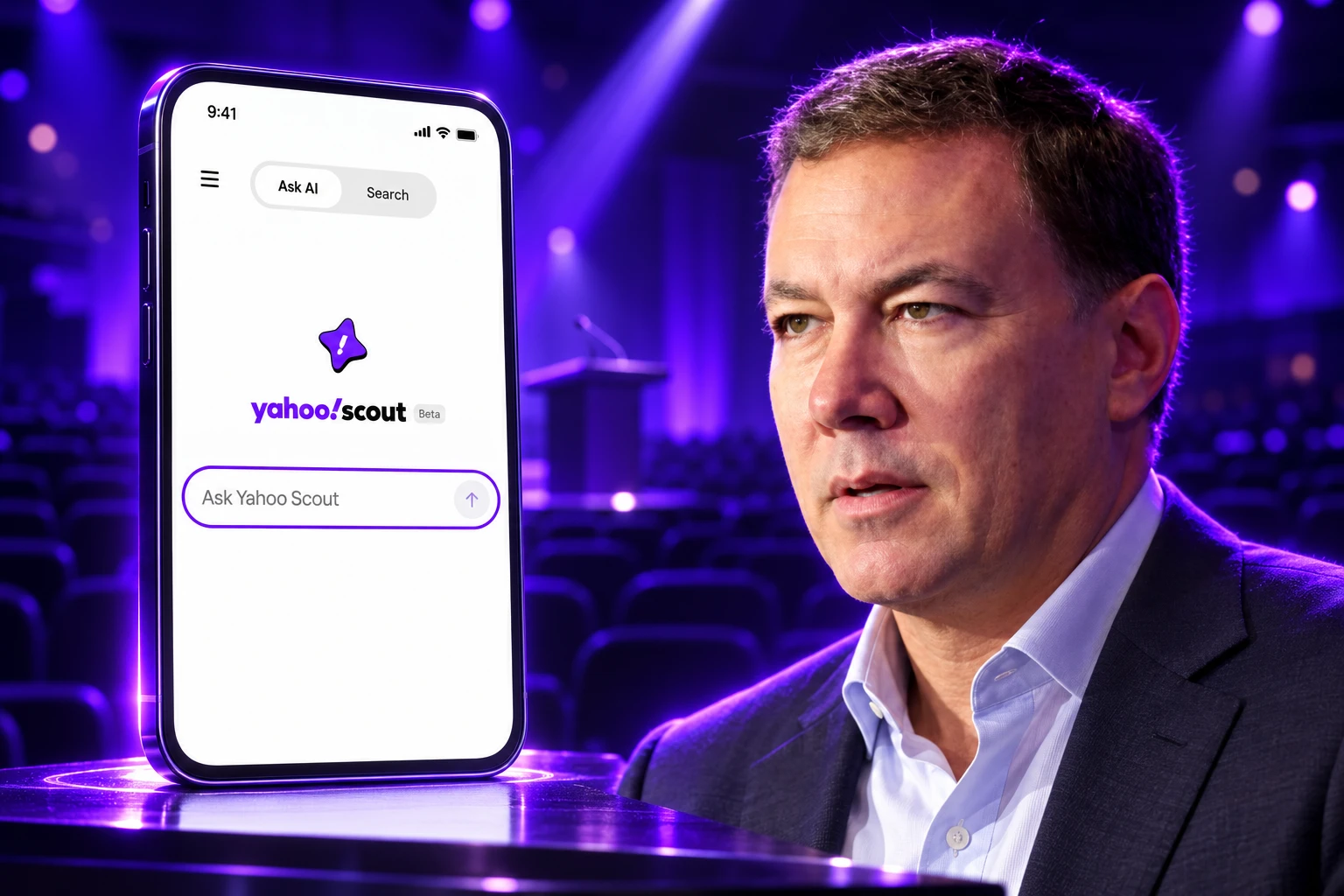
Yahoo CEO Jim Lanzone told a New York media summit on October 21 that AI search is an existential issue for digital publishers, citing traffic drops of 60% to 70%. He said the old bargain, crawl the page and send a reader back, had broken. He also runs the company that launched Yahoo Scout in January to answer questions and still point people at the sites behind those answers.
The speech was industry alarm. It was also a product argument he has been making all year.
A Warning With a Search Product Attached
Lanzone spoke on The New Economics of Attention panel at the Paley International Council Summit, held at the Paley Museum at 25 West 52 Street. The slot ran from 11:20 to 11:50 a.m. on October 21, with Optimum chairman and CEO Dennis Mathew and Bluesky chief operating officer Rose Wang. For the first 27, 28 years of the internet, Lanzone said, publishers let search engines crawl their sites in exchange for visits.
For the first 27, 28 years of the internet, there was a social contract
Jim Lanzone, CEO, Yahoo, Paley International Council Summit
AI answer engines now settle the question on their own page, he said, and that leaves publishers with declines of 60% to 70%. He did not name the publishers or the dates. “You can’t run a business that way,” he said, and he argued that AI firms could do more to send readers to the work they used.
That line matches the case he made when Yahoo Inc. introduced Scout on January 27. The company said the tool was live in beta across Yahoo Search and the rest of the Yahoo suite, and available to nearly 250 million users in the United States, a Comscore unique-visitor average for 2025. Yahoo also said its properties reach 90% of U.S. internet users each month. Scout runs on Anthropic’s Claude, Microsoft Bing’s grounding API, and Yahoo’s own stores: 500 million user profiles, a knowledge graph of more than 1 billion entities, and 18 trillion consumer events a year. Yahoo joined Microsoft’s Publisher Content Marketplace pilot at the same time.
Every Scout reply, Lanzone said at launch, would carry inline citations so search would again send traffic. He framed that design as a way to restore the contract he described again at Paley. Two days before the summit he put Yahoo on the other side of the same ledger, calling it a top 20 publisher whose material large language models had taken without permission, and saying Scout is built for live information those models photocopied poorly.
FROM SCOUT TO PALEY
- January 27, 2026: Yahoo launches Scout as a U.S. beta answer engine with visible citations.
- September 17, 2026: Court papers quote OpenAI’s ChatGPT chief calling publishers’ position an existential threat.
- October 15, 2026: Google says more than 400 publications are in its paid News AI pilot and that AI search will show source links higher.
- October 21, 2026: Lanzone repeats the social-contract case on the Paley stage.
Scout also writes summaries inside Yahoo Mail, News, Finance, and Sports, including comment roundups on Yahoo homepage stories. The same firm is building an answer layer on its own pages and asking the rest of the web to keep handing over clicks.
Google Search Referrals Fell 40 Percent
Lanzone’s 60% to 70% range came with no list of sites. Measured referral data sits lower, and it is still ugly for anyone who planned a newsroom around Google.
HOW THE TRAFFIC CLAIMS COMPARE
| Claim | Figure | What it counts | Window |
|---|---|---|---|
| Lanzone at Paley | 60% to 70% | Traffic drops at unnamed publishers | Not given |
| Chartbeat, via the Reuters Institute | 40% | Google Search referrals to hundreds of publishers | July 2025 to July 2026 |
| Pew Research Center | 8% vs 15% | Click on a regular result with an AI summary vs without one | March 2025 |
| Pew Research Center | 1% | Click on a source cited inside the AI summary | March 2025 |
Chartbeat’s 2026 Publisher Playbook, as cited by the Reuters Institute for the Study of Journalism, found that Google Search referrals fell 40 percent from July 2025 to July 2026, twice the decline recorded in the prior 12 months. That is a network of publisher sites, not a census of the whole web, and it is a different number from Lanzone’s unnamed 60% to 70%. Both describe a channel that no longer pays for the journalism it summarizes.
Newsrooms spent two decades staffing search desks, rewriting headlines, and shaping stories around queries. The Reuters Institute piece describes the next fear in the trade as “Google Zero”: Search keeps the user and stops acting as a front door. Google still withholds AI Overviews on many straight news queries, the Institute noted in October, but news-adjacent questions already draw machine summaries that compete with reporting.
Why a Source Link Rarely Becomes a Visit
Lanzone’s remedy is more linking. Pew already watched what people do when the link is sitting in the answer.
WHAT PEW MEASURED IN MARCH 2025
- The panel: 900 U.S. adults shared browsing data, producing 68,879 Google searches, of which 12,593 (18%) showed an AI summary.
- Regular results: Users clicked a traditional blue link in 8% of visits when a summary was present and in 15% when it was not.
- The citation itself: Users clicked a cited source in 1 percent of visits to pages that had a summary.
- The session: People quit the browser after 26% of pages with a summary, against 16% of pages with only classic results.
About 58% of the panel ran at least one Google search that month that produced a summary. Question-style queries beginning with who, what, when, or why triggered a summary 60% of the time. News sites made up 5% of the sources listed in those summaries, the same share they held in ordinary results. Wikipedia, YouTube, and Reddit together accounted for 15% of AI-summary sources.
Shelby Blackley, director of global SEO and AI search at The Athletic, told the Reuters Institute she does not like the trade and still treats absence from sports answers as a missed chance. People use summaries to get oriented, she said, and a familiar brand in the citation can become a later direct visit. Visibility without a click is now a metric some desks are willing to chase. It is not a substitute for the pageview that used to pay the reporter.
400 Newsrooms on Google’s AI Payroll
Six days before Paley, Google offered publishers money and a redesigned answer, which is a different bet from Lanzone’s open-web pitch.
On October 15 the company said more than 400 publications worldwide now take part in its News AI pilot, a paid licensing program that began last year with partners including The Washington Post and The Washington Examiner. New names include Axios, CNN, the Financial Times, and Forbes, plus local titles such as the Post and Courier, the Texas Tribune, Oil City News, and Shaw Media. Google said it pays those newsrooms for enhanced content used to build AI features, with attribution and direct links.
WHAT THE PILOT IS BUYING
- Story overviews: In-depth article summaries on Google News publisher pages, meant to give context before a click.
- Audio briefings: Customizable spoken editions in the Google News app.
- The check: Payment for delivery and use of the licensed material, with terms undisclosed.
- The search tweak: The same day, Google said inline links in AI Mode and AI Overviews will appear higher in answers more often, and it is testing a top box for the one or two official pages that complete a task.
That package turns some journalism into a wholesale input for Google’s own news products. It does not restore the old referral graph for the thousands of sites that are not on the list. Ben Berkowitz, who oversees newsroom AI work at Axios, one of the new partners, has said the desk still wants to show up in citations as an authority even when the click never comes. For a brand with newsletters and events, that can be a holding action. For a site that lived on search ads, a license fee is a different business.
The Same Phrase Showed Up in Court
Lanzone is late to the wording. On September 17, unsealed papers in the publishers’ copyright fight against OpenAI and Microsoft in Manhattan quoted Nick Turley, OpenAI’s head of ChatGPT, from internal messages.
Our products are largely substitutive, period
Nick Turley, head of ChatGPT, OpenAI, in communications cited in unsealed publisher filings
Turley wrote that publishers faced an “existential threat” from products that would get more substitutive as they improved. Microsoft director of applied science Brent Hecht, in language the publishers also put on the record, called large-scale absorption of human work an astonishing theft, and a Microsoft document warned of a “doom loop” that would hurt both the models and the web that feeds them. Those lines are allegations and internal comments in a live case, not findings. They are the same diagnosis Lanzone sold as a civic problem, written years earlier inside the firms that built the answer engines.
Yahoo Wants the Gateway Job Back
Yahoo is not a bystander asking Google to be nicer. It is a portal that lost the directory era, kept a large logged-in audience, and now wants the guide job back with a language model on top.
Lanzone has described Scout as a second chance at the original Yahoo mission, a trusted path across the internet. Eric Feng, senior vice president and general manager of Yahoo Research Group, said the engine is shaped by 30 years of Yahoo knowledge and will get more personal. Ami Vora, head of product at Anthropic, said Claude was picked because an answer engine for hundreds of millions of people has to reason and explain, not only retrieve.
The wager has a split personality. Scout is supposed to spill readers onto other publishers’ URLs. It is also wired through Yahoo News, Finance, Sports, Mail, and Shopping, where the useful next step can be a Yahoo widget, a shoppable link, or a summary of comments that never leaves the homepage. If that mix works, Yahoo becomes the polite answer engine and a destination. If users treat Scout the way Pew’s panel treated Google summaries, the citations will be décor.
Rose Wang Calls the Platforms Landlords
Wang used the rest of the Paley slot on a wider map. She described the present internet as “technofeudalism,” with a few platforms as landowners collecting from the people who build on their ground. Asked for advice to Meta chief executive Mark Zuckerberg, OpenAI chief executive Sam Altman, and Anthropic chief executive Dario Amodei, she called the three “monarchists” and did not bother with conversion. Companies that still want an open web, she said, should send traffic to one another instead of waiting on the largest platforms. Bluesky’s design lets people move across compatible apps without dropping a profile or a follower list, which is her version of an exit from rented land.
That coalition talk and Lanzone’s Scout pitch share a wish: keep a path off the answer page. They do not share a business. Yahoo wants to be the next gateway. Wang wants fewer gateways. Google, on October 15, offered a third path that pays selected newsrooms to feed AI features inside Google News.
Scout is live at Scout.Yahoo.com. Google is paying more than 400 publications. In Pew’s panel, a cited source inside an AI summary got the next click in 1% of visits.

Bulk Scotch Still Faces Full Duty After India’s UK Deal

Typhoon Champi Loops Off Taiwan and Still Injures 527

PM Modi Opens Chinmaya’s AI Guru and Asks for Unity

Mahim Police Hold a JeM Suspect on Enmity Charges

Gold Falls Below $4,000 as Hormuz Oil Hits $117

The iPhone 18 Pro Max Splits Apple’s Fall in Two

OpenAI Calls GPT-6 Astra AGI Then Locks Its Exploits

Clancy Juror Says the Holdout Never Cited Evidence

Trump Claims Hormuz Control as Oil Holds Near $96

Russia Closes the Goethe-Institut Berlin Tried to Save

 NEWS2 months ago
The iPhone 18 Pro Max Splits Apple’s Fall in Two
- NEWS2 months ago
OpenAI Calls GPT-6 Astra AGI Then Locks Its Exploits
- NEWS1 month ago
Clancy Juror Says the Holdout Never Cited Evidence
- BUSINESS2 months ago
Trump Claims Hormuz Control as Oil Holds Near $96
- LIFESTYLE2 months ago
Russia Closes the Goethe-Institut Berlin Tried to Save
- AUTO2 months ago
Volkswagen’s Job Cuts Leave Four Plants Without Cars
- NEWS2 months ago
Dyson Puts Nurovi Robots on Sale Without the UV Flagship
- NEWS2 months ago
The Lincoln’s 286-Day War Cruise Ends at a Thai Pier