NEWS
ITBP Confirms Arunachal Face-Offs as Shaurya Commandos Deploy
ITBP chief Shatrujeet Kapur confirmed live Arunachal face-offs that outlasted September talks as Shaurya commandos recast the China border force.

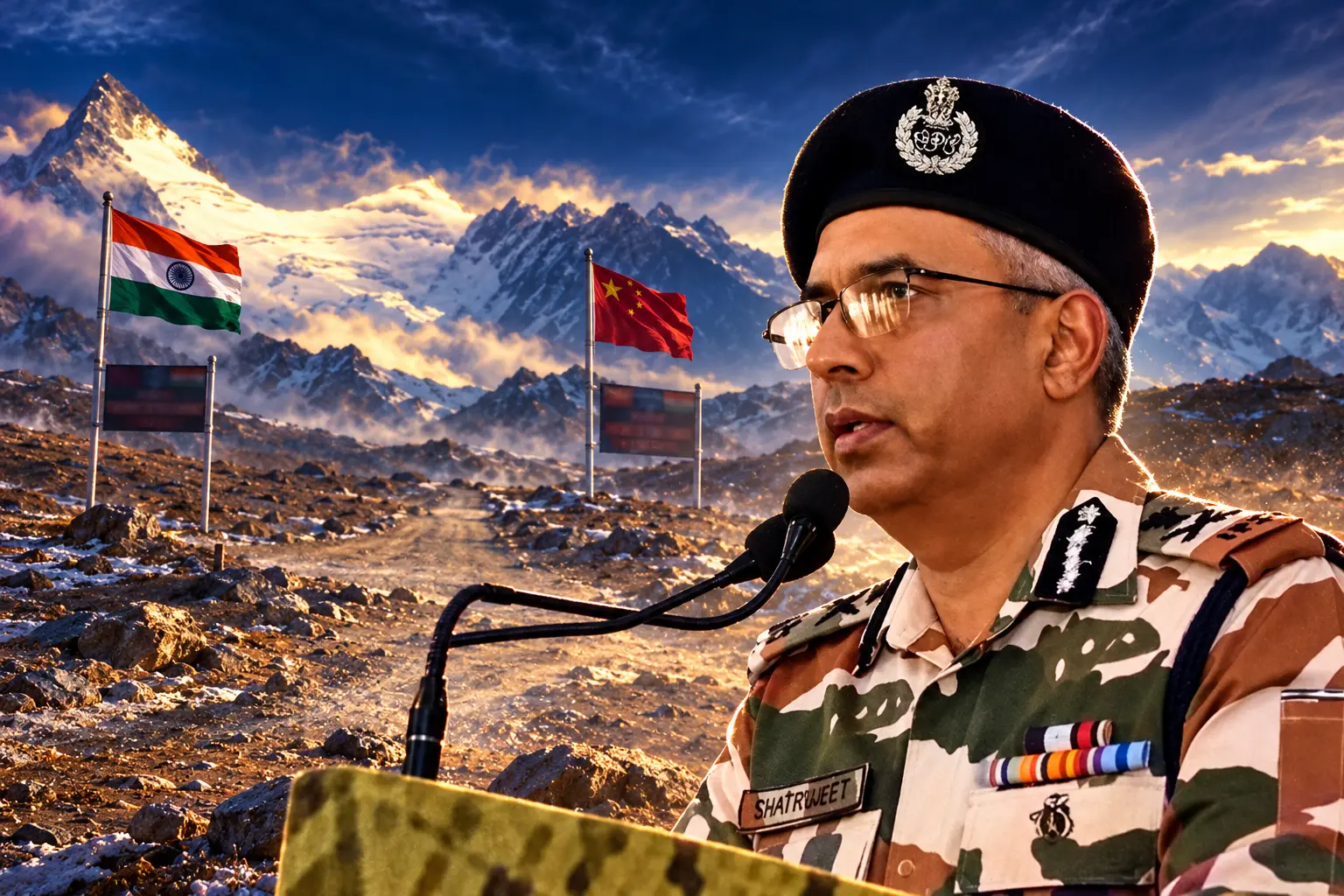
ITBP Director General Shatrujeet Kapur said on October 22 that face-offs with Chinese troops continue at several places in Arunachal Pradesh. He was speaking at the Central Training College in Alwar, Rajasthan, ahead of the force’s 65th Raising Day on October 24, and he credited newly raised Shaurya commando teams with an exemplary role in those contacts.
The line was a capability pitch to his own troops. It was also the first official confirmation that confrontations which began in late July were still live after Corps Commander talks on September 6 and Chinese President Xi Jinping’s BRICS visit to New Delhi from September 11 to 13.
Face-Offs That Outlasted the Delhi Summit
Kapur told the Himveer Samman Samaroh that “in the past few days, a situation arose where face-offs happened at several locations in Arunachal, and it still continues.” He did not name China in that sentence. He did not need to. The Indo-Tibetan Border Police guards the 3,488 km Line of Actual Control from the Karakoram Pass in Ladakh to Jachep La in Arunachal Pradesh, and he had already called China India’s “biggest adversary.”
Long-range patrols in Arunachal run from June to October because of the weather. That window is when troops walk the same tracks the other side also claims. Kapur’s admission lands at the end of that season, not at the start of a new crisis, which is why the date of the speech matters as much as the wording.
FROM GALWAN TO ALWAR
- June 2020: Twenty Indian soldiers are killed in the Galwan Valley clash; China later acknowledges four of its own dead.
- Late July 2026: Indian and Chinese troops meet near Maja in Taksing circle, Upper Subansiri district, during routine patrolling.
- September 6, 2026: Corps Commander-level talks are held at the Wacha-Damai border meeting point on the Indian side.
- September 11 to 13, 2026: Xi Jinping is in New Delhi for the BRICS summit while the eastern-sector contact remains open.
- October 22, 2026: Kapur confirms ongoing multi-location face-offs and praises Shaurya teams at Alwar.
- October 24, 2026: The force marks its 65th Raising Day.
Local reporters in Arunachal had been describing blocked patrols around Taksing since August. The Alwar hall is where a Delhi audience finally heard a force chief say the contact had not closed.
Shaurya Teams Are Already on the Line
Kapur did not announce a unit that will be ready someday. He said the new combat teams had already been used. “Our newly raised Shaurya commandos are doing great work,” he said. “There, our Shaurya Commando teams played an exemplary role.”
The build is staged, and it is larger than a single specialist platoon.
THE SHAURYA BUILD
- Now: One Shaurya commando team has been formed in every ITBP battalion.
- Next: Two more teams are being raised so each battalion can field a full company.
- After that: The operations wing is working up a dedicated Shaurya battalion as the force’s high-altitude elite unit.
- Training: A new Strike course, built around Galwan-like combat, is meant to cover the entire force by the end of 2027.
On the same day he said this, Kapur gave Director General’s Silver Discs to 10 personnel and Commendation Rolls to 126 others, 136 awards in all. The ceremony and the combat claim sat in the same hall.
Taksing, Asaphila and the 6 km Gap
Kapur named the state. He did not name the ridge. Government sources have filled that gap with a more specific picture that the DG did not put on the record in Alwar.
WHAT WE KNOW
- The confirmation: Face-offs have taken place at several locations in Arunachal Pradesh and, in Kapur’s words, still continue.
- The unit: Shaurya commando teams were used in those contacts.
- The talks: Corps Commander-level talks were held on September 6 at Wacha-Damai after the Taksing face-off.
- The patrol season: Army and ITBP long-range patrols in Arunachal run from June to October.
WHAT IS UNCONFIRMED
- The tents: Government sources say the PLA pitched tents at Asaphila near Taksing, 6 to 7 km within India’s perception of the LAC, near the Maja company operating base.
- The return: Those sources say both sides pulled back after a July meeting, then Chinese troops came back in larger numbers and stayed.
- The grazing claim: A People’s Party of Arunachal fact-finding team said in July that PLA troops were blocking designated patrolling points in Taksing; Kapur did not endorse that wording.
Indian troops, those sources add, remain deployed in large numbers around Taksing to stop the contact from widening. That is a holding pattern, not a settlement. The September talks did not produce a public account of who now walks which track.
How ITBP Is Rewriting Its China Mandate
The deeper shift in the Alwar speech is not the existence of another commando label. It is Kapur telling a Central Armed Police Force, which sits under the Ministry of Home Affairs, to stop thinking of itself as a guerrilla leftover and start thinking of itself as a mountain fighting arm that is not the Army.
We do not need guerrilla warfare in current days; a specialised high-altitude mountain fighting force is being set up, which will be different from the Army.
Shatrujeet Kapur, Director General, ITBP, Central Training College, Alwar
He reminded the hall that ITBP was raised as a mountain guerrilla force after the 1962 war, with four battalions, and was given China border-guarding duty in 2004. “We should not abandon our exact mandate,” he said. High-altitude work, he added, is the force’s strength.
The Home Ministry’s 2024-25 report still describes that evolution in older language: an integrated guerrilla, intelligence and fighting force that became a conventional border-guarding service. Kapur is pushing the next turn. The Army remains on the LAC with ITBP. He wants his own elite battalion anyway, with its own identity for high-altitude operations.
The force he is trying to recast is already larger than the outfit that walked into Galwan’s aftermath. The same ministry report puts sanctioned strength at 1,03,622 across 62 service battalions. Kapur spoke of a mountain-trained body of about 95,000. Those are different counts, one on paper and one in his own briefing, and both sit well above the four-battalion start in 1962.
Outposts have moved with the headcount. ITBP now mans 209 border outposts between 9,000 and 18,750 feet. There were 180 in the 2020-21 report, a net gain of 29 after Galwan. Patrol logs in the later report show 2,899 patrols from April 1 to December 31, 2022, then 6,561 from January 1, 2023 to March 31, 2024, and 4,503 from April 1 to December 31, 2024. More posts and more walks have not, on Kapur’s own account, ended the face-offs in Arunachal.
Drones Take 70 Percent of the New Money
Kapur’s other argument was that rifles and above-ground huts will not hold this border. Troops over 50, he said, still know the weapons they picked up when they joined. “There is a need for modernisation and we have made a big provision for it in our scheme.” That complaint sits beside a Cabinet-approved modernisation plan for CAPFs that already promised newer weapons, surveillance gear and specialised vehicles.
The cash he quoted on October 22 is more specific, and most of it is aimed at the sky.
THE MONEY BEHIND THE REBUILD
| Item | Figure | Status |
|---|---|---|
| Current modernisation funds | Rs 400 crore | Received |
| Share for drone warfare | 70 percent of that Rs 400 crore | Earmarked |
| Larger modernisation scheme | Rs 4,000 crore | In-principle MHA approval |
| Drone and anti-drone slice of the larger scheme | Rs 1,000 crore | Earmarked |
| Home Ministry border infrastructure, 2024-25 | Rs 3,757 crore | Budgeted across borders |
Each border-guarding battalion now has a drone platoon. The force is training pilots and building drones in-house. “The role of traditional armies has changed since the drones arrived,” Kapur said, pointing to Ukraine’s war with Russia and to Iran’s use of drones. He put a figure on Russian dead that is his claim, not a verified tally, and he used it to argue that India cannot meet China with “traditional” methods alone.
Underground shelters are the other half of that argument. “Anyone standing on the ground can be targeted easily,” he said. As a pilot, every company has started building underground structures at its border outposts, which he wants as permanent defences in a hot war. Above the ground, the force is insulating barracks, fitting solar water heaters, putting generator sets on remote posts and issuing cold-start kits so vehicles will turn over in a freeze.
The drone package sits inside a wider Home Ministry spend. PRS Legislative Research’s reading of the 2024-25 Demand for Grants puts the Rs 3,757 crore border infrastructure budget 18 percent above the 2023-24 revised estimate of Rs 3,172 crore. That envelope covers more than the China frontier, but it is the fiscal weather in which ITBP is asking for bunkers and airframes.
Silence in Delhi After an Alwar Speech
Congress general secretary Jairam Ramesh treated the DG’s praise as evidence that the Prime Minister’s office had said nothing while the contact ran. He wrote that Kapur had “lauded, and rightly so,” ITBP’s performance in recent face-offs with the PLA, “on which there has been a deafening silence from the PM and his establishment.”
While the self-styled Vishwaguru’s calibrated concessions to China continue, the DG, ITBP, has lauded—and rightly so—its performance in recent face-offs with the PLA in Arunachal Pradesh, on which there has been a deafening silence from the PM and his establishment.
Corps… pic.twitter.com/AudzBX5QCU
— Jairam Ramesh (@Jairam_Ramesh) October 23, 2026
Ramesh tied the Alwar remarks to three other files. Locals, he said, had reported that patrolling points had slipped from Indian control again, as in Ladakh. China, he said, continues to rename towns in Arunachal Pradesh. And Beijing, he said, is building a dam of 60,000 MW that threatens ecology and water security.
New Delhi has already rejected Chinese attempts to assign new names to places in Arunachal Pradesh, calling those lists fictitious and restating that the state is an integral part of India. The dam claim points at a separate, documented project: China has begun a 60,000 MW hydropower project on the Yarlung Tsangpo, the river that becomes the Siang in Arunachal Pradesh and then the Brahmaputra. There is no water-sharing treaty on that basin. Kapur did not discuss the dam. Ramesh used the DG’s border line to drag that file back into the same argument.
The opposition also noted that the face-offs were running while Xi was being hosted in New Delhi. That is a political reading of a calendar the DG himself made possible by speaking in public. The government did not issue a matching briefing on Taksing after the Alwar speech.
Kapur’s force will mark 65 years on October 24 with Shaurya teams still credited for work on an open contact in Upper Subansiri, and with a mountain-combat identity he is still building. The speech that was meant to show readiness is now the public record that the contact did not end in September.

Bulk Scotch Still Faces Full Duty After India’s UK Deal

Typhoon Champi Loops Off Taiwan and Still Injures 527

PM Modi Opens Chinmaya’s AI Guru and Asks for Unity

Mahim Police Hold a JeM Suspect on Enmity Charges

Gold Falls Below $4,000 as Hormuz Oil Hits $117

The iPhone 18 Pro Max Splits Apple’s Fall in Two

OpenAI Calls GPT-6 Astra AGI Then Locks Its Exploits

Clancy Juror Says the Holdout Never Cited Evidence

Trump Claims Hormuz Control as Oil Holds Near $96

Russia Closes the Goethe-Institut Berlin Tried to Save

 NEWS2 months ago
The iPhone 18 Pro Max Splits Apple’s Fall in Two
- NEWS2 months ago
OpenAI Calls GPT-6 Astra AGI Then Locks Its Exploits
- NEWS1 month ago
Clancy Juror Says the Holdout Never Cited Evidence
- BUSINESS2 months ago
Trump Claims Hormuz Control as Oil Holds Near $96
- LIFESTYLE2 months ago
Russia Closes the Goethe-Institut Berlin Tried to Save
- AUTO2 months ago
Volkswagen’s Job Cuts Leave Four Plants Without Cars
- NEWS2 months ago
Dyson Puts Nurovi Robots on Sale Without the UV Flagship
- NEWS2 months ago
The Lincoln’s 286-Day War Cruise Ends at a Thai Pier