NEWS
Ukrainian Drones Leave Finland Fighting a Russian Ship Fire
Ukrainian drones hit the sanctioned Sparta II in the Gulf of Finland, and Finland now leads the rescue of a Russian military logistics ship.

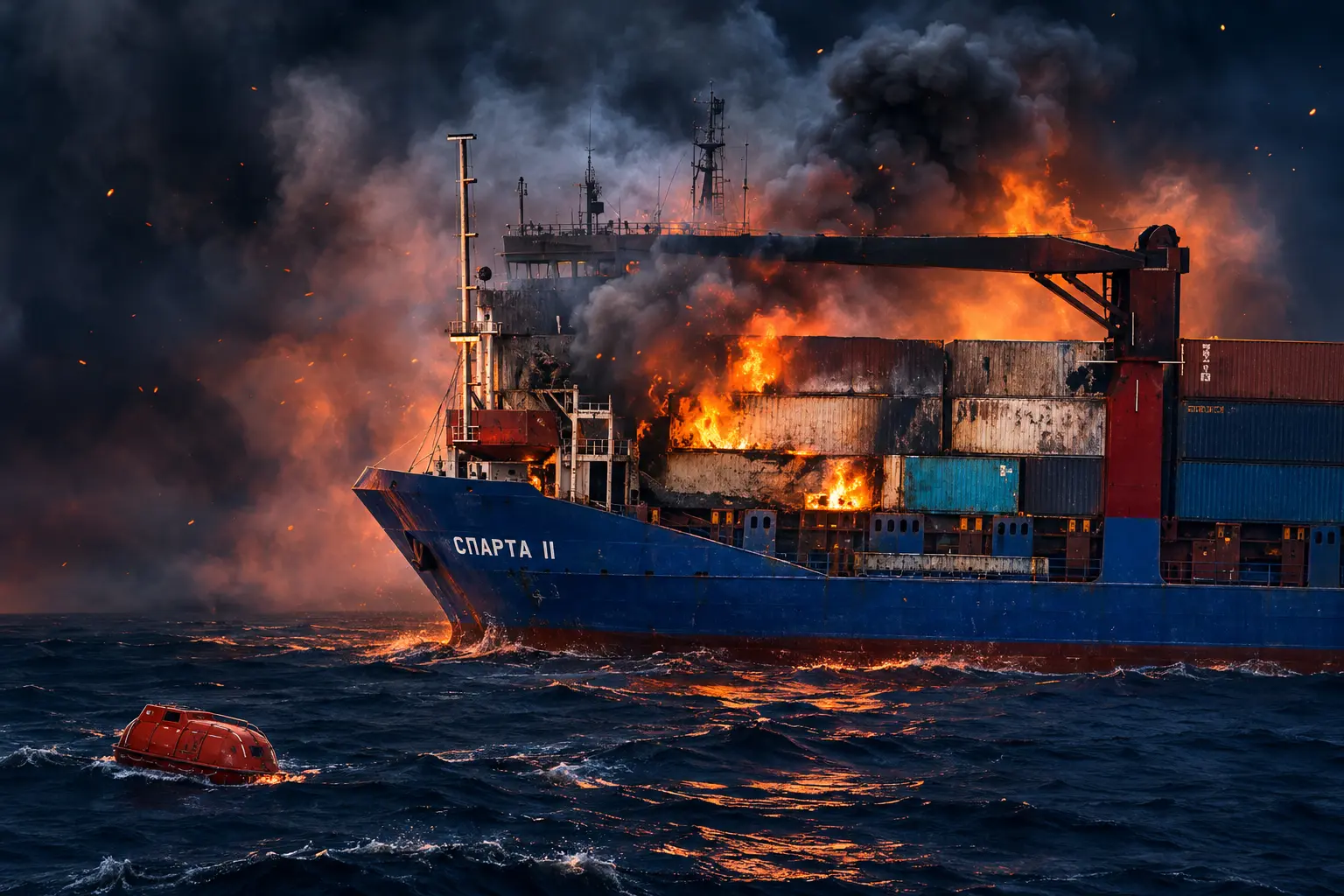
Two drones set the sanctioned Russian cargo ship Sparta II on fire in the Gulf of Finland on November 21. The 16-person crew left in lifeboats, and the hull drifted north into Finnish territorial waters off Loviisa.
Finnish officers said Ukraine was likely behind the attack. Kyiv had not claimed it. Helsinki is now running the firefight, the restricted zone, and the plan to tow a Defense Ministry logistics ship back toward Russia.
A Sanctioned Ro-Ro on the Kaliningrad Line
Sparta II is a 121.66-metre roll-on, roll-off cargo ship, IMO 9160994, flying the Russian flag and owned by Oboronlogistika, a shipping company built to move goods for the Russian Ministry of Defense. Ukrainian military intelligence files the ship as military cargo transport and records that it S-300 air-defense systems from Syria to Novorossiysk in August 2022, after a ship-spotter had already photographed military equipment on board in the Bosporus in April 2022.
The same file says the ship later helped lift gear from the Russian naval base at Tartus after the Assad government fell, leaving Baltiysk on December 13, 2024, and showing up in the Tunisian exclusive economic zone on January 6, 2025, on a run scheduled into Tartus on January 8. Since November 2022 it has also worked the Ust-Luga, Baltiysk, and Kaliningrad container line, the sea bridge Russia uses to supply its Baltic exclave without land transit through the European Union.
Oboronlogistika said in early October 2026 that Sparta II had returned to the Kaliningrad container line after scheduled repairs and had already completed a first round trip between St. Petersburg and Kaliningrad. The company lists a beam of 18.7 metres, a speed of 11 knots, a stern ramp, and ship cranes rated at 60 tons each. The United States listed the ship in May 2022 under Executive Order 14024, and Ukraine listed it on May 23, 2026. The GUR file also flags past AIS shutdowns.
None of that proves what sat in the holds on this sailing. Finnish officers said they could not confirm military cargo. A single unnamed Russian account described paints and coatings. The ship’s record is why the fire is not a random merchant accident, and why Helsinki is handling a Defense Ministry logistics hull rather than a tramp freighter.
THE SPARTA II FILE
| Item | Record |
|---|---|
| Type and IMO | Ro-Ro cargo ship, IMO 9160994 |
| Size | 121.66 m long, 7,260 gross tons, 8,194 tons deadweight |
| Owner | Oboronlogistika, Russian Defense Ministry logistics |
| U.S. listing | May 8, 2022, Executive Order 14024 |
| Ukrainian listing | May 23, 2026 |
| Known military runs | S-300 from Syria, August 2022; Tartus lift, winter 2024-2025 |
| Kaliningrad line | From October 2022; back after repairs, October 2026 |
Kaliningrad Governor Alexey Besprozvannykh said the incident did not threaten supplies to the exclave. The political problem is not a single missed cargo. It is that a sanctioned military logistics ship was moving the St. Petersburg-Kaliningrad run in a gulf so narrow that a hit immediately becomes a Finnish, Estonian, and Russian event.
Where Was Sparta II When the Drones Hit?
Finnish authorities were alerted at about 08:50 local time, 06:50 GMT, on November 21. Estonian rescuers received word of a fire and explosions at 09:35. From there the maps diverge, because the eastern Gulf of Finland is a stack of territorial seas, exclusive economic zones, rescue regions, and shipping lanes drawn by special boundary deals among neighbors who sit close together.
FOUR MAPS OF ONE STRIKE
| Who spoke | Where they placed the hit |
|---|---|
| Leningrad Oblast Governor Alexander Drozdenko | International waters, about 3 nautical miles (about 5.5 km) from Russia’s line, on a St. Petersburg to Kaliningrad run |
| Finnish Defense Forces | International waters west of Gogland Island, known in Finnish as Suursaari, about 40 km from Finland’s coast |
| Estonian Police and Border Guard Board | Estonia’s exclusive economic zone, 11 nautical miles north of Vaindloo Island, inside the St. Petersburg rescue region and in lanes open to international ships |
| Finnish Border Guard commander Ilja Iljin | Russian territorial waters, after which the ship lost steering and drifted into Finnish waters |
Those statements can all be true in their own paperwork and still collide. Territorial sea, which runs up to 12 nautical miles, about 22 km, from a coast, is a sovereignty belt. An exclusive economic zone is not. Ships may pass there, and the coastal state does not hold full control. Estonian duty officer Andres Tiik said explosions set the ship’s bridge on fire before the hull drifted north. Finnish Defense Forces spokesperson Aki-Mauri Huhtinen said Ukraine was likely responsible and that it was not clear why the ship had been targeted. Border Guard officer Petteri Blomvall later said a Ukrainian drone strike in the morning caused the fire.
Kyiv stayed silent on authorship. That silence does not freeze the legal mess. It leaves NATO’s northeastern shore arguing over a burning hull whose last AIS story was a routine Kaliningrad run, and whose owner is the ministry fighting the war.
Helsinki Now Owns the Fire and the Tow
Once the ship crossed into Finnish waters, the rescue title moved with it. The Finnish Border Guard took charge off Loviisa, put a restricted zone around the hull, and told neighboring states. Finland also told NATO. Temporary air and sea limits went up in the eastern gulf. A Russian helicopter was suspected of coming 4.1 km into Finnish airspace near Loviisa at 12:34, an incident the Border Guard said it was still investigating and that Defense Minister Antti Häkkänen said may have been tied to rescue or monitoring.
Prime Minister Petteri Orpo did not treat the fire as a distant news item.
War is spilling over into our immediate vicinity. Finnish authorities are handling the situation in the Gulf of Finland, where a drone strike has hit a Russian merchant ship. Ukraine has the right to fight back against the aggressor.
Petteri Orpo, Prime Minister of Finland, on X
Estonian Prime Minister Kristen Michal wrote that the consequences of fighting Russia’s aggression had reached the Baltic Sea, called it another signal for the aggressor to stop, and said nothing would stop Estonia from supporting Ukraine. Estonia sent the navy ship Kindral Kurvits. At Finland’s request, the Russian rescue ship Murman joined as well.
THE NOVEMBER 21 CLOCK
- November 21, 08:50 Finnish time: Finnish coast guard is alerted to a drone attack west of Gogland; two drones are the Russian governors’ count.
- November 21, 09:35: Estonia’s rescue center receives fire and explosion reports on Sparta II.
- Midday November 21: The hull is in Finnish waters off Loviisa, about 12 miles from the coast; air and sea limits go up; NATO is informed.
- November 21, 12:34: A Russian helicopter is suspected of flying 4.1 km into Finnish airspace near Loviisa.
- Evening November 21: The 16-person crew has left in lifeboats and moved to a nearby cargo ship bound for Russia; the fire is still burning; Helsinki’s plan is to tow the hull into the Russian area of responsibility.
- Morning November 22: Firefighting and cooling of containers have run through the night; the ship remains at anchor off Loviisa.
The Border Guard said the fire could last for days and that it was ready for pollution response with local rescue departments. No spill had been reported. That is luck in a gulf whose brackish water exchanges slowly with the North Sea. A heavy oil release here would not flush out on the next tide.
SHIPS ON THE FIRE LINE
- Finnish Border Guard: Patrol vessel Uisko, patrol boats, a surveillance aircraft, and helicopters on scene.
- Civilian tugs: Alfåns Håkans rescue tugs Ajax and H.Kanter on firefighting and cooling.
- Estonian Navy: Kindral Kurvits on firefighting and cooling.
- Russian rescue: Murman, called in by Finland, also on the job.
The plan, in the Border Guard’s own words, is towing the disabled vessel toward Russia to get a dead ship out of Finnish waters and to protect the marine environment. That choice is the second punch of the day. Sparta II still carries a U.S. Specially Designated Nationals listing from May 8, 2022, as property linked to Oboronlogistika. Helsinki is not seizing the hull. It is preparing to hand a sanctioned Defense Ministry logistics ship back to Russian tugs, because a burning Ro-Ro off Loviisa is a Finnish coast guard problem before it is a sanctions case.
That is the cost Ukraine exported with the strike. Finland can back Kyiv in a post and still spend the next nights pumping water onto a Russian military logistics ship, watching a helicopter track, and coordinating with Murman, while the fire decides whether the next headache is smoke or a spill.
Fifteen River Towns, and a Map That Includes Kyiv
While the gulf burned, President Volodymyr Zelensky named 15 occupied settlements where Ukraine wants another short, local pause to get civilians out, on the model of Oleshky. He said the updated list had gone to Ukraine’s ombudsman and to U.S. officials, and that he had gone over numbers and plans with Commander-in-Chief Mykhailo Drapaty. He thanked U.S. First Lady Melania Trump for the Oleshky operation, which ran from October 27 to November 1, 2026. On November 14 he had said Moscow rejected an earlier list. By November 22 there was still no public Kremlin answer to the new one.
THE 15 RIVER SETTLEMENTS
- Kherson Oblast (9): Radensk, Kostohryzove, Hola Prystan, Stara Zburyivka, Nova Zburyivka, Hladkivka, Velyki Kopani, Kardashynka, and Velyka Kardashynka.
- Zaporizhia Oblast (6): Mayachka, Zlatopil, Dniprorudne, Kamyanske, Verkhnia Krynytsia, and Vasylivka.
Zelensky said a pause like Oleshky would be extremely hard to copy onto Kostiantynivka in Donetsk Oblast, where the line is not a river wall and Russian forces do not hold the city. The Kremlin had floated a ceasefire there anyway. The 15 names are a narrower bet: towns on or just south of the Dnipro and the Kakhovka Reservoir, where the water already stops ground armies from walking into each other.
Sergei Lavrov, Russia’s foreign minister, used the same news cycle to draw a much larger map. In the documentary “Our Baptism: The Primate,” released on November 20, he treated Kyiv as Russian land and tied the war to a fight against what he called primitive Russophobia in the territory now called Ukraine.
The South-East part of Ukraine and a large part of the center of Ukraine, including Kyiv, are undoubtedly lands that have always belonged to Russia. The people living there were baptized in the same font as us; that is where we all came from.
Sergei Lavrov, Russian foreign minister, in the documentary “Our Baptism: The Primate”
Ukrainian Foreign Minister Andrii Sybiha answered by pointing at Kuban, Starodubshchyna, and the northern and eastern Slobozhanshchyna lands inside today’s Krasnodar Krai and Belgorod, Bryansk, Voronezh, Kursk, and Rostov oblasts, where people spoke Ukrainian and called themselves Ukrainian for centuries. Lavrov’s line is older than this week, and it still sits on top of any local pause. A government that calls Kyiv historically Russian is not, in its own words, bargaining over a few left-bank villages.
Why a Ceasefire Works Only on the Dnipro
The 15 towns are possible pause sites because of water, not goodwill. They sit on the river bank, on the reservoir, or a few kilometres south of it in the Russian near rear. A local halt would mean both sides stop drones and artillery across the water. It would not require pulling back tanks from a street fight, because the Dnipro and the reservoir already do that work.
That is why Oleshky could be done and Kostiantynivka cannot be treated as the same kind of problem. A freeze in Donbas would have to hold on ground where Russian forces are still trying to bend the fortress belt and where infiltration groups keep appearing inside towns neither army fully owns. The geography does not give either staff a clean line they can police for a week without the line itself moving.
So the same day produced two Ukrainian theories of limited war. One is a river corridor to get civilians out of occupied towns the water has already isolated. The other is a long-range drone shot at a sanctioned logistics ship on the St. Petersburg-Kaliningrad run, accepted by Finland as likely Ukrainian, and left unclaimed in public by Kyiv. Moscow’s answer to the first theory, so far, is silence. Its answer to the second is a burning hull that Finnish and Estonian ships are still cooling.
Russian Assaults Kept Moving While the Ship Burned
The land war did not take November 21 off. Geolocated combat footage showed Russian forces farther west of Kamyanka, northeast of Kupyansk, in weather that slows Ukrainian drones and cuts how many reconnaissance aircraft sit in the air at once. A Ukrainian military source said Russian units used that weather to push. A Ukrainian brigade soldier in the Dobropillya direction said Russian forces had taken Bilytske and were using it, with Pokrovsk and Rodynske, as a staging base. Other geolocated clips showed Russian movement northeast of Lyman. Those are local gains, not a broken front, and they still ate the same day as the gulf fire.
THE NOVEMBER 20-21 AIR PACKAGE
- Launch count: Russia fired 3 ballistic missiles and 148 drones, including 87 jet-powered drones, overnight on November 20 to 21.
- Kryvyi Rih: Zelensky said a strike on a civilian area killed 2 people, including a child, and injured 58, including 6 children; the Russian Defense Ministry claimed a hit on the Kryvyi Rih thermal power plant.
- Filin: A Ukrainian border unit said it intercepted a new small Filin cruise missile over Chernihiv Oblast, a low-flying type Ukraine’s military intelligence has said Russia began using in late summer 2026.
- Kerch Strait: Defense Minister Yevheniy Khmara said wreckage from the automobile span is blocking passage and that repairs could take several months to a year; Deputy Prime Minister Andrei Nikitin said rail traffic was running again; Zelensky said Russia had struck Ukrainian bridges 109 times before the Kerch hit.
The Filin shot and the Kerch wreckage belong to the same logistics fight as Sparta II. Ukraine is trying to raise the price of Russian movement at sea, on bridges, and in the air-defense belt. Russia is trying to keep throwing cheap cruise missiles and jet drones faster than Ukraine can shoot them. Finland is not a party to that exchange, and it still had to put Uisko, two tugs, an Estonian navy ship, and a Russian rescue ship around a hull that would not have been in Loviisa’s problem set if the Kaliningrad line were as safe as Moscow needed it to be.
By the morning of November 22 the fire was still being fought and the ship was still anchored off Loviisa. Russian tugs were expected to haul it toward the Russian area of responsibility when they could get there. Kyiv had not claimed the strike. Moscow had not answered the 15-town list. The part of the war you could see from the Finnish shore was a sanctioned Ro-Ro that would not stop burning on its own.

India’s First-Timers and Pant Build a Record 720

Kutch Crash Kills Seven From Army Families After October Toll

Ukrainian Drones Leave Finland Fighting a Russian Ship Fire

ICJ Genocide Order Runs Through Arakan Army Land

CII Asks Patel Panel to Shift Who Funds Indian Credit

Clancy Juror Says the Holdout Never Cited Evidence

The iPhone 18 Pro Max Splits Apple’s Fall in Two

OpenAI Calls GPT-6 Astra AGI Then Locks Its Exploits

Trump Claims Hormuz Control as Oil Holds Near $96

Russia Closes the Goethe-Institut Berlin Tried to Save

 NEWS2 months ago
Clancy Juror Says the Holdout Never Cited Evidence
- NEWS3 months ago
The iPhone 18 Pro Max Splits Apple’s Fall in Two
- NEWS3 months ago
OpenAI Calls GPT-6 Astra AGI Then Locks Its Exploits
- BUSINESS3 months ago
Trump Claims Hormuz Control as Oil Holds Near $96
- LIFESTYLE3 months ago
Russia Closes the Goethe-Institut Berlin Tried to Save
- AUTO3 months ago
Volkswagen’s Job Cuts Leave Four Plants Without Cars
- NEWS3 months ago
Dyson Puts Nurovi Robots on Sale Without the UV Flagship
- BUSINESS3 months ago
US Destroys Five Iranian Tankers as the Shock Hits Jordan