BUSINESS
China Used Operation Sindoor to Pin India, Panel Finds
A US commission finds China’s Operation Sindoor backing pinned India without a fight and now threatens US factory hedges.

A US congressional commission found that China’s help to Pakistan during Operation Sindoor let Beijing pin Indian forces without joining the fight. The 2026 Annual Report to Congress, released on November 18, 2026, gives India its own chapter on India and US strategy, built from a February 2026 hearing, a trip to India, and talks with officials and firms.
The second cost sits in the same chapter. If Indian troops, ships and factories are already spoken for, Washington cannot treat New Delhi as a spare workshop or a spare navy against China.
The Commission Says China Can Arm Pakistan Without Joining the Fight
The US-China Economic and Security Review Commission, created by Congress in 2000, told lawmakers that India is one of the few powers outside the US alliance system with the scale to change the long contest with China. Beijing, it wrote, is working to suppress that rise across military, maritime and economic lines.
India is one of the few powers outside the U.S. alliance system with the scale to materially affect the long-term competition with China. China understands this, and it is actively working to suppress India’s rise across multiple domains.
US-China Economic and Security Review Commission, 2026 Annual Report to Congress
China supplied 81 percent of Pakistan’s arms imports in 2020-2024, the commission said, citing Stockholm International Peace Research Institute figures. SIPRI’s own 81 percent of Pakistan’s arms imports series shows that share up from 74 percent in 2015-2019, while Pakistan’s total arms imports rose 61 percent and made it the world’s fifth largest buyer, at 4.6 percent of global transfers.
That inventory showed up in May 2025. After India launched Operation Sindoor, Pakistan used advanced Chinese-procured weapons, the commission said, while a survey ship with advanced sensors worked the waters of India’s exclusive economic zone. Indian officers later said Pakistan may have received real-time satellite imagery or other intelligence from Beijing. China’s foreign ministry neither confirmed nor denied that claim. Ambassador Xu Feihong called China-Pakistan defense ties “normal cooperation” not aimed at any third party.
A year later the argument was harder to wave away. In May 2026, China’s state broadcaster CCTV put Zhang Heng, an engineer at AVIC’s Chengdu Aircraft Design and Research Institute, on air. He said he and other AVIC staff gave onsite technical support in Pakistan during the fighting, work meant to make the equipment “truly perform at its full combat potential.”
At the support base, we frequently heard the roar of fighter jets taking off and the constant wail of air-raid sirens. By late morning, in May, the temperature was already approaching 50 degrees Celsius. It was a real ordeal for us, both mentally and physically.
Zhang Heng, engineer, Aviation Industry Corporation of China, on CCTV
Lt Gen Rahul R Singh, then deputy chief of army staff, had already told an Indian seminar that the country faced “one border and two adversaries, actually three,” with Pakistan in front and China “providing all possible support.” In Pune on November 22, 2026, defence expert Hemant Mahajan called the US paper “not a very big revelation” and asked what Washington would do with it. Indian planners had treated Chinese help as a given. The new fact is that a US body has now written that help into a report aimed at American lawmakers.
🚨The U.S.-China Economic and Security Review Commission’s 2026 Annual Report to Congress is out today!
The bipartisan Commission offers 30 recommendations for congressional action and draws on the Commission’s hearings, research, and fact-finding trips.https://t.co/y6qPYLmnVQ
— U.S.-China Commission (@USCC_GOV) November 18, 2026
Sameer Lalwani, a China-India military expert at the Special Competitive Studies Project and the German Marshall Fund, told the commission’s February 17, 2026 hearing that the most sophisticated cyber attacks on Indian critical infrastructure, including coordinated large-scale DDoS attacks, were traced back to Chinese soil. The commission said it cannot itself attribute those hacks. It did record Chinese-linked online actors pushing a campaign to knock India’s French-made Rafale jets and to sell the J-10.
WHAT WE KNOW
- Onsite technicians: Zhang Heng said AVIC staff were at a Pakistani support base during the May 2025 fighting.
- The arms pipeline: China supplied 81 percent of Pakistan’s major arms imports in 2020-2024, per SIPRI as cited by the commission.
- Ships in the fight window: A Chinese survey vessel worked near India’s exclusive economic zone, and another entered the Bay of Bengal as the crisis ran.
WHAT IS UNCONFIRMED
- Live satellite feed: Indian officers said Pakistan may have received real-time imagery from Beijing; China has not confirmed it.
- Who ran the DDoS: The commission recorded the attacks and Lalwani’s China-soil tracing, and stopped short of its own attribution.
Pakistan’s then army chief, Gen Asim Munir, called claims of Chinese wartime support “factually incorrect.” Zhang’s later interview left the technician piece on the record even so.
What Operation Sindoor Showed About a Fight Beijing Stayed Out Of
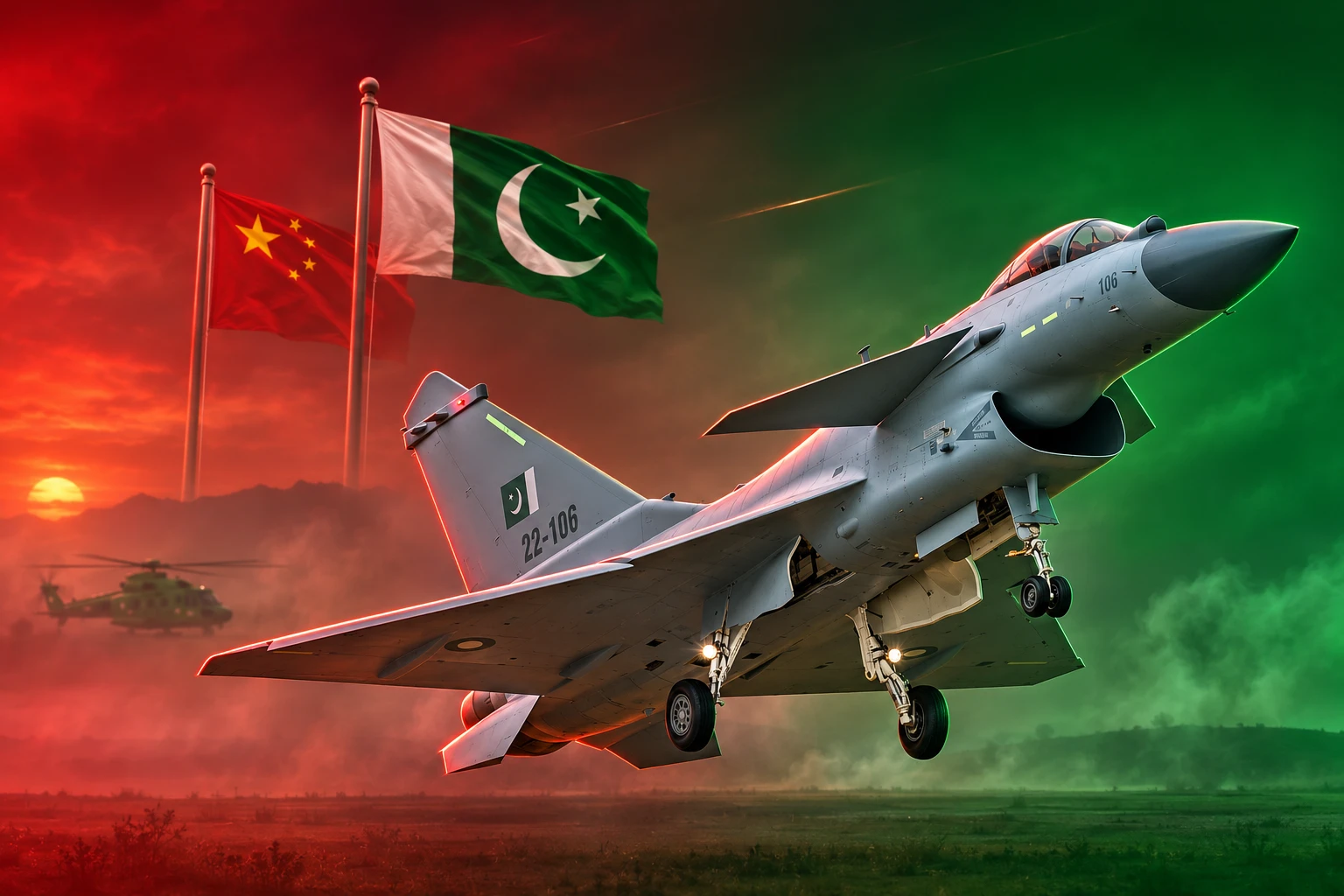
The fighting was short, nuclear-shadowed, and crowded with firsts. Christopher Clary, in a Stimson Center assessment of the four-day conflict, wrote that it was the first such clash involving a Pakistani force armed with modern Chinese weapons, including the HQ-9 air defense system, the PL-15 missile and the J-10 fighter.
THE MAY 2025 SEQUENCE
- April 22, 2025: Gunmen kill 26 people, most of them tourists, at Pahalgam in Indian-administered Jammu and Kashmir. New Delhi blames Pakistan-backed militants.
- May 7, 2025: India launches Operation Sindoor against nine sites in Pakistan and Pakistan-administered Kashmir, 15 days after the attack.
- May 7 to 10, 2025: Four days of strikes, drones and missiles. A Chinese survey ship is reported in the Bay of Bengal. Hackers hit Indian government networks, telecoms and digital services.
- May 10, 2025: The two sides stop the shooting after talks in which the United States played a large crisis-management role, Clary found.
- February 17, 2026: The commission hears testimony on India, China and the Indo-Pacific balance.
- May 2026: CCTV airs Zhang Heng describing onsite support at a Pakistani base.
- November 18, 2026: The annual report goes to Congress with 30 recommendations.
Clary found that India showed it could hit across large parts of Pakistan, especially on May 7 and May 10, and that Pakistan’s air defenses still posed a real threat. He also found that India likely lost several aircraft on the first day, a cost New Delhi would neither confirm nor deny, while saying no pilots were lost. Those battlefield details are still argued. The commission’s point is narrower. China did not have to fly its own jets to change Indian planning.
The policy is old. Beijing, the report notes, has used Pakistan to balance India since the 1962 Sino-Indian War, formalized a border with Pakistan in 1963, and backed Islamabad in the 1965 war. The May 2025 crisis put engineers, ships and a Chinese-built air force into that old pattern at once.
Chinese Survey Ships Sat Off India’s Coast
The land border remains the central fault line. India and China share a two-front map that begins with a 2,100-mile contested line, and the 2020 Galwan Valley clashes made New Delhi less willing to treat that dispute as a side issue. The commission said China is expanding dual-use infrastructure, airfields, railways and logistics across the Tibetan Plateau, which forces India to pull money and people away from ships and factories just to hold the line. Beijing still claims most of Arunachal Pradesh as “South Tibet,” publishes Mandarin names inside the state, and refuses to treat its residents as Indian citizens.
Ties have thawed in public since late 2024. Xi Jinping visited India in September 2026, his first trip there in seven years. The commission still found strategic distrust high, and a November 10, 2026 commission bulletin recorded PLA camps roughly four miles inside India’s claimed line in Arunachal Pradesh, with face-offs that the Indo-Tibetan Border Police later confirmed.
At sea the squeeze is newer. Since 2019, Chinese navy ships, survey vessels and research boats have worked closer to India’s coast and to the lanes that carry much of China’s energy and trade. In May 2025, as India-Pakistan tensions rose, a Chinese survey vessel entered the Bay of Bengal, raising the fear that Beijing could watch Indian forces and pass maritime intelligence to Pakistan in a crisis. Ports and logistics from Djibouti to Gwadar, Hambantota and Chittagong give that presence somewhere to plug in.
China is also borrowing from its South China Sea script, citing historic voyages and trying to rename undersea features in Mandarin. A former Indian navy chief told the commission those moves may be the same playbook in a new ocean. A more constant Chinese navy in the Indian Ocean would put extra load on US forces in a wider crisis, the report said, which is why India’s maritime capacity now matters in Washington as well as in New Delhi.
Around the rim, the commission flagged Bangladesh’s tighter security work with Beijing and Islamabad, including a plan to buy Chinese J-10CE fighters, and a trilateral economic mechanism launched in June 2025. Burma, Nepal and Bhutan sit in the same picture as hedges that chip at India’s old claim to be the region’s default lead.
Beijing’s Sharpest Tool Is the Factory Floor
The commission called economic pressure China’s sharpest instrument. India had the world’s sixth largest economy by nominal GDP in 2025 and was the sixth largest producer of manufacturing value-added in 2024. China’s manufacturing base, the report said, now exceeds that of the United States, Japan and Germany combined, and India is one of the few countries with the scale to narrow that gap. That is why Beijing works to keep Indian plants on Chinese machines, parts and know-how.
The goods gap makes the leverage visible. China is India’s largest trade partner, and the imbalance accounted for over 41 percent of India’s total trade deficit. In 2025, imports from China exceeded exports by more than five times, pushing the bilateral deficit to $106.8 billion, more than double its 2020 level, when India rolled out a wave of curbs after Galwan. Those imports rose 12.7 percent in 2025 and another 21.6 percent year over year in the first half of 2026. China is 16 percent of India’s total imports and 30.8 percent of industrial imports. India’s $18 billion of goods sales to China in 2025 were 0.8 percent of China’s imports, mostly raw materials.
CHINA’S ECONOMIC PRESSURE ON INDIA
| Tool | When | Effect |
|---|---|---|
| Specialized fertilizers and tunnel boring machines | After 2020, lifted August 2025 | Delayed kit for the Mumbai-Ahmedabad bullet train, then eased before Prime Minister Narendra Modi’s Beijing trip |
| Rare earth permanent magnets | April 2025 licensing, lifted August 2025 | Indian-bound cargo sat in Chinese ports while shipments to German and US carmakers cleared |
| Engineers and gear for Foxconn | January 2025 | Hundreds of Chinese engineers were pulled from Indian iPhone plants |
| Active pharmaceutical ingredients | 2025 | Prices on 41 APIs and key starting materials were cut 40 to 50 percent to undercut new Indian plants |
| Re-export certificates | 2025, later suspended in a Trump-Xi trade détente | Some Indian firms had to certify that Chinese inputs would not be sent on to the United States |
| Battery technology controls | October 9, 2025, delayed to November 10, 2026 | Held up tech for India’s clean-energy plants, including a Reliance gigafactory in Gujarat |
The re-export certificates are the piece that points at America. If Indian factories are the way US firms get off Chinese inputs, a Chinese rule that those inputs cannot travel on to the United States turns India’s dependence into a weapon aimed at US supply chains. The commission said Beijing suspended the demand during a broader Trump-Xi trade détente, and that the lever can be picked up again.
Medicine is the cleanest example of price as a weapon. In 2025 China slashed prices on 41 APIs and key starting materials by 40 to 50 percent, timed, Indian media told the commission, to undercut new Indian plants that had opened in November 2024 under the Production Linked Incentive program. China also opened WTO cases against those PLI schemes in October 2025 (batteries and vehicles) and December 2025 (solar and ICT), the first time Beijing used that forum against India.
New Delhi has not sat still. It has limited Chinese investment in sensitive sectors, subsidized local manufacturing, and still eased some rules in March 2026, allowing non-controlling Chinese stakes of up to 10 percent, because the cost of staying off Chinese kit kept rising. The commission’s phrase for the result is managed interdependence under strategic competition, a line drawn from Observer Research Foundation fellow Soumya Bhowmick’s testimony. Indian industry grew. So did the Chinese content inside it.
Cyber sits beside the factories. Cyfirma’s head told the commission that Chinese-linked actors accounted for 79 percent of cyberattacks on India as of 2023, a shift from the Pakistan-heavy mix of 2015-2016. After Galwan, Chinese-linked hackers had already gone after power-grid dispatch centers and two Indian seaports. The May 2025 DDoS wave fit that pattern even if the commission would not name a culprit of record.
Congress Is Asked to Buy Indian Drugs and Watch Chinese Subs
The report’s India chapter does not stop at diagnosis. Among 30 recommendations to Congress, three are aimed at this front.
WHAT THE COMMISSION WANTS FROM CONGRESS
- Trusted medicine demand: Set up a Comprehensive Critical Drug Diversification program with India, so US buyers keep purchasing non-Chinese APIs even when Chinese product is cheaper.
- Indian Ocean watch: Direct the defense secretary and the Joint Chiefs to move past exercises with India toward shared intelligence, shared tracking of Chinese navy and submarine traffic, and joint procedures for maritime threats.
- A leadership bench: Create an Indo-American Strategic Leadership Exchange Program for rising officers, officials, business people and academics.
India, for its part, has already shifted planning toward China, poured money into border roads, and launched Mission Sudarshan Chakra, a layered air and missile shield due by 2035. It is putting more weight on the navy, on unmanned systems, and on the Andaman and Nicobar Command, which sits in the Bay of Bengal near the Malacca Strait. Those are the same waters Chinese survey ships now treat as routine.
The partnership on paper is already large: a ten-year defense framework, a trade deal still in talks, work on semiconductors and biomanufacturing, and a revived Quad. The commission’s complaint is that export-control rules, procurement law and financing tools built for another era cannot carry that load. Ambition has outrun the plumbing.
India Will Not Join an American Camp
The report is blunt about the limit. India’s fight with China comes from its own border, its own neighbourhood and its own wish not to live in a unipolar Asia. Strategic autonomy, the modern form of non-alignment, means New Delhi will work with Washington, sit in the Quad, and still keep rooms in BRICS and the Shanghai Cooperation Organization. Closer cooperation, the commission warned, will not automatically mean alignment with broader US aims.
That is the second-order bind the Sindoor chapter is really about. China can strengthen Pakistan in a crisis, park survey ships in the Bay of Bengal, and cut the price of medicine ingredients, all without firing a PLA shot. India then spends people and rupees on a two-front problem and on Chinese machines it cannot yet replace. The United States, looking for a factory base and a maritime partner that is not China, finds the spare capacity already spoken for.
New Delhi is still buying some of that Chinese capacity on purpose, because growth will not wait. Washington is being told to buy Indian drugs on purpose, because cheap Chinese APIs will not wait either. The May 2025 fighting lasted four days. The planning problem it demonstrated does not reset when the sirens stop.
Frequently Asked Questions
What is the US-China Economic and Security Review Commission?
It is a bipartisan commission created by Congress in 2000 to watch the national security and economic effects of US-China trade and defense ties and to send Congress an annual report. The 2026 edition carried 30 recommendations and a dedicated India chapter drawn from a February 2026 hearing, a fact-finding trip, and open-source research, and the commission posted the full report on November 18, 2026.
How has China’s share of Pakistan’s arms imports changed?
SIPRI found China supplied 81 percent of Pakistan’s major arms imports in 2020-2024, up from 74 percent in 2015-2019, while Pakistan’s overall arms imports rose 61 percent and its global share reached 4.6 percent, enough to rank fifth among importers. China has been Pakistan’s top supplier in every five-year window since 1990-1994.
What military firsts defined the May 2025 India-Pakistan fighting?
Christopher Clary’s Stimson Center paper found it was the first time India used cruise missiles on Pakistan (BrahMos and the European SCALP-EG), the first time Pakistan used conventionally armed short-range ballistic missiles (Fatah-I and Fatah-II) on India, and the first India-Pakistan clash in which both sides flew drones with the intent to cause damage. It was also the first such crisis in which Pakistan fielded modern Chinese systems such as the HQ-9, the PL-15 and the J-10 in combat.
What would the proposed US-India medicine program actually do?
The commission wants a C2D2 early-warning list of essential medicines, their APIs and key starting materials, and the plants that make them, plus a Federal Trusted Demand Program at the Department of Health and Human Services with multiyear purchase commitments. Funding for Indian API plants would require proof of shrinking reliance on Chinese starting materials and, where possible, matching money from India so Chinese price cuts cannot wipe the new lines out.

India’s First-Timers and Pant Build a Record 720

Kutch Crash Kills Seven From Army Families After October Toll

Ukrainian Drones Leave Finland Fighting a Russian Ship Fire

ICJ Genocide Order Runs Through Arakan Army Land

CII Asks Patel Panel to Shift Who Funds Indian Credit

Clancy Juror Says the Holdout Never Cited Evidence

The iPhone 18 Pro Max Splits Apple’s Fall in Two

OpenAI Calls GPT-6 Astra AGI Then Locks Its Exploits

Trump Claims Hormuz Control as Oil Holds Near $96

Russia Closes the Goethe-Institut Berlin Tried to Save

 NEWS2 months ago
Clancy Juror Says the Holdout Never Cited Evidence
- NEWS3 months ago
The iPhone 18 Pro Max Splits Apple’s Fall in Two
- NEWS3 months ago
OpenAI Calls GPT-6 Astra AGI Then Locks Its Exploits
- BUSINESS3 months ago
Trump Claims Hormuz Control as Oil Holds Near $96
- LIFESTYLE3 months ago
Russia Closes the Goethe-Institut Berlin Tried to Save
- AUTO3 months ago
Volkswagen’s Job Cuts Leave Four Plants Without Cars
- NEWS3 months ago
Dyson Puts Nurovi Robots on Sale Without the UV Flagship
- BUSINESS3 months ago
US Destroys Five Iranian Tankers as the Shock Hits Jordan