NEWS
Surya Kant Wants Clinic Hours in Every Law Degree
CJI Surya Kant wants legal aid hours in every law degree, reviving a 2008 clinic duty a Supreme Court survey found mostly idle.

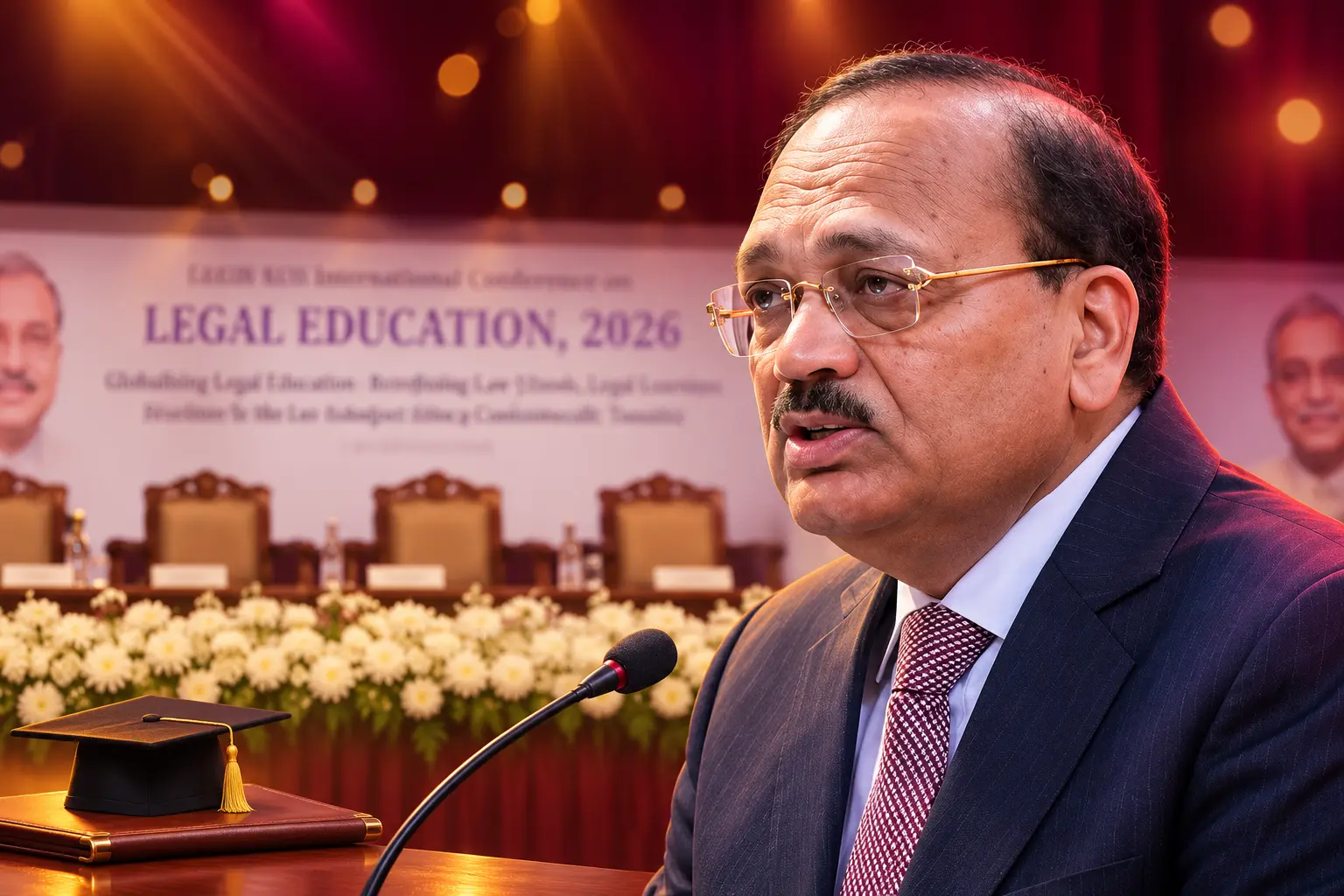
Chief Justice of India Surya Kant on Saturday proposed that every law student complete a minimum period of legal aid work to graduate. He was opening the Commonwealth Legal Education Association’s first annual conference on legal education in Hyderabad, and he offered extra academic credits to students who serve beyond that floor.
Indian law schools have been told for years to keep a legal aid clinic on campus. A Supreme Court research survey has already found that most of those cells never helped a lawyer on a real case.
Graduation Gate Built on Clinic Hours
Surya Kant, speaking on 21 November 2026, said legal education has to leave the classroom and reach people who cannot assert the rights they already have. He pointed to a labourer whose wages go unpaid, a widow whose pension stops on a document error, and a woman facing violence at home. For them, he said, the first block is often not a missing remedy. It is the missing person who can explain the remedy and help them use it.
I would further suggest that a minimum period of legal aid work be made compulsory for every student to graduate, with additional credits for those who go beyond it.
Surya Kant, Chief Justice of India, CLEA conference, Hyderabad
He asked law schools to issue certificates for clinic work done in semester breaks, and to treat clinics as places where students, panel advocates and legal services officers sit together on live files. Recurring problems at a clinic, he said, should shape the training offered to young lawyers, because the duty to learn does not end at enrolment.
Practical work, in his account, should also enter core subjects rather than sit in a separate clinical paper. A contract student could be asked to draft and negotiate an agreement. A constitutional law student could trace a denied benefit to the remedy on the books. A family law student could sit in a mediation. He said those exercises still rest on doctrine. They ask the student to apply it to a living file.
The 2008 Rule Already Demanded a Clinic
He did not present campus clinics as a new invention. He named N.R. Madhava Menon, the teacher he called a pioneer of clinical legal education in India, and recalled that Menon had taken students into clinics for the poor before the regulators made the model mandatory. Menon also served on the Expert Committee on Legal Aid in 1973, which treated law schools and their students as partners in taking justice to people who could not buy it.
The Legal Services Authorities Act, 1987 already gives the National Legal Services Authority the job of supervising legal services clinics in universities and law colleges. The Bar Council of India already requires every law school to maintain a legal aid clinic. Surya Kant had run part of that machinery himself. He was NALSA’s executive chairman from 14 May 2025 until he took office as the 53rd Chief Justice on 24 November 2025.
THE EXISTING CLINIC MANDATES
- 1973: The Expert Committee on Legal Aid, with Menon on it, treats law schools and students as partners in reaching the poor.
- 1987: The Legal Services Authorities Act sets up NALSA and, in later schemes, puts college clinics under its watch.
- 2008: The Bar Council of India’s Rules of Legal Education require each centre of legal education to keep a legal aid clinic.
- 2011: NALSA’s clinic regulations let final-year students give legal services under a faculty member, and let a district authority issue certificates.
- 2013: NALSA’s university clinic scheme repeats the Bar Council’s standard of a clinic run by students under senior faculty working with legal services authorities.
The 2011 rules for student legal services clinics already describe the hours he now wants to attach to a degree. Regulation 24 says final-year students may render legal services under a faculty member, and that a District Legal Services Authority may issue certificates for completed assignments. Students still cannot appear in court. That work stays with enrolled advocates under the Advocates Act.
Most Surveyed Cells Never Helped a Lawyer
The Centre for Research and Planning at the Supreme Court tested how those rules work on the ground. Its report, Legal Aid Through Law Schools, dated October 2024 and released at Rashtrapati Bhavan on 5 November 2024, used parliamentary figures of 1,662 law colleges, with legal services cells in 1,095 of them. Researchers sent a questionnaire to 125 colleges, about 11 percent of the colleges that had cells, and published findings on 83 of them.
WHAT THE 2024 SURVEY FOUND
| Finding | Share of 83 cells |
|---|---|
| Never assisted a lawyer in an actual case | 50 |
| Remotely assisted a lawyer in court | 33 |
| Student participation not compulsory | 59 |
| Actively involved in prison reform work | 10 |
| Contributed to public interest litigation | 17 |
| Engaged lawyers to assist and supervise | 37 |
The survey of 83 law-school legal aid cells is the record behind the room-and-calendar problem he described in Hyderabad. Fifty of 83 cells had never assisted any lawyer in an actual case. The other 33 had only remotely assisted a lawyer in court. In 59 of 83, student participation was not compulsory, which the authors read as a sign that the work sits outside the credited curriculum.
The same report already asked for the tool he offered on Saturday. It listed the grant of academic credit, and the enforcement of rules that already require student participation, among its main reforms. A graduation gate would be a harder version of that recommendation, aimed at every student rather than at the minority who join a cell by choice.
Jails and Villages Carry the Real Caseload
NALSA’s own clinic network shows where the live files sit. In a Rajya Sabha reply for 5 February 2026, the Ministry of Law and Justice listed legal services clinics and the people they helped in financial year 2025 to 2026, up to November 2025. Law college and university clinics are a thin slice of that list.
WHO LEGAL SERVICES CLINICS HELPED
| Clinic type | Clinics | People helped |
|---|---|---|
| Law colleges and universities | 872 | 18,654 |
| Jails | 1,145 | 366,292 |
| Villages | 5,479 | 345,604 |
| Courts | 1,109 | 128,347 |
| Community centres | 833 | 94,377 |
| All clinic categories | 13,588 | 1,219,722 |
The same official statement records 18,654 people helped by college clinics in that period, against 366,292 through jail clinics and 345,604 through village clinics. College clinics accounted for about 1.5 percent of the 1,219,722 people helped through the whole clinic network. The 872 college clinics on that NALSA list also sit below the 1,095 cells counted as established in the 2024 parliamentary figure used by the Supreme Court report, a gap between a cell on the books and a clinic that reports work through legal services authorities.
If every law student must log clinic hours to graduate, those hours have to land somewhere. They will not land in courtrooms in the student’s own name. They will land on the 872 college clinics, on district legal services offices, and on panel lawyers who already carry jail and village files. Without new supervisors, the degree gate adds unpaid student time to the smallest door in that network.
A Room and a Calendar Are Not Help
Surya Kant stated the failure mode in one sentence, before anyone could dress the proposal up as a finished reform.
A clinic may have a room, a coordinator, and a calendar of awareness camps, and still offer little real help.
Surya Kant, Chief Justice of India, CLEA conference, Hyderabad
He said the test is the help actually given, not the existence of a cell. Clinical teaching, he added, needs trained supervisors, a real assessment, and ethical safeguards, and clients should never bear the cost of weak supervision. That last point is the load-bearing one. A student who needs hours, faced with a person who cannot choose another lawyer, can turn a poor client into practice stock for a degree.
Jail legal aid already uses para-legal volunteers paid by district authorities, working beside panel advocates. Students would be a further unpaid layer in that chain, and they still cannot stand up in court. If the hours are counted by attendance at awareness camps, the 2024 survey’s idle cells simply fill with signatures. If the hours are counted by files, someone enrolled and paid has to sit with the student and the client at the same table.
AI Detectors Cannot Brand a Student a Cheat
The other half of the same speech was a warning about the research those students would file. He rejected a blanket ban on AI tools in legal education, saying the answer is responsible use, with rules on what is allowed and what must be disclosed. He asked CLEA to draft model guidelines on disclosure of AI help in legal research, for law schools and journals across the Commonwealth to adapt. He also said a fluent AI answer is not necessarily an accurate one, that fabricated authorities can look real, and that every citation has to be checked against its primary source, with the researcher still accountable for the work.
He cited a 2023 study in which seven widely used GPT detectors mislabelled essays by non-native English writers as machine-written. That paper, by Weixin Liang and colleagues at Stanford University in the journal Patterns, ran 91 TOEFL essays and 88 US eighth-grade essays through the tools and found an average false-positive rate of 61.3 percent on the TOEFL set. All seven detectors agreed on 19.8 percent of those human essays; at least one detector flagged 97.8 percent of them. He put the fairness problem in the register of a Commonwealth classroom, where many students write in English as a second or third language.
“In a Commonwealth, where so many students write in English as a second or third language, an honest student could thus be branded a cheat on the strength of a number that no one can explain, and that student cannot meaningfully challenge,” he said. “No student should therefore be held guilty of misconduct on the word of a machine alone.”
THE AI RULES HE ASKED CLEA TO WRITE
- Disclosure: Students should know which uses of AI are allowed and which must be declared, including material help in legal research.
- Primary sources: Every authority drawn from a tool has to be verified against the original case or statute before it is cited.
- Detectors: A software score cannot, by itself, support a finding of academic misconduct.
- Assessment: Written papers should be paired with oral explanation, a defence of authorities, and exercises that catch errors in machine-written answers.
- No ban: An outright prohibition, he said, is the wrong answer, because the profession already uses the tools and a ban would push that use out of sight.
Those rules sit beside the clinic proposal for a reason. The same cohort that would be sent into legal aid offices is the cohort writing with generators that invent case names. A compulsory clinic that accepts unverified research would export that problem from the seminar into a live file.
Hours Fail Without Teachers Who Can Sign Them
He left Hyderabad with a suggestion, not an amendment of the Bar Council’s Rules of Legal Education. No hour count was fixed. No certifying officer was named. The conference theme, “Globalising Legal Education: Reimagining Law Schools, Legal Learning and the Future of the Legal Profession for a Commonwealth in Transition,” gave him a Commonwealth audience for a problem that is already written into Indian rules.
WHAT WE KNOW
- The proposal: A minimum period of legal aid work would become a condition of graduation, with extra credits above that floor and certificates for semester-break service.
- The old duty: The Bar Council already requires a campus clinic, and NALSA already lets final-year students serve under faculty with district certificates.
- The survey: In the Supreme Court’s 2024 sample, 50 of 83 cells had never assisted a lawyer in an actual case, and 59 of 83 did not make student participation compulsory.
WHAT IS UNCONFIRMED
- The hours: No figure has been set for the minimum period, and no draft amendment of the 2008 Rules has been issued.
- The signer: It is not settled whether a faculty coordinator, a district secretary, or a panel advocate would certify the hours for the degree.
- The load: There is no plan yet for how 872 reporting college clinics, or the thinner set of cells that actually take files, would absorb a full student cohort.
Bar Council inspection notes already ask whether a legal aid clinic exists and functions. That check has not produced the supervisors the 2024 survey could not find. If the graduation gate is to be more than another calendar of camps, the Rules have to name the teacher or panel lawyer who sits on the file, and they have to credit that person for the time. Until then, the duty he described on Saturday is the same duty Menon ran in person, the same duty the 2008 Rules put on every college, and the same duty a Supreme Court survey found sitting in a room with a coordinator and no cases.

India’s First-Timers and Pant Build a Record 720

Kutch Crash Kills Seven From Army Families After October Toll

Ukrainian Drones Leave Finland Fighting a Russian Ship Fire

ICJ Genocide Order Runs Through Arakan Army Land

CII Asks Patel Panel to Shift Who Funds Indian Credit

Clancy Juror Says the Holdout Never Cited Evidence

The iPhone 18 Pro Max Splits Apple’s Fall in Two

OpenAI Calls GPT-6 Astra AGI Then Locks Its Exploits

Trump Claims Hormuz Control as Oil Holds Near $96

Russia Closes the Goethe-Institut Berlin Tried to Save

 NEWS2 months ago
Clancy Juror Says the Holdout Never Cited Evidence
- NEWS3 months ago
The iPhone 18 Pro Max Splits Apple’s Fall in Two
- NEWS3 months ago
OpenAI Calls GPT-6 Astra AGI Then Locks Its Exploits
- BUSINESS3 months ago
Trump Claims Hormuz Control as Oil Holds Near $96
- LIFESTYLE3 months ago
Russia Closes the Goethe-Institut Berlin Tried to Save
- AUTO3 months ago
Volkswagen’s Job Cuts Leave Four Plants Without Cars
- NEWS3 months ago
Dyson Puts Nurovi Robots on Sale Without the UV Flagship
- BUSINESS3 months ago
US Destroys Five Iranian Tankers as the Shock Hits Jordan