BUSINESS
Landini’s Unity Strike Splits on Turnout and Students
CGIL put 1.5 million in Italy’s squares against Meloni’s budget, while the government counted a 12 percent public walkout and students rejected the union.

CGIL, Italy’s largest union, said 1.5 million people filled more than 100 cities on Friday in a general strike against Giorgia Meloni’s 2027 budget. Workers wanted higher pay and stronger public services. Students wanted money for schools, not for weapons.
Maurizio Landini, the union’s general secretary, called it a day that unites every generation. The government’s walkout count, the other big unions’ absence, and a student column that burned his photo all cut against that claim.
A Million and a Half in 100 Squares
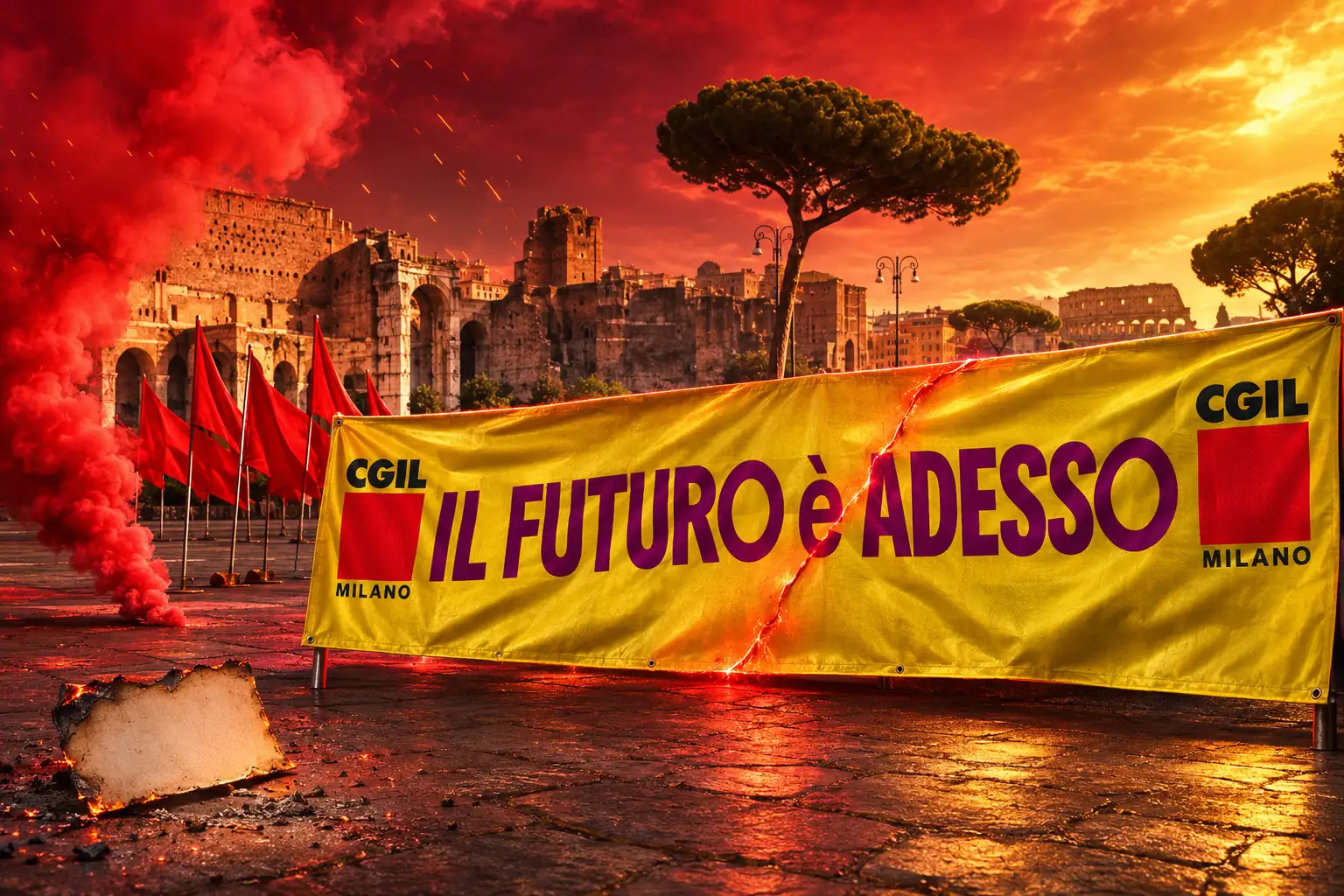
From a truck near the Imperial Forums, Landini told a Rome crowd the union counted at 50,000 that the squares were full. Democratic Party leader Elly Schlein marched near the front with Giuseppe Conte of the Five Star Movement and the Green-Left pair Angelo Bonelli and Nicola Fratoianni. The slogan on CGIL’s own posters was “The Future Is Now.”
The squares are full, and all generations are in the streets. It is a day that does not divide but unites.
Maurizio Landini, CGIL general secretary, Imperial Forums, Rome
By late afternoon the union had raised the national crowd to 1.5 million people in more than 100 cities, including students and pensioners, and put the average walkout at 60 percent across public and private workplaces. Landini said it had been “a beautiful day of extraordinary participation,” then added that CGIL would not stop if the government gave no answer.
Sciopero: Cgil, un milione e mezzo in oltre 100 piazze, adesione al 60%
“È stata una bellissima giornata di straordinaria partecipazione”. Così il segretario generale della Cgil, Maurizio Landini, commenta la mobilitazione di oggi che ha visto un milione e mezzo di persone, tra… pic.twitter.com/VqXzkxlwlm
— CGIL Nazionale (@cgilnazionale) November 20, 2026
He also said the people in the squares were the majority in the country. CISL and UIL, the other two large union confederations, did not join the walkout. Grassroots unions including Cobas ran their own strikes and marches beside the official column.
The Government Counted 12 Percent Walking Out
Public Administration Minister Paolo Zangrillo released a different sheet. At 6:45 p.m., with about half the public workplaces counted, he said under 12 percent of public employees had joined the strike, and he called the result another failure. The Education Ministry put the school walkout at about 15 percent.
THE TURNOUT FIGHT
| Measure | CGIL figure | Government figure |
|---|---|---|
| National crowd | 1.5 million in more than 100 cities | No official crowd count released |
| Walkout, all sectors | 60 percent, public and private | None published on that basis |
| Public employees | Folded into the 60 percent | Under 12 percent (sample at 6:45 p.m.) |
| Schools | Folded into the 60 percent | About 15 percent |
| Rome march | 50,000 at the Imperial Forums | None given |
Those percentages are not the same measurement. CGIL’s 60 percent mixes private factories with public offices. Zangrillo’s figure covers only public staff, and only the share already counted by early evening. The union still had color in more than 100 squares. The state still had most of its offices open.
Industry Minister Adolfo Urso said the strike had been “pre-emptive,” because Landini called it before the budget’s contents were known. Friday was CGIL’s fifth general strike in a row against a Meloni budget, and the union ran this one alone.
Why Students Burned Landini’s Photo
Students in Rome set fire to a photo of Landini beside pictures of Meloni and Defense Minister Guido Crosetto. They chanted that they were not the CGIL. The international youth strike was aimed at rearmament and school cuts, not at padding a union crowd that other confederations had already declined to join.
The student day had its own name, the International Youth Strike, and its own slogan, “Fight for Our Future, Not Their Wars.” Italy’s Union of Students said before the marches, “We will not stand idly by while our present and our future are taken from us.” In Rome the student columns moved on the Education Ministry. Fireworks, and at least one incendiary bottle, were thrown at the building. Clashes with police broke out among student groups in Turin and Bologna.
The union’s own pictures did not look like a young country on strike. Grey hair filled a lot of the frames, which is what a pensioner-heavy march looks like, and the students made the distance obvious by burning the general secretary’s face next to the premier’s. Landini needed them for the unity story. They used the same Friday for a fight he does not run.
An international coalition of more than 50 youth and student groups had called that walkout weeks earlier, and they listed militarisation, conscription and school funding ahead of any Italian budget line.
€17.2 Billion for New Weapons Next Year
Parliament is still working through a 2027 budget of €26 billion ($30 billion), with €27 billion sketched for 2028. The cabinet approved the draft on October 28. Landini says the package “gives nothing to 92 percent of citizens,” restores building and tax amnesties, and extends a flat tax for people earning more than €100,000. He also says people who work and pay tax are carrying an extra €36 billion they should not owe.
Italy’s statistics agency Istat put annual inflation at 5.5 percent in October, up from 4.2 percent in September. Real wages have not got back to early 2021 levels. Landini put the street case in plain terms: people cannot make ends meet, they need a health system that works, and young people need schools that work.
The money argument underneath those wages is the military line. The Milex Observatory, reading the budget tables, puts direct military spending above €40 billion in 2027, up 18 percent from 2026. New weapons account for €17.2 billion, 43 percent of that total, and 30.7 percent more than the year before.
THE 2027 MILITARY LINE
- Defense ministry: Tables assign €38.8 billion in 2027, up €6.4 billion, or 19.8 percent, from €32.4 billion in 2026.
- New weapons: Purchases rise to €17.2 billion, including funds parked at the enterprise ministry, or 43 percent of direct military spending.
- Since 2023: Direct military spending was €26.7 billion in Meloni’s first budget year, a 50 percent rise across five bills.
- New money in this bill: About €4.5 billion is added through the EU national escape clause for defense, on top of what prior law already locked in.
On forecast GDP of €2,394 billion, that direct military total is 1.67 percent. NATO’s target is 3.5 percent by 2035. The majority has tabled about 2,000 amendments to its own bill. CGIL wants higher pay and renewed contracts, full pension indexation, a more progressive tax, public health and schools, housing, and a stop to rearmament. The government has not rewritten the draft on those terms.
Fight for Our Future, Not Their Wars
The Italian squares were one piece of a youth strike the organizers dated across 25 countries. Stop ReArm Europe, citing the EU’s defense commissioner, puts planned military outlays at nearly €7 trillion by 2035. The same student platform treats the EU’s Readiness 2030 plan, which is designed to mobilise up to €800 billion for rearmament, as money taken from housing, classrooms and welfare.
WHAT THE YOUTH STRIKE ASKED FOR
- Welfare, not warfare: Public funds for schools, health, housing and a liveable climate instead of weapons budgets.
- No conscription: An end to every form of mandatory military service, and a refusal of recruitment inside schools.
- Diplomacy first: Conflicts settled through law and talks, not through a larger European arms build-up.
In Germany the GenZ regelt network logged about 21,000 people in about 70 cities, with about 1,000 in Berlin, much of it aimed at a possible return to compulsory service. Croatian students boycotted classes in about a dozen cities and asked for education, housing and public services rather than military outlays. Adam Powell-Davies, national chair of Socialist Students in Britain, said young people “will not sit quietly while our schools, colleges and universities are cut and billions are found for war.”
Friday sat inside a longer season of cost-of-living protests across Europe, where wages, rents and school budgets have been colliding with higher military outlays. The Italian union tried to hold all of that under one flag. The youth platform did not wait for permission.
Vienna’s University Steps Lasted Under an Hour
Austria held actions in 14 cities. In the afternoon, several NGOs and small parties led a march from Vienna’s Westbahnhof toward the centre under the line “Our future instead of their wars.” Organizers and police put that crowd between 1,000 and 3,000, and police said that column passed without incidents.
The morning “youth strike” in front of the University of Vienna did not. Police said some demonstrators, some of them masked, tried to force their way into the building. Officers closed the entrance, then dissolved the assembly in under an hour and used pepper spray. The Vienna police directorate later reported about 60 people held under administrative rules and six held under criminal procedure.
German cities had already seen rougher nights on October 31, 20 days earlier, when thousands came out and some marches turned violent. Friday’s Berlin gathering stayed smaller and stayed on the conscription argument. The pattern is the same demand in different registers: classrooms and wages on one side of the ledger, barracks on the other.
On Sunday the Airports Take Their Turn
The general strike itself left national rail and air out, after the strike guarantee commission carved those sectors away, and several city networks including Milan’s ATM and Naples’ ANM were exempt. Local buses, trams and metros ran only inside guaranteed bands. Schools and some health sites still felt the 24-hour stoppage. A separate grassroots rail walkout was scheduled from 9 p.m. Friday to 8 p.m. Saturday, which is the disruption that actually sat on the tracks after CGIL’s day ended.
THE DATES AROUND THE STRIKE
- October 28, 2026: The cabinet approves a 2027 budget of about €26 billion.
- November 13, 2026: A meeting with Meloni’s government fails to change the bill, and CGIL confirms the strike.
- November 20, 2026: CGIL holds the 24-hour general strike, and students join the international youth strike.
- November 20, 2026: Grassroots rail unions run a separate stoppage from 9 p.m. Friday to 8 p.m. Saturday.
- November 22, 2026: ENAV staff at Milan Malpensa strike from 1 p.m. to 5 p.m., and Venice Marco Polo security staff are listed for 24 hours.
- December 5, 2026: CGIL plans a joint march with doctors and nurses in defense of public health.
- December 12, 2026: CGIL gathers in Cosenza around the southern economy.
Sunday’s airport action is not a CGIL encore. FAST-CONFSAL is calling the four-hour Malpensa stoppage; FISASCAT-CISL is on the Venice security roster. Flights in the 7 a.m. to 10 a.m. and 6 p.m. to 9 p.m. bands are supposed to operate anyway. Venice’s notice covers checkpoint staff, not air-traffic control, so the risk is slower screening rather than a closed runway.
The bill is still in Parliament, and the government has not rewritten it. If the text does not change, Landini said, CGIL will mount a “democratic sit-in” outside Parliament. The numbered dates are already on the union calendar. The votes are still on Meloni’s side of the chamber.

India’s First-Timers and Pant Build a Record 720

Kutch Crash Kills Seven From Army Families After October Toll

Ukrainian Drones Leave Finland Fighting a Russian Ship Fire

ICJ Genocide Order Runs Through Arakan Army Land

CII Asks Patel Panel to Shift Who Funds Indian Credit

Clancy Juror Says the Holdout Never Cited Evidence

The iPhone 18 Pro Max Splits Apple’s Fall in Two

OpenAI Calls GPT-6 Astra AGI Then Locks Its Exploits

Trump Claims Hormuz Control as Oil Holds Near $96

Russia Closes the Goethe-Institut Berlin Tried to Save

 NEWS2 months ago
Clancy Juror Says the Holdout Never Cited Evidence
- NEWS3 months ago
The iPhone 18 Pro Max Splits Apple’s Fall in Two
- NEWS3 months ago
OpenAI Calls GPT-6 Astra AGI Then Locks Its Exploits
- BUSINESS3 months ago
Trump Claims Hormuz Control as Oil Holds Near $96
- LIFESTYLE3 months ago
Russia Closes the Goethe-Institut Berlin Tried to Save
- AUTO3 months ago
Volkswagen’s Job Cuts Leave Four Plants Without Cars
- NEWS3 months ago
Dyson Puts Nurovi Robots on Sale Without the UV Flagship
- BUSINESS3 months ago
US Destroys Five Iranian Tankers as the Shock Hits Jordan