
AUTO
Karnataka Unions Want a Ban the Court Rejected
After the Supreme Court backed regulated bike taxis, Karnataka auto unions want an ordinance to restore a ban the bench just rejected.

Karnataka auto and taxi unions asked the state on November 20, 2026, to ban bike taxis after the Supreme Court refused to restore that ban. A Bench of Justices Satish Chandra Sharma and N. Kotiswar Singh dismissed the government’s appeal against a January 23 High Court order and left motorcycle-permit applications on the table. Union leaders answered with a demand the courts had already boxed in: an ordinance, and a rewrite of cab-era aggregator rules so they cannot cover two-wheelers.
Unions Ask Karnataka to Ban What the Court Allowed
Sreenivas C.N., president of the Autorickshaw Drivers Union, put the fear in fleet terms. Individual drivers, he said, cannot match companies that spend crores and add thousands of vehicles at once.
We cannot compete with large companies that invest crores of rupees and induct thousands of vehicles into their fleets. Both the state and central govts should come to the aid of auto drivers, as this is a question of their livelihood.
Sreenivas C.N., president, Autorickshaw Drivers Union
Nataraj Sharma, president of the Federation of Karnataka State Private Operators’ Association, went further than aid. He asked the state to issue an ordinance banning bike-taxi operations in Karnataka, and to amend the On-Demand Transportation Technology Aggregator Rules so they name cabs and not motorcycles. He said the unions would also write to the state government, the Centre and the Chief Justice of India.
WHAT THE UNIONS HAVE ASKED FOR
- State help: Sreenivas said both the state and the Centre should step in because the fight is over livelihood, not a side dispute about apps.
- An ordinance: Sharma wants a state ban on bike-taxi operations after the Supreme Court left the High Court’s permit path in place.
- A rules rewrite: He wants the 2016 aggregator code limited to cabs so motorcycles fall outside it.
- Letters upward: The federation plans to put those reservations to the state, the Centre and the Chief Justice of India.
Five auto and taxi driver associations had already joined Karnataka in the Supreme Court, arguing that bike taxis without matching duties would hurt existing operators. Those appeals were dismissed with the state’s. The next union move is political, not another stay application.
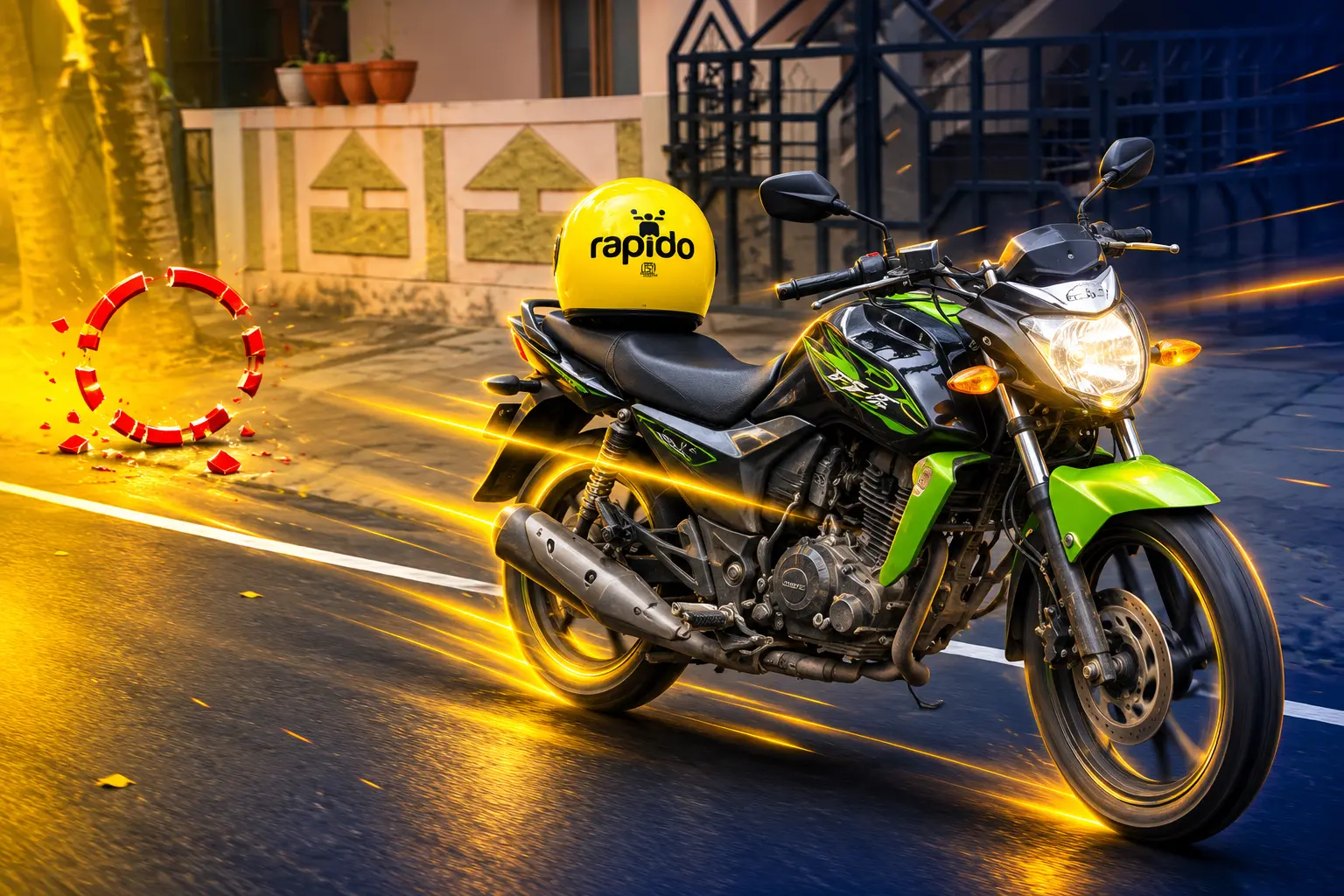
The Bench Heard That an Auto Costs Five Times as Much
The High Court’s January 23, 2026, judgment, a 111-page order of Chief Justice Vibhu Bakhru and Justice C.M. Joshi in ANI Technologies v. State of Karnataka and connected appeals (Writ Appeal No. 906 of 2025), had already treated bike-taxi work as a legitimate business under Article 19(1)(g). A blanket bar on contract-carriage permits for motorcycles, the Bench said, is not a reasonable restriction under Article 19(6). The Motor Vehicles Act occupies the field on mechanically propelled vehicles. The state cannot write motorcycles out of the transport-vehicle class when the central law lets them in.
The division bench held that a motorcycle hired with a pillion fits the definition of a motorcab in the Act, a hire vehicle built for not more than six passengers besides the driver. It also treated a motorcycle used for hire as a public service vehicle, a category whose statutory public service vehicle includes a motorcab. A 2004 central notification had already named a motorcycle used for hire to carry one passenger on the pillion. The High Court told authorities to consider applications to register motorcycles as transport vehicles and to grant contract-carriage permits, and said those applications could not be refused merely because the vehicle was a motorcycle. Conditions under Section 74 were still open. A class-wide no was not.
On November 20 the Supreme Court left that holding in place. Justice Sharma, while pronouncing the order, described a conversation with young women on his staff.
I asked them, how do you come to my office? They said on a motorbike because they do not have the money to hire a cab. I asked them, why don’t you take an auto? They said, ‘Sir, it is five times (the fare)’.
Justice Satish Chandra Sharma, Supreme Court of India, November 20, 2026
He said a bike taxi with GPS was safer for young girls, that it was better to regulate the service than to ban it, and that bike taxis already run in 25 states. He added that auto unions do not allow anyone except Namma Auto. During the hearings the Bench also questioned the state’s congestion argument, noting that motorcycles take less road space than cars. The Centre, asked in court, confirmed that motorcycles can be used as taxis under its notifications. Aggregators told the court that nearly 4.5 lakh passengers used the service in Karnataka.
Karnataka had argued the other way. Motorcycles and motor cabs are defined separately, it said, and its aggregator rules never envisaged bike taxis. It leaned on a 2019 expert committee that looked at safety, congestion and pollution, and it pointed to the Karnataka Platform-Based Gig Workers (Social Security and Welfare) Act, 2025, as other work for riders. Senior advocates Vikas Singh and Parag Tripathi appeared for the state. Abhishek Manu Singhvi appeared for Uber, Neeraj Kishan Kaul for Rapido, and advocate K. Shiva for auto unions backing the government.
How Karnataka Spent a Decade Keeping Bikes Off Apps
App companies first tried bike taxis in Bengaluru in 2016. The transport department called the runs illegal, impounded private white-board bikes and fined owners. The legal fight never really closed. It moved from seizures to show-cause notices, a short-lived electric-only scheme, a single-judge stop order, a division-bench reversal and, on November 20, a Supreme Court dismissal.
THE BIKE TAXI FIGHT IN KARNATAKA
- Early 2016: Aggregators launch bike taxis in Bengaluru, and the transport department impounds hundreds of private bikes.
- April 2, 2016: Karnataka notifies aggregator rules it later says apply only to motor cabs.
- April 29, 2019: The Ajay Seth committee recommends that motorcycles should not run as taxis.
- July 14, 2021: The state notifies an electric bike-taxi scheme for first- and last-mile trips.
- March 6, 2024: The state withdraws that scheme after union pressure, citing misuse and safety.
- April 2, 2025: A single-judge bench directs Rapido, Ola and Uber to stop bike-taxi services within six weeks unless the state frames rules under Section 93 of the Motor Vehicles Act.
- June 16, 2025: The halt takes effect after the high court extends the stop-date to June 15.
- January 23, 2026: A division bench sets the ban aside and tells the state to consider motorcycle permit applications.
- April 2026: Karnataka files a Supreme Court appeal against that judgment.
- November 20, 2026: The Supreme Court dismisses the appeal and the associations’ challenges with it.
The 2019 committee, the High Court noted, accepted last-mile gaps and then recommended roads and other infrastructure rather than bike taxis. The 2021 electric scheme’s own opening lines had recognised a need for the service, which is one reason the division bench found no informed, written policy behind a total ban, only an unwritten edict not to grant motorcycle permits. Haryana, Punjab, Rajasthan, Uttar Pradesh, West Bengal and Mizoram, the High Court said, had already issued bike-taxi permits.
What a Bike Taxi Costs Against an Auto
Mohammed Salim, president of the Namma Bike Taxi Association, said the base fare across platforms is about Rs 25 to 35 and the per-kilometre charge is not uniform. Rapido, he said, runs at Rs 7 a kilometre. Uber and Ola are around Rs 10 to 11. Bike captains, unlike auto drivers, get no extra night pay. That gap is the commercial fight inside the legal one. It is also the gap Justice Sharma put on the record when his staff called an auto five times the bike.
THE BIKE TAXI FARES CAPTAINS QUOTED
| Platform | Charge per km | Base fare |
|---|---|---|
| Rapido | Rs 7 | Rs 25 to 35 |
| Uber and Ola | Rs 10 to 11 | Rs 25 to 35 |
Those figures are association quotes, not a state tariff. They still explain why a one-person trip in peak traffic is the market bike taxis take first, and why auto unions treat the product as a raid on short, dense, high-frequency work rather than a side gig at the city edge.
Captains Want Permits Before the Next Crackdown
Nanjundan K., 59, a bike-taxi driver, said he has completed 25,000 rides in four years and dropped every passenger safely, yet the job still lacks credibility. In recent months, he said, rowdy auto and cab drivers have confronted him and his passengers, which deters people from booking. Adi Narayan, president of the Bike Taxi Welfare Association of Karnataka, said the legal position is now clear and the government should put rules in place, a structured framework for drivers, platforms and commuters that does not compromise passenger safety.
Pavan Guntupalli, co-founder of Rapido, which started bike taxis in Bengaluru, asked the state to write a clear, practical framework and to concentrate on four points.
RAPIDO’S FOUR ASKS FOR THE NEW RULES
- Safety and insurance: Uniform standards across operators, rather than a patchwork by app.
- Licensing: Simple, transparent, time-bound digital registration and permits.
- Last mile: Bike taxis tied into buses and metro so they feed public transport instead of floating beside it.
- Consultation: Talks with commuters, women riders, captains and operators before the draft is locked.
That is the opposite of Sharma’s ordinance. Captains are asking the transport department to do the work the High Court said it still can do: load permits with conditions, insurance, GPS, helmets and fares. They are not asking it to pretend two-wheelers are outside the Motor Vehicles Act.
The State Offered Bikes Everywhere Except Bengaluru
In the Supreme Court, Karnataka said it could consider bike taxis in other parts of the state and still keep them out of Bengaluru. That split is the political map. Auto unions are strongest in the capital, where short trips, metro last-mile work and IT-corridor peaks are the same pool of rides. A statewide legal win that dies at the Bengaluru RTO would be a win on paper.
The same city is already thick with app cabs. The state government has estimated that Ola has about 45,000 drivers in Bengaluru, Uber 77,000 and Rapido 75,000, or 1.97 lakh on those three platforms, and more than two lakh app-cab drivers in all, against 2.97 lakh registered cabs. Rapido has separately said it has about 3.14 lakh captains across 21 Karnataka cities, a statewide headcount that mixes products and should not be read as a Bengaluru bike-taxi fleet. Transport minister Byrathi Suresh has already complained that people from other states are signing up as aggregator drivers. Bike taxis land on a cab market the unions already call overcrowded.
WHERE THE STATE AND THE UNIONS STILL DIVERGE
- The instrument: The unions want an ordinance and a 2016-rules amendment that freeze motorcycles out. The two courts told the state to regulate, grant or refuse permits with reasons, and stop treating a two-wheeler as an illegal class.
- The map: Karnataka offered to look at bike taxis outside Bengaluru. The High Court and Supreme Court orders are not written as a capital-city exception.
- The safety file: The state still cites the 2019 committee, helmets, insurance and accident risk. The Bench answered with GPS, a five-times fare gap, and the fact of operations in 25 states, plus the Centre’s confirmation that motorcycle taxis are contemplated in central notifications.
Draft rules published for comment would match what the judgments left standing. A fresh ban would test how far an ordinance can go when a blanket prohibition has already failed the Article 19(6) test and a Supreme Court Bench has said regulation is the better course.
Karnataka’s 2016 Cab Rules Were Written for Four Wheels
The Karnataka aggregator rules notified in 2016 define an aggregator as a person who connects a passenger to the driver of a taxi by phone, internet or GPS, and they set a floor of 100 taxis and a Rs 50,000 licence fee. The state told judges those rules were built for motor cabs. The High Court read “taxi” through the Motor Vehicles Act and said a motorcycle used for hire is a motorcab, so the same licence path can cover bike taxis. Sharma’s amendment demand is an attempt to close that reading by statute after it failed as a policy of non-grant.
A day before the Supreme Court order, Rapido pointed states to Clause 23 of the central MVAG 2025 guidelines as the template for bike-taxi rules, the same alignment Union road transport minister Nitin Gadkari has urged states to adopt.
#Biketaxis are strengthening first- and last-mile connectivity, making #mobility more #affordable and creating livelihoods across India. @rapidoapp_ has been at the forefront of building and advancing this category, connecting #mobility needs with earning opportunities, including… pic.twitter.com/J0u0aSh3HT
— Rapido (@rapidoapp_) November 19, 2026
Regional transport authorities can still put conditions on each permit. They cannot, on the High Court’s reading of the Motor Vehicles Act, refuse a whole class of vehicles because they have two wheels. Permit applications are the work the January 23 order already told Karnataka to consider, and they remain the work the November 20 dismissal left on the state’s desk.

India’s First-Timers and Pant Build a Record 720

Kutch Crash Kills Seven From Army Families After October Toll

Ukrainian Drones Leave Finland Fighting a Russian Ship Fire

ICJ Genocide Order Runs Through Arakan Army Land

CII Asks Patel Panel to Shift Who Funds Indian Credit

Clancy Juror Says the Holdout Never Cited Evidence

The iPhone 18 Pro Max Splits Apple’s Fall in Two

OpenAI Calls GPT-6 Astra AGI Then Locks Its Exploits

Trump Claims Hormuz Control as Oil Holds Near $96

Russia Closes the Goethe-Institut Berlin Tried to Save

 NEWS2 months ago
Clancy Juror Says the Holdout Never Cited Evidence
- NEWS3 months ago
The iPhone 18 Pro Max Splits Apple’s Fall in Two
- NEWS3 months ago
OpenAI Calls GPT-6 Astra AGI Then Locks Its Exploits
- BUSINESS3 months ago
Trump Claims Hormuz Control as Oil Holds Near $96
- LIFESTYLE3 months ago
Russia Closes the Goethe-Institut Berlin Tried to Save
- AUTO3 months ago
Volkswagen’s Job Cuts Leave Four Plants Without Cars
- NEWS3 months ago
Dyson Puts Nurovi Robots on Sale Without the UV Flagship
- BUSINESS3 months ago
US Destroys Five Iranian Tankers as the Shock Hits Jordan










