
FINANCE
UPI Stays Free as Bill Locks In Foreign Capital Rules
Parliament clears the Taxation Bill with no UPI user charges and multi-year exemptions for foreign electronics, data centres and offshore funds managed from India.

Parliament cleared the Taxation and Other Laws (Amendment) Bill, 2026, after Finance Minister Nirmala Sitharaman told the Rajya Sabha that the law imposes no tax or transaction charge on UPI payments. The same measure rewrites tax rules to pull in foreign capital for electronics manufacturing, cloud services and fund management with certainty running to 2041.
The surface story is relief for hundreds of millions of daily users. The deeper shift sits in the capital and manufacturing chapters that now sit on the statute book. Those chapters convert temporary ordinance reliefs into multi-year statutory maps while the payment chapter quietly resets the legal frame around merchant discount rates.
Sitharaman Draws a Hard Line on User Charges
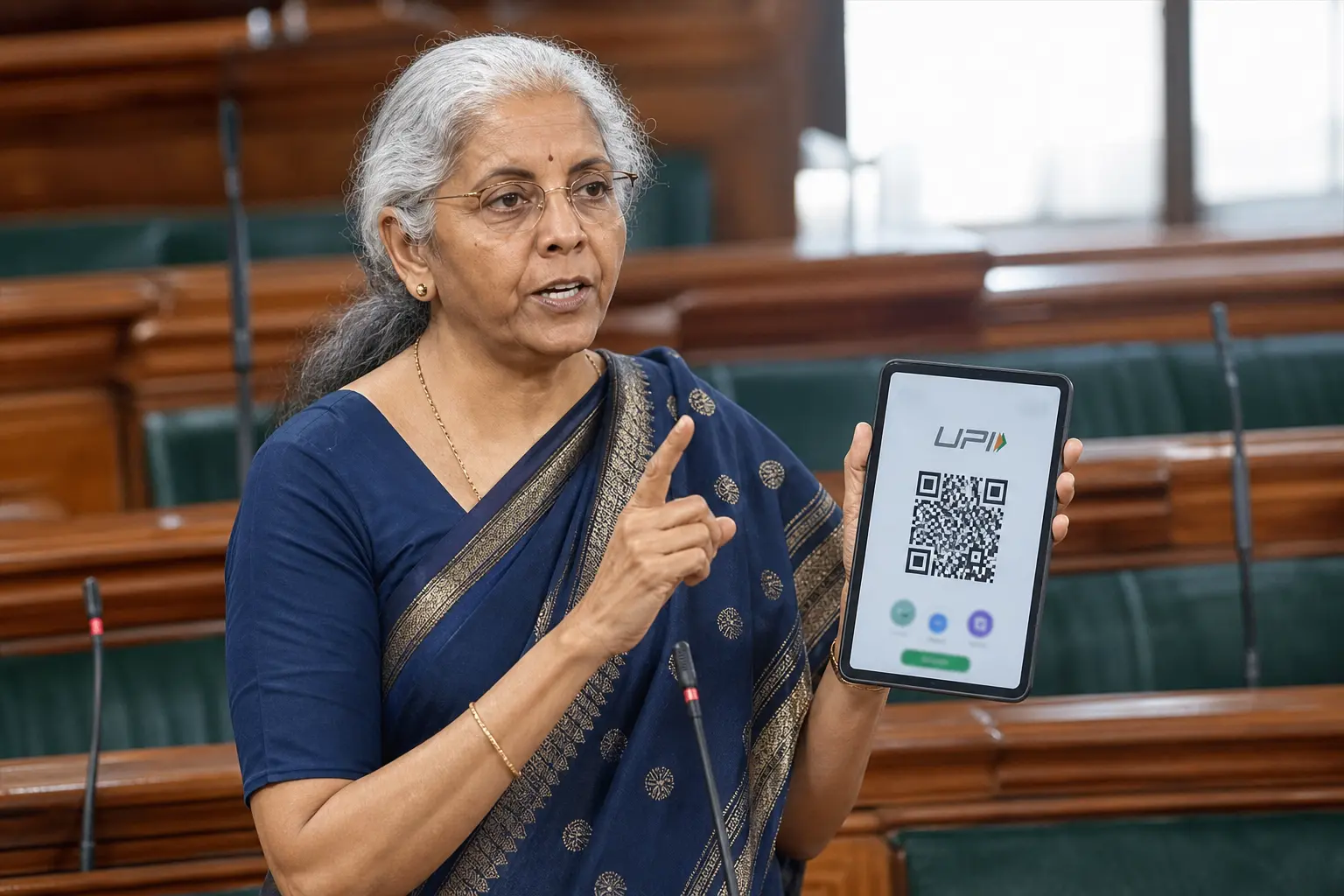
On 10 August the bill completed its parliamentary journey. Sitharaman used the Rajya Sabha debate to shut down claims that ordinary people would start paying for UPI. She called the assurance “good news” and urged the opposition to stop spreading misinformation.
World’s largest real-time payment system belongs to us. In July 2026 alone, we processed 2,366 crore UPI transactions worth ₹29.9 lakh crore. It’s because of the UPI transactions being done by the SVANidhi merchants, redi-patriwalas, etc., that UPI has become so big.
The line came from her office account during the debate. She also noted UPI now runs in 11 countries and reminded the House that earlier critics had mocked the system at launch. The scale she cited underpins the political commitment: any fee structure that thins out those small merchants would undercut the density that made the system indispensable.
The clarification matches the source reporting: the legislation does not place any tax or charge on UPI users. Any future merchant discount rate, if notified, would fall on merchants, not end customers or peer-to-peer transfers. That distinction keeps the daily user experience unchanged while opening a later path for infrastructure cost recovery.
What the Payment Law Changed
The operational change is surgical. Section 10A of the Payment and Settlement Systems Act, 2007 previously barred banks and payment providers from levying any charge on electronic modes prescribed under the old Income-tax section 269SU. That language covered UPI and RuPay.
The bill substitutes a new formula. Charges may now apply to “one or more electronic modes of payment as the Central Government may, by notification, specify.” The automatic zero-MDR shield becomes a discretionary power held by the Centre.
- No fee is live today. Zero MDR continues until a notification appears.
- The government can later carve out free categories (P2P, small merchants) and chargeable ones (large-ticket merchant payments).
- RTGS and NEFT already carry service charges; UPI had been the outlier since 2020.
- RBI Governor Sanjay Malhotra called discussion of MDR “premature” the day before Lok Sabha passage, while noting that infrastructure costs must be met either by taxes or by a user-pays model.
Industry voices have long argued the free ride is unsustainable. The bill simply removes the statutory roadblock and leaves the political decision for later. The substitution itself does not trigger any charge; it only restores the legal space the earlier blanket bar had closed.
The Capital Chapters That Will Outlast the Headlines
While UPI dominated the chatter, the bulk of the bill rewrites Schedule IV and related provisions of the Income-tax Act, 2025. These changes give foreign companies multi-year visibility that the earlier ordinance and Finance Act had only partly delivered. A PRS summary of the full bill provisions lays out the list cleanly.
| Provision | Who Benefits | Key Change | Sunset |
|---|---|---|---|
| Electronics capital goods & tooling | Foreign companies supplying contract manufacturers | Exemption extended; “specified electronic goods” defined (phones, laptops, servers, sub-assemblies, hearables/wearables) | Tax year 2040-41 |
| Component storage in bonded warehouses | Foreign suppliers to Indian contract makers | New exemption for income from storage and sale of components | 31 March 2041 |
| Rough diamond sales in special zones | Foreign mining firms, sightholders, brokers | New exemption for sales in notified SNZs (Mumbai, Surat) | 31 March 2041 |
| Data-centre services for cloud firms | Foreign cloud companies using Indian centres | Notification requirement dropped; leased centres allowed; conditions to be prescribed | Up to 31 March 2047 |
| Eligible investment funds managed from India | Offshore funds with India-based managers | Conditions cut from 13 to 5 (residence, DTAA, <5% Indian corpus, no India business control, no other PE) | Ongoing |
| FII / BIS government securities | Foreign institutional investors, Bank for International Settlements | Interest and capital gains exempt | From 1 April 2026 |
The official FAQs on the electronics and data-centre exemptions confirm the leased-model opening and the removal of dual notification hurdles. Those frictions had slowed big-ticket cloud and manufacturing decisions. The bill also adjusts surcharge rules for special purpose vehicles of REITs and InvITs so unit holders keep dividend exemptions even when the SPV opts for the new tax regime.
Taken together the package tells foreign boards they can park tooling, components and managers in India for fifteen years without fresh tax surprises. The sunsets themselves become planning anchors: 2041 for most manufacturing and diamond lines, 2047 for data-centre services, and an open-ended frame for eligible funds once the five residual conditions are met.
UPI’s Scale Makes the Sustainability Question Inevitable
The free model worked. NPCI July 2026 UPI volume and value figures show 23,658.35 million transactions (2,366 crore) worth ₹29,87,880.49 crore. Sitharaman rounded the same numbers in the House. Banks live on UPI now number 741.
That growth came after the zero-MDR mandate took effect on 1 January 2020. Before that, merchants could face fees. The policy deliberately removed friction so kirana stores, street vendors and small merchants would accept QR codes. Crowd reaction on X after the bill surfaced the same point: the network effect lives on those low-value, high-volume merchants. Charge them and the density that makes UPI useful thins out.
Banks and payment apps absorbed the cost for six years. Estimates from the early years put industry losses in the thousands of crores. The bill does not solve the revenue gap. It only creates the legal door for a future notification that could let large merchants pay a modest MDR while shielding individuals and small sellers.
The arithmetic is straightforward. High volume at zero fee expands the rail; the same volume at even a thin fee on large merchants could begin to close the infrastructure gap without touching the peer-to-peer or small-seller layers that built the network.
How Zero MDR Became Law and Why the Door Reopened
- 2016, UPI launches under NPCI; MDR is possible.
- December 2019 / 1 January 2020, Government announces and implements zero MDR for UPI and RuPay to accelerate digital adoption.
- 2020-2025, Volumes explode; banks and PSPs repeatedly flag sustainability; government holds the free line as a public-good policy.
- June 2026, Income-tax (Amendment) Ordinance provides temporary FII and related reliefs.
- 4 August 2026, Taxation and Other Laws (Amendment) Bill introduced in Lok Sabha, replacing the ordinance and amending PSS Act Section 10A.
- 6 August 2026, Lok Sabha passes the bill by voice vote amid disruptions.
- 10 August 2026, Rajya Sabha clears it; Sitharaman delivers the free-UPI clarification on the floor and in follow-up clips.
The sequence shows a classic policy arc: heavy subsidy to build the network, then a quiet legal reset once scale is achieved. The full text of the Taxation Bill 2026 makes the substitution in Section 10A explicit and ties commencement to Gazette notification for that chapter. The capital reliefs move on a parallel track from temporary ordinance to durable statute in the same legislative vehicle.
Winners, Protected Users and the Open Decision
Payment infrastructure companies and banks gain optionality. They can plan for a revenue line if the government later notifies chargeable categories. Large e-commerce and organised retail merchants are the most likely first payers under any “user-pays” design.
End users and small merchants remain protected by political commitment for now. Sitharaman’s language left little room for immediate consumer fees. Foreign electronics suppliers, diamond traders, cloud operators and fund managers walking into the new exemptions gain the clearest multi-year certainty.
The mixed outcome is structural. India keeps the free, high-velocity payment rail that underpins daily commerce while simultaneously offering capital the kind of long-horizon tax map that competes with other manufacturing and services hubs. The second-order consequence is that any future MDR debate will be conducted against the backdrop of a payments system already too big to reverse and a manufacturing pitch already locked into statute until the early 2040s.
Simplified Fund Rules Cut Barriers for Managers
The eligible investment fund chapter compresses the compliance list that once deterred relocation. Thirteen conditions shrink to five: residence, DTAA coverage, Indian corpus below 5 percent, no India business control, and no other permanent establishment.
That reduction removes the densest friction points for offshore funds that want India-based managers. The change is ongoing rather than sunset-bound, so the simplified frame remains available after the manufacturing and data-centre clocks run out.
- Residence and DTAA tests stay as gatekeepers.
- The corpus cap and control tests keep the fund clearly foreign.
- The PE bar prevents accidental taxable presence.
Together the five tests still protect the tax base while giving fund boards a shorter checklist when they weigh an India desk. The earlier thirteen-condition list had raised the cost of even exploratory moves; the trimmed set lowers that threshold without rewriting the underlying policy.
Leased Centres and Tooling Open Parallel Paths
Cloud operators no longer need dual notifications before they can claim the data-centre exemption. Leased centres now qualify, and the conditions shift to a later prescribed list. The outer sunset stretches to 31 March 2047, giving the longest planning horizon in the package.
Electronics suppliers receive a matching clarity track. Specified electronic goods now carry an explicit definition that covers phones, laptops, servers, sub-assemblies, hearables and wearables. Tooling and capital goods exemptions run to tax year 2040-41, while bonded-warehouse storage of components receives its own exemption through 31 March 2041.
| Track | Core Opening | Outer Date |
|---|---|---|
| Data-centre services | Leased model allowed; dual notification dropped | 31 March 2047 |
| Electronics tooling | Specified goods list locked in | Tax year 2040-41 |
| Component storage | Bonded warehouse income exempt | 31 March 2041 |
These three openings move in parallel. A foreign board can park tooling under one exemption, store components under a second, and route cloud workloads through a leased centre under a third, all inside the same statutory window. The earlier ordinance and Finance Act had delivered only fragments of that map; the bill completes the grid.
What We Know
- No UPI user charge or tax is imposed by the bill.
- Section 10A now lets the Centre notify chargeable electronic modes later.
- Electronics, diamond and data-centre exemptions run to 2041 or 2047 with simplified conditions.
- Fund-manager relocation barriers are sharply reduced.
- July 2026 UPI hit 23.66 billion transactions and nearly ₹30 lakh crore.
What’s Unconfirmed
- Whether, when and at what rate any MDR will be notified.
- Exact thresholds (value or merchant size) if charges appear.
- How quickly foreign firms will file under the new data-centre and tooling rules.
The bill is now law. The free UPI promise holds. The real test will be whether the capital chapters draw the factories, servers and fund desks they were written to attract while the payment rail stays cheap enough for the vendors who made it indispensable.

-
 TECH1 year ago
Where Garmin Watches are Made and How They are Assembled
-

 AUTO3 months ago
Tesla’s Roadster Is ‘a Few Weeks Away,’ Says Its Chief Designer
-
 NEWS10 years ago
Samsung Releases Galaxy Note7 TV Ad as Reddit AMA Leaks Specs
-
 NEWS10 years ago
Android 7.0 Nougat Rolls Out To Nexus Devices With New Emoji, Features
-
 FINANCE9 years ago
Cardano Price Surges as ADA Enters the Crypto Top Ten List
-
 NEWS10 years ago
Pre-Order the First Camera Made for Facebook Live Streaming Video
-
 FINANCE1 year ago
Binance Suspends Trading and Withdrawals for a System Upgrade
-
 FINANCE9 years ago
RChain Price Jumps Nearly 150% to a New All-Time High of $2.03