BUSINESS
Zomato’s Analogue Paneer Ban Hits Kitchens That Confessed
Zomato’s analogue paneer ban turns off dishes partners already declared, after labelling failed and 109 of 308 Maharashtra samples did not pass.

Zomato on Monday delisted analogue paneer dishes that restaurant partners had already declared, and warned that non-compliant kitchens can be removed from the app. The rule landed two days ago, after eight states had already moved against the vegetable-fat cube sold as paneer.
The first dishes to vanish were the ones partners admitted. That is the policy as written.
Zomato Turned Off Dishes Partners Had Already Flagged
In a note to merchants on 31 August 2026, Zomato said it was putting a zero-tolerance rule on analogue cheese, analogue paneer and other analogue dairy listed on the platform. Dishes partners had already marked as analogue dairy were turned off at once. The company said it can also recover costs if a non-compliant product still reaches a customer.
Aditya Mangla, chief executive of Zomato, tied the step to the firm’s food brief.
At Zomato, our core mission is better food for more people, and that means safeguarding customer health and upholding clear standards for what’s listed and served by our restaurant partners. This policy reflects that commitment, one we’re taking together with partners who share it.
Aditya Mangla, CEO, Zomato
Partners were told to act at once. The note did not describe a lab test, a kitchen audit calendar, or a way to catch a slab that was never declared.
WHAT RESTAURANTS MUST DO NOW
- Switch the cube: Move dishes to natural dairy products if they want those items to stay on the app.
- Drop the dish: Take analogue dairy items off the menu if a switch cannot be done at once.
- Check the invoice: Read supplier labels and ingredient sheets so the listing matches what leaves the kitchen.
Partners that stay out of line can be taken off the platform. Swiggy has not published a matching rule.
The Menu Label the Regulator Wanted
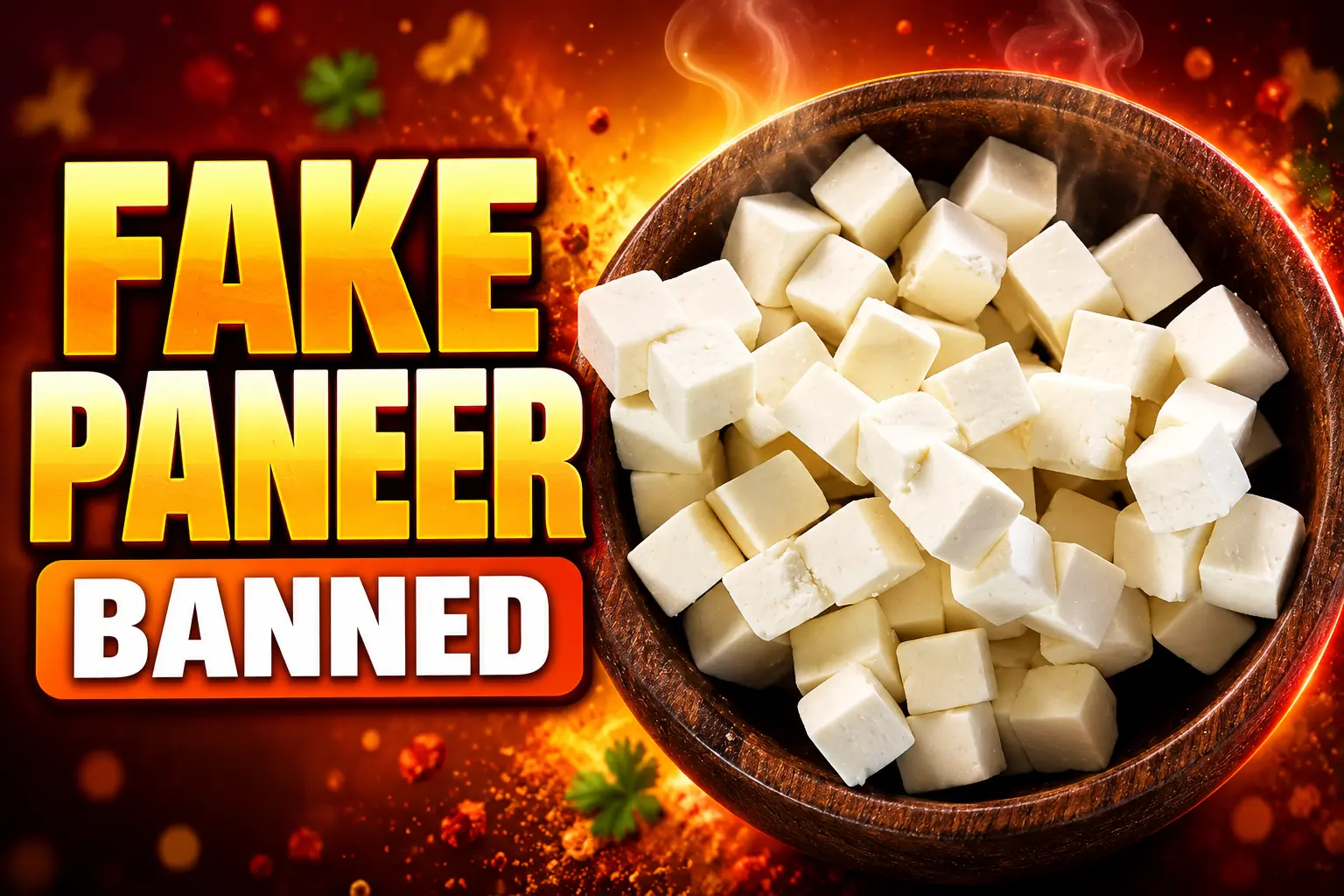
Analogue paneer is not a secret recipe that slipped through a gap in the law. The Food Safety and Standards Authority of India defines an analogue in the dairy context as a lookalike in which vegetable oil, vegetable fat or other non-milk parts take the place of milk fat or milk protein, in part or in full. Traditional paneer is a standardised food made from milk, with milk fat as an essential part. The substitute is built to copy the bite and the way it holds in gravy.
FSSAI’s own dairy FAQs are blunt: analogues are not recognised as dairy products, and they may not use dairy names as if they were paneer. Packs must say “Contains” the non-milk part, or “Contains no milk fat,” when milk fat is fully swapped out. A product sold simply as paneer is the offence. The recipe, if named correctly, was not banned nationwide.
In March 2025 the regulator met hotel, restaurant and catering firms on those labels. On 16 April 2025 it put out a consultation paper asking whether kitchens should print Analogue on restaurant menus, boards and booklets, in type a diner can actually read. The example was kadhai paneer made with analogue of paneer, or a burger using analogue of cheese. The paper also floated a ban on selling the stuff loose under 500 grams, and tighter licences for analogue makers.
That path was disclosure. Put the word on the card. Let the diner choose. Zomato did not take it. The app will not host an “analogue paneer tikka” line. The dish comes off, or the cube becomes milk.
109 Failures in 308 Maharashtra Samples
Maharashtra tried the label first. From 25 March 2026, hotels, restaurants and vendors in the state had to say on menus or screens whether a dish used natural paneer or a cheese analogue. Inspectors still kept pulling slabs that did not match the standard.
Between 1 April 2025 and 31 March 2026 the state Food and Drug Administration drew 308 paneer and dairy analogue samples. 109 of them, 35.4%, failed. Of those failures, 79 were classed sub-standard and 30 were classed unsafe. FDA Commissioner Tukaram Mundhe banned manufacture, storage, distribution and sale of analogue, non-dairy and synthetic paneer for one year from 30 July 2026, and told hotels, restaurants, caterers and cloud kitchens to stop using it. Selling the substitute as dairy paneer, the order said, misleads buyers. Penalties run to six months in jail and a fine of ₹1 lakh, and to life in jail and a minimum fine of ₹10 lakh if unsafe food kills.
Chhattisgarh moved on 1 August. Karnataka’s gazette of 17 August barred analogue or non-dairy paneer sold as paneer for one year; officials there said local tests had not shown adulteration and called the order a preventive step. Gujarat, Madhya Pradesh, Uttarakhand, Punjab and Himachal Pradesh are on the same list of states that have restricted the cube. Punjab’s order names “Analogue Paneer,” “Non-Dairy Paneer,” “Vegan Paneer,” “Synthetic Paneer” and “Plant-based Paneer” when those names are used to pass the product off as paneer.
THE YEAR THAT ENDED WITH A PLATFORM BAN
- March 2025: FSSAI meets hotel and restaurant firms on analogue labelling.
- 16 April 2025: The regulator invites comments on menu prefixes, packed-only sales and tighter licences.
- 25 March 2026: Maharashtra makes eateries declare natural paneer or analogue on the menu.
- 21 April 2026: FSSAI’s West Region tells manufacturers that selling cheese analogue as paneer is a grave breach of the law.
- 30 July 2026: Maharashtra bans the product for one year after 109 of 308 samples fail.
- 17 August 2026: Karnataka issues a one-year gazette ban on analogue paneer sold as paneer.
- 31 August 2026: Zomato turns off declared analogue dairy dishes on the app.
A 29 April note from the Press Information Bureau, repeating the West Region order, said any cheese analogue sold as paneer must stop at once, and that officers were told to inspect all units making or using such analogues. Disclosure was still the federal tool. Several states then decided a label was not enough.
How Will Zomato Know the Paneer Is Real?
The app’s first cut is an honesty rule. If a partner has already said a dish contains analogue dairy, that line is dark. If a partner never said so, the paneer tikka still reads as paneer tikka. Pranav Rungta, vice president at the National Restaurants Association of India, has said kitchens cannot tell analogue from dairy by eye, and that even a test can throw a false positive. He also said FSSAI still permits the substitute when it is labelled, which is why it sat in wholesale markets in the open.
Zomato has long told unhappy diners that it does not cook the food and does not set the restaurant’s price. A platform that uses that line now says it will police the cube inside someone else’s fridge. The merchant note asks partners to read supplier labels. It does not say who will walk into a cloud kitchen at 2 a.m. with a beta-sitosterol kit.
In 2024, Zomato’s restaurant supply arm Hyperpure carried a listing for “Soft and Fresh Paneer (Analogue), 1 Kg,” priced at ₹205.53 a kg on a 5 kg-plus order, described as made from skimmed milk and fit for tikka and gravy. The listing named the product as analogue. The gap then, as now, was the plate: the diner saw “paneer.” Whether that SKU is still on Hyperpure this week is not clear from public pages. The supply arm is still how many listed kitchens buy dairy, oil and dry goods.
Pritee Chaudhary, regional director of FSSAI West Region, put the naming duty on the manufacturer and the menu duty on the kitchen.
Any cheese analogue sold as paneer by the manufacturer to any food service establishment is a grave violation of the law and hereby directed to adhere to proper naming of the product sold to the food service establishments.
Pritee Chaudhary, Regional Director, FSSAI West Region, in the 21 April 2026 public notice
The same notice told centrally licensed kitchens to train buyers and chefs, keep test records, and display analogue use on menu boards. Zomato’s rule skips the board. It deletes the line.
WHAT WE KNOW
- Declared dishes: Items partners flagged as analogue dairy were turned off on 31 August.
- Delist threat: Zomato says it can remove a restaurant that stays out of line and recover losses from a bad delivery.
- State bans: Eight states have already barred making, storing or selling the cube as paneer, most for one year.
WHAT IS UNCONFIRMED
- Kitchen tests: No public method for catching undeclared analogue in a cooked dish.
- Hyperpure stock: No current catalogue proof that the 2024 analogue listing is gone or still live.
- Swiggy: No matching public ban from the other large delivery app.
A rename will not fix a state ban. It will fix an app filter that only reads the words a partner typed.
Real Paneer Costs Twice the Kitchen Substitute
The cube is cheap because milk is not. About five litres of milk go into a kilogram of dairy paneer. At ₹60 a litre, the milk alone is ₹300, before tax, transport and the press. Ram Khutwal, managing director of Kutwal Foods, which sells milk under the Urja brand, put the make-cost of good milk paneer at more than ₹350 a kg, and analogue paneer at about ₹150 a kg to start. Amul’s 200 g pack at ₹95 works out to ₹475 a kg on the shelf.
Rungta’s rule of thumb is harsher for the delivery menu: if a restaurant is selling the paneer itself for less than ₹200, he said, you are buying analogue. Small stalls, cafes and cloud kitchens used the cheaper slab to hold dish prices. Once they are told to buy milk paneer, some plates rise. One set of kitchen estimates put paneer butter masala around ₹220 moving to about ₹260, a cheese club sandwich around ₹200 to about ₹240, and a Margherita around ₹150 to about ₹180, a lift of ₹20 to ₹60 a dish.
THE PRICE GAP IN THE KITCHEN
| Item | Analogue or old ticket | Dairy or new ticket |
|---|---|---|
| Paneer, per kg (make-cost) | From ₹150 | More than ₹350 |
| Amul paneer, per kg (shelf) | – | ₹475 |
| Paneer butter masala | About ₹220 | About ₹260 |
| Cheese club sandwich | About ₹200 | About ₹240 |
| Margherita pizza | About ₹150 | About ₹180 |
Those restaurant kitchen costs after the ban land first on partners who actually switch. A kitchen that never declared analogue, and that still buys the ₹150 slab, keeps the old ticket until someone tests the gravy. Larger chains that already buy branded dairy are the group Rungta said would feel this least, because they were not running the cheap cube.
Mangla’s line is better food for more people. Milk paneer is better food by the standard on the statute book. It is also the version fewer delivery tickets can hold at ₹200.
Spare Capacity at a 150-Tonne Paneer Plant
K Rathnam, whole-time director and chief executive of Milky Mist Dairy Food, the largest private packaged paneer brand in the organised market, put India’s paneer market at about ₹1 lakh crore. Organised brands still hold only a thin slice; Milky Mist’s own share inside that slice is about 20%. The company’s plant at Perundurai in Tamil Nadu can make 150 tonnes of paneer a day and is running at about 60% of that. Paneer volumes at the firm grew 34% in the June quarter, with the category contributing ₹248.29 crore against ₹185 crore a year earlier. Rathnam said a wider analogue crackdown could take category volume growth toward 25%, and that Milky Mist’s own paneer volume could run toward 40%.
“Right now, it (crackdown) is only a few states like Maharashtra, Gujarat, Uttarakhand and other places in Delhi. If the ban of analogue paneer extends across the country, the paneer volumes will go up,” Rathnam said after the company’s first results as a listed firm.
That is the other side of Monday’s note. Declared analogue dishes are already dark on Zomato. Dairy plants have idle tonnes. The kitchens that told the truth are the ones shopping for milk this week. The kitchens that did not say a word still have a white cube in the fridge, and the app still calls it paneer.

Police Tighten the Ring Around Gyanesh Kumar’s House

Ravi Shankar Calls Hanuman Ansh a Slap to Big Spenders

Microsoft Puts Nvidia in the Surface Laptop Ultra Flagship

Adult Fires on an Armed Juvenile at Longmont Dollar Tree

Jordan Absorbs Iranian Missiles Aimed at Parked US Jets

The iPhone 18 Pro Max Splits Apple’s Fall in Two

OpenAI Calls GPT-6 Astra AGI Then Locks Its Exploits

Russia Closes the Goethe-Institut Berlin Tried to Save

Trump Claims Hormuz Control as Oil Holds Near $96

Volkswagen’s Job Cuts Leave Four Plants Without Cars

 NEWS2 months ago
The iPhone 18 Pro Max Splits Apple’s Fall in Two
- NEWS1 month ago
OpenAI Calls GPT-6 Astra AGI Then Locks Its Exploits
- LIFESTYLE2 months ago
Russia Closes the Goethe-Institut Berlin Tried to Save
- BUSINESS2 months ago
Trump Claims Hormuz Control as Oil Holds Near $96
- AUTO1 month ago
Volkswagen’s Job Cuts Leave Four Plants Without Cars
- NEWS1 month ago
Clancy Juror Says the Holdout Never Cited Evidence
- BUSINESS1 month ago
Cable Stocks Fall as UltraTech Copies the Paints Playbook
- BUSINESS2 months ago
Japan’s 3 Percent Yield Reprices Government Debt Worldwide