
FINANCE
High Oil From Hormuz Standoff Hits India Harder Than the Index Drop Shows
Early Sensex drop of 320 points on crude near $89 reflects deeper India import dependence that keeps oil-sensitive sectors and sentiment under pressure until.

The BSE Sensex dropped 320.14 points to 78,204.40 and the NSE Nifty fell 94.35 points to 24,490.85 in early trade on Tuesday as elevated crude oil prices weighed on sentiment. Brent traded near $87.61 early and later pushed higher, while Wall Street’s weaker close and mixed Asian cues set a cautious tone.
The session decline is real. The larger force is how India’s oil import dependence turns every stalled Strait of Hormuz negotiation into sustained pressure on margins, the import bill and investor positioning.
Early Session Numbers and the Crude Backdrop
From the Sensex pack, InterGlobe Aviation, Axis Bank, UltraTech Cement, Bharti Airtel, Eternal and Bajaj Finance ranked among the laggards. Titan, HCL Tech, Tech Mahindra and Infosys posted gains. Foreign institutional investors had bought equities worth ₹1,974.76 crore on Monday, when the Sensex closed up 43.27 points at 78,542.44 and the Nifty edged 13.15 points higher to 24,583.80.
- Sensex early: 78,204.40, down 320.14 points
- Nifty early: 24,490.85, down 94.35 points
- Brent early reference: $87.61 per barrel, later trading near or above $89
- Prior day FII net: +₹1,974.76 crore
By midday, losses had extended, with one businessline update showing the Sensex near 78,129 and the Nifty near 24,450 as Brent approached $87.9. WTI had climbed back toward the $82 mark on Monday. South Korea’s KOSPI traded higher while Shanghai and Hong Kong indices were lower.
The gap between Monday’s modest advance and Tuesday’s early retreat shows how quickly the oil tape can overwrite domestic flow support. FIIs added nearly two thousand crore on the prior session, yet that bid did not hold once Brent left the mid-$87 zone and Asian cues split.
| Reference | Sensex | Nifty | Brent cue |
|---|---|---|---|
| Monday close | 78,542.44 (+43.27) | 24,583.80 (+13.15) | Settled near $87.72 after ~5% jump |
| Tuesday early | 78,204.40 (-320.14) | 24,490.85 (-94.35) | Near $87.61, later above $89 |
| Tuesday midday | Near 78,129 | Near 24,450 | Approached $87.9 |
Mixed Asia did not offer a clean risk-on offset. A firmer KOSPI sat beside softer Shanghai and Hong Kong prints, leaving Mumbai without a regional bid strong enough to counter the crude move.
Why the Oil Link Cuts Deeper in India
India imports over 85% of its crude requirements. That single fact converts a global oil move into a domestic macro event. Higher prices widen the import bill, pressure the rupee, feed into inflation via fuel and transport costs, and raise questions about the fiscal space if subsidies or under-recoveries appear.
| Channel | Immediate effect | Market transmission |
|---|---|---|
| Import bill / CAD | Larger dollar outflows | Rupee pressure, FII caution |
| Inflation (fuel, logistics) | Higher CPI weight items | Rate-cut timing risk |
| Corporate costs | ATF, petrochemicals, freight | Margin compression in sensitive sectors |
| OMCs / upstream | Marketing losses vs realisation gains | Stock-specific swings |
Ponmudi R, CEO of Enrich Money, linked the subdued start to renewed geopolitical uncertainty that lifted crude, weakened Wall Street and set a cautious Asian backdrop. Investor sentiment stays restrained while negotiations look more complex, he said. Hariselvan Radhakrishnan, Founder and CEO of HST Wealth, expects a wait-and-watch stance, with domestic earnings as the main stock-specific driver and higher crude limiting broader upside until fresh catalysts arrive.
The four transmission channels in the table do not hit at the same speed. Import-bill and currency effects can show up in positioning within a session. Inflation and rate-path doubts build more slowly, yet they still shape how long investors will pay up for rate-sensitive names while Brent holds the high $80s.
That sequencing helps explain the early tape. Laggards clustered in aviation, banks, cement, telecom and finance-linked names, while IT and a selective consumer name found bids. The macro channel sets the ceiling; stock-level earnings still decide the relative winners inside it.
Aviation and Industrials Absorb the First Hit
Fuel can account for up to 40% of airline operating costs. InterGlobe Aviation’s presence among the early laggards fits a pattern seen through 2026, when ATF spikes forced surcharges and prompted a government fuel-stabilisation scheme. Paints, chemicals, tyres and logistics face similar input-cost squeezes when crude-derived feedstock and diesel rise faster than pricing power can catch up.
- Aviation: margin compression without heavy hedges
- Paints and chemicals: raw-material cost lag
- Logistics and tyres: diesel and feedstock pass-through delays
- Upstream producers: higher realisations support earnings
- IT and select defensives: relative shelter in risk-off sessions
The early gainers list (Titan, HCL Tech, Tech Mahindra, Infosys) shows capital rotating toward names less exposed to the oil bill. That split is the second-order footprint: the index move is modest relative to the sectoral re-pricing already underway.
When fuel is up to two-fifths of an airline’s cost base, even a few dollars on Brent changes the margin math before management can fully reset fares or hedges. Industrials that buy crude-linked feedstock meet the same lag: input prices move on the global screen, while domestic realisation often trails.
Upstream names sit on the other side of that ledger. Higher realisations can support earnings even as marketing-oriented oil companies wrestle with the opposite pressure. The index averages those cross-currents; the stock list does not.
Hormuz Talks Stall and the Premium Stays
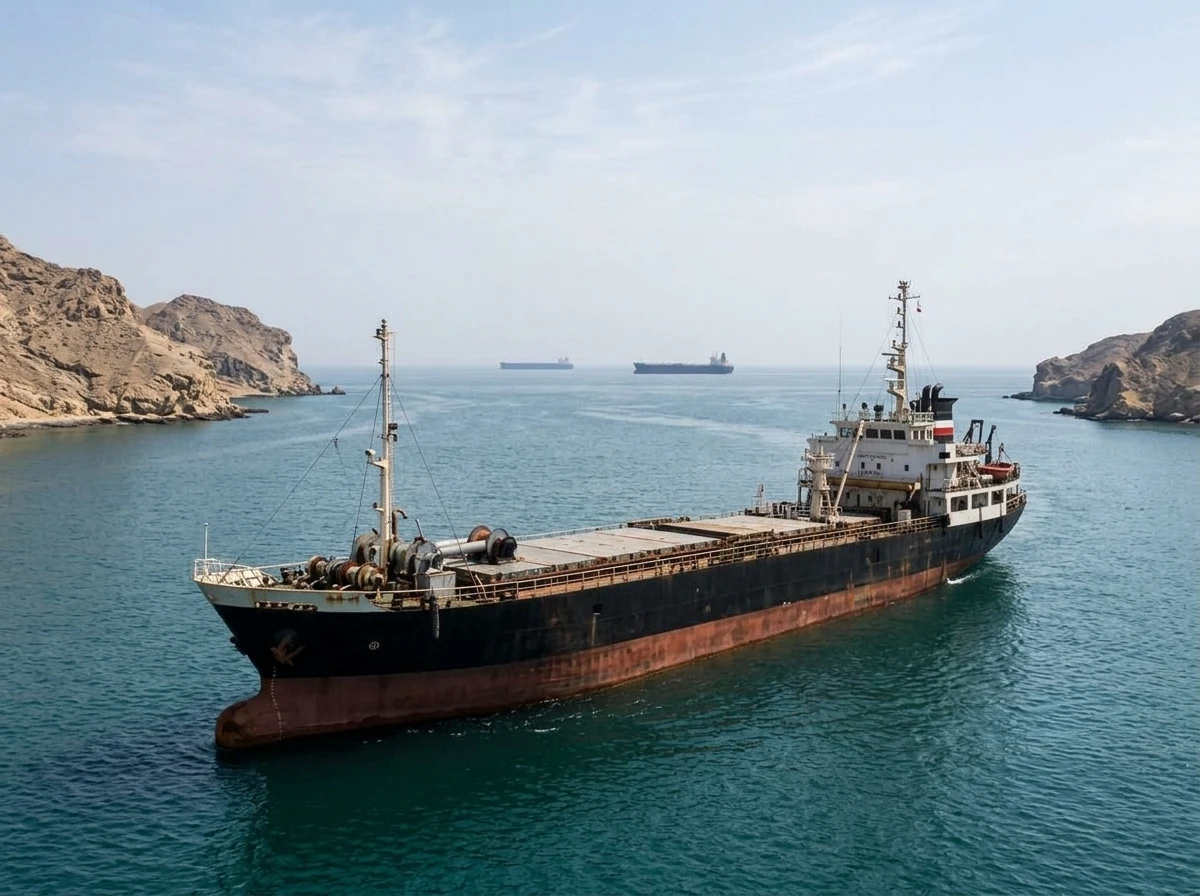
Shipping through the Strait of Hormuz, a conduit for roughly one-fifth of global oil before the conflict, has collapsed. MarineTraffic data cited in recent coverage showed only eight to fifteen vessels crossing on some August days against roughly 130 pre-war. Iranian Foreign Minister Abbas Araghchi has tied any reopening to US concessions including sanctions relief and reparations. Tehran also wants the US naval blockade lifted.
- Late February 2026: US-Israel war on Iran begins; Hormuz traffic disrupted
- June 2026: Brief memorandum collapses; tanker attacks and renewed blockade
- Early August: Trump cancels planned strike to allow talks; oil slides on optimism
- August 9-10: Trump says US is “only semi-negotiating”; Iran links full reopening to end of blockade and compensation demands
- August 11: Brent extends gains as clarity remains absent
President Donald Trump told Axios the US is watching Iran’s economic pain and prefers blockade pressure over fresh airstrikes. Brent settled around $87.72 on Monday after a roughly 5% jump. On Tuesday Brent climbed above $89 per barrel amid the same uncertainty. The residual risk premium is the point: even an announced deal would face credibility questions after earlier collapses.
The timeline itself is part of the premium. A brief memorandum already failed in June. Early August optimism faded once talks were described as only semi-active and Tehran restated conditions on the blockade and compensation. Markets now price not only barrels withheld but the chance that any future announcement unravels again.
- Vessel traffic: roughly 8 to 15 crossings on some August days
- Pre-war reference: roughly 130 crossings
- Brent Monday settle: about $87.72 after a roughly 5% jump
- Brent Tuesday: above $89 amid unchanged uncertainty
Trump’s preference for blockade pressure over fresh airstrikes keeps the physical constraint in place even without a new strike headline. That choice sustains the freight and insurance overhang while diplomats trade conditions that have not yet narrowed.
The Chokepoint Numbers That Matter for Asia
According to the US Energy Information Administration, oil flows through the strait averaged about 20 million barrels per day in 2024, equal to about 20% of global petroleum liquids consumption. Roughly 84% of that crude headed to Asian markets, with China, India, Japan and South Korea accounting for a large combined share. Pipeline bypass capacity in Saudi Arabia and the UAE exists but is limited relative to the volumes at stake.
Crowd observation on X and in logistics notes has already moved past the barrel price. Companies face higher freight, war-risk insurance, inventory buffers and longer routes. That connectivity premium does not appear on the crude screen yet it shows up in corporate costs and in equity risk premia for import-heavy economies.
For India the Asia concentration matters as much as the headline 20 million barrels. When most of the disrupted flow path points toward Asian refiners and importers, the adjustment does not disperse evenly across the globe. It concentrates in the same economies that already run large crude import bills.
Limited pipeline bypass in Saudi Arabia and the UAE caps how much volume can simply route around the strait. Until sea traffic recovers toward the pre-war reference near 130 vessels, the logistics stack (freight, insurance, buffers, longer voyages) remains a parallel cost layer beside the flat price of Brent and WTI.
Domestic Flows Meet a Hard Oil Ceiling
Monday’s FII purchase of ₹1,974.76 crore and the small Sensex and Nifty gains that day showed that domestic and foreign equity demand can still lift the tape when oil is not the dominant headline. Tuesday’s open reversed that lift once Brent pushed from the high $87 area toward $89 and Wall Street’s weaker close filtered through.
The mechanism is straightforward. Import dependence above 85% ties the rupee, the current-account arithmetic and inflation-sensitive rate expectations to the same crude marker that sets ATF and feedstock costs. When that marker jumps roughly 5% in a session and then extends, equity buyers step back from broad beta and crowd into relative shelter.
- Flow support arrives: FIIs buy and the index scrapes higher on a quieter oil day.
- Crude re-prices: Brent holds the high $80s and probes above $89 as talks stall.
- Sector split widens: aviation and cost-sensitive industrials lag; IT and select defensives hold up.
- Index upside caps: headline risk keeps directional positioning light until Hormuz clarity improves.
Hariselvan’s wait-and-watch framing fits that sequence. Earnings remain the stock-specific filter, which is why HCL Tech, Tech Mahindra and Infosys could still post gains inside a down session. Broader upside stays limited while the strait remains contested and the residual premium clings to the oil complex.
What Stalled Talks Imply for Positioning
Iran’s linkage of full reopening to sanctions relief, reparations and an end to the US naval blockade sets a high bar beside Washington’s stated preference for economic pressure over new airstrikes. Those positions can coexist for weeks. Markets must therefore trade a range defined by incomplete diplomacy rather than by a clean binary outcome.
Credibility is the binding constraint after the June memorandum collapse and the early August false dawn. An announced deal would still need to prove durable before the risk premium fully exits freight rates, war-risk cover and equity multiples in import-heavy sectors. Until then, each incremental signal from Tehran or Washington can move Brent and, through India’s import channel, the local book.
Positioning consequences follow from facts already on the screen:
- Index moves stay headline-sensitive rather than trend-driven.
- Oil-sensitive margins (aviation near 40% fuel cost share, paints, chemicals, tyres, logistics) absorb pressure first.
- IT and selective consumer names remain the preferred relative shelter on risk-off mornings.
- FII strength on quiet days does not guarantee follow-through once crude extends.
Ponmudi’s caution on complex negotiations and a subdued Asian backdrop is consistent with that map. The market is not closed to stock-specific stories. It is closed to aggressive index-level bets while vessel counts linger in the single- to low-double-digit range against a pre-war backdrop near 130 and while Asia still accounts for roughly 84% of the strait’s crude direction.
Headline-Driven Markets Stay Range-Bound
Until greater clarity emerges, markets are likely to remain headline-driven, with investors reluctant to take aggressive directional positions, Ponmudi said. Hariselvan added that higher crude may keep pressure on oil-sensitive sectors in the near term. Domestic earnings season remains the primary stock-specific driver, which explains why IT names can still advance while airlines and rate-sensitive or cost-sensitive industrials lag.
The renewed geopolitical uncertainty has triggered a rebound in crude oil prices, contributing to a weaker close on Wall Street and a subdued start across Asian markets, setting a cautious backdrop for domestic equities.
Ponmudi R of Enrich Money made that assessment as the session opened. The same logic holds later in the day: without a durable Hormuz arrangement, every incremental demand from Tehran or signal from Washington can re-price the oil complex and, through India’s import channel, the local equity book.
FIIs bought the previous day. That did not prevent the early slide. The pattern is consistent with a market that absorbs good domestic flows only until the next oil headline arrives. Tech and selective consumer names offer partial shelter. Broader upside stays capped while Brent holds the high $80s and the strait remains contested.
India has absorbed oil shocks before and continued growing. The current episode simply makes the transmission channels visible in real time: aviation and industrial margins first, currency and inflation second, and a cautious, earnings-plus-headline market third. Clarity on Hormuz would reverse the order. Until then the second-order costs keep showing up in the tape.

-
 TECH1 year ago
Where Garmin Watches are Made and How They are Assembled
-

 AUTO3 months ago
Tesla’s Roadster Is ‘a Few Weeks Away,’ Says Its Chief Designer
-
 NEWS10 years ago
Samsung Releases Galaxy Note7 TV Ad as Reddit AMA Leaks Specs
-
 NEWS10 years ago
Android 7.0 Nougat Rolls Out To Nexus Devices With New Emoji, Features
-
 FINANCE9 years ago
Cardano Price Surges as ADA Enters the Crypto Top Ten List
-
 NEWS10 years ago
Pre-Order the First Camera Made for Facebook Live Streaming Video
-
 FINANCE1 year ago
Binance Suspends Trading and Withdrawals for a System Upgrade
-
 FINANCE9 years ago
RChain Price Jumps Nearly 150% to a New All-Time High of $2.03