BUSINESS
Rubio Skips Delhi to Bargain Over Oil and Trade
Rubio’s Mumbai visit sells a near-done trade deal after a 100% oil-tariff pause, while a green-card freeze still hits Indian IT.

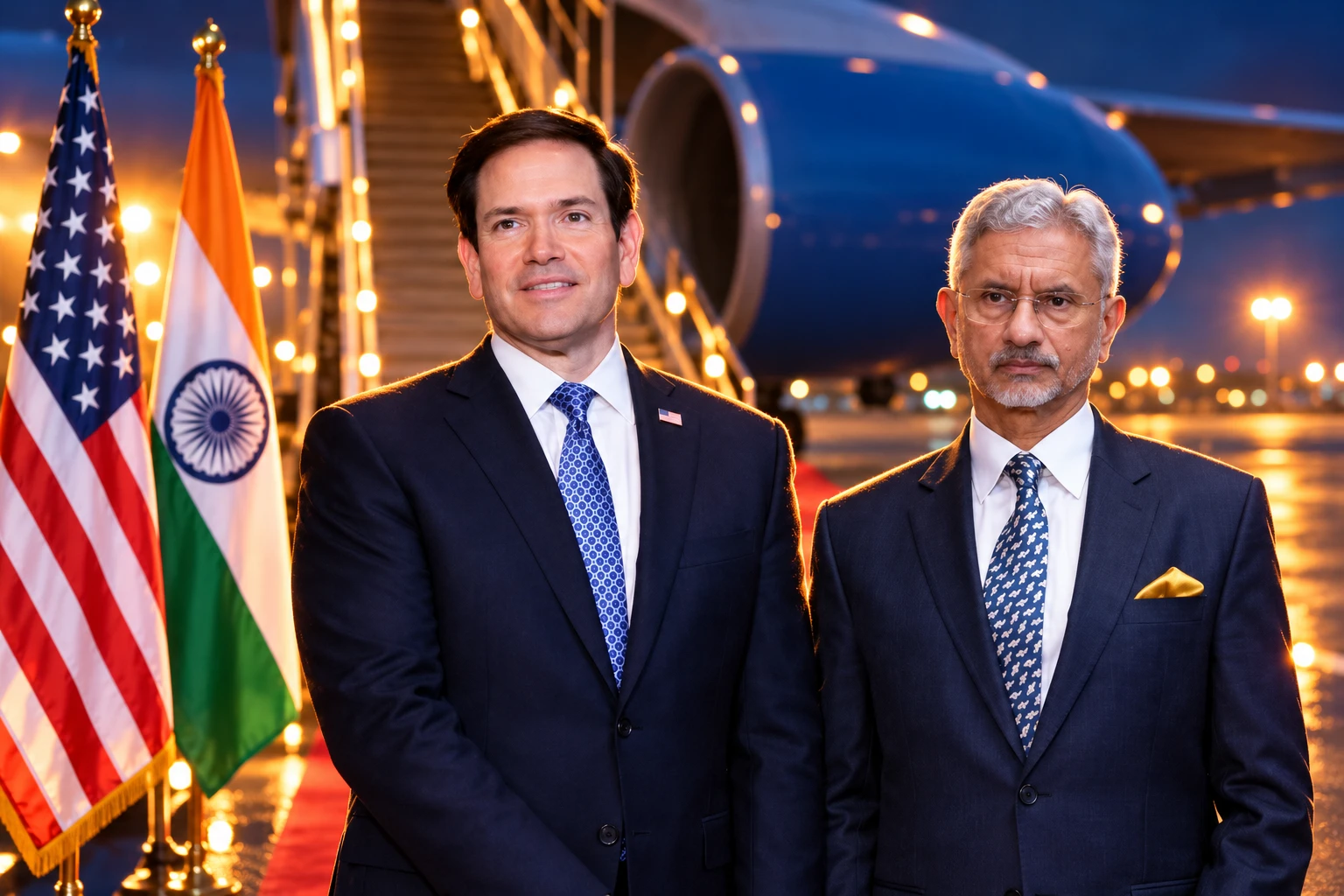
US Secretary of State Marco Rubio landed in Mumbai on October 20 for talks on a trade pact Washington had just sweetened with a pause on 100% oil tariffs. He skipped New Delhi. External Affairs Minister S. Jaishankar met him at the Taj Mahal Palace Hotel, and the two men later stood together at the memorial for the 2008 attacks.
On October 21 he flies to Jamnagar to talk Venezuelan crude with Reliance Industries. On October 8 the Labor Department froze green-card filings at eight technology firms, including Tata Consultancy Services, Infosys and Wipro.
Rubio Landed in Mumbai, Not New Delhi
The State Department listed Mumbai and Jamnagar, not Delhi, on Rubio’s October 17-22 travel notice, after a C5+1 stop in Samarkand, Uzbekistan. This is his second official trip to India this year. In May he sat with Prime Minister Narendra Modi and Jaishankar and joined a Quad foreign ministers’ meeting in the capital.
The India clock on October 20 was tight and public. He was due at Chhatrapati Shivaji Maharaj International Airport at 2:15 p.m., at the Taj memorial at 3:40 p.m., and across the table from Jaishankar at 3:50 p.m. A Freedom 250 reception at the Jio World Centre was set for 6:35 p.m., with Jaishankar as guest of honour, marking 250 years of US independence.
RUBIO’S MUMBAI-JAMNAGAR CLOCK
| Day | Time | Stop |
|---|---|---|
| October 20 | 2:15 p.m. | Lands at CSMIA, Mumbai |
| October 20 | 3:40 p.m. | Wreath at the Taj memorial |
| October 20 | 3:50 p.m. | Talks with Jaishankar at the Taj |
| October 20 | 6:35 p.m. | Freedom 250 reception, Jio World Centre |
| October 21 | 10:30 a.m. | Departs Mumbai for Jamnagar |
The wreath was for the November 26, 2008 attacks, which killed over 160 people, including six Americans. Rubio wrote that the United States and India still share the work of fighting terrorism, and he named those six citizens in his post from the hotel.
At the Taj Mahal Palace Hotel, I laid a wreath honoring the victims of the horrific November 26, 2008 terrorist attacks, including six American citizens.
We remember those lost, honor the courage of those who responded, and reaffirm the enduring U.S.-India partnership and our… pic.twitter.com/zAU1LvsPaK
— Secretary Marco Rubio (@SecRubio) October 20, 2026
Jaishankar said they had shared views on trade, energy, technology, defence and people to people ties, and on regional events. Foreign Secretary Vikram Misri and US Ambassador Sergio Gor sat in. The two ministers also held a trilateral with UAE Deputy Prime Minister and Foreign Minister Abdullah bin Zayed on energy, connectivity and current events.
Pleased to meet US @SecRubio in Mumbai today.
We shared views on further advancement of our ties, focusing on trade, energy, technology, defence and people to people ties. Also exchanged views on regional developments.
🇮🇳 🇺🇸 pic.twitter.com/KVrFPvWm0K
— Dr. S. Jaishankar (@DrSJaishankar) October 20, 2026
The Uzbekistan leg carried a US commercial group of over 200 business leaders. The India notice is thinner. It says Rubio will meet senior officials on the strategic partnership, regional politics and energy, and will see business leaders on investment. It does not put that 200-person group on the Gujarat flight.
The Graham Act Pause That Bought 60 Days
President Donald Trump signed the Lindsey O. Graham Sanctioning Russia and Iran Act on September 18. The statute let Washington put new duties on Russia and on countries that keep buying its oil and gas. In the implementing order, the rate on goods from the largest five importers of Russian crude and gas rises by 100% if a country knowingly makes new purchases on or after October 18. A separate line lifts the duty on goods from Russia by 500%. Both are extra charges on top of other US tariffs.
Trump waived those duties on October 16, four days before Rubio reached Mumbai and two days before the 100% trigger. He told Congress the waiver was in the national interest. The pause stays in force until the president or the secretary of state, with Treasury and the trade representative as needed, decides that further action is appropriate. It is not a repeal of the law.
Rubio, speaking in Samarkand, gave that pause a clock of his own. He said the president wanted a 60-day period to study what the sanctions and the tariffs would do to the world economy and to the US economy. He also tied the waiver to the India trade talks.
We’re trying to finalise a trade deal with India right now. We’re very close to doing that. That’s one of the things we take into consideration when the President makes a decision about national security waivers and things of that nature.
Marco Rubio, US Secretary of State, in Samarkand
He added that the measures were not only sanctions on Russia, because they include tariffs on countries such as India, and that India has diversified its energy mix but still takes a substantial amount from Russia because a pivot does not happen overnight. Geography is real, he said, and that is not an excuse, but it has to be balanced.
That is a different bargain from the one New Delhi lived through in 2025, when Washington stacked a 25% reciprocal duty with a 25% penalty on Indian goods over Russian oil, a combined 50% from late August that year. The Graham Act pointed a new 100% gun at the same dispute. The October 16 order holstered it for now.
FROM THE 50% DUTIES TO A PAUSED 100%
- August 2025: Combined 50% US duties on Indian goods take effect, a 25% tariff plus a 25% penalty tied to Russian oil.
- May 2026: Rubio’s first official India visit, including talks with Modi and Jaishankar and a Quad foreign ministers’ meeting in New Delhi.
- September 18, 2026: Trump signs the Graham Act, opening a path to 100% tariffs on the largest buyers of Russian oil and gas.
- October 8, 2026: Labor Secretary Keith Sonderling suspends PERM green-card filings at eight technology firms.
- October 16, 2026: Trump waives the Graham Act duties, including the 100% buyer tariff and the 500% duty on Russian goods.
- October 18, 2026: The date on which new Russian oil purchases would have triggered the 100% tariff, had the waiver not been issued.
- October 20, 2026: Rubio lands in Mumbai for talks with Jaishankar and a wreath at the Taj.
The USTR is told to keep watching who buys Russian crude and gas and who helps evade oil sanctions, and to tell the president if the waivers should move. India is on that list. So is China. The pause can come off as fast as it went on.
Why Jamnagar Is on the Map
Jamnagar holds Reliance’s refining complex, the world’s largest single-site plant, with capacity of 1.4 million barrels a day. Gor told an audience in New Delhi that Rubio would meet “some of the folks” at Reliance there, and that he expected chairman Mukesh Ambani to be present because Ambani runs the company. Trump said in March that Reliance would help build the first new US refinery in 50 years, a project Gor has tied to Brownsville, Texas.
In Mumbai on October 20, Rubio made the energy ask plain. He called India a refining superpower with the kit to run heavy crude, said Indian firms already hold oil concessions in Venezuela that can produce more, and said the US team would talk with Reliance about producing oil there. He also said India had made substantial progress in diversifying oil purchases, which he called a smart thing to do.
India is a refining superpower. They have the capability to refine heavy crude. They’ve done so in the past, and I think as more and more Venezuelan oil comes online, it’s something they can do.
Marco Rubio, US Secretary of State, in Mumbai
He was careful on scale. Venezuela alone cannot fill every hole in world supply, he said, but over time it can, and in the short term it can help. India sounds ready, he said, though sanctions and other blocks still sit in the way and will have to be worked through. Asked why he was going to Jamnagar, he said you have to see a company with that much refining capacity if you want to talk about making energy usable, especially when nation-states are involved.
The same Washington that spent 2025 taxing Indian goods over Russian barrels is now asking Indian refiners to process more heavy crude, including oil from Venezuela, as it looks for extra refined product. Rubio’s own words put that request on the record. The plant that can run those barrels is the reason a secretary of state is going to Gujarat instead of sitting in South Block.
The Trade Pact Is Still in Legal Drafting
Jaishankar said in the days before the visit that the talks were nearing a landing point. Rubio, in Uzbekistan, said the two sides were very close. Commerce and Industry Minister Piyush Goyal, speaking in New Delhi on October 15, put more ink on the page and a condition behind it.
“US bilateral trade agreement’s first tranche has been finalised and it is going through final contours, the legal drafting, and we hope to be able to finalise that soon and operationalise that once we get the competitive advantage over our peer countries,” Goyal said at the SRCC centenary conclave. He added that this was the same line he had used the day before, a week before, and three months before.
Commerce Secretary Rajesh Agrawal said talks were moving in the right direction and that legal drafting was under way on the US side as well, with the tariff structure still being rebuilt off Section 301 outcomes. A trade deal, he said, is meant to give preferential access against competitors, and that piece has to come with the new US tariff frame. India wants better rates than the countries it actually fights in the American market, not a signature for its own sake.
Talks have run since early 2025. The list on October 20 still included energy, trade and investment, defence, critical and emerging technologies, and West Asia. A first tranche in legal drafting is not a signed pact, and Goyal’s peer-advantage test is still live. Rubio can say the deal is very close. New Delhi can keep the pen in the drawer until the tariff math beats Vietnam and Bangladesh.
Eight Firms Lost the PERM Green-Card Lane
On October 8, Labor Secretary Keith Sonderling stood with Vice President J.D. Vance and said the department would stop taking new permanent labor certification filings, and stop working pending ones, at a set of large technology and outsourcing employers. PERM is the step a firm uses to show that no qualified US worker is available before it sponsors a foreign employee for a green card. It is not the H-1B visa. Existing H-1B status does not fall automatically when PERM is frozen.
EMPLOYERS CUT OFF FROM PERM
- Infosys: Indian IT services firm named in the October 8 suspension.
- Tata Consultancy Services: India’s largest IT exporter; it said it had filed fewer than 10 PERM applications in two years.
- Wipro: Indian IT services firm named in the same order.
- HCL Technologies: Indian IT services firm grouped with the others on the list.
- Cognizant: IT services firm named by Sonderling at the top of the roll.
- Capgemini: French IT services firm included with the Indian names.
- Microsoft: US technology company; Vance used it as the example for hiring American workers.
- Adobe: US software company named alongside Microsoft.
Vance said Microsoft is a great American company that has to hire great American workers, and that it cannot lay off American staff and replace them with “foreign indentured servants.” Nasscom, the Indian IT trade body, said firms have cut their use of H-1B visas and hired more people locally in the United States, and that relatively few staff move from H-1B to permanent residency through PERM. TCS told the exchange the freeze would not change its workforce plan or client work.
The channel is still a wide one. Employers filed 130,432 PERM prevailing-wage requests in the first three quarters of fiscal 2026, Labor Department figures show. Closing it at eight large sponsors does not empty the system. It does freeze the residency path at the firms that still send the most Indian staff to US clients, in the same month Washington is trying to close a trade text with New Delhi.
A planned six-figure H-1B fee is a separate fight. A California court blocked an earlier $100,000 levy in September, and the administration has kept pushing the cost of the visa up. That track and the PERM freeze sit beside the oil waiver, not under it. Goods may get a softer tariff while people get a harder gate.
A Protocol Fight Over Who Travels to Whom
The itinerary became a political object before Rubio’s wheels hit the runway. Gor, speaking on October 15, said Washington expected Jaishankar and other officials to come from Delhi to Mumbai. Congress leader Rahul Gandhi wrote that Rubio had summoned his employee to Mumbai and that Modi’s officials seemed confused about what was going on.
The ministry still confirmed the Mumbai meeting. Jaishankar was already in the city. He hosted UAE Deputy Prime Minister Abdullah bin Zayed there a day before Rubio arrived. A secretary of state who wants a refinery tour, a business audience and a hotel memorial can hold the bilateral in Mumbai. The capital still noticed that it was not on the published list.
Gor also used the trip to talk up energy. He has said the Jamnagar complex could matter for diesel supply into the US market, and he has pushed talks on Venezuelan barrels for India. The opposition line writes that as corporate diplomacy. The government line is that Jaishankar chose the venue and that the partnership still runs through trade, defence and technology as well as oil.
None of those arguments is settled by a wreath or a handshake. The Graham Act waiver can be pulled by the same two men who are now posing in Mumbai. The first tranche of the trade pact is in legal drafting until India gets the rate it wants against its peers. PERM is closed at eight firms. Rubio leaves Mumbai at 10:30 a.m. on October 21 for Jamnagar, to walk a refinery and talk Venezuelan crude, with all three files still open.

Bulk Scotch Still Faces Full Duty After India’s UK Deal

Typhoon Champi Loops Off Taiwan and Still Injures 527

PM Modi Opens Chinmaya’s AI Guru and Asks for Unity

Mahim Police Hold a JeM Suspect on Enmity Charges

Gold Falls Below $4,000 as Hormuz Oil Hits $117

The iPhone 18 Pro Max Splits Apple’s Fall in Two

OpenAI Calls GPT-6 Astra AGI Then Locks Its Exploits

Clancy Juror Says the Holdout Never Cited Evidence

Trump Claims Hormuz Control as Oil Holds Near $96

Russia Closes the Goethe-Institut Berlin Tried to Save

 NEWS2 months ago
The iPhone 18 Pro Max Splits Apple’s Fall in Two
- NEWS2 months ago
OpenAI Calls GPT-6 Astra AGI Then Locks Its Exploits
- NEWS1 month ago
Clancy Juror Says the Holdout Never Cited Evidence
- BUSINESS2 months ago
Trump Claims Hormuz Control as Oil Holds Near $96
- LIFESTYLE2 months ago
Russia Closes the Goethe-Institut Berlin Tried to Save
- AUTO2 months ago
Volkswagen’s Job Cuts Leave Four Plants Without Cars
- NEWS2 months ago
Dyson Puts Nurovi Robots on Sale Without the UV Flagship
- NEWS2 months ago
The Lincoln’s 286-Day War Cruise Ends at a Thai Pier