
HEALTH
Karnataka’s One-Year Tobacco Ban Joins a Long Cycle of Partial Wins
Karnataka’s August 2026 order under FSSAI rules repeats a decade-plus pattern of state gutkha bans that lower some use yet leave mixing loopholes and black.

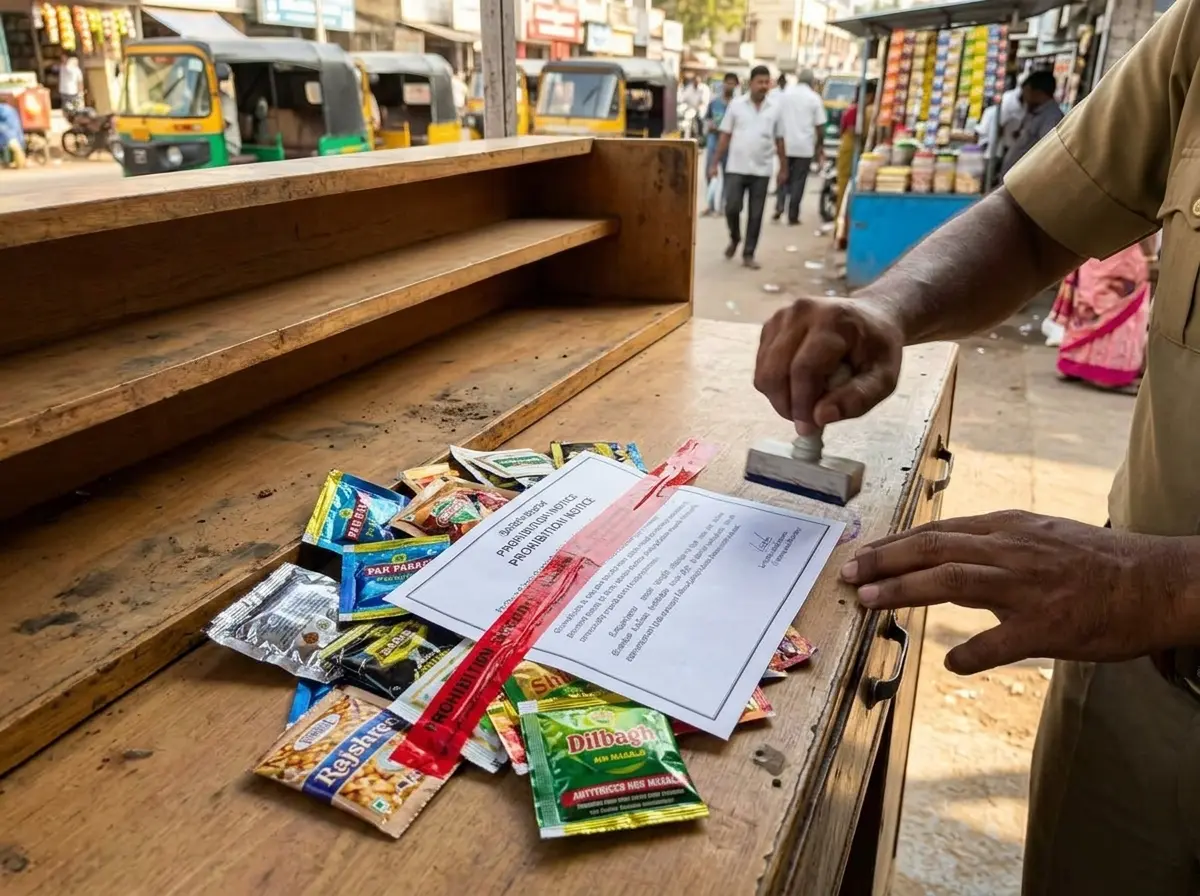
Karnataka barred the manufacture, storage, transportation, distribution and sale of gutkha, pan masala and any other products containing tobacco or nicotine for one full year starting 10 August 2026. The Food Safety and Drugs Administration order cites public health under the Food Safety and Standards Act and targets both ready-mixed packets and items sold separately so consumers can mix them.
Commissioner Srinivas K framed the move as part of a push for a healthy, addiction-free state. Special inspections by Food Safety Officers are already under way across the supply chain. The step arrives two days after the notification and lands inside a familiar Indian pattern: temporary state bans that begin with clear intent and then meet the same workarounds year after year.
The order’s reach is deliberate. It does not stop at branded sachets. It also names the separate components that let a buyer rebuild the product at the counter. That breadth is the difference between a paper ban and one that can touch daily retail practice, if officers apply it that way in the field.
What the Notification Covers
The order rests on Section 30(2)(a) of the Food Safety and Standards Act, 2006, read with Regulation 2.3.4 of the 2011 Prohibition and Restrictions on Sales Regulations. That regulation states plainly that tobacco and nicotine shall not be used as ingredients in any food products.
It reaches gutkha, pan masala and “other prohibited products containing tobacco and/or nicotine,” whether sold in sachets, pouches, packages or containers. It also catches products marketed separately if they facilitate consumer mixing. Manufacture, storage, transport, distribution and sale all fall under the prohibition for twelve months from the issue date.
The department has asked the public to report violations and cooperate with enforcement. Food Safety Officers lead the inspections. The language matches the template used by multiple states when they renew similar one-year orders.
Because the legal hook is food safety rather than a standalone tobacco statute, the same clause can travel from factory floor to roadside stall. Officers can act on storage and transport as readily as on open sale. That design explains why states keep returning to this wording when they reissue annual bans.
Fifteen Years of the Same Legal Tool
India’s modern gutkha crackdown began after the 2011 FSSAI regulation. States then issued prohibitory orders under Section 30. Many have renewed them annually ever since. Courts have largely upheld the food-safety route against industry challenges that once tried to treat the products solely under tobacco laws.
- 2011: FSSAI Regulation 2.3.4 takes effect, barring tobacco and nicotine as food ingredients.
- 2012 onward: Maharashtra and other states issue first one-year bans; more states follow within two years.
- 2014: WHO and Johns Hopkins document early impacts across seven states including Karnataka.
- 2024-2026: Telangana, Tamil Nadu, Nagaland and others continue or extend identical one-year notifications; Karnataka’s 10 August 2026 order joins that list.
The pattern is deliberate. A fixed one-year term keeps the order fresh, forces periodic review, and sidesteps some longer-term legal attacks. It also means the ban never becomes permanent without fresh political will each cycle.
Continuity across more than a decade has turned the one-year notice into a shared administrative habit. Each renewal restates the same core ban, then leaves results to local inspection capacity and political attention inside that twelve-month window.
Karnataka’s Own Tobacco Numbers
The state’s baseline comes from the Global Adult Tobacco Survey. The Karnataka GATS-2 fact sheet data from 2016-17 remains the most detailed public snapshot.
- 22.8% of adults used any tobacco (down from 28.2% in GATS-1).
- 16.3% used smokeless tobacco (men 22.2%, women 10.3%).
- 5.9% used gutka specifically; betel quid with tobacco sat at 9.4%.
- Mean age of initiation rose to 19.8 years.
Nationally the Tobacco Atlas puts adult smokeless use at 21.4 percent adult smokeless tobacco use. Smokeless products drive a large share of India’s oral cancers and contribute to more than a million tobacco-attributable adult deaths a year. Karnataka’s rates sit below some northern states yet remain high enough that any sustained drop would register in cancer registries and hospital loads within a few years.
| Indicator (Karnataka GATS-2) | Men | Women | All adults |
|---|---|---|---|
| Current smokeless tobacco | 22.2% | 10.3% | 16.3% |
| Current gutka | 10.4% | 1.3% | 5.9% |
| Current any tobacco | 35.2% | 10.3% | 22.8% |
| Betel quid with tobacco | 10.8% | 8.0% | 9.4% |
Those figures pre-date several renewals of state bans. Later national surveys show further gradual declines in some categories, but gutka and related products have proved sticky.
The gender split matters for enforcement messaging. Men account for most gutka use in the state data, while betel quid with tobacco is more evenly shared. A ban that only disrupts one product form can leave parallel habits untouched unless officers and health workers treat the full smokeless set as one problem.
What Earlier Bans Delivered
A 2014 WHO-Johns Hopkins study across seven states (Assam, Bihar, Gujarat, Karnataka, Madhya Pradesh, Maharashtra, Odisha plus Delhi) remains the clearest multi-state evidence.
- Support for the bans ran at 92%; 99% agreed they were good for youth health.
- Of continuing pre-packaged gutka users, 49% said they consumed less after the ban.
- A substantial share of quitters in each state (41-88%) named the ban as the reason they stopped.
- Pre-packaged gutka largely vanished from open retail display; prices of remaining illicit packs rose.
- Yet most users simply bought pan masala and tobacco separately and mixed their own.
- More than a quarter of retailers reported being approached by suppliers to keep selling banned packs.
A smaller Mumbai study after Maharashtra’s 2012 ban found 23.5% of gutkha users quit and 55.9% reduced use, largely because of non-availability. Vendors still sold it clandestinely or in altered forms at higher prices. Similar vendor surveys in other cities showed income often held steady through the black market.
The consistent finding: open retail of branded mixed gutkha shrinks fast. Overall smokeless consumption falls more modestly because the mixing workaround and illicit channels absorb much of the demand.
Public backing was never the weak link in those early years. Availability and substitution were. Where pre-packaged stock disappeared from shelves, dual-product counters and higher-priced illicit packs filled the gap within months. That sequence is the benchmark against which Karnataka’s new cycle will be judged.
Who Carries the Immediate Cost
Small paan-shop owners and street vendors lose a high-margin, high-turnover item. Many operate on thin daily cash flow; gutkha and pan masala often subsidise the rest of the stall. Larger organised manufacturers of pure tobacco or cigarette firms face limited direct exposure, as one market note on X observed, because their core volumes sit elsewhere. Informal gutkha makers and transporters take the heaviest hit when raids succeed.
- Street and paan vendors: lose a fast-moving margin item that props up thin daily cash flow.
- Informal makers and transporters: face the sharpest losses when seizures land.
- Organised cigarette and pure-tobacco firms: limited direct hit, core volumes elsewhere.
- Continuing consumers: higher prices or lower-quality illicit product.
- The state: slower fiscal and health returns through fewer lesions, lower treatment costs, less absenteeism.
Consumers who keep using pay higher prices or accept lower-quality illicit product. Public health gains accrue slowly to the state through fewer oral lesions, lower cancer treatment costs and reduced workplace absenteeism. The department’s appeal for citizen reporting tries to enlist ordinary people as unpaid enforcers, a common feature of these orders.
Chief Minister D.K. Shivakumar had already warned manufacturers in June 2026 that products found with intoxicants could face full bans, linking the category to the state’s broader anti-drug posture. The August notification converts that warning into a concrete, time-bound order.
The Mixing Loophole That Never Fully Closed
Regulation 2.3.4 bans tobacco and nicotine inside food. Industry response was rapid: sell flavoured pan masala (areca nut, lime, spices) under the old brand colours and logos, and sell loose or pouch tobacco beside it. The consumer does the final mix. Surrogate advertising of the “tobacco-free” pan masala kept brand recall alive on buses, billboards and cricket grounds.
Karnataka’s 2026 order explicitly tries to close that door by covering products “sold either individually or in a manner that facilitates mixing by consumers.” Enforcement will decide whether dual display at the same counter still occurs. Past studies showed the practice became the new normal within months of earlier bans.
Illicit pre-mixed packs also never disappeared. Raids seize them regularly; supply simply shifts to smaller, more mobile networks. Quality control vanishes, raising the risk of adulteration. Public cheers on X for cleaner streets and less spitting sit beside quieter field notes that “enforcement will decide if this actually bites or just stays on paper.”
Closing the loophole on paper is the easy half. The hard half is proving, stall by stall, that two products sold together for immediate mixing count as the same offence as a ready-made sachet. Without that field reading, the 2026 wording risks repeating the earlier cycle in which branded mixed packs faded while total smokeless volume held up.
Annual Renewal Keeps Pressure Without Permanence
States have treated the one-year term as a feature, not a flaw. Fresh orders reset the clock, invite a new round of inspections, and limit the window in which industry can build a long legal siege against a single notice. Karnataka’s August 2026 text follows that same administrative rhythm already used by Telangana, Tamil Nadu, Nagaland and others.
The cost of the design is continuity of effort. Each cycle must re-win attention from officers, prosecutors and political leadership. When that attention fades after the first publicity wave, seizure volumes drop and dual-pack retail returns to routine. Court petitions in some states have already shown how a delayed or diluted year can blunt an order before it matures.
Commissioner Srinivas K’s framing of a healthy, addiction-free state therefore has to survive past the announcement week. The legal tool is settled. The open variable is whether twelve months of inspections stay intense enough to change supplier and vendor calculations before the next renewal debate begins.
Quit Support Still Trails the Enforcement Wave
The GATS snapshot showed many smokeless users already wanted to stop, and advice from health workers already reached a majority of them. What remained patchy was sustained cessation support once non-availability alone wore off. Earlier bans produced quitters who named the ban as their reason, yet they also produced large groups who only cut down or switched to mixed components.
Karnataka’s order can shrink open retail quickly if dual-pack sales are treated as violations. Lasting drops in the 16.3 percent smokeless rate, and in the 5.9 percent gutka rate, need a parallel path for people ready to quit. Without that path, the same studies imply demand will lean on illicit packs and home mixing once the first raid wave passes.
Health gains from fewer oral lesions and lower cancer loads will show up only if consumption, not merely shelf display, falls for long enough to register in registries and hospital data. Enforcement creates the scarcity. Quit support decides how much of that scarcity turns into lasting exits rather than temporary rationing.
One Year Is Both Long Enough and Too Short
Twelve months gives Food Safety Officers time to run repeated inspection waves and build cases. It is also short enough that manufacturers and distributors can wait it out, stockpile outside the state, or prepare the next dual-pack iteration. Most states simply reissue the order when the year ends. A few face court petitions that delay or dilute enforcement for months.
Karnataka’s success will turn on three practical tests:
- Dual-pack sales are treated as violations in the field, not only on paper.
- Seizure and prosecution volumes stay high after the first publicity wave.
- Quit-support services expand so people who want to stop have more than non-availability as a reason.
The GATS numbers show many users already want to quit; advice from health workers reaches a majority of smokeless users, yet sustained cessation support remains patchy.
The order is real, the legal foundation is settled, and earlier bans produced measurable though incomplete reductions. The same historical pattern also shows that a one-year notification alone rarely dismantles the market. What happens on the ground between August 2026 and August 2027 will decide whether this cycle looks different from the last dozen.

-
 TECH1 year ago
Where Garmin Watches are Made and How They are Assembled
-

 AUTO3 months ago
Tesla’s Roadster Is ‘a Few Weeks Away,’ Says Its Chief Designer
-
 NEWS10 years ago
Samsung Releases Galaxy Note7 TV Ad as Reddit AMA Leaks Specs
-
 NEWS10 years ago
Android 7.0 Nougat Rolls Out To Nexus Devices With New Emoji, Features
-
 FINANCE9 years ago
Cardano Price Surges as ADA Enters the Crypto Top Ten List
-
 NEWS10 years ago
Pre-Order the First Camera Made for Facebook Live Streaming Video
-
 FINANCE1 year ago
Binance Suspends Trading and Withdrawals for a System Upgrade
-
 FINANCE9 years ago
RChain Price Jumps Nearly 150% to a New All-Time High of $2.03