
FINANCE
July CPI Rise to 4.45% Locks RBI Hold Through Food Peak
Retail inflation edged to 4.45% in July as food hit 5.52%, confirming RBI’s Q3 peak outlook and keeping rates on hold with core still contained.

India’s retail inflation rose to 4.45% in July from 4.38% in June, the National Statistics Office reported on 12 August, as food prices pushed the consumer price index higher for a second straight month above the Reserve Bank of India’s 4% target.
The print matched the broad contour of market forecasts and the central bank’s own near-term path. Food inflation, measured by the consumer food price index, climbed to 5.52% from 5.32%. Rural households felt it more than urban ones. The numbers leave the RBI’s August decision to hold the repo rate at 5.25% looking well founded and keep the door closed on early cuts while the food peak is still ahead.
Two months above target do not yet rewrite the policy map. They do confirm that the food impulse is still building, just as the Monetary Policy Committee said it would when it left the repo unchanged earlier in August. Headline momentum remains a food story first and a demand story second.
Rural Readings Outran the Cities
Combined CPI stood at 107.94 in July on the new 2024 base. Rural inflation printed 4.84% against urban 3.96%. On the food side the gap was similar: rural CFPI inflation 5.79%, urban 5.05%.
| Measure | July 2026 (Prov) | June 2026 (Final) |
|---|---|---|
| CPI Combined | 4.45% | 4.38% |
| CPI Rural | 4.84% | 4.74% |
| CPI Urban | 3.96% | 3.93% |
| CFPI Combined | 5.52% | 5.32% |
| CFPI Rural | 5.79% | 5.45% |
| CFPI Urban | 5.05% | 5.09% |
The year-on-year CPI inflation of 4.45% is the highest since the revised series began earlier this year. Month-on-month the general index rose 0.88% while the food index jumped more sharply. Response rates hit 100% in both rural and urban markets, MoSPI said.
The rural lead is not a one-month quirk. Food still claims a larger share of rural budgets, so the same spice and bulb shocks land harder outside the cities. Urban CFPI even eased a touch from June to July, while rural CFPI climbed. That split keeps the combined food reading elevated even when city markets look calmer.
Full response rates matter for trust in the print. With every surveyed market reporting, the rural-urban gap is less likely to be a sampling artefact and more likely to reflect genuine price pressure in village supply chains.
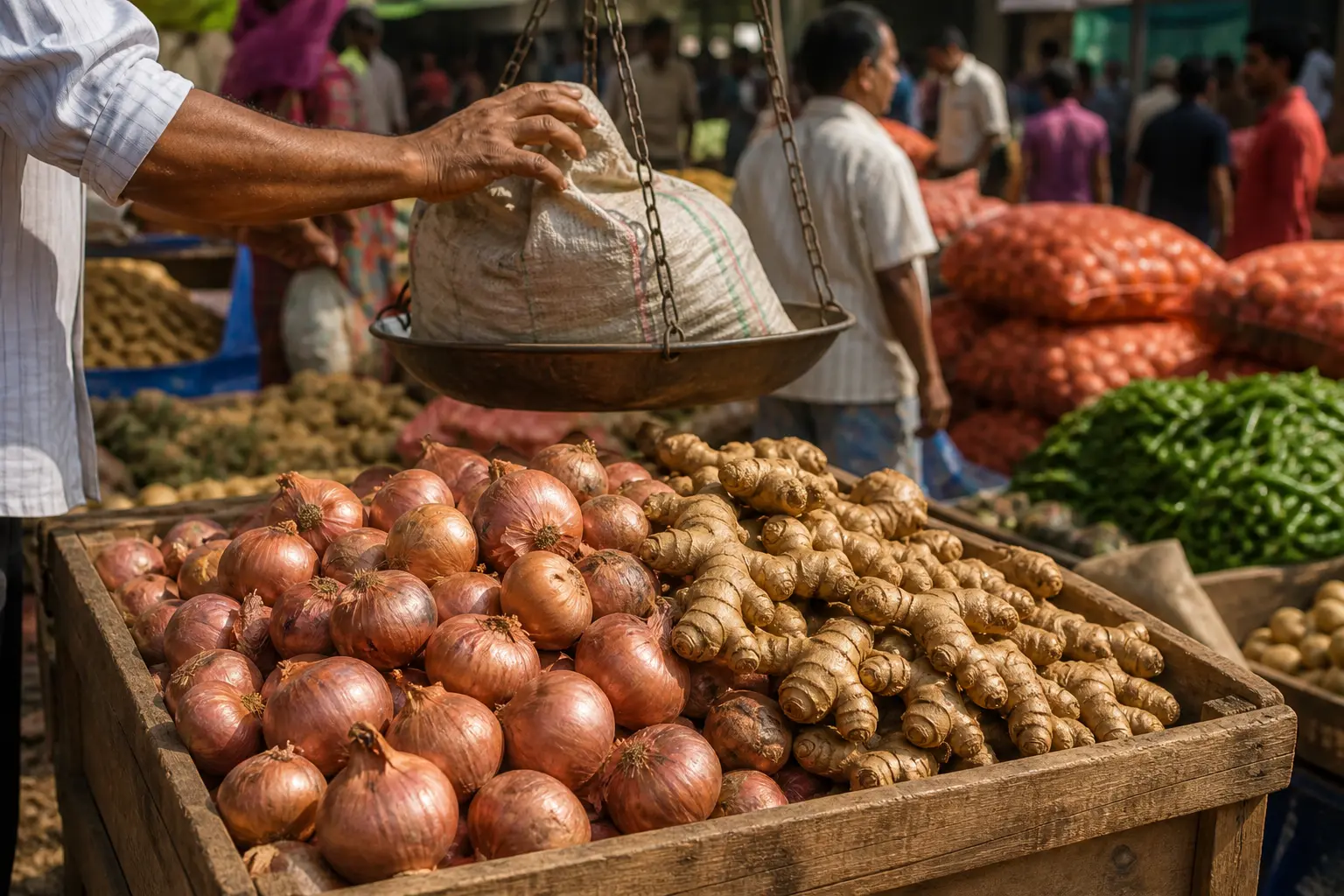
Ginger, Garlic and Onion Led the Food Charge
Specific perishables and spices did most of the damage. Ginger inflation accelerated to 83.62% from 50.41% in June. Garlic climbed to 35.36% from 17.93%. Onion inflation jumped to 22.54% from 4.73%.
- Ginger: 83.62% (weight 0.2556)
- Garlic: 35.36% (weight 0.3738)
- Onion: 22.54% (weight 0.7006)
- Silver jewellery: 109.84%
- Gold/diamond/platinum jewellery: 32.98%
Offsetting those gains, potato prices fell 16.56% year-on-year, tomato deflated 4.59%, peas 5.27% and lady’s finger 5.52%. The food and beverages division overall registered 5.24% inflation. Beverages themselves were flat at 0.04%.
Uneven monsoon progress and emerging El Niño concerns have kept supply of some kharif-sensitive items tight. Vegetable prices often swing hard on short harvest cycles; the July basket shows that pattern in reverse for potatoes and tomatoes while bulbs and rhizomes spiked.
Onion’s heavier weight means its jump from single digits to above 22% moves the food index more than ginger’s larger percentage rise. Garlic sits between the two on weight and still doubled its pace in a month. The three items together explain why food inflation climbed even while several other vegetables deflated.
Beverages near zero kept the broader food and beverages division from running as hot as the pure CFPI. That cushion is thin. If bulbs and spices stay firm into the festival quarter, the division reading will track the food index more closely.
Personal Effects and Restaurants Added Non-Food Heat
Outside food the standout pressure sat in personal care, social protection and miscellaneous goods and services at 14.77%. That was driven by “other personal effects” at 43.54%, a category that includes jewellery. Silver jewellery alone ran above 100%. Transport inflation edged up to 4.43%, with operation of personal transport equipment at 7.36% and goods transport services at 7.77%. Restaurants and accommodation services printed 7.72%.
Housing stayed soft at 2.22% overall. Health was 1.34%, education services 3.64%, clothing and footwear 3.38%. Information and communication barely moved at 0.63%. The division-wise picture shows food and beverages still the largest single contributor, yet precious-metal and dining-out costs kept miscellaneous and services categories elevated.
Core measures that strip food and fuel (and sometimes precious metals) remain contained according to private estimates and RBI commentary. That separation matters for the second-order read: demand-side pressure is limited even as headline numbers sit above target.
Soft housing, health and communication readings show that broad services inflation is not running away. The heat is concentrated in jewellery, transport operation and dining. Strip those and the non-food picture looks far quieter than the 14.77% miscellaneous print suggests at first glance.
The RBI Already Wrote This Script
At its 3-5 August meeting the Monetary Policy Committee kept the repo rate unchanged at 5.25% and retained a neutral stance. It trimmed the FY27 CPI forecast to 5% from 5.1% and raised the GDP growth projection to 6.7%. Quarter-wise it sees 4.7% in Q2, a peak of 5.9% in Q3 and 5.5% in Q4.
| Horizon | RBI Projection |
|---|---|
| FY27 CPI (full year) | 5.0% |
| Q2 CPI | 4.7% |
| Q3 CPI (peak) | 5.9% |
| Q4 CPI | 5.5% |
| FY27 GDP growth | 6.7% |
| Repo rate (held) | 5.25% |
As projected earlier, headline inflation is expected to rise further in the near term and is likely to peak in the third quarter of this year, primarily due to food and fuel prices, before moderating thereafter. The underlying inflation, reflected in core inflation excluding precious metals, which has remained benign for some time, is expected to align with overall core inflation towards the end of the financial year.
Governor Sanjay Malhotra made the point after the policy decision. July’s outcome sits squarely inside that path. A Reuters poll ahead of the data had expected roughly 4.5%. Food came in hotter than many private estimates, yet the headline surprise was small. The second-order consequence is straightforward: the pause stays locked at least until the Q3 numbers arrive and the monsoon outcome firms up.
Risks the RBI flagged remain live: West Asia tensions and crude volatility, uneven southwest monsoon under El Niño conditions, and global trade uncertainty. Softening in some global oil prices helped the slight downward revision to the full-year CPI projection, but the bank still sees risks as evenly balanced.
July at 4.45% leaves the path to a 5.9% Q3 peak still open. The committee’s own arc already baked in a further rise. Matching the near-term forecast so closely gives the RBI cover to wait rather than react to a single print.
Households and Rate-Sensitive Borrowers Carry the Load
Rural consumers face the sharper food bill. Higher rural CPI and CFPI readings mean a larger share of household budgets is already going to staples. Urban inflation is lower but dining-out and transport costs still bite. Jewellery-driven miscellaneous inflation hits discretionary spending and savings in physical assets.
On the other side of the ledger, banks and rate-sensitive sectors benefit if the contained core keeps the RBI from hiking and eventually allows cuts once the food peak passes. Equities have already priced a prolonged hold; the FPI July inflow into Indian equities arrived against a tight trading range and thin domestic institutional cash. Fiscal space looks healthier after July GST collections of Rs 2.11 lakh crore, which rose 15.4% and opens modest room for supply-side measures if vegetable prices stay elevated.
Farmers of onions, ginger and garlic enjoy higher realisations in the short run. Processors and restaurants face margin pressure. The net distribution effect tilts against lower-income rural households whose food share is highest.
Positive real rates at a 5.25% repo and headline inflation still near 4.5% favour depositors over new borrowers. Home and auto loan demand tends to wait when markets price a long hold. That restraint is the channel through which a food-led headline still cools rate-sensitive spending even while core stays contained.
How the New Series Changes the Baseline
India shifted to a 2024 base year for CPI earlier in 2026, updating weights and the consumption basket. The new series makes direct long-run comparisons with the old 2012-base data imperfect. Still, the July 4.45% reading is the highest under the revised methodology so far. Food weight remains substantial near 46% in the basket, so perishable spikes continue to dominate headline moves.
Historical averages under the prior series sat near 5.6%. The current episode is milder than the 2022-23 or 2013 peaks, yet it arrives after a period of sub-4% prints that allowed earlier easing. The MoSPI all-India CPI series now tracks both the general index and the CFPI in real time on the ministry dashboard, with state-level detail available on the eSankhyiki portal.
Monsoon performance will decide whether vegetable deflation continues or onions and spices stay elevated into the festive quarter. El Niño risks remain the main weather variable for kharif output of rice, pulses and oilseeds.
A near-46% food weight means the headline will keep tracking harvest and storage outcomes more than wage or credit cycles. That is why the RBI can hold while core is benign, and why a single bad vegetable season can still push the print toward the Q3 peak the committee already flagged.
Supply Shocks Still Outweigh Demand Pressure
The July mix points to supply stress in a narrow set of farm items, not a broad overheating of demand. Ginger, garlic and onion accelerated together while potatoes, tomatoes, peas and lady’s finger deflated. That dispersion is typical of harvest and storage shocks rather than a uniform rise in household spending power.
Contained core readings, soft housing at 2.22%, and information and communication at 0.63% reinforce the same split. When services and rent stay quiet, the policy problem is timing the food peak, not cooling an overheating economy.
- Food and beverages: 5.24%, still the main headline driver
- Miscellaneous and personal effects: elevated on jewellery, not broad goods
- Transport and restaurants: firm, but narrower than food
- Housing, health, education, clothing, communication: all soft to moderate
El Niño and uneven monsoon progress keep the supply risk alive for rice, pulses and oilseeds as well as the spices already spiking. West Asia tensions and crude volatility remain the external swing factors the RBI listed. Softening in some global oil prices bought the small downward tweak to the full-year CPI forecast; that cushion can fade if fuel re-accelerates.
Fiscal Strength Offers a Narrow Buffer
July GST collections at Rs 2.11 lakh crore, up 15.4%, give the Centre and states a little more room if they choose targeted supply measures on vegetables or fuels. Strong indirect tax intake does not lower onion prices by itself. It does ease the trade-off between supporting households and protecting the fiscal math while the RBI stays on hold.
Foreign portfolio inflows in July and a firmer growth projection at 6.7% also reduce the sense of a policy bind. Growth has been upgraded even as the inflation path still climbs toward a Q3 peak. That combination favours patience on rates over a defensive hike.
The buffer is narrow. GST strength and modest FPI flows do not cancel rural food stress or jewellery-driven hits to discretionary budgets. They only mean the macro backdrop can absorb a longer pause without an immediate growth scare.
The Path Runs Through the Festival Quarter
August CPI is due on 14 September. Until then the July data reinforce the RBI’s base case: food and fuel lift the headline into a Q3 peak near 6%, core stays orderly, and policy waits. Growth has been upgraded, GST is firm, and foreign flows have returned in modest size. The second-order cost of the food spike is simply more time spent at 5.25% with real rates still positive.
- 3-5 August: MPC held the repo at 5.25% and trimmed the FY27 CPI view to 5%.
- 12 August: July CPI printed 4.45%, in line with the near-term rise the committee described.
- 14 September: August CPI release will test whether food momentum is still building.
- Q3 FY27: RBI expects the peak near 5.9% before moderation in Q4.
If the monsoon recovers and global crude stays contained, the moderation the central bank expects after December becomes more likely. If spices and bulbs stay high and fuel re-accelerates, the peak could linger and push any eventual easing deeper into 2027. For now the numbers say the pause is the path of least resistance.
Markets have already treated a prolonged hold as the base case. The next decisive evidence is not a single jewellery or transport print. It is whether the festival quarter delivers the food peak and the subsequent easing path the RBI has on the books.

-
 TECH1 year ago
Where Garmin Watches are Made and How They are Assembled
-

 AUTO3 months ago
Tesla’s Roadster Is ‘a Few Weeks Away,’ Says Its Chief Designer
-
 NEWS10 years ago
Samsung Releases Galaxy Note7 TV Ad as Reddit AMA Leaks Specs
-
 NEWS10 years ago
Android 7.0 Nougat Rolls Out To Nexus Devices With New Emoji, Features
-
 FINANCE9 years ago
Cardano Price Surges as ADA Enters the Crypto Top Ten List
-
 NEWS10 years ago
Pre-Order the First Camera Made for Facebook Live Streaming Video
-
 FINANCE1 year ago
Binance Suspends Trading and Withdrawals for a System Upgrade
-
 FINANCE9 years ago
RChain Price Jumps Nearly 150% to a New All-Time High of $2.03