
BUSINESS
India Pushes Its Solar Cell Sourcing Mandate to December 31
MNRE has deferred India’s mandatory domestic solar cell rule to December 31, exposing a capacity gap between panels and cells that new plants cannot close that fast.

India’s renewable energy ministry has pulled back a mandatory domestic solar cell rule for the second time in as many months. On Saturday, the Ministry of New and Renewable Energy (MNRE) told developers of domestic, commercial and industrial solar projects they have until December 31 to keep sourcing cells from wherever they want, instead of switching immediately to India’s approved domestic list.
The reprieve buys time. It leaves the five-to-one gap between India’s solar panel factories and its solar cell factories exactly where it was, a gap now colliding with a module glut at home and a 126 percent US tariff wall abroad.
A Second Reprieve Inside Seven Weeks
The rule at issue is the Approved List of Models and Manufacturers List-II, widely known in the industry as ALMM-II or the domestic content requirement mandate. It forces solar projects to use cells certified by India’s own approved manufacturers, not the imported cells, mostly from China, that have fed the bulk of India’s module assembly lines for years.
In an office memorandum issued Saturday, the ministry said the exemption followed detailed deliberations with solar industry stakeholders to ensure a smooth transition. The timing is notable. Just seven weeks earlier, on May 25, the government had said there would be no blanket relief from the mandate, offering only case by case extensions to developers who had already installed modules or completed land acquisition, financial closure or connectivity arrangements.
Saturday’s memo goes further than that. It grants a blanket exemption to an entire category of projects until December 31, seven additional months to commission without meeting the cell sourcing rule.
A senior government official told The Indian Express, the newspaper that first reported the exemption, why the ministry moved.
The number and capacity of module manufacturers is pretty high vis-a-vis domestic cell manufacturers. This will allow domestic module manufacturers to get some more time to adjust to the ALMM-II and protect their investment.
The saga has moved fast enough that the dates alone tell most of the story.
- December 2024: MNRE first announces it will require domestically produced solar cells under ALMM List-II, giving manufacturers roughly 18 months of lead time.
- May 25, 2026: The ministry reiterates the mandate and rules out blanket relief, days before it takes effect.
- June 1, 2026: The domestic cell sourcing requirement comes into force for eligible projects.
- July 18, 2026: MNRE issues a fresh office memorandum exempting domestic, commercial and industrial projects until December 31.
Five Times More Module Capacity Than Cells
Cells are the physical building block of a solar panel. Polysilicon gets processed into ingots, ingots are sliced into wafers, wafers become cells, and cells get soldered and laminated into the finished modules installed on rooftops and solar farms.
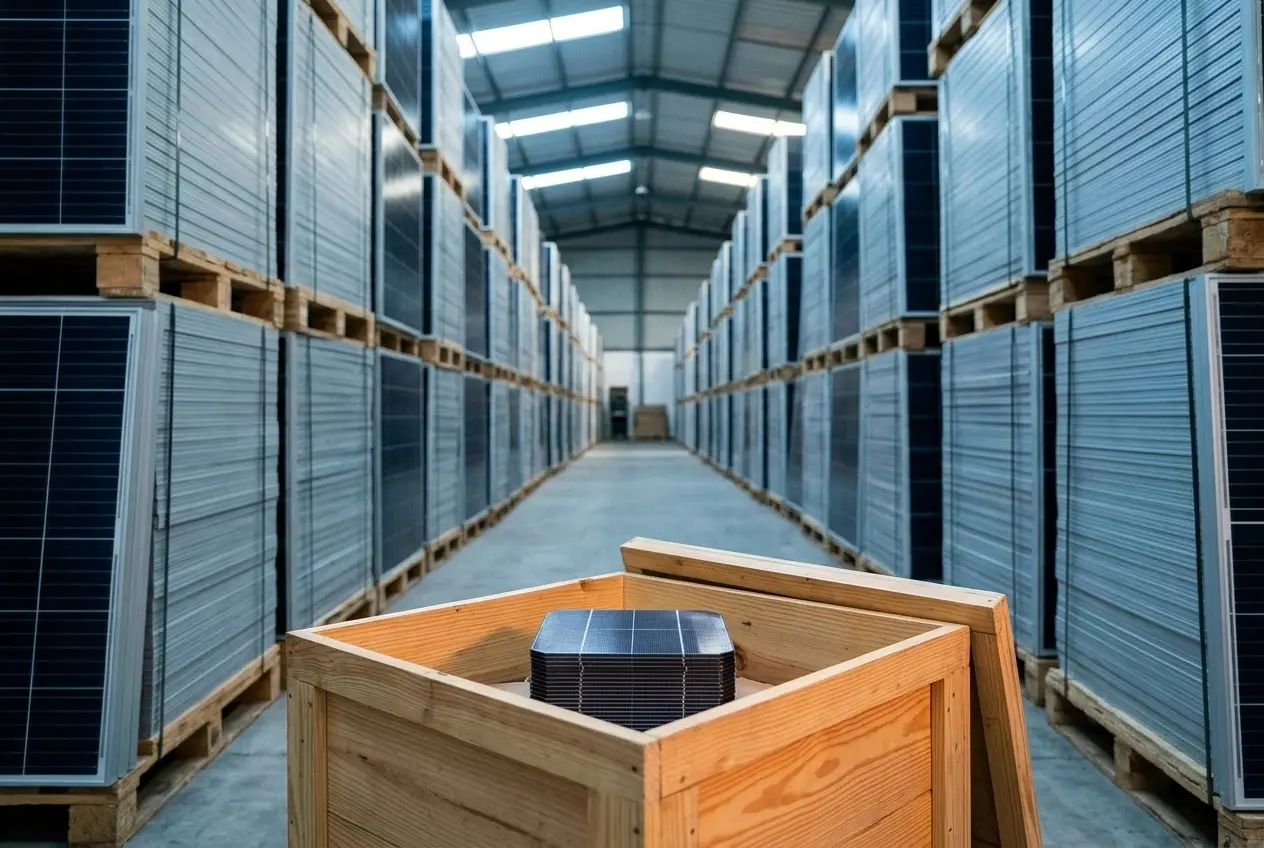
India built the finishing end of that chain first. The country’s approved module manufacturing base runs to nearly 200 gigawatts (GW) a year, while its approved cell base sits at only around 30 GW, according to the ministry’s own framing of the problem. A recent cross-analysis of the two ALMM lists put the figures at roughly 193 GW of module capacity against about 31 GW of cell capacity, a gap that widens further in advanced cell technologies.
The imbalance traces back to how India tried to build a manufacturing base in the first place. The government’s production linked incentive scheme for high-efficiency solar modules carries a total outlay of Rs 24,000 crore (about $2.7 billion), split across two tranches. The first, worth Rs 4,500 crore, went to three companies in 2021 for 8,737 megawatts of fully integrated capacity. The second, worth Rs 19,500 crore, went to 11 bidders in 2023 for another 39,600 megawatts.
| Value Chain Segment | Approximate Capacity | Snapshot Date |
|---|---|---|
| Polysilicon | 3.3 GW | June 2025 |
| Wafers and ingots | 5.3 GW | June 2025 |
| Solar cells | About 31 GW | Mid-2026 |
| Solar modules | About 193 GW | Mid-2026 |
The scheme itself has underperformed its own targets. As of June 2025, only 31 GW of a 65 GW module target had been commissioned, drawing roughly Rs 48,120 crore in investment against a goal of Rs 94,000 crore, and creating 38,500 direct jobs against a target of nearly 195,000. Cell and wafer capacity have grown faster in percentage terms since 2022, but off a much smaller base, which is why the absolute gap with modules keeps widening even as both numbers climb.
Why Smaller Manufacturers Fear Their Own Rivals
Not all module makers are built the same way. Large, vertically integrated players such as Reliance, Adani and Waaree already manufacture their own cells. Smaller, standalone module assemblers do not, and they are the ones the mandate squeezes hardest.
Industry executives have warned that these companies would now have to buy domestically made cells from larger competitors who also sell finished modules, the same product the smaller firms are trying to sell. That creates the uneven playing field the ministry’s own official alluded to.
Building a cell line from scratch is not a quick fix. Contendre Greenergy, a solar panel manufacturer, has said a 1 GW cell manufacturing facility requires an investment of Rs 250 crore to Rs 400 crore, five to eight times the cost of setting up module assembly, with a gestation period of 18 to 24 months and specialised, semiconductor-grade expertise most module-only firms do not have.
- Capital intensity: Roughly Rs 250 to 400 crore per gigawatt of cell capacity, against roughly Rs 50 to 80 crore for the same scale in module assembly.
- Time to output: 18 to 24 months for a new cell line to reach stable production yields.
- Technical barrier: Semiconductor-grade process control that lamination-based module assembly does not require.
- Financial exposure: Companies must keep servicing existing module-plant debt while trying to raise fresh capital for cells, a bind the company described as double financial jeopardy.
Manufacturers unable to clear that bar risk being pushed off the primary approved list altogether and shifted to a separate, lower-standing category reserved for module makers who cannot show compliant cell sourcing, a consequence that hits smaller firms far harder than the integrated majors who triggered the policy’s original intent.
A Factory Glut Meets a 126 Percent Tariff Wall
The cell mandate landed on an industry already sitting on unsold capacity. Against roughly 45 GW of solar installations in India during 2025-26, annual module production is estimated at nearly 60 to 65 GW. Capacity utilisation at several assembly plants is currently running at just 30 to 40 percent, according to industry sources.
Exports, once the release valve for that extra capacity, have narrowed sharply. US duties on Indian solar shipments climbed from around 14 percent before 2025 to 50 percent by August 2025, then jumped again in February 2026 after two Adani Group units withdrew from a US anti-subsidy investigation, triggering the harshest penalty US trade law allows.
The result shook shares across India’s major solar exporters, with preliminary countervailing duties on Indian cells and modules set at 126 percent. Waaree Energies had roughly 60 percent of its order book tied to US exports before the escalation; Vikram Solar had about 20 percent. Premier Energies has said its US-bound shipments have already fallen by more than half this year and now make up only 5 to 7 percent of its total production.
With the US market largely closed off, more of that unsold capacity has nowhere to go but the domestic market the cell mandate was designed to serve, adding downward price pressure on Indian manufacturers just as the government asks a subset of them to switch to costlier domestic cells.
The Rooftop Subsidy Riding on Cell Prices
The mandate’s most politically sensitive exposure is not a factory floor at all. It is PM Surya Ghar: Muft Bijli Yojana, the government’s flagship rooftop solar scheme, launched in February 2024 with a total outlay of Rs 75,021 crore and a target of one crore rooftop installations by March 2027. Households get a subsidy of up to Rs 78,000 for a 3 kW system and up to 300 units of free electricity a month.
Industry executives have cautioned that forcing cell sourcing domestic could push up the price of domestically made cells, making cell production more attractive to integrated manufacturers who enjoy stronger margins and guaranteed demand, while limiting the rooftop panel supply that Surya Ghar households and installers depend on.
There is already a separate cost pressure feeding into that same panel price. A 30 percent anti-dumping duty imposed by India’s Directorate General of Trade Remedies on imported cells has pushed their landed price to about $0.07 per watt, close enough to domestic cell prices that it narrows the usual cost advantage of importing. Modeling by the Council on Energy, Environment and Water found that a resulting rise in cell costs could push module costs up by roughly $0.024 per watt, enough that domestic tariffs could rise by about Rs 0.14 per unit.
MNRE Secretary Santosh Kumar Sarangi held a meeting with domestic cell manufacturers in June specifically to press for adequate supply of domestic content requirement cells and modules for distributed renewable energy projects, rooftop systems and solar agricultural pumps among them, while keeping prices reasonable. Saturday’s exemption effectively buys the ministry more runway to make good on that request before rooftop economics feel the pinch.
What Happens When the Clock Runs Out in December?
Nothing structural changes before December 31. The gap between India’s cell and module capacity narrows only as fast as new cell plants can be built and ramped, and the newest large one broke ground just three weeks before this exemption was announced.
SAEL Industries started construction on June 27 on a 10 GW integrated cell and module complex in Jewar, Uttar Pradesh, an Rs 8,200 crore investment split evenly between 5 GW of cell capacity and 5 GW of module capacity. It is exactly the kind of project the mandate is meant to encourage.
But a 10 gigawatt cell and module complex in Jewar does not produce a single certified cell on the day it breaks ground. New cell lines typically need 18 to 24 months after commissioning just to reach stable production yields, meaning the Jewar plant’s first qualified cells are unlikely to reach the market before the new December 31 deadline, let alone at a scale that closes a gap measured in tens of gigawatts.
December 31 will arrive with whatever cell capacity exists by then, not the capacity the policy was designed around.
Frequently Asked Questions
Does the December 31 extension cover PM Surya Ghar rooftop projects too?
The exemption applies specifically to domestic, commercial and industrial solar projects, the category named in Saturday’s memo. Government-backed, net-metered and open-access projects, including many rooftop installations, have separately operated under the June 1 rules with their own narrower carve-outs, such as exemptions tied to bid submission dates before August 31, 2025.
What happens to module makers still unable to source approved cells after December 31?
Module manufacturers who cannot show compliant domestic cell sourcing risk being delisted from the main approved list and shifted onto a separate category sometimes referred to as List-I(a), which carries reduced eligibility for government-linked and subsidy-backed projects compared with full ALMM List-I status.
How much certified cell capacity does India actually have right now?
As of the most recent revision to the approved cell manufacturers list in late April 2026, enlisted domestic cell capacity had crossed roughly 30.3 GW, including newly added heterojunction (HJT) cell capacity from Reliance Industries, a sign that the largest integrated players are adding advanced capacity faster than smaller standalone manufacturers can.
Why did regulators target cells specifically instead of just finished panels?
India’s approved list has governed finished modules since 2019, but it never restricted where the cells inside those modules came from, letting module assembly scale for years on imported cells even as it counted as domestic production. List-II closes that gap by regulating the cell layer directly.
Is India helping its tariff-hit solar exporters sell at home instead?
Yes. The 2026-27 Union Budget introduced relief letting solar manufacturers operating in Special Economic Zones sell a portion of their output into India’s domestic market at concessional duty rates, a shift meant to help absorb export capacity stranded by the US tariff escalation.

-
 TECH1 year ago
Where Garmin Watches are Made and How They are Assembled
-

 AUTO3 months ago
Tesla’s Roadster Is ‘a Few Weeks Away,’ Says Its Chief Designer
-
 NEWS10 years ago
Samsung Releases Galaxy Note7 TV Ad as Reddit AMA Leaks Specs
-
 NEWS10 years ago
Android 7.0 Nougat Rolls Out To Nexus Devices With New Emoji, Features
-
 FINANCE9 years ago
Cardano Price Surges as ADA Enters the Crypto Top Ten List
-
 NEWS10 years ago
Pre-Order the First Camera Made for Facebook Live Streaming Video
-
 FINANCE1 year ago
Binance Suspends Trading and Withdrawals for a System Upgrade
-
 FINANCE9 years ago
RChain Price Jumps Nearly 150% to a New All-Time High of $2.03