NEWS
India Turns the UN’s Dawood File on a Rapporteur
India used the UN’s own 1267 file to rebut a rapporteur who called Dawood Ibrahim’s D-Company India-based, despite Karachi addresses on that listing.

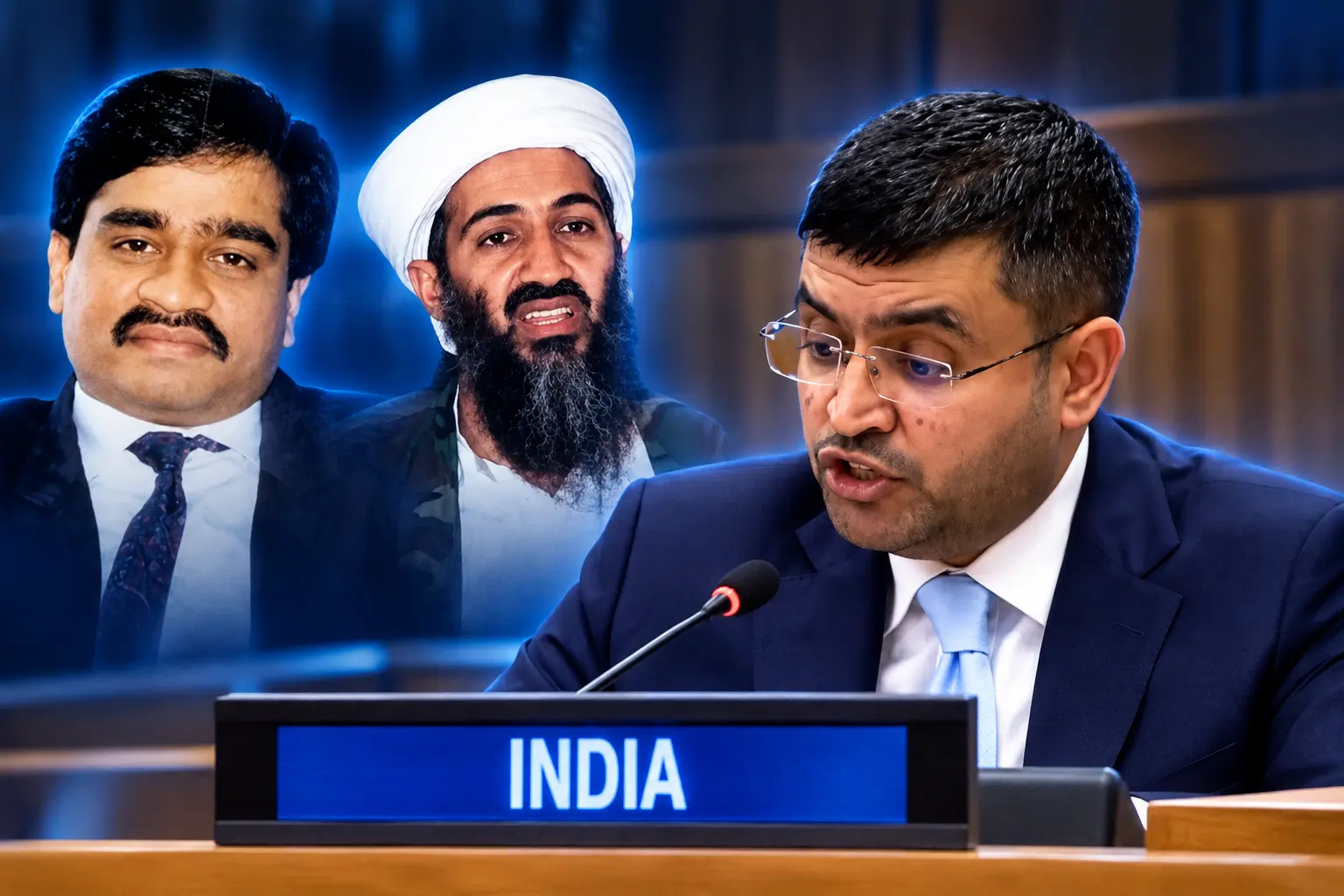
India told the UN General Assembly on 21 October that a special rapporteur had described Dawood Ibrahim’s D-Company as India-based. First Secretary Raghoo Puri said the world body’s own 1267 listing already treats the gangster as a wanted man who lives in Pakistan, where Osama bin Laden was found and killed in 2011.
Puri was answering a July report that used the phrase in passing, while citing the Security Council page India then quoted back.
India Corrected the UN With the UN’s Own File
The exchange came in an interactive dialogue of the General Assembly’s Third Committee. Puri, speaking for the Permanent Mission of India, said special rapporteurs were putting out reports with factual errors and were not being held to account for them.
This presents Member States with a fait accompli, which is unfortunate for this organisation that is facing challenges of legitimacy.
Raghoo Puri, First Secretary, Permanent Mission of India to the UN, Third Committee, 21 October 2026
He said report A/81/227 notes that in 2003 the Security Council listed the leader of one criminal group, D-Company, for association with Al-Qaeda. “Read in isolation, this line paints a very different picture from the actual reality,” he told the room. D-Company and its listed leader, Dawood Ibrahim Kaskar, have been wanted in India for terror attacks since 1993, he said, and that fact is written into the 1267 file.
“Not mentioning this fact is regrettable, and such incompetence on the part of special mandate holders does this organisation tremendous harm,” Puri said. He added that Ibrahim fled India well before the 2003 listing and was named for ties to Al-Qaeda and Osama bin Laden while operating from outside the country.
“To date, he remains a wanted criminal in my country, and as per the UN’s listing entry, resides in the same country where Osama bin Laden was found and neutralized,” he said. The mission posted the same points, with video of the floor statement.
Raghoo Puri, First Secretary, took part in the interactive Dialogue with Special Rapporteur on the promotion and protection of human rights and fundamental freedoms while countering terrorism in the Third Committee of the General Assembly. He highlighted:
➡️ Factual… pic.twitter.com/MNm3yW3Ljk
— India at UN, NY (@IndiaUNNewYork) October 22, 2026
A Report Aimed at Cartels Named D-Company
Ben Saul, an Australian international lawyer and Challis Chair of International Law at the University of Sydney, has held the mandate of special rapporteur on counter-terrorism and human rights since 1 November 2023. The Human Rights Council extended that mandate on 3 April 2025 for three more years.
His July report on crime and terrorism, issued as A/81/227 on 20 July 2026, is 23 pages. The disputed sentence is not the thesis. It sits in paragraph 2 as a historical example, after which Saul writes that the report “largely does not consider the nexus between organized crime and genuine terrorism.”
WHAT THE JULY REPORT SET OUT TO DO
- Legal treatment: It reviews how some states now class organised crime groups as terrorist organisations.
- The distinction: It argues that folding profit-driven crime into terrorism is legally and politically unsound.
- The harm: It warns that extra security powers used this way damage human rights and often fail on their own terms.
- The alternative: It points to firearms controls, anti-corruption work, drug-policy reform and development tools instead of a “war on narco-terrorism.”
Saul collected 64 submissions and held four regional consultations. At least nine states, most of them in the Americas, have legally designated crime groups as terrorist, the report says, with a wave of listings after 2025 U.S. designations. Paragraph 3 again refers to “an India-based gang” among groups “mainly engaged in other crimes.”
The same chapter notes that Pakistan has used anti-terror law and an Anti-Terrorism Court against Karachi syndicates, including Lyari factions, for killings, kidnapping and extortion. The report that tagged D-Company as India-based also describes gang prosecutions in the city where the UN list still prints Ibrahim’s addresses.
Saul presented the paper in New York on 21 October. On 20 September he had posted that it urges states not to conflate drug crime with terrorism or to pursue illegal wars on “narco-terrorism.”
I look forward to presenting my new report today to the General Assembly in New York, and engaging in dialogue with UN Member States about the risks of the new “war on narco-terrorism” and the need for human rights compliant responses to organized crime and violence https://t.co/D2KAHJ5Og9
— Prof Ben Saul – UN SR Human Rights & Counterterror (@profbensaul) October 21, 2026
What the 1267 Listing Says About Dawood
Ibrahim is listed as QDi.135. The committee posted a narrative summary of reasons for listing on 7 October 2011 and updated it on 22 August 2016. Saul’s footnote 8 in paragraph 2 points to that same page.
TWO UN DOCUMENTS, TWO GEOGRAPHIES
| Item | Report A/81/227 | UN file QDi.135 |
|---|---|---|
| How the group is placed | “the India-based D-Company”; “an India-based gang” | “D company”; “Indian underworld”; crime in India and Nepal |
| The listing | 2003, association with Al-Qaida | 3 November 2003, association with Al-Qaida, Usama bin Laden or the Taliban |
| The 1993 bombings | Omitted in that sentence | Wanted in India for the 12 March 1993 Bombay Exchange bombings; over 250 killed; over 1,000 injured |
| Where he is filed | No address | Three Karachi addresses on the consolidated list |
The narrative summary does not name Pakistan as his home. It says Kaskar used his standing in the Indian underworld to support Al-Qaida, shared narcotics routes with bin Laden’s network, travelled to Afghanistan under Taliban protection in the late 1990s, and, according to 2002 information, helped finance Lashkar-e-Tayyiba attacks in Gujarat. It also says D-Company and associates “continue to engage in criminal activity in India and Nepal,” including plots to kill political leaders and currency counterfeiting.
Puri split the paperwork on purpose. He pointed to the narrative summary for the 1993 warrant. He pointed to the listing entry for residence. Sanctions records updated on 21 October 2026 still carry three Karachi sites: White House, near Saudi Mosque, Clifton; House Nu 37, 30th Street, Defence Housing Authority; and a palatial bungalow in the hilly area of Noorabad. An international arrest warrant issued by India is noted on the file, with an Interpol-UN special notice attached. Citizenship is recorded as Indian. Place of birth is Kher, Ratnagiri, Maharashtra.
The U.S. Treasury file on Ibrahim, also refreshed on 21 October 2026, goes further. It lists Karachi properties plus a Dubai address and a Dongri, Bombay address, and records passports issued in India, Pakistan, Yemen and the United Arab Emirates. He sits on both the SDGT terrorism track and the SDNTK kingpin track.
Mandate Holders Publish First and Answer Later
Puri’s deeper complaint was process. Member states, he said, are handed finished reports and then asked to live with the errors. He said his mission had already flagged the problem “in other forums as well.” He also noted “clear bias in different parts of the report” and “certain media allegations against this important office,” and he asked that “the highest standards of probity and impartiality be maintained.”
Special rapporteurs are independent mandate holders, not UN staff writers. They issue thematic papers in their own names, then take questions in rooms such as the Third Committee. There is no editor who can pull a two-word geographic tag before the PDF is numbered. That is the opening India used: if the expert is unaccountable, the only remedy left is a public correction on the floor, using the organisation’s own annexes.
Puri tied the error to a wider argument about rights language. “It seems to have become fashionable for sponsors of terror to use human rights and the framework of counter-terrorism to justify their misdeeds,” he said. “Human rights framework cannot be the refuge of the perpetrators of terror and those who propagate radicalization and extremism. Terrorism can never be justified.”
The sharper problem is narrower than that speech. Saul’s paper is a brief against treating cartels as terrorists. D-Company appears as the rare Security Council case of a crime group listed for Al-Qaida ties, the example the report then sets aside. The adjective did the damage because it was detached from the footnote sitting under it.
The Military, Kashmir and a Right of Reply
The same statement answered a Pakistani delegate who had spoken about Jammu and Kashmir and Ladakh. Puri called those remarks “pure propaganda made for very narrow political gains,” and said they came from “the actual rulers of Pakistan, which is its military.”
“I would like to reiterate for the record that Jammu and Kashmir and Ladakh are inalienable parts of India, have been so, and will always remain so,” he said. He added that he would not “dignify” the Pakistani statement with further comment.
The Kashmir lines were stock, and they sat beside the Dawood file rather than replacing it. India has used the 1267 entry against Islamabad for years. Pakistan has denied that Ibrahim lives on its soil. The UN list still prints the Karachi addresses. The rapporteur’s paper did not try to settle that dispute; it borrowed the group as a one-line exhibit and moved on to the Americas.
Over 250 Dead, Then a 2003 Listing
The dates India recited are not new. They are the spine of the UN summary Saul cited.
HOW DAWOOD ENTERED THE UN FILE
- 12 March 1993: Bombay Exchange bombings kill over 250 people and injure over 1,000; India wants Kaskar in connection with the attacks.
- Late 1990s: The UN summary records that Kaskar travelled to Afghanistan under Taliban protection and that his syndicate shared smuggling routes with bin Laden’s network.
- 3 November 2003: The Security Council lists him as associated with Al-Qaida, Usama bin Laden or the Taliban.
- 7 October 2011: The committee posts the narrative summary; bin Laden has already been killed in Pakistan that year.
- 22 August 2016: The summary is updated. Three Karachi addresses stay on the consolidated list after other sites are struck through.
- 1 November 2023: Saul takes up the counter-terrorism and human rights mandate.
- 20 July 2026: A/81/227 is issued with the “India-based D-Company” line and a footnote to the 1267 summary.
- 21 October 2026: Puri reads the file back to the Third Committee.
Ten years separate the blasts from the listing. Puri’s point was that the listing itself records a man already outside India. The summary still calls him a figure of the Indian underworld, which is how a careful writer can defend “India-based” as a note on origin. It is also why dropping that word into a sentence about the 2003 Al-Qaida listing, without the warrant and without the addresses, gave New Delhi an easy floor intervention.
Calling It India-Based Omits the Flight
WHERE THE PHRASING SPLITS
- Origin reading: D-Company was built in Mumbai, Kaskar is an Indian national, and the UN summary still says the gang commits crimes in India and Nepal, so “India-based” can describe where the group began.
- India’s reading: The isolated line hides the flight before 2003, the 1993 warrant in the narrative summary, and the Karachi sites on the listing entry, and it does so in a paper whose own footnote leads to that file.
- What Saul has said: He has posted about the report’s warning on “narco-terrorism.” He has not posted a correction of the D-Company tag.
Indian accounts treated the skip of Pakistan as habit. The cleaner observation is mechanical. Footnote 8 sent any careful reader to a page that already contained the 1993 death toll and the Al-Qaida theory of the case. The consolidated list, a click away from that page, still names Clifton, the Defence Housing Authority and Noorabad. Two words in paragraph 2 did not carry any of that.
Saul’s office also listed a side event at UN Headquarters on 22 October, titled “Counter-terrorism, Organized Crime and Human Rights.” The QDi.135 file he cited in July remains the version with three Karachi addresses.

Bulk Scotch Still Faces Full Duty After India’s UK Deal

Typhoon Champi Loops Off Taiwan and Still Injures 527

PM Modi Opens Chinmaya’s AI Guru and Asks for Unity

Mahim Police Hold a JeM Suspect on Enmity Charges

Gold Falls Below $4,000 as Hormuz Oil Hits $117

The iPhone 18 Pro Max Splits Apple’s Fall in Two

OpenAI Calls GPT-6 Astra AGI Then Locks Its Exploits

Clancy Juror Says the Holdout Never Cited Evidence

Trump Claims Hormuz Control as Oil Holds Near $96

Russia Closes the Goethe-Institut Berlin Tried to Save

 NEWS2 months ago
The iPhone 18 Pro Max Splits Apple’s Fall in Two
- NEWS2 months ago
OpenAI Calls GPT-6 Astra AGI Then Locks Its Exploits
- NEWS1 month ago
Clancy Juror Says the Holdout Never Cited Evidence
- BUSINESS2 months ago
Trump Claims Hormuz Control as Oil Holds Near $96
- LIFESTYLE2 months ago
Russia Closes the Goethe-Institut Berlin Tried to Save
- AUTO2 months ago
Volkswagen’s Job Cuts Leave Four Plants Without Cars
- NEWS2 months ago
Dyson Puts Nurovi Robots on Sale Without the UV Flagship
- NEWS2 months ago
The Lincoln’s 286-Day War Cruise Ends at a Thai Pier