NEWS
CJP Climbs Barricades After Delhi Strips Jantar Mantar
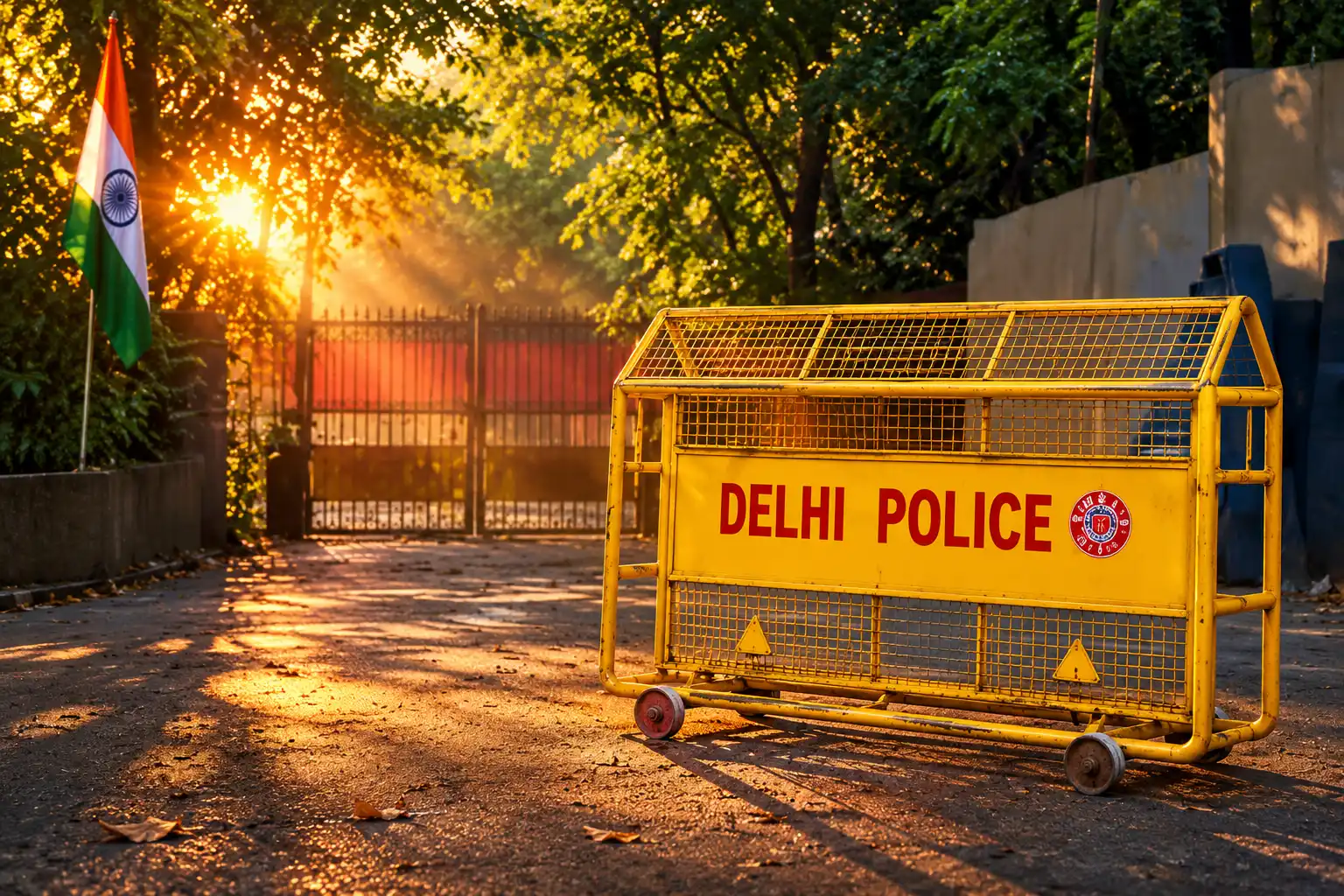
After Delhi Police denotified Jantar Mantar, CJP volunteers climbed barricades. The new grounds sit up to 21 km from the old road.

CJP leaders climbed police barricades at Jantar Mantar on October 13 and were detained soon after. Founder Abhijeet Dipke said they had entered with the Tiranga after Delhi Police dropped the road as a designated protest site.
The order signed on October 11 sends organised protests to Ramlila Ground, Burari Ground and CBD Ground in East Delhi, the last of them nearly 21 km from the old strip.
CJP Climbed the Barricades Before Dawn
Ashutosh Ranka, Saurav Das and Ajinkya Shinde, leaders of the unregistered youth group Cockroach Janta Party, went over the fences on Tuesday morning, October 13, with other volunteers. Das posted video of slogans inside the campus and said they had “reclaimed Jantar Mantar.” Ranka’s clip showed the climb itself. Delhi Police detained them.
Dipke, who started CJP on May 16 after a courtroom slight at jobless youth, put the raid on X and tagged Prime Minister Narendra Modi.
Cockroaches with the Tiranga sneaked into Jantar Mantar early this morning before they were picked up by Delhi Police. You cannot denotify the resistance.
Abhijeet Dipke, founder, Cockroach Janta Party, on X
Cockroaches with the Tiranga sneaked into Jantar Mantar early this morning before they were picked up by Delhi Police. @AshutoshRanka, @SauravDassss, @AjinkyaCJP along with other team members have been detained.
You cannot denotify the resistance, @narendramodi pic.twitter.com/x7B40akCVO
— Abhijeet Dipke (@abhijeet_dipke) October 13, 2026
Das, an investigative journalist who is also a CJP co-convenor, went further. “The right to protest is our fundamental right. No one can ‘denotify’ it,” he wrote, claiming “40,000+” security personnel still could not hold the youth. That figure is his. The legal paper that matters is the police list, and Jantar Mantar is no longer on it.
The clip is built for a phone. A dawn entry that lasts long enough to film a flag and ends in a van does not put the road back on the designated roster. It does show how much of the fight is now over a fence that went up after the list moved.
The demand that brought CJP, and a separate opposition march, into central Delhi is the resignation of Chief Election Commissioner Gyanesh Kumar over the Special Intensive Revision of electoral rolls. The Election Commission has denied manipulating the lists. The venue fight is what the October 13 raid actually tested.
Three Grounds Sit Farther From Parliament
Delhi Police Commissioner Anurag Kumar issued the standing order on October 11. It became public on October 12. The Union home ministry had set up a committee “to examine alternative proper venues for citizens’ right to organise protest/demonstrations in place of the existing ‘designated site.’” On those recommendations, the notice said, Jantar Mantar as a protest venue has been de-notified.
The three named replacements are Ramlila Ground in Central Delhi, Burari Ground in North Delhi and CBD Ground in East Delhi. A detailed SOP for those sites “will be issued separately.” Until that paper exists, organisers have names of fields and no published rules for using them. The notice is a partial change to Standing Order No. L&O/48/22, dated April 28, 2022.
The old strip sat about 2 km from Parliament. Protests never ran inside the ticketed monument at Jantar Mantar; they ran on the adjoining road, a short walk from Connaught Place, with water, cheap food, toilets and tree shade. Under the earlier rules, organisers had to apply 10 days ahead, and the cap was 1,000 people. Ramlila Maidan was already a designated overflow ground for much larger crowds.
THE NEW PROTEST MAP
| Venue | District | Distance from Jantar Mantar | Scale |
|---|---|---|---|
| Jantar Mantar Road (former) | Central Delhi | Former site, about 2 km from Parliament | 1,000-person cap under old rules |
| Ramlila Ground | Central Delhi | 4 km | 50,000 people, 12 acres |
| CBD Ground | East Delhi | 12 to 13 km | 12 acres |
| Burari Ground | North Delhi | nearly 21 km | more than 50,000 people |
A crowd that filled the old road would be a speck on Ramlila or Burari. Distance is the other tax. Burari sits in the north, almost a full city away from Raisina Hill. CBD Ground sits in Shahdara. Both are easier to ring with buses than a lane beside Parliament Street.
From October 10, police had already sealed approaches under Section 163 of the Bharatiya Nagarik Suraksha Sanhita. The observatory itself stayed open that Saturday, with visitors let in as groups of at most four, because the Archaeological Survey of India issued no closure order. The heritage compound and the protest road were always different places. The October 11 notice made that split official.
How Delhi Moved Dissent Off the Boat Club
Jantar Mantar became the capital’s protest address because an older, closer one was shut. For decades after Independence, the Boat Club lawns near India Gate put marchers in earshot of North Block, South Block and Parliament. In October 1988, farmer leader Mahendra Singh Tikait brought an estimated five lakh people onto those lawns for nearly a week. In 1993 the Boat Club was closed to large rallies, and the lane beside the 1724 observatory took the overflow.
The road was never spacious. That was part of the bargain. Few entry points and a hard cap made it simpler to police than Rajpath. It was still close enough that a small group could be seen from the buildings it was shouting at.
HOW THE PROTEST MAP SHIFTED
- October 1988: Tikait’s farmers occupy the Boat Club lawns for nearly a week.
- 1993: Large rallies are kept off the Boat Club; Jantar Mantar Road becomes the working protest strip.
- October 2017: The National Green Tribunal orders a ban on protests at Jantar Mantar and points organisers to Ramlila Maidan.
- July 23, 2018: The Supreme Court sets aside a blanket ban and keeps a limited, regulated stretch of the road open for smaller groups.
- April 28, 2022: Delhi Police standing order L&O/48/22 records Jantar Mantar among designated venues.
- October 9, 2026: The Supreme Court asks the government to consider another location, citing amenities, ahead of the October 10 mobilisation.
- October 11, 2026: Commissioner Anurag Kumar signs the order that de-notifies Jantar Mantar and names three grounds.
- October 13, 2026: CJP volunteers climb the barricades and are detained.
Each move left a lawful place to gather and took that place farther from the offices being addressed. Burari is the sharpest version of that pattern.
Ramlila Maidan Is Booked Until Late December
Ramlila is the only replacement that still sits in central Delhi, 4 km from the old road. It has held Jayaprakash Narayan’s 1975 rally, Anna Hazare’s 2011 anti-corruption sit-in, and the December 2012 crowds after the Nirbhaya attack. It can take about 50,000 people on 12 acres. It is also a hired ground, not a free lane with a 1,000-person cap.
WHAT A DAY AT RAMLILA MAIDAN COSTS
- Open dates: Civic officials said the ground could be booked only for December 29, 30 and 31.
- Hire: Rs 50,000 per day, plus a Rs 55,000 refundable security deposit.
- First bill: The initial outlay, including taxes, comes to Rs 1.21 lakh for one day, an official said.
- Free slice: A small portion stays open for gatherings, with a capacity of 150 people.
A student group that used to file a 10-day notice for the Jantar Mantar strip now needs a winter date and a six-figure cheque, or it is asked to try Burari or Shahdara. The SOP that would say how those two fields actually work has not been published. Naming them is not the same as opening them.
Police have a real problem in New Delhi district, where Parliament, ministry blocks and the railway station sit on the same map as any crowd that wants to be seen. Traffic and residents on Jantar Mantar Road have been in this fight for years. The NGT record is full of noise, garbage and tents that turned a residential stretch into a camp. Those facts did not vanish on October 11. They also do not turn a 21 km relocation into a like-for-like swap.
The Court Already Flagged Distance From Power
Article 19 of the Constitution of India protects the right to assemble peaceably and without arms, with reasonable limits in the interest of public order. Delhi is a special case. Public order, police and land sit with the Union, not the city assembly, under Article 239AA, so Delhi Police answers to the home ministry. That is why an MHA committee, not a municipal vote, could redraw the protest map.
In the 2018 Supreme Court ruling in Mazdoor Kisan Shakti Sangathan v. Union of India, decided on July 23, 2018, petitioners said Ramlila Maidan was too far from the “concentration of ‘power’” in New Delhi and would blunt the point of a protest aimed at those offices. The court accepted that contention. It still held that areas can be earmarked in public interest, and it left a limited portion of Jantar Mantar Road open for regulated, smaller demonstrations because the site had been used that way for a long time.
The October 11 notice does what that bench declined to do in full. It takes the road off the designated list and points organisers at grounds the 2018 petitioners already called too far. Whether a later SOP, or a fresh writ, walks that back is open. The standing order itself does not discuss the 2018 map.
Senior advocate Gopal Sankaranarayanan has drawn a line the police often blur. Law and order, he said, is a street fight or a blocked car. Public order is a wider breakdown of transport or access. “Law and order is not a valid basis to limit the right to speech and expression,” he said. The police, he added, need a law that actually grants the power they are using, and they must name it.
Professor G Mohan Gopal put the other side of the same week: closing designated sites and treating peaceful dissent as a law-and-order problem pushes people off the lawful channel. Then Section 163 becomes the only road left, which is how a designated-site system is supposed to avoid ending.
A Flag on a Fence Does Not Reopen the Road
CJP’s October 13 raid was a claim about memory. The group still talks as if Jantar Mantar is the place you go when the state will not listen, because for three decades that was true. The police paper says the place you go is Ramlila if you can book December, or Burari, or a 12-acre plot in East Delhi, under rules that have not been issued.
Dipke’s line, “You cannot denotify the resistance,” is a slogan. The commissioner can denotify a venue, and he has. The right to assemble is still in Article 19. The argument left on the table is the one the 2018 bench already heard: how far from Parliament a lawful crowd can be moved before the crowd is only talking to itself.
Until the SOP appears, even the three new names are incomplete. CJP says it will keep coming to the old road anyway.

Bulk Scotch Still Faces Full Duty After India’s UK Deal

Typhoon Champi Loops Off Taiwan and Still Injures 527

PM Modi Opens Chinmaya’s AI Guru and Asks for Unity

Mahim Police Hold a JeM Suspect on Enmity Charges

Gold Falls Below $4,000 as Hormuz Oil Hits $117

The iPhone 18 Pro Max Splits Apple’s Fall in Two

OpenAI Calls GPT-6 Astra AGI Then Locks Its Exploits

Clancy Juror Says the Holdout Never Cited Evidence

Trump Claims Hormuz Control as Oil Holds Near $96

Russia Closes the Goethe-Institut Berlin Tried to Save

 NEWS2 months ago
The iPhone 18 Pro Max Splits Apple’s Fall in Two
- NEWS2 months ago
OpenAI Calls GPT-6 Astra AGI Then Locks Its Exploits
- NEWS1 month ago
Clancy Juror Says the Holdout Never Cited Evidence
- BUSINESS2 months ago
Trump Claims Hormuz Control as Oil Holds Near $96
- LIFESTYLE2 months ago
Russia Closes the Goethe-Institut Berlin Tried to Save
- AUTO2 months ago
Volkswagen’s Job Cuts Leave Four Plants Without Cars
- NEWS2 months ago
Dyson Puts Nurovi Robots on Sale Without the UV Flagship
- NEWS2 months ago
The Lincoln’s 286-Day War Cruise Ends at a Thai Pier