
BUSINESS
Oil at $110 Splits Large Caps From Smaller Stocks
Sensex and Nifty fall on $110 oil, but midcaps and smallcaps take the heavier hit while Jio IPO dollars still lift the rupee.

The BSE Sensex fell 610.57 points, or 0.83%, to 73,099.12 by 9:27 a.m. IST on Thursday. The Nifty 50 dropped 242.70 points, or 1.06%, to 22,568.65 as Brent crude held above $110.
That is a third straight session of losses. The damage is not even. Mid-cap and small-cap indices are still giving up more than the benchmarks, a split that has been building for weeks as oil stays high and the domestic money that had held smaller stocks starts to look elsewhere.
Sensex Slides as Brent Crude Holds Above $110
GIFT Nifty had already flagged the open, trading at 22,643.5, down 85 points, or 0.37%. The cash market followed. The Sensex opened at 73,163.24, down 546.45 points, or 0.74%, and the Nifty 50 opened at 22,687.75, down 123.60 points, or 0.54%.
By 9:27 a.m. both indices had extended those losses. Brent crude, which had printed $110.11 early in the morning, was later at $110.69, up 1.72%. West Texas Intermediate was at $98.52, up 1.41%. November crude on the Multi Commodity Exchange rose 1.47% to ₹9,343.
Asia was already in the red. Hong Kong’s Hang Seng was down 2.09%, South Korea’s Kospi 1.92%, Shenzhen 1.41%, Shanghai 0.69%, Australia’s ASX 200 0.47%, and Japan’s Nikkei about 0.4%. MSCI’s Asia-Pacific index outside Japan was off 0.2% and headed for a fourth weekly decline. Wall Street had closed higher on Wednesday, with the Dow at 52,856.09, up 0.69%, the S&P 500 at 7,757.17, up 0.58%, and the Nasdaq at 26,702.86, up 1.05%. The US 10-year yield still sat at 5.123%.
A handful of large names still found bids. Around 10:06 a.m., Bharti Airtel was up 0.75% at ₹1,906.65, Infosys 0.21% at ₹1,169.80, Kotak Mahindra Bank 0.19% at ₹437.35, and Eternal 0.14% at ₹312.20. Earlier in the auction, Coal India was down 2.82% at ₹396.00, Power Grid 2.58% at ₹245.65, Nestle India 2.55% at ₹1,192.70, Bharat Electronics 2.40% at ₹362.30, and Hindalco 2.37% at ₹871.65.
Around 9:23 a.m., 15 of 16 major sectoral indices were lower. Nifty Auto was down 1.86%, Nifty Metal 2.01%, Nifty FMCG 1.55%, and Nifty Pharma 1.58%. Nifty IT, which had led Wednesday, was off 0.44%. Nifty Midcap 100 was down 1.65% and Nifty Smallcap 100 1.48%.
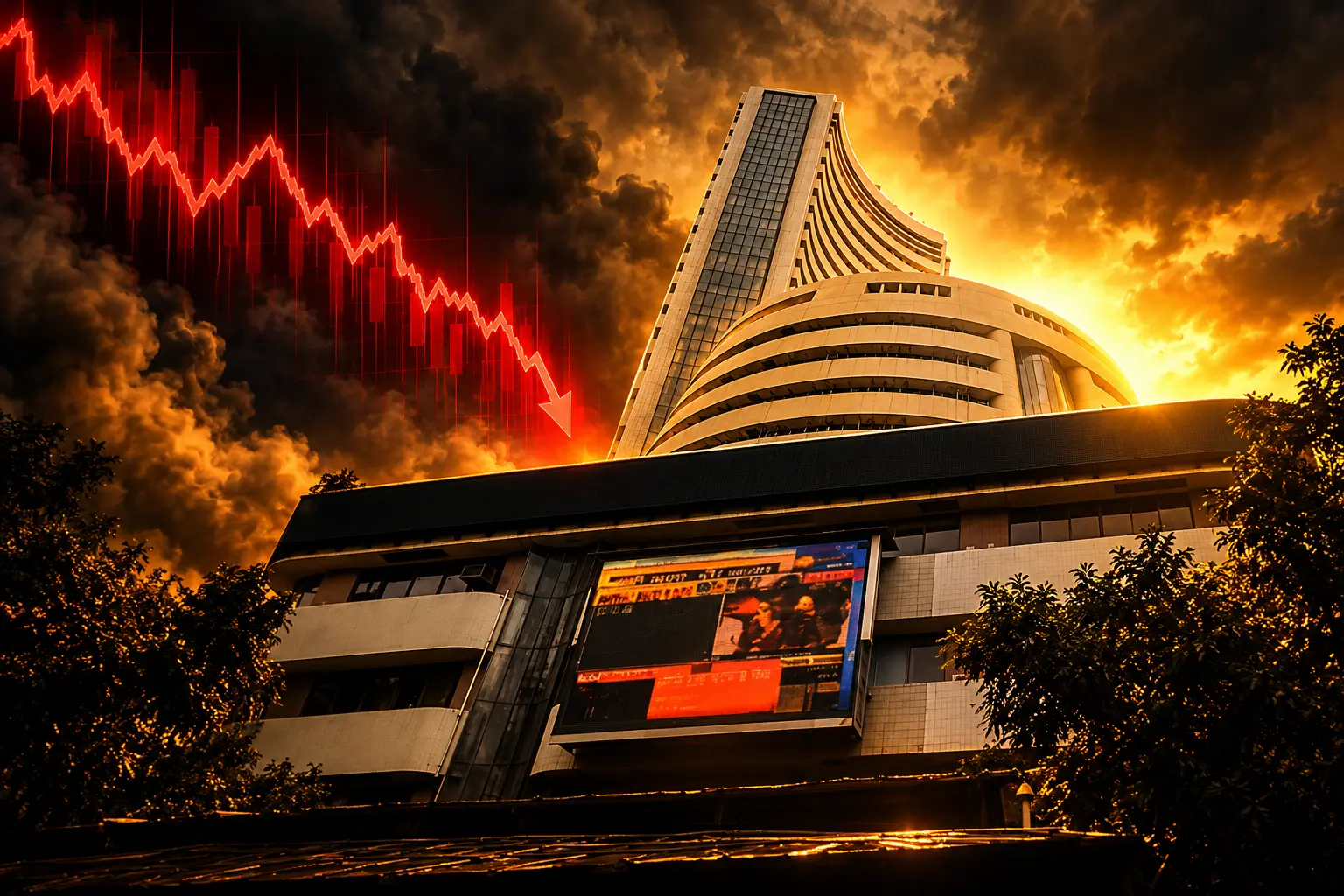
Midcaps and Smallcaps Took the Heavier Hit Wednesday
Thursday’s open is a continuation of Wednesday’s tape, not a fresh scare. On Wednesday the Sensex closed at 73,709.69, down 143.21 points, or 0.19%, after touching an intraday high of 74,682.19, a gain of 829.29 points from Monday’s close of 73,852.90. Selling then dragged it 1,452.74 points from that high to a low of 73,229.45. The Nifty 50 closed at 22,811.35, down 77.60 points, or 0.34%, after swinging between 23,120.90 and 22,702.85.
Ajit Mishra, SVP of research at Religare Broking, put the mid-cap and small-cap declines on Wednesday at about 1.5% to 2.4%. The Nifty 500 breadth was thin: only 80 of 497 stocks rose. On the BSE, 1,042 shares advanced, 4,279 declined, and 174 were unchanged.
HOW THE INDICES MOVED
| Index | Wednesday close | Thursday morning |
|---|---|---|
| Sensex | -0.19% | -0.83% (9:27 a.m.) |
| Nifty 50 | -0.34% | -1.06% (9:27 a.m.) |
| Nifty Midcap 100 | -1.58% | -1.65% (~9:23 a.m.) |
| Nifty Smallcap 100 | -2.37% | -1.48% (~9:23 a.m.) |
| Nifty IT | +2.88% | -0.44% (~9:23 a.m.) |
| Nifty Auto | -1.99% | -1.86% (~9:23 a.m.) |
| Nifty Metal | -1.97% | -2.01% (~9:23 a.m.) |
Nifty Smallcap 250 fell 2.26% on Wednesday and Nifty Microcap 250 2.61%. The frontline index absorbed the oil headline. The rest of the market paid the bill.
The Median Stock Has Fallen Much Further Than the Index
Index levels still understate how far individual names have already dropped. Capitalmind Mutual Fund, a SEBI-registered fund house, mapped each stock’s fall from its own peak, with data through October 16. The Nifty 500 is 9% below its all-time high, but the median stock in that index is 29% below its own peak. Nifty Smallcap 250 is 5% below its high, while its median stock is down 32%.
The Nifty 500 is down 9% from its all time high. But the median stock in the index is down 29% from its own peak.
The gap is even wider in small caps. The Nifty Smallcap 250 is down 5% while its median stock has fallen 32%.
The correction looks very different when you look… pic.twitter.com/iaIMxxo44c
— Capitalmind Mutual Fund (@CapitalmindMF) October 21, 2026
Those drawdowns are not Wednesday’s session returns, and they are not the return on an equal-weight fund. They measure how far the typical name has already retraced from its own top. A fund that owns the index has had a milder ride than a holder of the median small-cap. That is the split Thursday is still working through.
Why Large-Cap Stocks Still Attract Buyers
V K Vijayakumar, chief investment strategist at Geojit Investments, has been describing this gap since September. On September 23 he put the Nifty 50 on a trailing PE of 19.7, against 29.9 for Nifty Midcap 100 and about 34.4 for the Nifty 100 Smallcap index, nearly twice the large-cap multiple. By October 21 the Midcap 100 PE had eased to 26.91. The direction of the gap has not reversed.
The broader market resilience in recent months has been more a function of liquidity than earnings. This paradox of overvalued mid- and small-caps coexisting with attractively valued large-caps cannot continue for long.
V K Vijayakumar, Chief Investment Strategist, Geojit Investments
A Motilal Oswal note in early October put 12-month forward PE for large-caps at 17.6 times, down 29% from 24.8 times at the peak. Mid-caps had come down 27%, from 35.6 times to 25.8. Small-caps had reset only 4%, to 23.6 times. Mahesh Nandurkar at Jefferies has large-caps at a 30% valuation discount to mid-caps, against a 10-year average discount of 20%.
On Thursday morning, Sandeep Tandon, founder of Quant Mutual Fund, told investors to use the weakness to rebuild large-cap exposure, including higher-beta names. He also said a crowded group of about 150 mid-cap stocks, many of them new-age names owned by mutual funds, family offices and wealthy individuals, was starting a sharp unwind.
WHERE EXPERTS DISAGREE
- The floor: Tandon said the Nifty has already bottomed near 22,000 and that the remaining pain sits in that mid-cap basket.
- The condition: Vijayakumar said elevated crude and high US yields are letting bears build shorts, which is why the market falls even on days of net institutional buying, and that opening declines will draw only tactical bids until both of those prints retreat.
- The timing: Hariselvan Radhakrishnan, founder of HST Wealth, made the same crude-and-yields test for any durable reversal.
Infosys holding a small gain while autos, metals and chemicals stay under pressure is that argument playing out in one session. IT had risen 2.88% on Wednesday after a firm Nasdaq close. It is the large-cap sleeve that still has a bid when oil is the story.
Oil at $110 Feeds Straight Into India’s Import Bill
The oil print is not a mood. India imported 88.6% of the crude it used from April to January of FY26. Dated cargoes from April to August of FY27 cost $95.57 billion, against $78.07 billion a year earlier.
HOW $110 CRUDE LANDS IN INDIA
- The import bill: A higher dollar price for the same barrels raises the current-account gap and the demand for dollars.
- The CAD rule: HDFC Mutual Fund, citing the RBI’s rule of thumb, has said a $10 rise in crude widens the current-account deficit by about 0.5 percentage points of GDP.
- Inflation: Manoranjan Sharma, chief economist at Infomerics Ratings, has put a $10 increase at about 49 basis points on headline inflation, or 43 basis points on the fiscal deficit if the government absorbs it.
- The FY27 path: He has said an average crude price of $100 could take the FY27 current-account deficit to 1.9% to 2.2% of GDP, from a projected 0.7% to 0.8%.
That is why autos, metals, chemicals and other energy-heavy names are the first to be sold, and why a fairly valued bank or IT stock can still see a bid on the same tape.
The supply scare that pushed Brent through $110 is specific. On October 21 the US Embassy in Riyadh said Iranian-supported Houthis had carried out attacks on civilian airports and other critical infrastructure, with civilian deaths and severe travel disruptions. Operations at King Khalid International Airport in Riyadh remain suspended. King Fahd International Airport in Dammam and King Abdulaziz in Jeddah were operating with delays.
THE WEEK THAT REPRICED OIL
- October 10: A strike on Riyadh’s main airport kills at least 12 people and wounds more than 300, according to Saudi civil aviation figures relayed by the UN.
- October 21: A strike on King Fahd International Airport in Dammam kills one person and injures eight. Debris from a drone aimed at Saudi Aramco’s Shaybah oil field kills two people, a Filipino national and a Nepali national, the energy ministry said. The State Department orders non-emergency US government staff and families to leave Saudi Arabia.
- October 21: The Sensex gives back more than 1,450 points from its high. The rupee still closes at 94.38 on Jio IPO inflows.
- October 22: Brent holds above $110 and the Nifty 50 opens below 22,700, then trades at 22,568.65 by 9:27 a.m.
State Department spokesman Tommy Pigott said the departure order covered non-emergency staff and family members in Saudi Arabia only. King Khalid remaining closed is the operational fact oil traders are marking, not a metaphor.
Jio’s $3.2 Billion Issue Props Up the Rupee
The rupee is running a different tape from equities. It closed Wednesday at 94.38 per dollar, up 53 paise, its strongest finish in about six weeks, last at a similar close on September 4 at 94.43. It opened at 94.78, traded as high as 94.35 and as low as 94.82. Early on Thursday it gave back 12 paise to 94.50, as weaker shares and the oil print weighed.
The support is lumpy, not structural. Reliance Industries’ Jio Platforms opened a fresh issue of up to 27 crore shares on October 21, with a price band of Rs 1,065 to Rs 1,119, aiming to raise ₹30,213 crore, about $3.2 billion, at a valuation of $108.3 billion. The issue runs through October 23 and is due to list on October 28. It was fully subscribed in 100 minutes. By 5 p.m. on day one, bids covered 62.36 crore shares against 19.75 crore on offer, 3.16 times, with qualified institutional buyers at 9.42 times. Bid value was about ₹69,800 crore.
Anchor investors had already taken shares worth ₹8,109.84 crore, about $853 million, across 212 accounts, including Abu Dhabi Investment Authority, BlackRock, Fidelity and Life Insurance Corporation. Anil Kumar Bhansali, head of treasury at Finrex Treasury Advisors, put the related dollar inflows at about $6 billion to $7 billion over two to three days. The Reserve Bank has been selling dollars near 95 and tightening the way oil importers buy forwards, which has capped speculative demand.
Anuj Choudhary, a research analyst at Mirae Asset Sharekhan, said the rupee could keep a positive bias while the dollar is soft and US yields ease, and put the spot range at 94.20 to 94.80. That range can hold on IPO dollars and RBI action even as $110 oil keeps the import bill heavy. It does not recapitalise a small-cap that was priced for liquidity, not earnings.
A Cash Inflow That Did Not Buy a Rally
Wednesday’s cash-market flow makes the split plainer. Combined across the exchanges, foreign funds were net buyers of ₹1,022.32 crore, purchasing ₹17,003.90 crore and selling ₹15,981.58 crore. Domestic institutions bought a net ₹1,614.32 crore. Combined net buying was ₹2,636.64 crore. The Nifty 50 still fell 0.34%.
THE WEDNESDAY FLOW
- FII cash: Net +₹1,022.32 crore, after buying ₹17,003.90 crore and selling ₹15,981.58 crore.
- DII cash: Net +₹1,614.32 crore, after buying ₹14,931.57 crore and selling ₹13,317.25 crore.
- The index: Nifty 50 still closed at 22,811.35, down 0.34%.
- Futures: Foreign funds’ long-short ratio in index futures sat at 0.11, a heavy net short, even as they bought cash.
Over the past 20 sessions, exchange tallies show foreign funds net sellers of about ₹85,291 crore, buyers on only 3 sessions and sellers on 17. Domestic institutions were net buyers of about ₹89,998 crore. Vijayakumar’s line on Thursday morning was that high crude and high US yields are letting bears build shorts, which is why the market declines even on days of positive institutional buying.
Jio’s book is still open through October 23, and quarterly results from Adani Enterprises, Colgate, Havells, HPCL and others are due in the session. Those prints will move single names. They will not, on their own, close a valuation gap that had small-caps at nearly twice the Nifty 50 multiple in September, or refill a median small-cap that is already 32% below its own peak.
Unless Brent and the 10-year yield both come in, Thursday’s opening decline is the same trade as Wednesday’s: large-caps still get the bid, and the rest of the market keeps paying for a rally that was built on liquidity.
Disclaimer: This article is news reporting and market analysis for information only. It is not investment advice, a recommendation to buy or sell any share, fund, currency or commodity, or a forecast of returns. Readers who are considering any trade or portfolio change should consult a SEBI-registered investment adviser or a qualified financial planner who can review their own holdings, time horizon and risk. Index levels, oil prices, rupee prints, IPO subscription figures and flow data here reflect the cited exchange, company and official sources dated October 21 and 22, 2026, and can change in later sessions.

Bulk Scotch Still Faces Full Duty After India’s UK Deal

Typhoon Champi Loops Off Taiwan and Still Injures 527

PM Modi Opens Chinmaya’s AI Guru and Asks for Unity

Mahim Police Hold a JeM Suspect on Enmity Charges

Gold Falls Below $4,000 as Hormuz Oil Hits $117

The iPhone 18 Pro Max Splits Apple’s Fall in Two

OpenAI Calls GPT-6 Astra AGI Then Locks Its Exploits

Clancy Juror Says the Holdout Never Cited Evidence

Trump Claims Hormuz Control as Oil Holds Near $96

Russia Closes the Goethe-Institut Berlin Tried to Save

 NEWS2 months ago
The iPhone 18 Pro Max Splits Apple’s Fall in Two
- NEWS2 months ago
OpenAI Calls GPT-6 Astra AGI Then Locks Its Exploits
- NEWS2 months ago
Clancy Juror Says the Holdout Never Cited Evidence
- BUSINESS2 months ago
Trump Claims Hormuz Control as Oil Holds Near $96
- LIFESTYLE2 months ago
Russia Closes the Goethe-Institut Berlin Tried to Save
- AUTO2 months ago
Volkswagen’s Job Cuts Leave Four Plants Without Cars
- NEWS2 months ago
Dyson Puts Nurovi Robots on Sale Without the UV Flagship
- NEWS2 months ago
The Lincoln’s 286-Day War Cruise Ends at a Thai Pier










