NEWS
Rubio Hands Ukraine’s Starshield Switch to Musk
Rubio says Musk holds Ukraine’s Starshield switch, a week after Musk named the president, leaving a 100 mph cap on a Pentagon network.

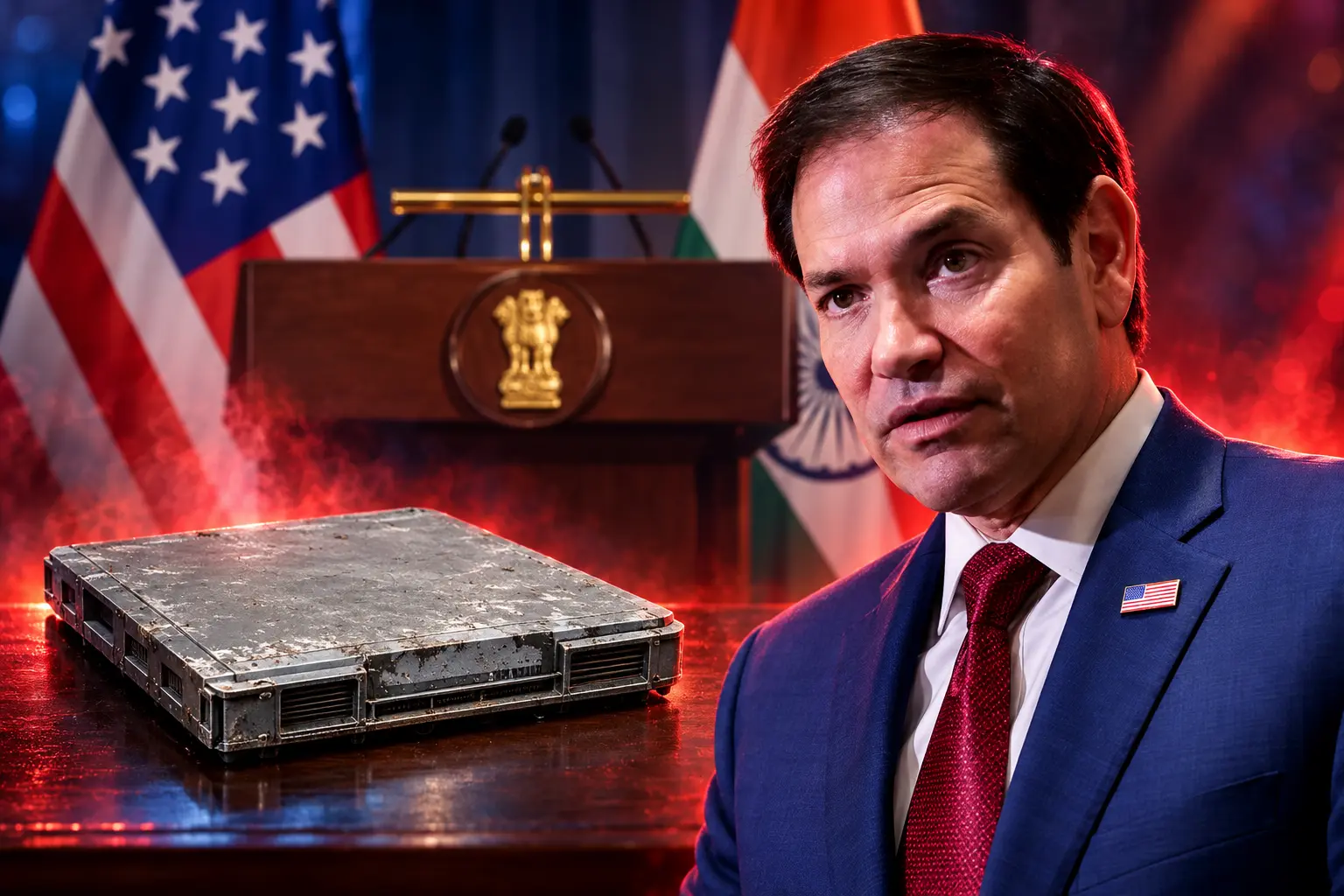
Secretary of State Marco Rubio said Wednesday that Ukraine’s Starlink access is Elon Musk’s call, not the White House’s. He was speaking in Mumbai, a week after a speed cap hit the military network Kyiv uses to fly interceptor drones.
The same week, Musk wrote that Starshield belongs to the US government and that speed limits are set by the military and, in the end, the president. No US official has publicly asked SpaceX to lift the cap.
Rubio Hands Ukraine’s Starshield Switch to Musk
Asked in India about an account that Musk ordered Starshield slowed, Rubio said he had not seen that reporting and was not sure Washington had been told in advance. He also said that did not matter.
I’m not aware that we knew about this decision beforehand. But that’s irrelevant. The bottom line is that that is governed by a private commercial contract as to how their stuff can be used and what speeds they’ll allow it to be used at.
Marco Rubio, US Secretary of State, to reporters in Mumbai
President Donald Trump, asked the same day whether Musk had ordered the slowdown, said, “I don’t know who did it, but I was not involved.” Musk and SpaceX did not answer questions about the order.
That is a different line from Saturday, when Rubio left for Uzbekistan and India. “I’m not sure Zelenskiy knows what he’s talking about, but it wasn’t deliberate,” he said then. “The United States, nobody ordered that Starlink speed to be slowed down. It sort of happened, but my understanding is it’s been restored.”
On Saturday he also suggested Ukraine had never had Starshield. President Volodymyr Zelenskiy has said both Starlink and Starshield were disrupted. In Mumbai, Rubio told reporters the two products are separate, called Starshield a defense item sold through the Pentagon, then said Washington cannot direct a private firm on how its technology is used.
Pentagon chief Pete Hegseth, speaking Tuesday, put the cutoff in commercial language as well. “There are terms of service that ultimately need to be complied to, and that’s where Starlink has the option to make those decisions,” he said.
The Post That Named the President
On October 14, after Ukrainian officials described an overnight speed cap, Musk answered Mykhailo Fedorov, Ukraine’s former defense minister, on X. “Starshield systems are owned and controlled by the US government,” Musk wrote. “Any limits on speed or usage are decided by the US military and ultimately POTUS.”
He drew a hard line under the consumer product. Starlink, he wrote, is a commercial service owned by SpaceX, limited to civilian or defensive work, and “cannot be used for offensive military action, as doing so would be inappropriate for a commercial company.”
Fedorov had said Starlink links at speeds up to 160 km/h, about 100 miles per hour, were coming back, and that taking the Starshield cap off entirely was “critical for Ukraine’s defense.” Ukraine’s Defense Ministry said a 161 km/h limit was still in place, with better quality up to 160 km/h.
Two US officials and a Western official later said the order to slow Starshield came from inside the White House and reached Defense Department leaders. A senior US official said President Trump himself made no such request. Zelenskiy has also said the restriction was an American decision. Other officials described Musk as the one who ordered the slowdown, with one person saying he, Trump, and White House officials talked beforehand, and two people saying Musk and the president talked in the days after.
Those accounts cannot both be the last word. What they share is simpler. A week after Musk named the president, the secretary of state named Musk, and the defense secretary named a terms-of-service clause. The cap’s practical owner is whoever can stand the silence.
A 100 mph Cap Against 280 mph Drones
The fight over credit sits on a speed limit. SpaceX, the senators’ letter says, acknowledged a cutoff at 100 miles per hour (160 km/h). Ukrainian testing on October 14 found dropouts above about 63 miles per hour, a lower figure from field checks, not a second official cap.
THE SPEEDS THAT DID NOT MATCH
| Link or threat | Speed | What it did |
|---|---|---|
| Starshield cap acknowledged by SpaceX | 100 mph (160 km/h) | Terminals lose the military link in motion |
| Ukrainian field test on October 14 | About 63 mph | Dropouts recorded below the acknowledged cap |
| Jet-powered Shahed drones, per a Senate aide | 280 mph (450 km/h) or faster | Incoming strike drones Ukraine has to catch |
A Senate Democratic aide called it “a basic math problem.” “If you have a 280-mph object coming towards you, you are not going to be able to counter it with something that goes 100 mph,” the aide said, adding that Kyiv lost a lot of air assets the first night of the slowdown.
Zelenskiy said Russia launched more than 850 Shaheds from the start of October 14 until 9 a.m. on October 15, “precisely at a time of an artificial speed restriction on our defensive capabilities.” Some were shot down, he said. There were also dozens of hits.
Ukrainian commanders described video feeds going fuzzy on drones already in the air. Interceptor work against jet Shaheds, strike runs over occupied territory, reconnaissance, and frontline relays all slowed when terminals could not stay locked in motion. Zelenskiy later said intelligence sharing on ballistic-missile warning had resumed after a call with Rubio, and that Starshield was still restricted.
The Delegation Was Already in Kyiv
The cap did not land on an empty capital. A bipartisan congressional delegation was in Kyiv from October 13 to 16, the same window as the slowdown.
THE WEEK THE FEED DROPPED
- October 12 to 14, 2026: Senators say speed limits hit SpaceX terminals used by Ukrainian aircraft and drones, with no warning.
- October 13 to 16, 2026: A bipartisan US delegation is in Kyiv while the cap is in force.
- October 14, 2026: Ukrainian forces report the restriction; Fedorov asks for the Starshield limit to come off; Musk writes that the US government owns Starshield.
- October 15, 2026: Zelenskiy cites more than 850 Shaheds in roughly a day and a half under the cap.
- October 16, 2026: Nine senators ask the Pentagon inspector general to open an inquiry; four House members write Trump for answers by October 30.
The Senate aide said the slowdown put lawmakers and staff in that group at risk, along with 230 US personnel on the ground. Problems moving US data, and a slowdown in security assistance, meant drones were putting the staff and delegation’s path to official shelters in doubt, the aide said.
Jack Reed, Jeanne Shaheen, Thom Tillis, Dick Durbin, Susan Collins, John Cornyn, Chris Coons, Lisa Murkowski, and Richard Blumenthal put the same fear in a letter to the Pentagon inspector general, Platte Moring III. They asked for a briefing by November 1.
We are particularly alarmed by incidents in which U.S. diplomatic, military, and security personnel were unable to reach designated bunkers during Russian air raids, amid reported disruptions to intelligence-sharing and early-warning capabilities.
Nine US senators, letter to Defense Department Inspector General Platte Moring III, October 16, 2026
The letter treats Starshield as a US-maintained system, not a consumer add-on, and notes that Musk had already said the government owns it. That is the gap Rubio’s Mumbai answer does not close. If the product is the government’s, a commercial contract is a thin shield. If the product is Musk’s, the Pentagon still paid for the terminals sitting on Ukrainian airframes.
What Starshield Is Sold As
SpaceX’s own page draws the line Rubio and Musk keep blurring. Starlink, it says, is built for consumer and commercial customers. Starshield, it says, is designed for government use, with extra cryptography so it can hold classified payloads. The listed jobs are earth observation, communications for government users, and hosted payloads.
STARLINK AND STARSHIELD, AS SOLD
| Starlink | Starshield | |
|---|---|---|
| Who it is built for | Consumers and companies | Governments and national security users |
| Who Musk said owns it | SpaceX | The US government |
| How Ukraine uses it | Civilian links, logistics, some military traffic | Faster military drones, sensors, and command links |
| Who pays in Ukraine | Allies and aid contracts, including Poland on the commercial side | The Pentagon, which first bought about 500 terminals and later expanded the military package to about 3,000 |
US European Command first contracted service for those 500 terminals. Space Systems Command signed a follow-on award in August 2024 that moved about 2,500 Starlink kits already in Ukraine onto Starshield, bringing the military package to about 3,000. The Pentagon has also bought dedicated Starshield spacecraft for missile warning and for the National Reconnaissance Office.
That purchase history is why the commercial-contract line lands so oddly. Starshield was announced in late 2022 as the government twin of Starlink, built so SpaceX would not have to run offensive war traffic on a civilian network. Once the Pentagon is the customer, a terms-of-service clause is still a contract term. It is also a US-paid war tool. Rep. Jason Crow and three House colleagues wrote Trump that this leaves two possibilities for who imposed the cap: SpaceX acting alone on a Defense Department contract, or the US government directing the company.
Mixing the two brand names has become a useful fog. Officials say Starlink when they mean the dish on a roof, then Starshield when they mean the kit on a jet drone, then Starlink again when they want the dispute to sound like a customer-service row. The hardware in the fight is the military package. The political shelter is the consumer one.
Crimea Already Showed Who Can Flip Coverage
Kyiv has been here with Musk before. In 2022, Ukrainian officials asked him to turn Starlink on all the way to Sevastopol so maritime drones could reach the Russian Black Sea Fleet. Musk refused. He said coverage had never been switched on there, that enabling it would have made SpaceX “explicitly complicit in a major act of war,” and that US sanctions barred the beams without a US government waiver he did not have.
Walter Isaacson’s biography first described engineers switching coverage off within 100 kilometers of the Crimean coast during the raid. Isaacson later corrected that. The Ukrainians thought the map was live. It was not. They asked Musk to turn it on. He said no.
Gwynne Shotwell, SpaceX’s president, has said the company can “limit their ability” to use the network for long-range strikes, “and have done.” Musk wrote in January 2023 that Starlink would not be used for long-range drone strikes. Starshield was the promised answer to that bind: a smaller, government-owned system whose limits, he said then, would sit with Washington.
October’s cap is that design meeting a political fight. Musk still says the government holds Starshield. Rubio now says a private contract does. The 2022 Crimea file was about a civilian network and a raid Musk would not enable. The 2026 file is about a Pentagon product already in Ukrainian service, slowed in place, while jet Shaheds kept flying.
Nine Senators Want the Inspector General In
Reed’s group asked Moring to treat the week as a contract and safety failure, not a messaging spat. They want records kept among the Pentagon, SpaceX, and other agencies.
WHAT THE INSPECTOR GENERAL WAS ASKED TO FIND
- Shelter failures: Whether broken warnings or links stopped American diplomatic, military, or security staff from reaching bunkers during Russian raids.
- Who knew: Whether Defense Department or other US officials directed, approved, or had advance notice of changes to Starlink, Starshield, or intelligence sharing.
- The contractor: Whether SpaceX set the limits on its own, whether those limits fit the US contracts, and what the Pentagon did in response.
- Notice: Whether the US Embassy in Kyiv, US staff, and Ukrainian authorities were warned before the change.
Crow’s letter, joined by Adam Smith, Jim Himes, and George Whitesides, asked Trump the same fork by October 30: who authorized the speed limits, whether anyone in the White House or Pentagon talked to SpaceX, and why Ukrainian forces got no notice. “If a private company can unilaterally restrict a critical operational service governed by a signed contract with the Department of Defense during an active conflict,” they wrote, “it raises serious concerns about public accountability and the outsized influence of private actors over U.S. national security matters.”
Rubio’s Mumbai answer picks the private-actor branch and leaves the contract branch unnamed. Hegseth’s terms-of-service line does the same. Musk’s October 14 post picked the president. Trump said he was not involved. Zelenskiy is still waiting on the military package. Crow asked for answers by October 30. The inspector general was asked to brief by November 1.

Bulk Scotch Still Faces Full Duty After India’s UK Deal

Typhoon Champi Loops Off Taiwan and Still Injures 527

PM Modi Opens Chinmaya’s AI Guru and Asks for Unity

Mahim Police Hold a JeM Suspect on Enmity Charges

Gold Falls Below $4,000 as Hormuz Oil Hits $117

The iPhone 18 Pro Max Splits Apple’s Fall in Two

OpenAI Calls GPT-6 Astra AGI Then Locks Its Exploits

Clancy Juror Says the Holdout Never Cited Evidence

Trump Claims Hormuz Control as Oil Holds Near $96

Russia Closes the Goethe-Institut Berlin Tried to Save

 NEWS2 months ago
The iPhone 18 Pro Max Splits Apple’s Fall in Two
- NEWS2 months ago
OpenAI Calls GPT-6 Astra AGI Then Locks Its Exploits
- NEWS1 month ago
Clancy Juror Says the Holdout Never Cited Evidence
- BUSINESS2 months ago
Trump Claims Hormuz Control as Oil Holds Near $96
- LIFESTYLE2 months ago
Russia Closes the Goethe-Institut Berlin Tried to Save
- AUTO2 months ago
Volkswagen’s Job Cuts Leave Four Plants Without Cars
- NEWS2 months ago
Dyson Puts Nurovi Robots on Sale Without the UV Flagship
- NEWS2 months ago
The Lincoln’s 286-Day War Cruise Ends at a Thai Pier