
BUSINESS
DMart Grows Q2 Sales 17.8% While Profit Trails Shares
DMart grew Q2 sales 17.8% while profit rose 8.5%, a gap already reflected in a 52-week low for Avenue Supermarts.

Avenue Supermarts reported a 17.8% rise in second-quarter consolidated revenue to ₹19,644 crore, while net profit rose 8.5% to ₹743 crore. Older DMart stores grew 9.5%, and the company added 15 outlets, taking the network to 518.
The stock had already closed at ₹3,516.80 on October 9, a session that included a 52-week low of ₹3,497.70. Sales sped up. Profit did not keep pace, and a rich multiple had already given way.
Saturday’s Filing Split Sales From Profit
The Mumbai grocer, promoted by Radhakishan Damani, published standalone and consolidated results on October 10 for the quarter ended September 30. On a standalone basis, the BSE filing showed standalone revenue up 18.4% at ₹19,206 crore, against ₹16,219 crore a year earlier. Net profit rose 7.6% to ₹804 crore from ₹747 crore.
EBITDA rose 14.1% to ₹1,403 crore, which still left the margin at 7.3% against 7.6% in Q2 FY26. The profit margin slipped to 4.2% from 4.6%. Basic earnings per share were ₹12.32, up from ₹11.47.
The consolidated line is the one the market will run through models, because it folds in Avenue E-Commerce, which operates DMart Ready. Consolidated EBITDA rose 14.7% to ₹1,393 crore, and the margin was 7.1% against 7.3%. The profit margin was 3.8% against 4.1%. Consolidated EPS was ₹11.40, against ₹10.53.
Q2 FY27 SCORECARD
| Metric | Standalone | Consolidated |
|---|---|---|
| Revenue | ₹19,206 crore (+18.4%) | ₹19,644 crore (+17.8%) |
| EBITDA | ₹1,403 crore (+14.1%) | ₹1,393 crore (+14.7%) |
| EBITDA margin | 7.3% (from 7.6%) | 7.1% (from 7.3%) |
| Net profit | ₹804 crore (+7.6%) | ₹743 crore (+8.5%) |
| PAT margin | 4.2% (from 4.6%) | 3.8% (from 4.1%) |
| Basic EPS | ₹12.32 | ₹11.40 |
For the first half, standalone revenue rose 16.8% to ₹37,550 crore and profit rose 10.3% to ₹1,739 crore. Consolidated first-half revenue was ₹38,439 crore, up 16.4%, with profit of ₹1,603 crore, up 9.9%. The half-year still grew. The second quarter did more of the sales work than the profit work.
9.5% Growth at Stores Older Than Two Years
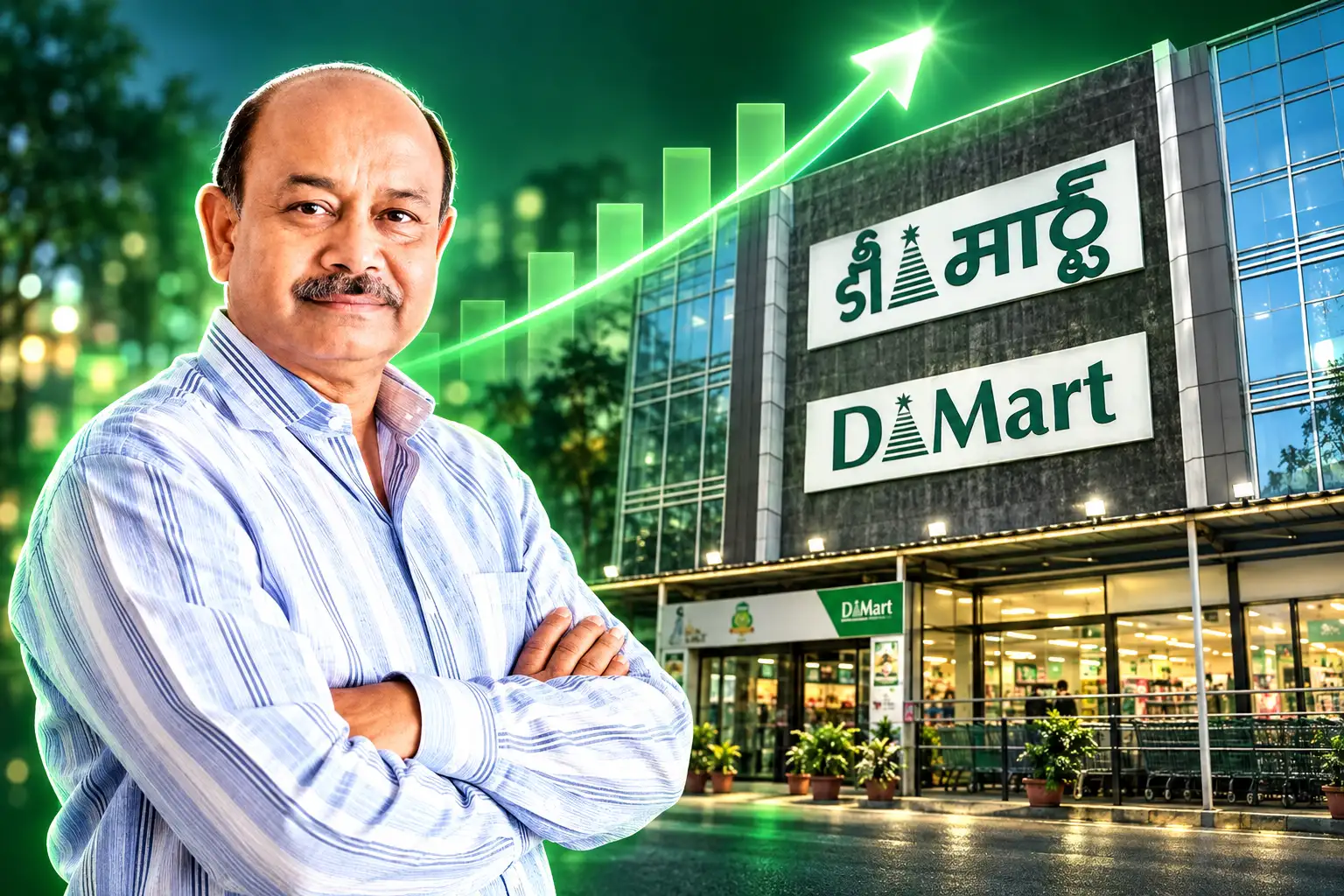
Anshul Asawa, managing director and chief executive officer, said stores that have been open at least two years grew 9.5% in Q2 FY27, compared with 6.8% in Q2 FY26. That is the operational beat inside the sales print, because it is not just new floorspace talking.
The same measure was 5.5% in the June quarter. A 9.5% reading after that slowdown is why the revenue line looks healthy even before counting the 15 new stores. It also sits below the 10.8% older-store growth Goldman Sachs Research had flagged for the March quarter, so this is a rebound, not a new peak.
Foods were 56.9% of first-half sales, general merchandise and apparel 23.6%, and non-food FMCG 19.5%. The chain still lives on grocery baskets, which is why a recovery in older stores matters more than a burst of festive apparel. Retail business area reached 21.4 million sq ft, across Maharashtra, Gujarat, Telangana, Andhra Pradesh, Karnataka, Tamil Nadu, Madhya Pradesh, Rajasthan, Punjab, NCR, Chhattisgarh, Uttar Pradesh, Daman, Goa, Odisha, Uttarakhand and Haryana.
The count of 518 stores includes the Sanpada outlet in Navi Mumbai, which is closed to customers for reconstruction. Sequential standalone revenue rose about 4.7% from ₹18,343.49 crore in the June quarter. The stores that were already on the map did more work in July to September than they did in April to June.
Why Profit Trailed an 18.4% Jump in Sales
Asawa did not blame demand. He blamed pay at the bottom of the roster, while repeating the company’s everyday-low-cost, everyday-low-price pitch: buy cheap, run tight, sell cheap.
We remain committed to offering best value to our customers. Our pricing proposition thus remains strong in an inflationary environment. Wage inflation at entry-level has led to a marginal increase in operating expenses.
Anshul Asawa, Managing Director and CEO, Avenue Supermarts press release
The consolidated cost lines are less marginal than that wording. Employee benefits rose 18.7% to ₹447.14 crore, a touch faster than 17.8% sales growth. Other expenses rose 18.3% to ₹1,091.83 crore. Depreciation rose 25.4% to ₹317.75 crore. Finance costs jumped 82.8% to ₹63.90 crore, the lease-heavy bill that comes with a larger store grid. Total expenses rose 18.3% to ₹18,632.70 crore, matching sales, which is how a grocer grows the top line and still surrenders margin.
THE COST LINES THAT MATCHED SALES
- Staff pay: Employee benefits rose 18.7% to ₹447.14 crore, slightly ahead of consolidated sales growth.
- Other costs: Other expenses rose 18.3% to ₹1,091.83 crore, in step with the 17.8% sales increase.
- Store wear: Depreciation and amortisation rose 25.4% to ₹317.75 crore as the grid expanded.
- Lease bill: Finance costs jumped 82.8% to ₹63.90 crore.
- The total: Expenses of ₹18,632.70 crore rose 18.3%, so profit could not grow with sales.
That is the DMart bargain in one quarter. The company will not raise shelf prices enough to protect a 7.6% EBITDA margin if doing so would break the value offer. Entry-level wages then show up in the operating line, and new stores show up in depreciation and finance costs. Standalone profit growing 7.6% against 18.4% sales is that choice, booked.
DMart Ready Cut Cities and Still Lost Money
The gap between standalone profit of ₹804 crore and consolidated profit of ₹743 crore is the rest of the group, mainly the online unit. Consolidated statements show DMart Ready with a net loss of ₹75.35 crore in the September quarter and ₹166.62 crore in the first half. Those two figures are not the same as the ₹61 crore standalone-to-consolidated profit gap, which includes other consolidation items.
The investor presentation put DMart Ready in 11 cities in the first half, down from 19 a year earlier. Quick-commerce players have spent the past two years putting dark stores closer to the customer than a weekly DMart run. Avenue E-Commerce is answering by occupying fewer cities, not more.
We are focused on driving greater operational efficiencies and strengthening overall customer experience in the cities that we currently operate in. Our organisational efforts are aligned in that direction.
Vikram Dasu, Whole Time Director and CEO, Avenue E-Commerce Ltd
Dasu did not give a path back to profit or a city target. The brick-and-mortar chain is still adding floorspace. The app is still losing money in a smaller map.
The 52-Week Low Ahead of Saturday’s Print
NSE trading was shut on October 10, so the first session after the print is Monday, October 12. The tape did not wait. After the October 3 business update showed 18.4% standalone sales growth and 518 stores, the stock fell 4.07% to ₹3,657.70 on October 5. By October 9 it had tagged ₹3,497.70, the 52-week low, and closed at ₹3,516.80, down ₹68.20 or 1.90% from ₹3,585.
THE WEEK THE MULTIPLE GAVE WAY
- October 3, 2026: Business update shows standalone revenue of ₹19,206 crore, up 18.4%, and 518 stores.
- October 5, 2026: Shares fall 4.07% to ₹3,657.70 after that sales update, with no profit numbers yet in the market.
- October 9, 2026: Intraday low of ₹3,497.70, the 52-week floor; close ₹3,516.80. The 52-week high is ₹4,644, set on April 17, 2026.
- October 10, 2026: Full results land on a Saturday: consolidated profit ₹743 crore, up 8.5%.
- October 12, 2026: First NSE session after the print.
A clean sales update that still produced a heavy down day is the tell. The market was not arguing about 518 stores. It was arguing about what those stores would earn.
THE OCTOBER 9 CLOSE
- Last price: ₹3,516.80, down 1.90% on the day, with the 52-week low at ₹3,497.70.
- Multiple: The trailing PE ratio of 73.51 and a forward PE of 60.98, with a PEG ratio of 3.41.
- Size: Market cap of ₹2.29 trillion, price-to-sales of 3.09, and price-to-book of 8.79.
- Cash drain: Trailing twelve-month free cash flow of -₹1,879 crore after ₹4,500 crore of capital spending.
A grocer at 73.51 times trailing earnings is priced as if profit will catch sales. This quarter, it did not. Consolidated profit also stepped down from ₹860.6 crore in Q1 to ₹743 crore in Q2, a 13.7% sequential drop, even as sales moved up. That mix (better older stores, thinner margin, a still-expensive multiple) is what October 5 and October 9 were already trading.
Goldman Kept Sell as Morgan Stanley Stayed Overweight
The split on the Street was visible before Saturday. After the October 3 sales update, Goldman Sachs kept a Sell rating and a ₹3,800 target, and said standalone growth had sped up from 15.1% in Q1, helped in part by FMCG price hikes and inflation. It still expects around 75 store additions in FY27, against 85 in FY26, and lifted FY27-29 EPS estimates by less than 1%. Morgan Stanley kept Overweight with a ₹4,464 target.
GOLDMAN SELL VERSUS MORGAN STANLEY OVERWEIGHT
- Goldman Sachs: Sell, target ₹3,800, after the Q2 sales update; about 75 FY27 stores against 85 in FY26.
- Morgan Stanley: Overweight, target ₹4,464, on the same update.
- Wider desk: 32 analysts show a Hold consensus and an average 12-month target of ₹4,228.66, which is 20.24% above the October 9 close.
The 75-store year is the hinge. Motilal Oswal, after the July analyst meeting, also built in about 75 store additions in FY27, down from 85, and treated a 15% annual rise in the store base as the company’s own pace. H1 added 18. The calendar still bunches openings late, as it did when Q4 FY26 added 58 stores and took the count to 500.
HOW THE STORE GRID MOVED
| Period | Stores added | Store count |
|---|---|---|
| Q4 FY26 | 58 | 500 |
| Q1 FY27 | 3 | 503 |
| Q2 FY27 | 15 | 518 |
| H1 FY27 | 18 | 518 |
Eighteen stores in a half-year against a 75-store full-year build leaves most of the work for the second half, which is how DMart has been opening rooms. Each of those rooms still has to be staffed at a higher entry wage, and each one still sells at the same everyday price. That is the quarter the filing described, and it is the quarter the stock had already marked down to ₹3,497.70. Monday, October 12, is only the first session in which that markdown can meet the audited numbers.
Frequently Asked Questions
How Many Shares Does Avenue Supermarts Have Outstanding?
Avenue Supermarts has 652.25 million shares outstanding, of which 149.53 million form the public float. Insiders own 63.47% and institutions 14.34%, according to the October 9 share count on StockAnalysis, so control remains tightly with the promoter group around Radhakishan Damani.
Does Avenue Supermarts Pay a Dividend?
No. The company shows no dividend per share and a 0% payout on that statistics page, and the October 10 results did not declare one, which is consistent with a model that still puts cash into owned stores rather than a cash return.
What Was Avenue Supermarts’ Free Cash Flow Over the Past Year?
Trailing twelve-month free cash flow was a deficit of ₹1,879 crore, after operating cash flow of ₹2,621 crore and capital spending of ₹4,500 crore, so the store programme is still larger than cash from operations.
What Is Avenue Supermarts’ Debt-to-Equity Ratio?
Debt to equity is 0.16, with a current ratio of 1.72 and interest coverage of 22.57 on the same October 9 snapshot, which is a light balance sheet for a 518-store grocer even after finance costs jumped 82.8% in the quarter on leases.
Disclaimer: This article is news reporting and analysis of Avenue Supermarts’ published results and share-price data, and it is for information only. It is not investment advice, a research report, or a recommendation to buy, sell, or hold DMart or any other security. Readers should consult a SEBI-registered investment adviser or other qualified professional before making any investment decision. Figures, ratings, and trading levels reflect the company filing, data pages, and brokerage notes cited above as of those documents’ dates and may change when markets open or when later filings are issued.

Bulk Scotch Still Faces Full Duty After India’s UK Deal

Typhoon Champi Loops Off Taiwan and Still Injures 527

PM Modi Opens Chinmaya’s AI Guru and Asks for Unity

Mahim Police Hold a JeM Suspect on Enmity Charges

Gold Falls Below $4,000 as Hormuz Oil Hits $117

The iPhone 18 Pro Max Splits Apple’s Fall in Two

OpenAI Calls GPT-6 Astra AGI Then Locks Its Exploits

Clancy Juror Says the Holdout Never Cited Evidence

Trump Claims Hormuz Control as Oil Holds Near $96

Russia Closes the Goethe-Institut Berlin Tried to Save

 NEWS2 months ago
The iPhone 18 Pro Max Splits Apple’s Fall in Two
- NEWS2 months ago
OpenAI Calls GPT-6 Astra AGI Then Locks Its Exploits
- NEWS1 month ago
Clancy Juror Says the Holdout Never Cited Evidence
- BUSINESS2 months ago
Trump Claims Hormuz Control as Oil Holds Near $96
- LIFESTYLE2 months ago
Russia Closes the Goethe-Institut Berlin Tried to Save
- AUTO2 months ago
Volkswagen’s Job Cuts Leave Four Plants Without Cars
- NEWS2 months ago
Dyson Puts Nurovi Robots on Sale Without the UV Flagship
- NEWS2 months ago
The Lincoln’s 286-Day War Cruise Ends at a Thai Pier










