
BUSINESS
US Destroys Five Iranian Tankers as the Shock Hits Jordan
Washington sank five Iranian tankers under a hit-a-warship, lose-a-tanker rule, and the shock landed on a Jordanian air base and a $100 oil print.

U.S. forces destroyed five Iranian oil tankers on September 8 after two missed ballistic-missile shots at a Navy warship. Iran answered overnight with a 20-missile barrage at a U.S.-used air base in Jordan, and Brent crude touched $100.19 on Wednesday, September 9.
The ships were not random hulls in a gunfight. They were the exposed remainder of an oil route the United States is trying to shut, and the blast radius showed up in Amman, in the Gulf of Oman, and on the price board.
Five Named Tankers Went Down on Tuesday
U.S. Central Command said it destroyed five Iranian crude oil carriers after the Islamic Revolutionary Guard Corps twice fired ballistic missiles at a Navy warship over two days. The ship evaded both shots, CENTCOM said, and no Americans were hurt.
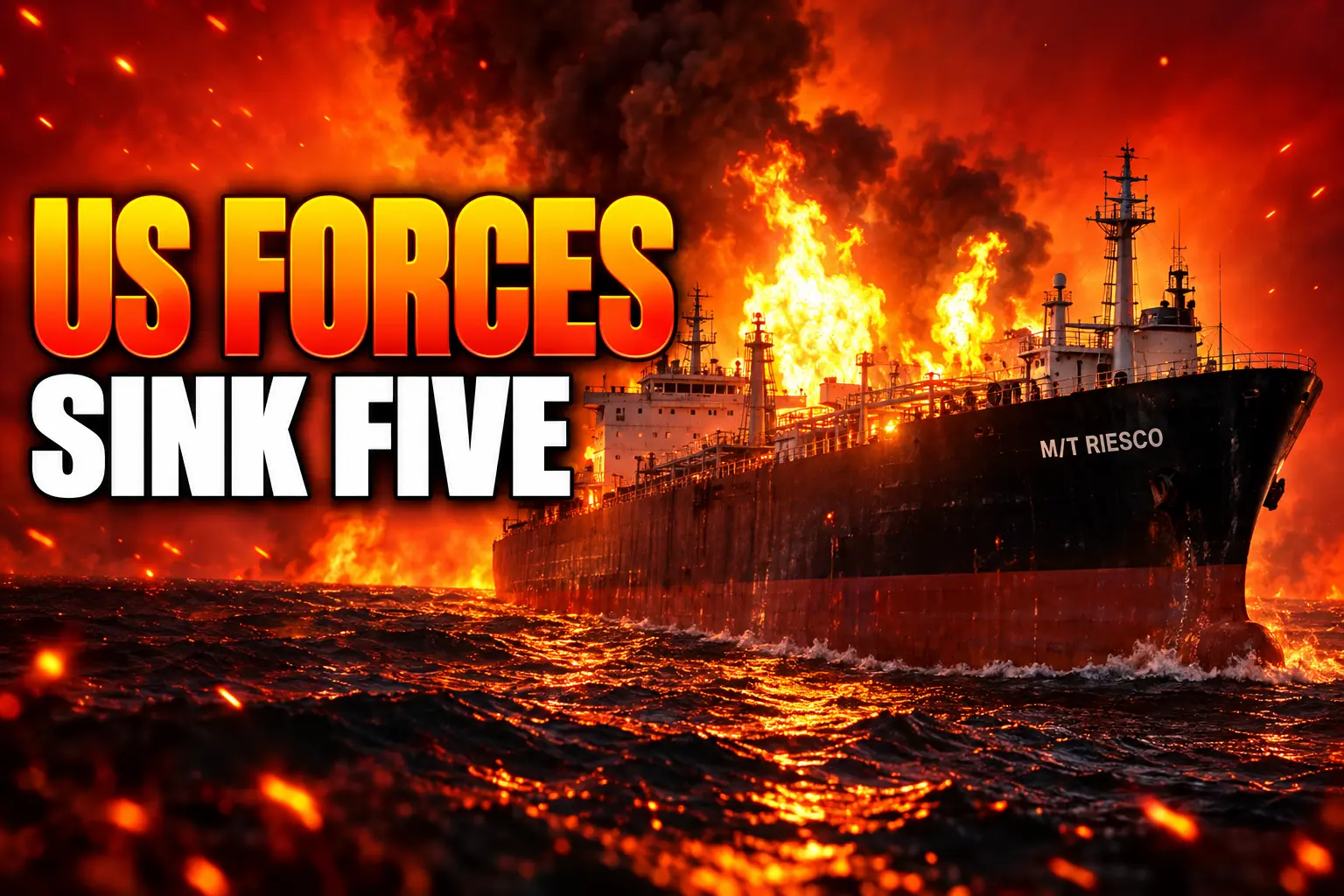
The named hulls were M/T Kaviz, M/T Charminar, M/T Horizon 1 and M/T Riesco in the Gulf of Oman, plus M/T Derya near Kharg Island. American forces told the crews to leave before the ships were hit and put out of action, the command said, and later posted video it described as the Riesco sinking.
M/T Riesco sinks in the Gulf of Oman, Sept. 8, after being destroyed by CENTCOM forces in response to attempted IRGC attacks on a U.S. Navy warship. pic.twitter.com/EkmG8uyMT9
— U.S. Central Command (@CENTCOM) September 9, 2026
Iran’s IRIB state broadcaster confirmed a strike near Kharg, which handled some 90 percent of the country’s oil exports before the war that began on February 28, and said the crew got off. It also reported a hit near the southern port of Jask. The IRGC later said five tankers were targeted.
Maritime security firm Vanguard Tech put one of those hits in a precise patch of water: Horizon 1, struck in the stern in international waters 38 nautical miles northeast of Dibba in the UAE. Fire ran into the accommodation block, and all 16 crew left the ship and were picked up by a bunker barge named Savona.
THE FIVE HULLS CENTCOM NAMED
| Vessel | Where it was hit | What it is |
|---|---|---|
| M/T Derya | Near Kharg Island | Iranian-flagged NITC VLCC |
| M/T Kaviz | Gulf of Oman | Aframax, Comoros flag in Equasis |
| M/T Riesco | Gulf of Oman, later filmed sinking | Aframax, Zimbabwe flag in Equasis |
| M/T Charminar | Gulf of Oman | Oil and product tanker, Comoros flag |
| M/T Horizon 1 | 38 nm northeast of Dibba | LPG carrier, Palau flag, 16 crew rescued |
CENTCOM video of Derya, Kaviz, Charminar and Horizon 1 showed stern strikes aimed at the engine room. Riesco was shown with fire on deck and around the living block. Kaviz, Charminar and Riesco had ownership listed as unknown in Equasis and in Pole Star Global’s PurpleTrac after sales to undisclosed buyers. Horizon 1 is listed as operated by KBT Ship Management in Mumbai.
Miss a Destroyer and Lose a Tanker
Secretary of State Marco Rubio, speaking in Colombia, turned the exchange into a standing rule. “Iran continues to try to hit US naval ships, and for every time they do that or try to do that, they’re going to lose tankers,” he said, and a fuller cut of the same remarks added, “And I think you’ll see that again today.”
That line did not start on Tuesday. After a September 5 round, Adm. Brad Cooper, the CENTCOM commander, had already priced the trade in hulls, not in apologies.
Let the message to the IRGC be clear: If you shoot at two of our ships, we will impose an even higher economic cost, taking out three of yours. We will not hesitate to defend American forces, and if necessary, destroy Iran’s limited and exposed oil fleet.
Adm. Brad Cooper, CENTCOM commander, Sept. 5 public release
On September 5, after missiles toward a U.S. aircraft carrier and a guided-missile destroyer, CENTCOM said it permanently disabled M/T Downy off Kharg and M/T Stark 1 near Jask, and completely destroyed the empty M/T Kylo, also known as Noxen, in the Gulf of Oman. Cooper’s ratio that day was two U.S. ships shot at, three Iranian tankers taken off the board. Tuesday’s count was two missed shots at one warship and five tankers gone. The command later wrote that it was taking out three of yours for two shots, and that Iran “has no means by which to defend these vessels.”
THE WEEK THE RATIO CHANGED
- September 5, 2026: CENTCOM disables Downy and Stark 1 and destroys Kylo after missiles toward a carrier and a destroyer.
- September 8, 2026: After two missed shots at one warship, CENTCOM destroys Kaviz, Charminar, Horizon 1, Riesco and Derya.
- September 9, 2026: CENTCOM says U.S. forces have destroyed 10 Iranian tankers in the last week and calls IRGC claims of hits on two destroyers false.
The five Tuesday wrecks plus the three named on September 5 add to eight public hulls. CENTCOM’s Wednesday tally of 10 implies two more ships in that week that the command has not listed in those two releases. Tehran’s foreign ministry called the latest hits a violation of the United Nations charter and a “war crime,” and said Washington and its partners bear the consequences of an “economic war.”
Jordan Took the Missiles Aimed at America
Iran had already said what it would do if the tankers were hit. Ali Abdollahi, chief of staff of Iran’s armed forces, warned that Tehran would strike U.S. military sites across the region. The IRGC then said it subjected Al Azraq base in Jordan to “fierce missile strikes” and claimed hangars used by U.S. fighter jets were destroyed.
Jordan’s Armed Forces said air defences engaged 20 ballistic missiles, “successfully intercepting and destroying 18 of them.” Two missiles “fell in unpopulated areas.” The army said there were no casualties, and that teams had started securing debris and shrapnel. The base, also called Muwaffaq Salti, is about 100 km from Amman.
The IRGC named the operation and the aircraft it said it was hunting. It said its aerospace force used solid-fuel and liquid-fuel ballistic missiles in a strike it called “Punishing the Aggressors,” aimed at maintenance and repair bays, aircraft-preparation areas, shelters, and sites it said held U.S. F-35, F-16 and F-15 jets. Liquid-fuel missiles take longer to ready than solid-fuel ones, which is why that mix reads as a planned shot, not a scramble.
Jordan is not a new address for this war. On September 2 the Jordanian military said 13 ballistic missiles from Iranian territory entered its airspace; air defences destroyed 10, and three fell in remote areas, again with no deaths. The Tuesday night barrage was larger. IRGC Aerospace Force commander Seyed Majid Moosavi had previewed the logic before the tankers burned. “The moment the enemy strikes Iranian tankers, a domino chain of consequences will begin that no one but Iran can stop,” he said.
Brent Crossed $100 With Hormuz Already Starved
Early Wednesday trade printed Brent at $99.49 a barrel. Later in the Singapore morning the contract traded at $99.93, up $2.01 or 2.05%, after touching $100.19, the first print above $100 since July 24. West Texas Intermediate was at $94.52, up $1.49 or 1.60%. Brent is up about 25% since early August. Since the war began on February 28 it has been as high as $126.41, a peak set on April 30.
That is not a panic over a closed strait that just slammed shut. Hormuz has been a trickle for months. Claudio Galimberti, chief economist at Rystad Energy, said that in the week before fighting resumed on August 30, roughly 8 million to 9 million barrels a day had moved through the strait, double the prior week, and that more recently the flow had fallen below 2 million barrels a day.
WHERE THE OIL MARKET BROKE ON WEDNESDAY
- Brent high: The contract touched $100.19 a barrel on September 9, then stood at $99.93 by 0802 GMT.
- Hormuz now: Rystad’s Galimberti put recent strait flows below 2 million barrels a day, after 8 million to 9 million just before August 30.
- Hormuz then: An International Energy Agency note put Hormuz flows down from 20 million barrels a day before the war to an average of 2.7 million in March, April and May.
- Year’s supply: The IEA’s August Oil Market Report projects global oil supply to fall 4.3 million barrels a day in 2026, to 102 million, with 8.3 million barrels a day of Gulf output still shut in.
Hamad Hussain, senior climate and commodities economist at Capital Economics, pointed at the workaround the Tuesday strikes actually hit. “The key risk is whether the recent attacks on oil tankers lead to fewer ship-to-ship transfers taking place in the Gulf of Oman, which have so far played a key role in providing oil to global markets and keeping a lid on prices,” he said. Four of the five wrecks were in that gulf. The fifth was at Kharg.
Jeffrey Currie, co-chairman at Abaxx Markets, called the move structural. “I think the market is trying to treat this rise in energy prices as a one-off. It’s not. This is structural. It’s not going away, and it’s part of what I would argue as a security premium. And it’s only going to get bigger,” he said. Crude had already been through an earlier stretch of oil holding near 96 dollars a barrel while Washington talked about control of the strait. Wednesday’s print was the same war, with the remaining bypass under fire.
What the Shadow Fleet Looked Like on the Water
CENTCOM’s repeated phrase is a “multibillion-dollar shadow network” that funds the IRGC and its regional proxies. On the water that network looked like false flags, unknown owners, and a mix of crude, product and gas hulls still trying to load or transfer after Hormuz ceased to be a normal seaway.
HOW THESE SHIPS WERE HIDDEN
- Comoros paper: Kaviz and Charminar are listed as Comoros false-flag in Equasis, a common cloak for ships that no longer want a real registry attached to them.
- Zimbabwe paper: Riesco is listed as Zimbabwe false-flag, with ownership unknown in both Equasis and PurpleTrac after a sale to undisclosed interests.
- A Mumbai operator: Horizon 1 appears Palau-flagged and operated by KBT Ship Management in Mumbai, an LPG carrier in a round of strikes CENTCOM described as crude-oil carriers.
- A state VLCC: Derya is an Iranian-flagged NITC very large crude carrier, hit beside the island that used to move most of Iran’s oil.
Tehran closed the Strait of Hormuz after the war began, and Washington has been running a naval blockade on Iranian ports. Mohsen Rezaei, a senior Iranian security official, said Tehran planned a restricted zone outside Hormuz and that “any ship entering this new zone will be placed on the sanctions list [of Iran].” The Tuesday hits did not reopen that argument. They moved it onto the ships still using Kharg and the Gulf of Oman as the last doors.
The IRGC also said it had captured an unmanned U.S. submarine at the entrance to Hormuz “in a complex intelligence and operational action.” The U.S. military said the underwater drone had “malfunctioned” while watching regional waters, and that the “defective drone” had not collected sensitive data and carried no classified sonar or radar. Iranian media identified the vehicle as a Dive-LD platform. A U.S. official separately described it as an older model and did not confirm that Iranian forces had seized it.
Tehran’s Destroyer Claims Meet a Pentagon Denial
After the tanker hits, the IRGC said it had fired ballistic missiles at the U.S. Navy destroyers DDG-119 and DDG-53 and caused “significant damage” to those ships. A later statement said naval forces targeted “2 American vessels and 8 tankers in the region, causing great damage to them.” It was not clear whether those two American vessels were the same destroyers. Washington had no immediate comment on the claims on Tuesday night.
On Wednesday morning CENTCOM closed the gap in public. It said the IRGC claim that it struck two U.S. Navy destroyers was “completely FALSE,” that “no U.S. Navy warship has been struck,” and that “all IRGC attempted attacks failed.” In the same post it put the week’s tanker score at 10. The destroyer claim is the part of the night that still splits. The tanker losses are the part that does not.
WHAT WE KNOW
- The five wrecks: CENTCOM named Kaviz, Charminar, Horizon 1, Riesco and Derya, ordered crews off, and released video it said showed Riesco going down.
- The Jordan tally: Jordan’s army counted 20 ballistic missiles, 18 shot down, two in empty land, and no deaths.
- The oil print: Brent traded through $100.19 on September 9, the first time since July 24.
WHAT IS UNCONFIRMED
- The destroyers: Iran says DDG-119 and DDG-53 took “significant damage.” CENTCOM says no U.S. warship was hit.
- The eight tankers: The IRGC says it damaged eight tankers plus two American vessels. The United States has not answered that specific sea claim ship by ship.
- The extra two: CENTCOM’s week tally of 10 is two ships above the eight hulls named in the September 5 and September 8 releases.
Distrust of CENTCOM’s fact-check is now part of the argument around the war, which is why the command posted the denial at all. The oil market is not waiting for hull-camera proof from DDG-119. It is pricing whether the next STS transfer in the Gulf of Oman still sails.
Warnings Reach Crews Near Kuwait and Bahrain
Before the return fire at sea, the IRGC warned of imminent attacks on oil tankers at the borders of Bahrain and Kuwait and told all crews to get off at once. Iranian state television, citing the Guard, said crews near Kuwaiti and Bahraini piers should “immediately abandon their vessels, whether at anchor or docked, as they will be targeted.” Those waters are not the strait, and they are not Kharg. They are the next commercial door Iran can kick if the tanker-for-tanker rule holds.
Tehran still has hulls. The United States still has a written policy that a missed shot at a destroyer costs Iran another tanker. Jordan has now had to shoot down 18 of 20 missiles aimed at a base it hosts, and Brent has already shown what that loop does to the price of a barrel. The next ship that stays lashed to a Kuwaiti pier is in that loop too.

US Destroys Five Iranian Tankers as the Shock Hits Jordan

Eiffel Tower Managers Hid Women for a Guru’s Visit

Russia Ends the Kyiv Pause With Missiles After Envoys Leave

Putin Meets Modi With Jets and Reactors Under a Tariff Cloud

iOS 27 Folds Pro Camera Tools Into the Default App

The iPhone 18 Pro Max Splits Apple’s Fall in Two

OpenAI Calls GPT-6 Astra AGI Then Locks Its Exploits

Trump Claims Hormuz Control as Oil Holds Near $96

Russia Closes the Goethe-Institut Berlin Tried to Save

Volkswagen’s Job Cuts Leave Four Plants Without Cars

 NEWS2 weeks ago
The iPhone 18 Pro Max Splits Apple’s Fall in Two
- NEWS2 weeks ago
OpenAI Calls GPT-6 Astra AGI Then Locks Its Exploits
- BUSINESS2 weeks ago
Trump Claims Hormuz Control as Oil Holds Near $96
- LIFESTYLE2 weeks ago
Russia Closes the Goethe-Institut Berlin Tried to Save
- AUTO2 weeks ago
Volkswagen’s Job Cuts Leave Four Plants Without Cars
- BUSINESS2 weeks ago
Japan’s 3 Percent Yield Reprices Government Debt Worldwide
- NEWS2 weeks ago
Samsung Splits Galaxy Book6 With a $799 Core 3 Twin
- BUSINESS2 weeks ago
Cable Stocks Fall as UltraTech Copies the Paints Playbook