NEWS
Dyson Puts Nurovi Robots on Sale Without the UV Flagship
Dyson put two Nurovi robots on sale and left the UV flagship unpriced until 2027, its fourth try at the floor.

Dyson put two new Nurovi robot vacuums on sale on September 3 and left the UV flagship unpriced until early 2027. Chief engineer Jake Dyson used a Berlin stage to describe machines that can see, think, and respond, a line that fits the delayed R3 far better than the two robots in the shop.
The cheaper models start at £499.99. They arrive as Dyson’s fourth serious run at the floor, and after the company that coined Roomba filed for bankruptcy protection.
Jake Dyson Sold a Shift the Shop Cannot Fully Stock
The Dyson Unveiled event in Berlin was held at Bolle on September 3, beside IFA week and not on the IFA floor. Dyson’s own release listed 10 new products under one idea: cameras, vision systems, and machine learning sitting on top of the motors the firm already knows how to make.
We’ve always been very focused on the mechanical engineering of a product, spending decades honing the physical way that each machine performs. Now we have shifted from purely mechanical devices to intelligent machines that can see, think, and respond. We’re using artificial intelligence, vision systems, and machine learning to allow the machines to understand the environment they are operating in. The approach is the same, whether it’s operating in your mouth, on your hair or around your home.
Jake Dyson, Chief Engineer, Dyson Unveiled, Berlin
That see, think, and respond pitch is the wager. The machine built to hunt stains people cannot see, the R3 Nurovi Spot+Scrub UV, is the one Dyson has not priced, and it is the one it will not ship until early 2027.
What the Nurovi R1 and R2 Cost
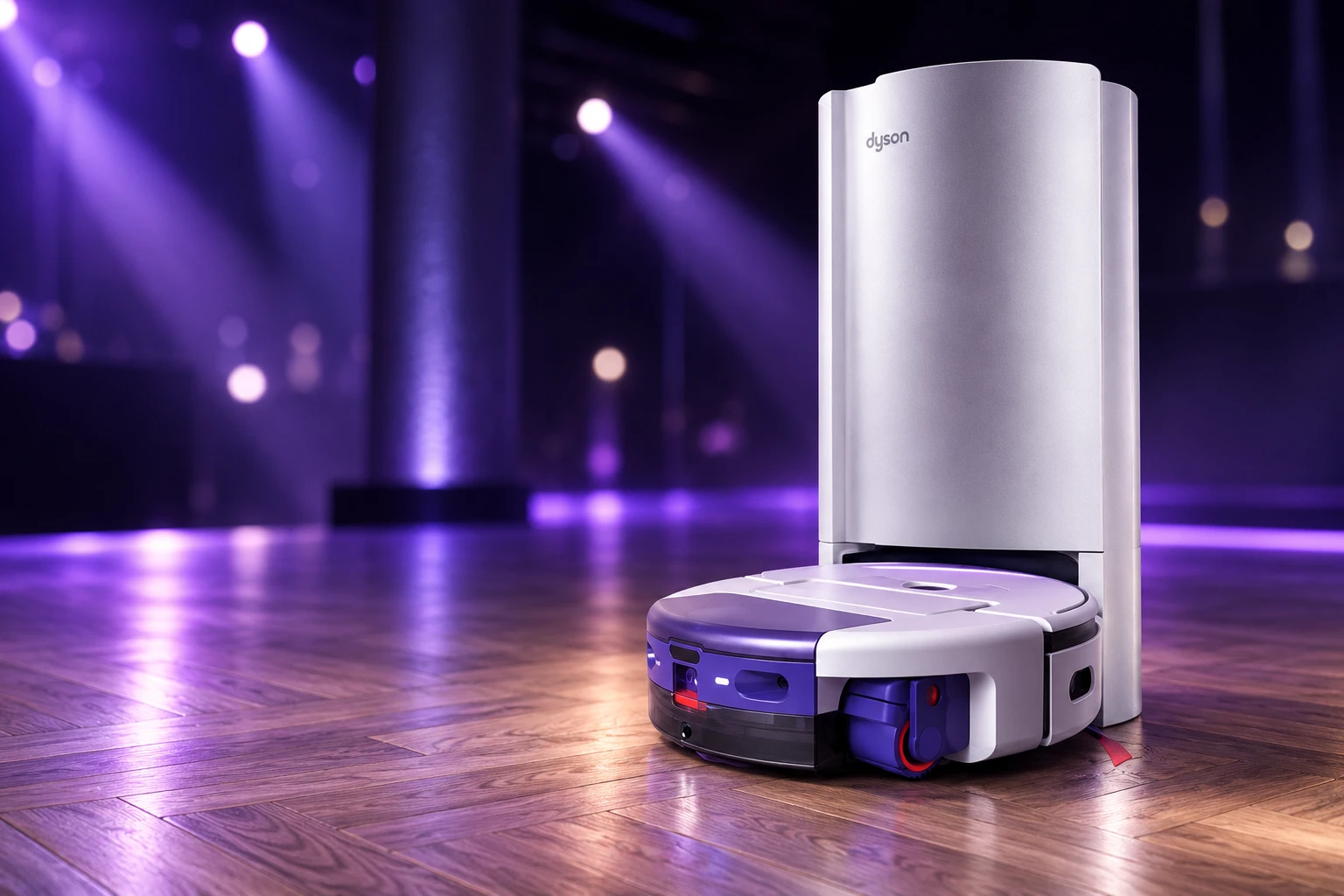
Britain can buy two of the three Nurovi robots now. The R1 Nurovi Dry is listed at £499.99 and the R2 Nurovi Wash+Dry at £749.99 on Dyson’s UK shop, which already showed the R1 out of stock after the launch. Dyson Japan put the R2 on sale on September 4 and said the R1 would follow.
THE NUROVI LINE
| Model | UK price | Suction | Wet heat | On sale |
|---|---|---|---|---|
| R1 Nurovi Dry | £499.99 | 21,000 Pa | None | Listed; UK shop out of stock |
| R2 Nurovi Wash+Dry | £749.99 | 21,000 Pa | 75 C (167 F) | On sale in Britain and Japan |
| R3 Nurovi Spot+Scrub UV | Not set | 30,000 Pa | 70 C (158 F) | Early 2027 |
| Spot+Scrub Ai (2025) | £799.99 (was £1,049.99) | 18,000 Pa | 60 C | Still listed |
Last year’s Spot+Scrub Ai, the camera robot the R3 is meant to replace, is still listed on the same UK page at a £250 cut. The discounted 2025 flagship now costs only £50 more than the new R2.
Nurovi is a blend of neural intelligence and vision, per Dyson. The R3 is the only model that really wears that name. It pairs UV light, green illumination, and on-board stain detection to pick out nearly 200 household substances and objects, then scrubs the same patch until the mark is gone. A 12-point wet roller feeds 158 F water, the roller extends 1.6 in (40 mm) into edges, and Dyson rates the motor at 30,000 Pa, 65% more suction than the Spot+Scrub Ai.
The R2 is the mop you can actually wheel out of a box. Circular pads leave corners dirty, so Dyson used Reuleaux triangle wash pads that keep a constant width as they turn. Japan’s spec sheet puts the R2 at 352 mm square and 96 mm tall, 3.5 kg, with pads that lift 9 mm on carpet, a 40 mm threshold climb, and a side brush that grows 27 mm at a wall. The dock washes those pads at 75 C and dries them at 45 C, and it holds 2.1 L of clean water against 1.2 L of waste. Runtime is listed at about 90 minutes after a 6.5-hour charge. The R1 keeps Twin-capture and 21,000 Pa, skips water, and is rated for about 120 minutes. Both docks are sold as holding about 90 days of debris.
Four Tries at a Floor Robot
Dyson has been circling this product for two decades. Each pass has been late, dear, or both, which is why a £499.99 dry robot is a change of posture even before the UV model appears.
FOUR ATTEMPTS ON THE FLOOR
- 2004: The DC06 is shown with more than 70 sensors and 54 batteries, then killed before retail. Senior robot engineer Mike Aldred later said it did the job the team intended, but it was not the right product.
- 2016: The 360 Eye reaches U.S. shops and is widely treated as a miss, after which Dyson leaves the American robot aisle for years.
- March 19, 2024: The 360 Vis Nav launches in the United States at $1,199.99 as a dry-only, non-emptying, non-mopping robot. Dyson later lists it at $999.99. Reviewers hammered mapping, runtime, and the gap between suction and the rest of the job.
- 2025-2027: Spot+Scrub Ai adds a camera and a hot roller. Nurovi then splits the line into a £499.99 dry robot, a £749.99 wash robot, and an unpriced UV flagship for early 2027.
James Dyson, the founder, was still wary of wet-and-dry combos in September 2025. He said he would rather keep a strong dry robot and a separate wet machine, and that wet robots were not doing well enough, which was one reason Dyson had not rushed. Twelve months later the sellable Nurovi pair is built around that combo, and the dry-only R1 is the budget rung.
The R1’s £499.99 list is about 42% of the Vis Nav’s U.S. launch price. That is the cleanest signal in the drop: Dyson is no longer asking four-figure money for a first look at a floor robot that cannot mop.
iRobot’s Collapse Did Not Clear the Field
Roomba’s parent, iRobot, filed for Chapter 11 protection in Delaware on December 14, 2025, and said Shenzhen-based Picea Robotics, its main manufacturer, would take the firm private. Court papers put 2024 revenue at about $682 million. A 46% U.S. tariff on goods from Vietnam, where many Roombas are made, added $23 million in costs in 2025, the company said. iRobot still claimed about 42% of the U.S. robot-vac market and 65% in Japan at the filing. Those are legacy shares, not a clear runway.
WHO SHIPPED THE CATEGORY IN 2025
- Roborock: 21.7% of global smart robot-vac shipments in the first three quarters of 2025, 3.8 million units, per IDC.
- The next four: Ecovacs 14.1%, Dreame 12.4%, Xiaomi 10%, Narwal 7.5%, which with Roborock adds to 65.7%.
- Hot water, already shipping: Roborock’s Saros 10R has been listed around $899.99 with an 80 C mop wash, above the temperatures Dyson quotes on the R2 and R3.
- iRobot’s hole: a famous American brand in court, not an empty premium shelf.
Chinese firms already sell extending mops, stain routines, and boiling-range docks. Dyson’s bet is that a British name, cyclonic bagless docks, Reuleaux pads, and on-board vision can still pull a premium in that pile. The R2’s £749.99 tag is not exotic next to a $900 Roborock. The R3 has to justify whatever Dyson eventually prints on the box, against machines that have been mopping hot for a year or more.
The $499 Brush With a Live Camera
The gadget that actually matches Jake Dyson’s sentence, and the one people argued about, is not on the floor. On September 1 in Paris, James Dyson launched the CameraJet, a $499 toothbrush with a 100,000-pixel macro camera in the head. Gap Optical Targeting reads 28 live images a second, and within 100 ms of finding a gap it fires a conical jet of mouthrinse. Dyson says 661 engineers spent six years on it, that the model trained on 470,000 dental images, and that the code base runs to 16 million lines. A 12.5 ml anti-gravity tank feeds the jet from any angle. The dock refills it in three seconds.
Flossing is an awkward and time-consuming chore. Few of us do it even though we know we should. Dyson engineers and scientists have spent well over a decade understanding oral care regimes and how nasties build up in the mouth. Our research has shown that people consistently miss the areas where plaque forms: the gaps between teeth. We wanted to solve three fundamental problems: how to see those gaps, remove plaque, and how to improve cleaning performance while brushing. By combining a camera, machine learning, precision fluid dynamics, advanced brushing technologies, connectivity and WiFi, Dyson CameraJet introduces an entirely new way to keep your mouth healthy.
James Dyson, Founder and Chief Engineer, Paris launch
Dyson’s own 2017 usage study said 9 in 10 people do not floss as often as they should, and that brushing time averages 45 seconds. Lab tests the firm cites claim up to 69% more plaque removed in hard-to-reach spots than leading premium electric brushes. The camera is live-view only. Dyson says images are not recorded or stored on the brush or in the cloud. Colors are Ceramic Ultra Blue and Ceramic Pink.
A live camera in a mouth is a harder privacy sell than a camera aimed at a skirting board, and that is the smart gadget Dyson already priced. Online argument ran toward the figure and the ick of filming gums, not toward Nurovi. The floor flagship that uses UV to light stains like a blacklight lane is the product testers lingered on in Berlin, and it is the one you cannot take home.
A Giant Purifier, a Ball Vac and a £200 Brush
Much of the Berlin list is hardware with a thinner AI story, which is how Dyson fills 2026 while the R3 is still in the lab.
THE REST OF THE BERLIN DROP
- W1 PencilWash: £299.99, a slimmer mop with a thirstier roller, a cleaner waste path, and a dock that now washes itself. The first PencilWash landed in Britain in early 2026 at the same price without that dock cycle.
- Big Ball Konical: £349.99 on the UK shop, a self-righting cylinder with a green dust light and a colour nod to the old DC01 De Stijl machine. It is a mechanical encore, not a neural net.
- V15 Konical cordless: shown, not priced, due in 2027.
- HushJet purifiers: the Mini Cool fan in April 2026 sold out, per Dyson. The new Big+Quiet Cool Pure+ Formaldehyde is the largest, with a three-stage filter that Dyson says captures 99.999% of particles down to 0.01 microns and breaks down formaldehyde. The Pure Cool+ Formaldehyde is listed at £549.99 from October, up to three times the output of older TP purifiers in Dyson’s comparison. The Hot Cool Pure+ 3-in-1 is £549.99 from December.
- Corrale CoolShine: a straightener with water-filled heat-extracting pipes in a cooling clip-on. Dyson claims up to 154% more shine versus untreated hair and styles that last up to 24 hours. Price not set.
- Airsmooth: £199.99, Dyson’s first dedicated hot-air brush, reading temperature 100 times a second, with looped anti-snag bristles and PivotFlex bristles that bend up to 90 degrees.
The HushJet nozzle copies aircraft tricks for moving a lot of air without a howl, and that is classic Dyson: a new plastic shape around a fluid problem. It is not the same bet as a UV robot that classifies almost 200 messes. The Big Ball at £349.99 makes the point in chrome and cyclone plastic. If the intelligence era were the whole of the business, a 1990s ball vac would not need a revival this week of launches.
On-Device Vision and a Spare Machine in the Shop
Dyson is trying to defuse the obvious objection before regulators or owners force it. Japan’s Nurovi note says the AI runs in a secure box inside the robot, does not lean on the cloud, and does not store images on the robot. The CameraJet release uses the same rule for teeth. That is the privacy offer: the machine may look, and the file is not supposed to exist later.
The commercial offer sits in a new “Never Without Your Dyson” promise. Robot buyers get Concierge onboarding. Selected stores will diagnose and repair on site. If a fix cannot be done at once, Dyson says it will lend a machine. Connected diagnostics in the MyDyson app are meant to flag trouble before the motor dies in a cupboard. After Vis Nav’s mapping complaints and a robot that some owners said would not find its dock, a loaner in the shop is a quieter part of the wager than UV light.
So the September 3 show leaves a split inventory. You can buy an R2 that mops corners with 75 C water, an R1 if the UK shop has one, a $499 camera for your mouth, and a £349.99 ball vac. The robot that sees invisible stains, the one Jake Dyson’s sentence was written for, remains a 2027 product with no price. That is the bet Dyson just placed, and it is still open.

Bulk Scotch Still Faces Full Duty After India’s UK Deal

Typhoon Champi Loops Off Taiwan and Still Injures 527

PM Modi Opens Chinmaya’s AI Guru and Asks for Unity

Mahim Police Hold a JeM Suspect on Enmity Charges

Gold Falls Below $4,000 as Hormuz Oil Hits $117

The iPhone 18 Pro Max Splits Apple’s Fall in Two

OpenAI Calls GPT-6 Astra AGI Then Locks Its Exploits

Clancy Juror Says the Holdout Never Cited Evidence

Trump Claims Hormuz Control as Oil Holds Near $96

Russia Closes the Goethe-Institut Berlin Tried to Save

 NEWS2 months ago
The iPhone 18 Pro Max Splits Apple’s Fall in Two
- NEWS2 months ago
OpenAI Calls GPT-6 Astra AGI Then Locks Its Exploits
- NEWS2 months ago
Clancy Juror Says the Holdout Never Cited Evidence
- BUSINESS2 months ago
Trump Claims Hormuz Control as Oil Holds Near $96
- LIFESTYLE2 months ago
Russia Closes the Goethe-Institut Berlin Tried to Save
- AUTO2 months ago
Volkswagen’s Job Cuts Leave Four Plants Without Cars
- NEWS2 months ago
The Lincoln’s 286-Day War Cruise Ends at a Thai Pier
- BUSINESS2 months ago
Japan’s 3 Percent Yield Reprices Government Debt Worldwide