
BUSINESS
Zelenskyy Asks Modi to Work Black Sea Food Corridors
Zelenskyy asked Modi on November 9 to keep mediating Black Sea food corridors, a track Moscow has praised and not signed, as US talks opened without India.

Ukrainian President Volodymyr Zelenskyy asked Prime Minister Narendra Modi on November 9 to keep mediating Black Sea food corridors. Delegations from Russia, Ukraine and the United States were opening two days of talks in Abu Dhabi on November 10. India is not in that room.
Kyiv named the grain route. New Delhi’s public line stayed wider: dialogue, diplomacy, and a willingness to help end a war that has run since February 2022. The gap is the story.
Zelenskyy Asked India to Work the Black Sea File
The call was the first between the two men since they met on the margins of the G7 summit in France in June. Zelenskyy said he briefed Modi on the diplomatic picture and on every item on the Abu Dhabi agenda. He said Ukraine had taken a constructive approach and that Russia had to show the same readiness to de-escalate.
Then he pointed at India. He said Modi had told the Russian leader, more than once, that now is the time to end the war, not to continue it. He asked India to identify the steps it can take, and the talks it can hold with other leaders, to bring the fighting to a close. Food security, he said, could be one such area.
That is a narrower brief than a general peace mission. Zelenskyy said they discussed Russia’s blocking of grain exports via the Black Sea, that India is ready to mediate in establishing food corridors, and that Ukraine is counting on those efforts to continue. He added that blocked sea routes are hurting the global economy and hundreds of millions of people, and that the two teams would stay in touch.
This was also the first time Zelenskyy has spoken in public about India’s Black Sea proposal. External Affairs Minister S. Jaishankar had already taken that file to Kyiv and Warsaw in early September and had described it in New Delhi in early October. Zelenskyy is now asking for the work to continue while Washington tries a different track in the Emirates.
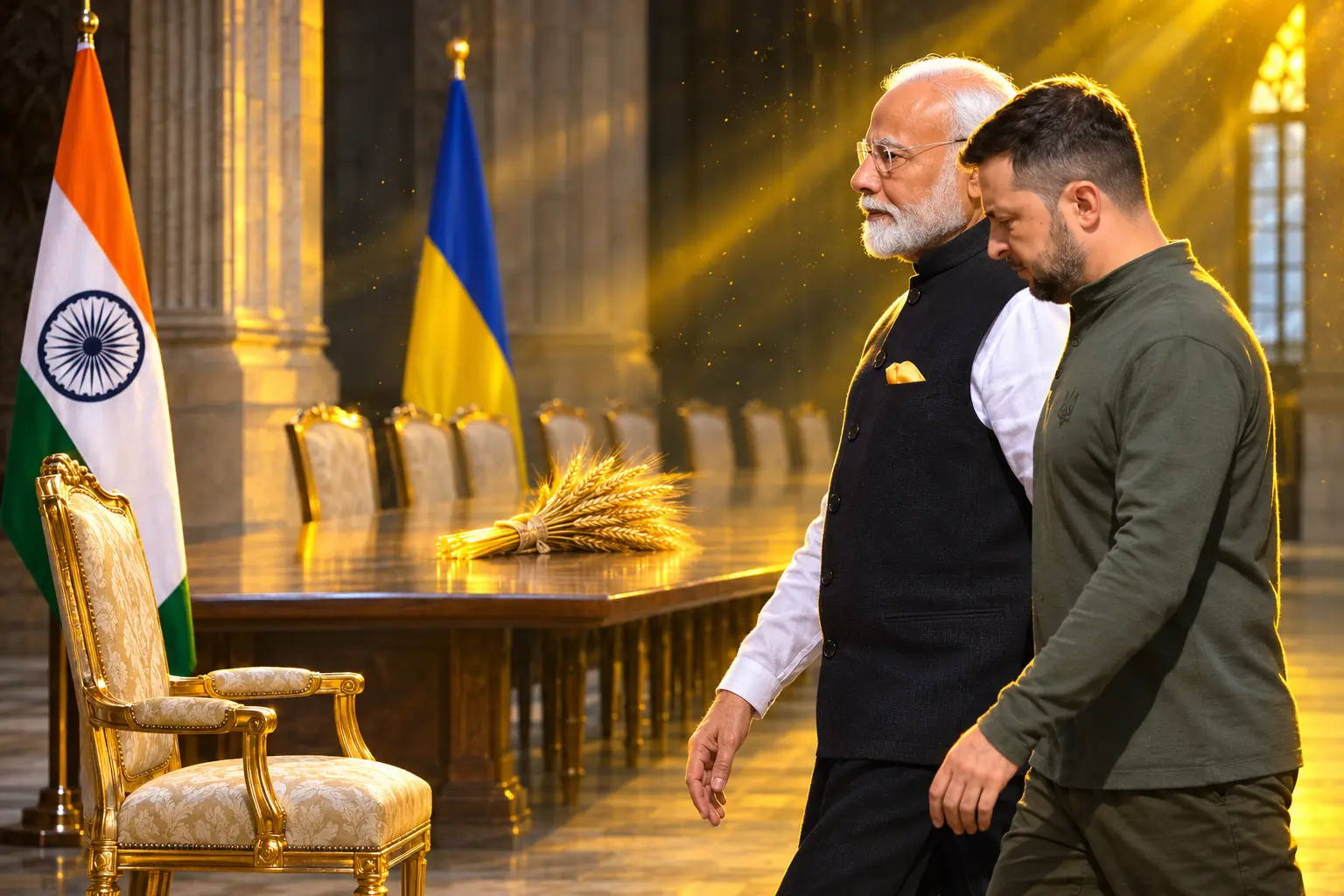
Ships, Grain and a Non-Attack Pause
India has not published a full text of its plan. Jaishankar has. Speaking on October 4, he said New Delhi had gone “a little more involved beyond advocacy” and was talking to both Russia and Ukraine. He listed three live files: safety of shipping in the Black Sea, grain and energy exports, and “non-attack possibilities.”
WHAT JAISHANKAR SAID INDIA IS WORKING ON
- Shipping safety: Talks with both sides on civilian vessels after merchant ships in the Black Sea were attacked, including ships with Indian crews.
- Grain and energy: An effort to keep food and fuel moving through Black Sea ports rather than leaving those cargoes as bargaining chips.
- Non-attack possibilities: A search for limited pauses, including on energy plants and other civilian targets, short of a full ceasefire.
Ukraine’s foreign minister, Andrii Sybiha, put that package against three other national ideas. He said Kyiv had four proposals, from India, Turkey, Egypt and the United States, and that India’s was the broadest. He said Ukraine was ready for an energy and Black Sea ceasefire, but only in that combination: a halt on energy plants, including port facilities, tied to the sea route.
| Who put a plan forward | What that plan is built around |
|---|---|
| India | Shipping safety, grain and energy flows, and a non-attack pause |
| United States | An energy ceasefire, later folded into a wider security talk |
| Turkey | A maritime truce in the Black Sea |
| Egypt | A Black Sea pause aimed at protecting grain imports |
Sybiha’s “only in this combination” line is the catch for anyone offering Kyiv a thinner deal. An energy pause with the ports still under fire is, in that reading, not a pause. A grain corridor with power plants still being hit is not much better. India’s value to Zelenskyy is that it tried to hold those pieces together, and that it can still pick up the phone in Moscow.
Putin Praised the Ideas as the Kremlin Narrowed Them
Moscow has not signed that package. It has also not slammed the door in public. In early October, President Vladimir Putin said Modi “constantly raises the question” of ending the conflict and has “very good ideas.” Kremlin spokesman Dmitry Peskov welcomed India’s willingness to help and then described the plan as addressing only one specific aspect of a potential settlement.
That is praise with a fence around it. Russia has said it wants a lasting settlement, not a ceasefire that would give Ukraine time to rearm. A food corridor, in that frame, is a humanitarian slice. It is not the security deal the Kremlin says it came to Abu Dhabi to discuss.
WHERE THE THREE CAPITALS DIVERGE
- Kyiv: India’s plan is the broadest of four, and an energy pause only works if it is tied to the Black Sea.
- Moscow: Modi’s ideas are welcome; the written plan is one aspect of a larger settlement, not a substitute for it.
- Washington: The November 10-11 round is about postwar security, de-escalation and, in private, some flex on eastern Ukraine.
The war at sea is why Kyiv keeps handing India this file. Russia has struck Ukrainian port operations around Greater Odesa. Ukraine has hit grain vessels and port sites on the Sea of Azov and around the Kerch Strait. Each round of those attacks is a reason for New Delhi to stay on the line, and a reason for Moscow to treat a corridor as leverage rather than a gift.
Two Readouts From the Same Phone Call
Modi’s account of the November 9 conversation did not mention the Black Sea, grain, or food corridors. He said the call was productive. He said they reviewed bilateral cooperation and agreed to strengthen India-Ukraine ties. He thanked Zelenskyy for sharing his view of the conflict, its humanitarian cost, and efforts to restore peace. He repeated India’s firm commitment to contributing in every possible way toward a peaceful resolution.
The Ministry of External Affairs, in its readiness to contribute to all efforts, used the same register: a human-centric approach, dialogue and diplomacy, no battlefield solution. That is the Indian public line, and it is older than this call. It is also less specific than what Zelenskyy put on the record minutes later.
It is important that India identify what steps it can take and what dialogue it can pursue with other leaders to help bring the war to an end. Food security could be one such area. We discussed Russia’s blocking of grain exports via the Black Sea. India is ready to mediate in establishing food corridors, and we are counting on these efforts to continue.
Volodymyr Zelenskyy, President of Ukraine, on X
I spoke with Prime Minister of India Narendra Modi @narendramodi and briefed him on the latest diplomatic developments. We are actively preparing on every item on the agenda for the meeting in Abu Dhabi. Ukraine has always taken a constructive approach, and Russia must show the… pic.twitter.com/UTe17pVWBN
— Volodymyr Zelenskyy / Володимир Зеленський (@ZelenskyyUa) November 9, 2026
Glad to have had a productive telephone conversation with President Zelenskyy. We reviewed our wide-ranging bilateral cooperation and agreed to further strengthen India-Ukraine ties.
I thanked President Zelenskyy for sharing his perspectives on the ongoing conflict, its…
— Narendra Modi (@narendramodi) November 9, 2026
Read the two posts side by side and the division of labour is plain. Zelenskyy wants operational steps on grain and a wider set of calls with other leaders. Modi offers a relationship, a hearing, and a standing offer to help. Neither man said India would join the US-run table in Abu Dhabi.
Indian accounts treated the call as proof that New Delhi is now an honest broker. The sharper reading is less flattering to anyone. Kyiv is still waiting on a corridor Moscow has not accepted. New Delhi is still speaking in the language of process. The phone call did not close that gap. It made the gap visible.
Abu Dhabi Is Talking Security, Not Grain
The United Arab Emirates meeting is the fourth US-brokered trilateral round and the first since Geneva on February 17-18. US special envoy Steve Witkoff and Jared Kushner are leading the American side. Kremlin aide Vladimir Medinsky is leading Russia’s. Rustem Umerov, head of Ukraine’s foreign intelligence service, is leading Kyiv’s. The sessions are set for November 10 and 11.
| Delegation | Who is leading | Who else is named |
|---|---|---|
| Ukraine | Rustem Umerov | Kyrylo Budanov, Davyd Arakhamia, Serhii Kyslytsia, Vadym Skibitskyi |
| Russia | Vladimir Medinsky | Sergei Ryabkov, Mikhail Galuzin, Igor Kostyukov, Yury Zhigarlovsky |
| United States | Steve Witkoff and Jared Kushner | Working-level US team around the two envoys |
Kushner said the round would focus on the postwar security concerns of both Russia and Ukraine, and that it could at most build momentum toward the next phase. A US official, speaking before the opening session, said Moscow and Kyiv had shown a little flexibility in private on who would control Ukraine’s east after a war, and that the Donetsk question would not move until the security design after the war was clearer.
Those are not India’s files. Russia does not want European officials in the trilateral room. Ukraine is holding separate coordination meetings in Abu Dhabi with the United Kingdom, France, Germany, Italy, NATO and the European Commission. European Commission President Ursula von der Leyen spoke to Zelenskyy the same day as Modi and discussed Black Sea security and the Emirates talks. Grain is on Kyiv’s list. The published US agenda is security architecture, de-escalation, humanitarian issues, and how to end the war.
President Donald Trump said a deal was close and that Ukraine would end up with “a little bit different shape.” That is a territorial sentence. It is not a sentence about wheat. If Abu Dhabi produces anything in the next two days, it is more likely to be a security sketch or another pause in strikes than an Indian-brokered food corridor.
Why Food Corridors Matter to Kyiv
Zelenskyy’s ask is not abstract. Ukraine still needs the sea to sell grain. Russia still uses pressure on that sea, and on energy plants, as a winter tool. India still needs the same waters to stay open for food and fuel cargoes, and it has Indian mariners on ships that have already been hit. Those three facts are why a corridor is a job New Delhi can own even if it never sits with Witkoff and Medinsky.
They are also why the job is hard. A corridor only works if both navies, both air forces, and both sets of drones leave the ships alone. That is a ceasefire at sea, whatever name it is given. Moscow has so far treated that as a piece of a larger bargain. Kyiv has treated it as a test of whether Russia will de-escalate at all.
Modi’s own words to Putin, spoken in Bishkek on August 31 on the sidelines of the Shanghai Cooperation Organisation summit, are the text Zelenskyy was quoting without quoting. In the Kremlin transcript, Modi said every day of war pushes humanity back, that every step toward peace gives hope, and that the world must move from endless war to the end of war. Zelenskyy is now asking India to turn that sentence into a shipping arrangement.
A food corridor would not settle Donetsk. It would not write security guarantees. It would not bring European troops into a postwar force. It would move grain and, if the non-attack piece held, take some pressure off power plants and ports. For a country that buys Russian oil and sells food politics in the Global South, that is a lane India can work without joining a Western coalition.
Jaishankar Dialed Lavrov the Same Evening
Hours after the Modi-Zelenskyy call, Jaishankar posted that he had spoken with Russian Foreign Minister Sergey Lavrov. He said the conversation focused on the Ukraine conflict and ongoing diplomatic initiatives. He did not list the corridor. He did not need to. The sequence is the message: Kyiv in the afternoon, Moscow in the evening, the same file in both hands.
That two-phone method is what Jaishankar first described after his September 3-5 visit to Ukraine and Poland, his first standalone trip to Kyiv as foreign minister. On October 7, the ministry spokesman said that, in keeping with the Bishkek line, India has engaged both sides, and that both Putin and Sybiha had acknowledged it. The spokesman pointed back to Jaishankar’s own elaboration rather than reading out a treaty text.
THE ROAD TO THE NOVEMBER 9 CALLS
- August 31, 2026: In Bishkek, Modi tells Putin the world must move from endless war to the end of war.
- September 3-5, 2026: Jaishankar visits Kyiv and Warsaw and takes the shipping, grain, energy and non-attack talks to both sides of the war.
- October 1, 2026: Putin says Modi constantly raises an end to the conflict and has very good ideas.
- October 4, 2026: Jaishankar says India has gone beyond advocacy and is working the Black Sea, grain, energy and non-attack files.
- October 7, 2026: The ministry confirms the dual outreach and declines to publish a full draft.
- November 9, 2026: Modi speaks to Zelenskyy; Jaishankar speaks to Lavrov; Zelenskyy names food corridors in public.
- November 10-11, 2026: The United States, Russia and Ukraine meet in Abu Dhabi without India at the table.
The teams, Zelenskyy said, will stay in touch. That is the only operational promise either side put on paper. In Abu Dhabi, Witkoff and Medinsky can argue about security maps. In New Delhi, the live question is still the one Kyiv asked out loud: which call, to which leader, turns a food corridor from a talking point into a route that ships can actually use.

ADNOC Ship Hit in Hormuz Leaves One Crew Missing

SpiceJet’s Rs 5,500 Crore Plan Follows a Rescue That Failed

Hasina’s Return Fight Sets Fire to Yunus’s Bank

Bancroft Recants the 2018 Inquiry and Names the Team

Adhikari Ties the Saffron Saree Row to School Licences

Clancy Juror Says the Holdout Never Cited Evidence

The iPhone 18 Pro Max Splits Apple’s Fall in Two

OpenAI Calls GPT-6 Astra AGI Then Locks Its Exploits

Trump Claims Hormuz Control as Oil Holds Near $96

Russia Closes the Goethe-Institut Berlin Tried to Save

 NEWS2 months ago
Clancy Juror Says the Holdout Never Cited Evidence
- NEWS3 months ago
The iPhone 18 Pro Max Splits Apple’s Fall in Two
- NEWS3 months ago
OpenAI Calls GPT-6 Astra AGI Then Locks Its Exploits
- BUSINESS3 months ago
Trump Claims Hormuz Control as Oil Holds Near $96
- LIFESTYLE3 months ago
Russia Closes the Goethe-Institut Berlin Tried to Save
- AUTO3 months ago
Volkswagen’s Job Cuts Leave Four Plants Without Cars
- NEWS3 months ago
Dyson Puts Nurovi Robots on Sale Without the UV Flagship
- BUSINESS2 months ago
US Destroys Five Iranian Tankers as the Shock Hits Jordan










