NEWS
The US Moved Mildenhall’s Tankers and Left the People
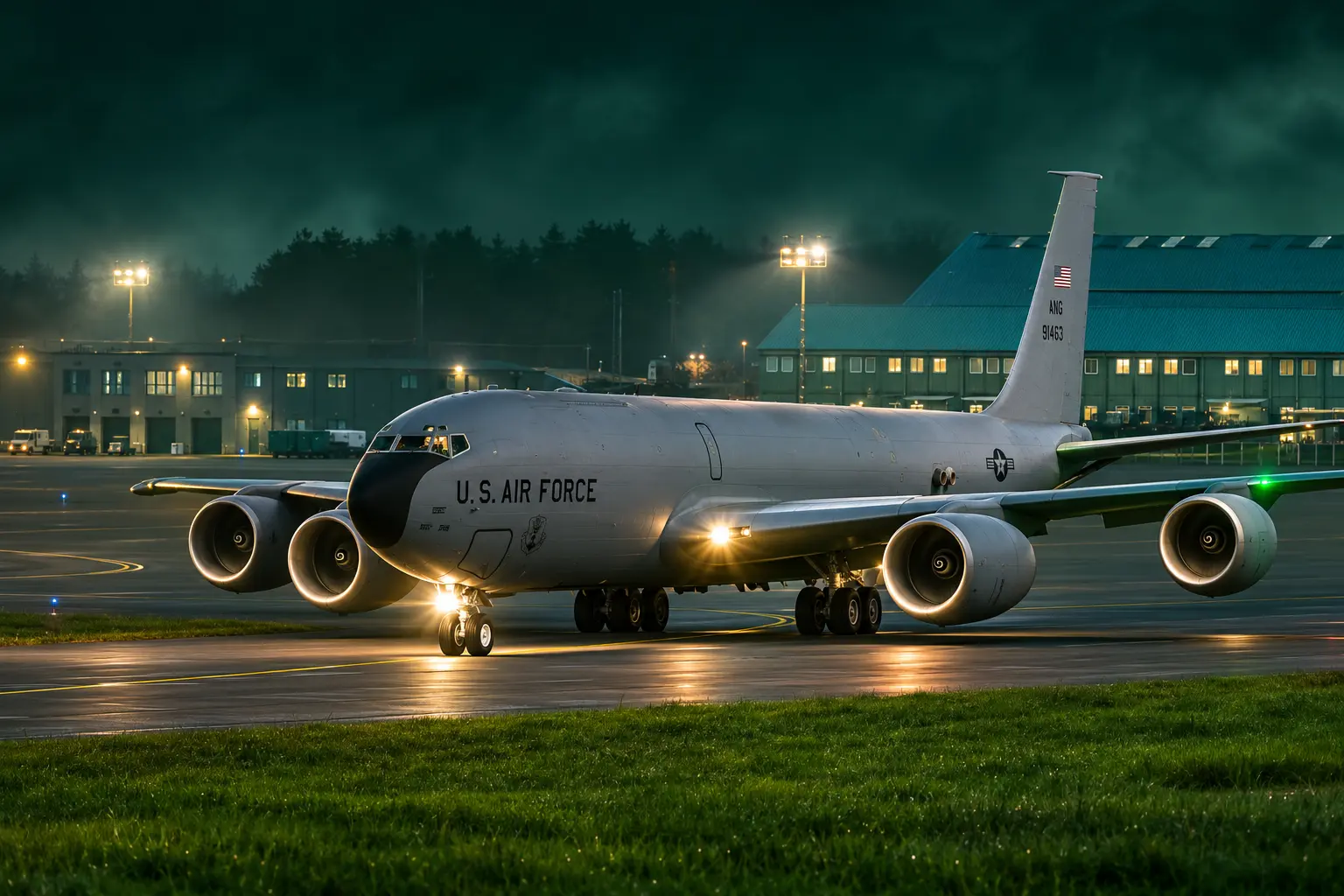
Ten KC-135 tankers left RAF Mildenhall after a reported Iran threat, while thousands of personnel stayed and one jet parked at civilian Prestwick.

10 U.S. Air Force KC-135 tankers left RAF Mildenhall on Monday, 9 November, after officials described an Iranian threat against American bases in Britain.
Flight tracking put them in Germany, Spain and at Glasgow Prestwick Airport. Three CV-22B Ospreys only moved to RAF Lakenheath, already under the same alert, while about 3,000 military personnel stayed in Suffolk and the public still had a view of the ramp.
Ten Tankers Left Mildenhall on Monday Night
Public tracking on Flightradar24 showed KC-135 Stratotankers leaving the Suffolk base through the day. Two went out in the morning toward U.S. sites in Germany and Italy. One came back to Mildenhall before both ended at Spangdahlem Air Base in Germany, after the second had flown circuits over Aviano in Italy. Eight more left later on Monday.
Trackers watching the ramp first treated those morning hops as fog diversions. The evening pulse, with jets going to Spain and Scotland as well as Germany, did not look like local training. A notice that the bases would close during the week does not explain that spread either.
Open-source logs of callsigns and tail numbers put the 10 tankers at four places, and the three Ospreys at Lakenheath, the fighter station next to Mildenhall.
WHERE MONDAY NIGHT’S AIRCRAFT WENT
| Destination | Aircraft | Count |
|---|---|---|
| Spangdahlem Air Base, Germany | KC-135 Stratotanker | 4 |
| Morón Air Base, Spain | KC-135 Stratotanker | 4 |
| Ramstein Air Base, Germany | KC-135 Stratotanker | 1 |
| Glasgow Prestwick Airport, Scotland | KC-135 Stratotanker | 1 |
| RAF Lakenheath, England | CV-22B Osprey | 3 |
U.S. European Command, in a statement on Tuesday, said Air Force aircraft regularly rotate between bases for training and real-world needs and would not discuss specific force-protection steps. “Please be assured that in close partnership with our host nation allies, both RAF Mildenhall and RAF Lakenheath remain vigilant,” a spokesperson said. The command added that it was taking “coordinated and appropriate actions” for service members, host-nation civilians, contractors and families.
A Ministry of Defence spokesperson said Britain does not routinely comment on the activity of other nations, and that aircraft move according to operational needs. A U.S. Air Force spokesperson said the same rotation line and refused further detail on asset movements “due to operations security.”
The Only U.S. Tanker Wing in Europe and Africa
Mildenhall is not a spare parking lot. It is home to the 100th Air Refueling Wing, which conducts air refueling and combat support across Europe and Africa and is the only U.S. tanker wing in the theater. Its KC-135s are valued at $1.1 billion. The 351st Air Refueling Squadron flies those jets over the Atlantic, Europe, Africa and Southwest Asia for fighters, bombers, support aircraft and reconnaissance aircraft.
Tankers do not drop bombs. They give the aircraft that do the range to reach a target and get home. When they sit in Suffolk they are the air bridge for U.S. and NATO jets working from Britain. When they scatter to Germany and Spain, that bridge still exists, just not on the island that has hosted it for decades.
WHAT THE 100TH AIR REFUELING WING RUNS
- The airfield: The wing’s fact sheet, current as of 2 September 2026, calls Mildenhall the only 24-hour U.S. Air Force airfield in the United Kingdom, with a 9,214-foot runway.
- The people it supports: More than 16,000 military staff, civilians, dependents and retirees sit under the wing and partner units, a wider figure than the 3,000 military personnel stationed at the base.
- The store: The logistics squadron holds 25 million gallons of JP-8 fuel worth $92 million, and the comptroller squadron handles a $105 million budget for the theater’s tanker fleet.
- The ground: A 289-member combined U.S.-UK security force is listed against a 1,167-acre site holding $4 billion in warfighting assets.
The same base hosts RC-135 reconnaissance aircraft and the 352nd Special Operations Wing’s CV-22B Ospreys, the three airframes that only moved next door. Lakenheath, in turn, flies F-15E Strike Eagles and F-35A Lightning IIs. Emptying Mildenhall of tankers while leaving the special-operations aircraft at a fighter base a short hop away is a choice about which metal is too precious to leave on the Suffolk concrete.
Fairford Lost Its Bombers After Three Vans
Monday’s tanker lift is the second time in six weeks that the United States has pulled high-value aircraft from a British station after an Iran-linked scare. The first was RAF Fairford in Gloucestershire, the bomber strip used for U.S. strikes on Iran.
In the early hours of 27 September, Gloucestershire police answered a call about three suspicious vehicles near the base. Armed officers arrested five men at the scene. About 85 households were moved out while bomb-disposal teams went through the vans. No explosives were found. Police later described petrol in drums, water butts and dashcams. The five men, all in their 20s and from London, were released on bail.
The United States then withdrew its B-1 bombers from Fairford in October and sent them back to America. Fairford had been a launch point for those bombers during the campaign against Iran. The ramp that had supported strikes was cleared after a night of vans, not after a blast.
FROM FAIRFORD TO MILDENHALL
- 22 August 2026: Nouman Essghir, 24, is later charged with entering a prohibited place for a purpose prejudicial to the United Kingdom on this date, after a visit to Fairford that prosecutors say included a video call with a handler known as Ali.
- 27 September 2026: Five men are arrested near RAF Fairford beside three vans. A major incident is declared.
- October 2026: U.S. B-1 bombers leave Fairford and return to the United States.
- 27 October 2026: Essghir and Mohmed Ahmad Abdulkarim, 24, appear in court. Counter Terrorism Policing announces two men charged under the National Security Act, and says it believes the foreign service in Abdulkarim’s case is Iran.
- 9 November 2026: 10 KC-135s leave Mildenhall. Mildenhall and Lakenheath go to Force Protection Condition Charlie.
Assistant Commissioner Laurence Taylor, head of national counter-terrorism policing, said on 27 October that the Fairford activity was conducted on behalf of a foreign intelligence service and that Iran is a daily case, not a theory. “This is not a theoretical threat, this is something we are responding to every day at Counter Terrorism Policing, particularly in the case of Iran,” he said outside New Scotland Yard. Other men arrested in the inquiry remain on police bail. Tehran has denied a role.
Prestwick Already Sells Itself as a Military Stop
One of the 10 tankers landed at Glasgow Prestwick Airport, a civilian field in Ayrshire that the Scottish government owns. Photographs on Tuesday morning showed U.S. military aircraft on that ramp. The jet is with the Nebraska Air National Guard, so it may have been a booked transatlantic stop rather than a hide. That caveat does not make the landing quieter. It shows how thin the line already is between a U.S. warplane in trouble and a Scottish commercial airport that wants the business.
Prestwick Aviation Services, the airport’s in-house handler, markets a dedicated and discreet military FBO a few metres from the apron, with no prior-permission or slot limits, crew rest, briefing rooms and a Defence Logistics Agency fuel contract (SPE60725D0076). The pitch is 24 hours a day, any size of aircraft. The company says the field has served the military for almost 90 years.
WHAT THE AIRPORT OFFERS CREWS
- Access: No prior permission and no slot restrictions, day or night, for aircraft of any size.
- Fuel: A U.S. government DLA contract location with Jet A-1 on site around the clock.
- The FBO: Rest areas, briefing rooms, customs next door, and a detachment facility on the flight line.
The same airport was already a tanker waypoint earlier in 2026, when KC-135s stopped there on their way toward the Middle East as the United States and Israel struck Iran. Parking a Mildenhall tanker at Prestwick after an Iran scare puts the aircraft on a civilian field that had just been part of the same war’s logistics trail, with none of a military base’s perimeter.
Why Raise Charlie and Then Shift Ospreys Next Door?
The same Monday, the United States raised RAF Mildenhall and RAF Lakenheath to FPCON Charlie, the second-highest level in the Pentagon’s force-protection system. A U.S. official confirmed “enhanced force protection measures” at both stations. Charlie is not a weather flag. It terrorist action or targeting is likely as the test: an incident has happened, or intelligence says some form of terrorist action against people or facilities is likely.
FPCON CHARLIE
- The test: An incident has occurred, or intelligence says terrorist action against people or facilities is likely.
- The posture: 100 percent ID checks, tighter gates, and plans to send nonessential staff home. It is built as a short hold, not a new normal.
- Above it: Only Delta, used when an attack has happened nearby or a specific strike is imminent.
Lakenheath went to Charlie with Mildenhall. The three Ospreys still flew there. If Charlie means a terrorist hit on those two Suffolk bases is likely, moving special-operations aircraft from one to the other is a shuffle inside the same problem, not a way out of it. The tankers, the large slow airframes Lord Ricketts later called obvious targets, went to Germany, Spain and Scotland. The Ospreys, which can hide in a fighter pattern, stayed in the county.
In early November, a week before the tanker lift, U.S. European Command had already launched a theater-wide “See Something, Do Something” drive. Troops and families were told to change commuting routes, switch off location sharing on fitness apps, and cut what they post. The command did not name a single threat. The advice followed warnings of Iranian-backed attacks on American bases in Britain and of Russian sabotage elsewhere in Europe.
Three Thousand Personnel Remained on the Suffolk Base
Secretary of State Marco Rubio, asked on Monday about Iranian threats against American diplomats overseas, said Washington had “addressed it by moving people away from the threat.” He said that when a danger crosses a threshold, the United States will act, because it worries about personnel and their families. That was a statement about people.
At Mildenhall the United States moved the tankers. About 3,000 military personnel were still stationed there, around 80 miles (130 km) north of London. The wing’s own count of who lives off its support is over 16,000 once dependents, civilians and retirees are in. Education Secretary Lucy Powell, asked about the aircraft leaving, said she could not comment on operational matters and that Britain takes the security of its bases seriously and will act on intelligence.
On Tuesday there was very little aircraft movement at Mildenhall and no extra security obvious from outside. The spots from which the public can photograph aircraft were still open. Charlie, on paper, means a likely attack and a harder gate. The visible Suffolk picture was a quiet ramp and an open fence line.
WHAT WE KNOW
- The metal: 10 KC-135s left Mildenhall on 9 November, and 3 Ospreys went to Lakenheath, according to public flight tracking.
- The alert: Mildenhall and Lakenheath were raised to FPCON Charlie, which the Pentagon uses when terrorist action is likely.
- The precedent: U.S. B-1 bombers left Fairford in October after the 27 September van arrests, and two men have been charged, with police naming Iran as the suspected service.
WHAT IS UNCONFIRMED
- The Mildenhall threat: Officials have described an Iranian threat as the reason for the tanker move. The precise warning has not been published, and it has not been independently confirmed.
- Prestwick’s role: The Nebraska Guard tanker at the civilian airport may be a scheduled fuel stop, not a hide from Suffolk.
- How long Charlie lasts: Commanders have not said when the two Suffolk bases will drop the alert, or whether the tankers will return.
Former UK National Security Adviser Lord Ricketts, speaking on BBC Radio 4’s Today programme, put the vulnerability in plain terms. The tankers are large, the perimeter is long, and caution is cheap compared with a hole in a wing.
Downing Street Calls the Bases Safe
We are talking about an airbase which houses these large tanker aircraft. Of course, they are large targets, an airbase has a long perimeter, so they are inevitably vulnerable.
Lord Ricketts, former UK National Security Adviser, on BBC Radio 4’s Today
He added that nobody yet knows what the information was, and that he suspects “part of it is an abundance of caution.” Downing Street, through the prime minister’s official spokesperson, said the protection of British bases at home and abroad is a top priority and that the government works with police and allies to protect those sites. The spokesperson insisted the bases are safe.
A Nebraska Guard tanker sat at Prestwick on Tuesday morning on a civilian apron the airport already sells to the U.S. military. In Suffolk the public could still point a camera at the places where the 10 tankers had been.

ADNOC Ship Hit in Hormuz Leaves One Crew Missing

SpiceJet’s Rs 5,500 Crore Plan Follows a Rescue That Failed

Hasina’s Return Fight Sets Fire to Yunus’s Bank

Bancroft Recants the 2018 Inquiry and Names the Team

Adhikari Ties the Saffron Saree Row to School Licences

Clancy Juror Says the Holdout Never Cited Evidence

The iPhone 18 Pro Max Splits Apple’s Fall in Two

OpenAI Calls GPT-6 Astra AGI Then Locks Its Exploits

Trump Claims Hormuz Control as Oil Holds Near $96

Russia Closes the Goethe-Institut Berlin Tried to Save

 NEWS2 months ago
Clancy Juror Says the Holdout Never Cited Evidence
- NEWS3 months ago
The iPhone 18 Pro Max Splits Apple’s Fall in Two
- NEWS3 months ago
OpenAI Calls GPT-6 Astra AGI Then Locks Its Exploits
- BUSINESS3 months ago
Trump Claims Hormuz Control as Oil Holds Near $96
- LIFESTYLE3 months ago
Russia Closes the Goethe-Institut Berlin Tried to Save
- AUTO3 months ago
Volkswagen’s Job Cuts Leave Four Plants Without Cars
- NEWS3 months ago
Dyson Puts Nurovi Robots on Sale Without the UV Flagship
- BUSINESS2 months ago
US Destroys Five Iranian Tankers as the Shock Hits Jordan