BUSINESS
America Cancelled Its G20 Family Photo to Hide a Split
Washington scrapped the G20 family photo in Atlanta after ministers refused to stand with Sergey Lavrov, while a founding member sat outside the room.

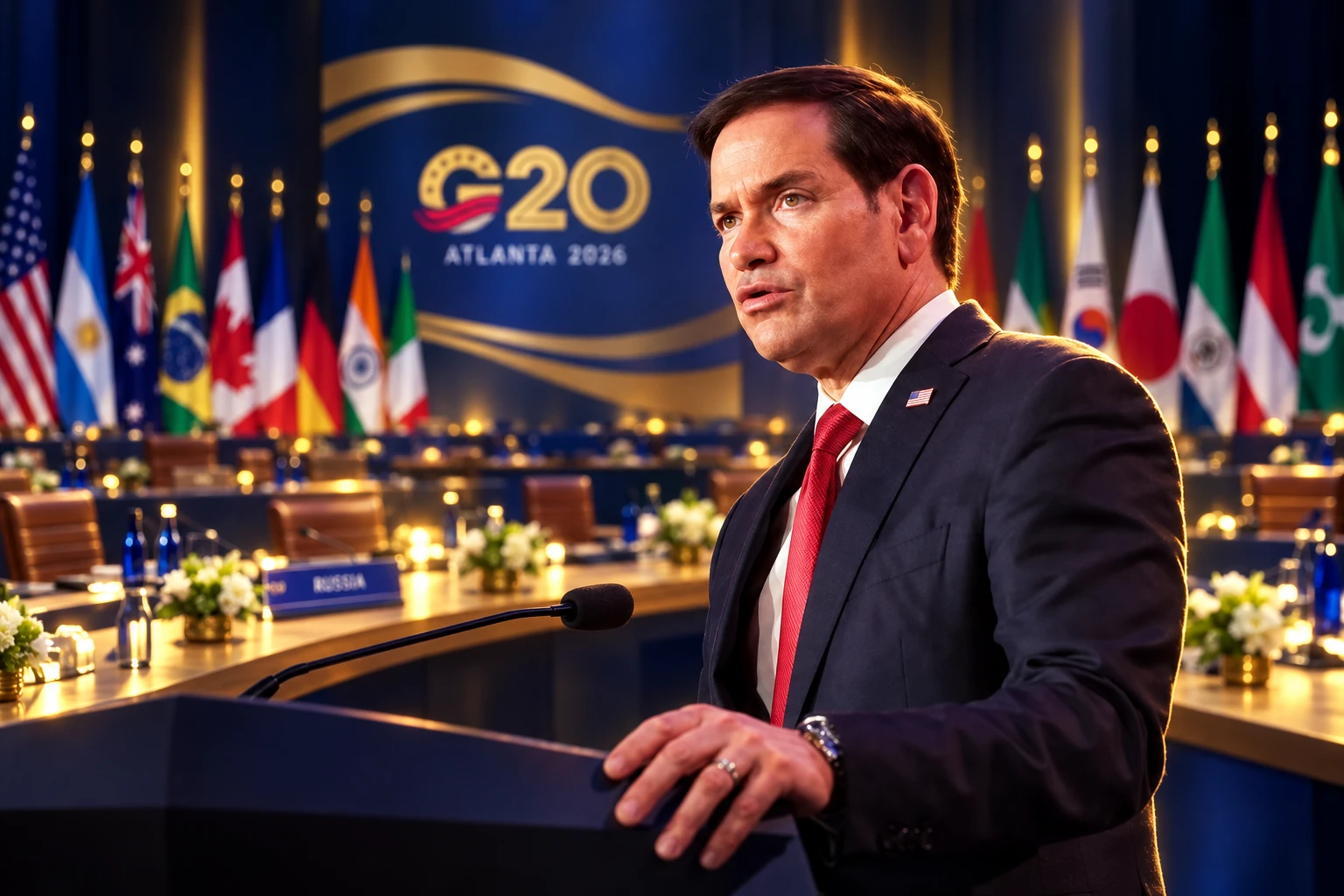
Marco Rubio cancelled the G20 family photo in Atlanta on October 30 after more than a third of officials refused to stand with Sergey Lavrov. The US secretary of state still opened the ministerial and called it a moment of choosing. The portrait that usually starts these meetings never happened.
Washington had already written a guest list that seated Russia, locked South Africa out, and left Ukraine off. The camera was the first ritual that list could not survive.
Why the G20 Family Photo Was Cancelled
European ministers, joined by Britain, Australia and Poland, said they would boycott or walk out of a snapshot with the Russian foreign minister. Two Western officials said more than a third of the officials in the room had threatened to leave the frame. Rubio pulled the plug rather than let that walkout become the picture.
The United States had looked at a fudge. Three people familiar with the planning said hosts explored two family photos, one with Lavrov and one without. Rubio dropped both. A US official said the photo was cancelled once it was clear some delegations would not join a joint picture, and that a ceremonial shot would turn into a distraction from the talks.
WHAT WE KNOW
- The walkout threat: More than a third of attending officials said they would not stand with Lavrov.
- The two-photo idea: Hosts weighed one picture with him and one without, then scrapped the ritual.
- The host’s line: A US official said the United States chose to forgo the photo and keep the focus on the meeting.
The talks themselves went ahead. Session I on geopolitical issues opened at 10:30 a.m. on October 30, with a pooled camera spray at the top and no group portrait behind it. Rubio told colleagues the world faced interconnected crises that threatened energy and food supplies, trade, and freedom of navigation. He asked each minister for about three minutes, in alphabetical order, on navigation and then on food security.
A Founding Member Is Missing From the Room
Russia was in the room. South Africa was not. Ukraine, which is not a member but had been invited to earlier G20 meetings, was not invited either. US officials said they wanted only formal members this year, a rule they did not apply to Poland.
Pretoria is a G20 member and chaired the forum in 2025. On December 3, 2025, Rubio wrote that President Donald Trump and the United States will not be extending an invitation to the South African government during the US presidency. He accused Pretoria of ignoring US objections during its year in the chair and said Washington would keep a seat for South Africa if it changed course. Foreign Minister Ronald Lamola answered the next day that South Africa is a founding member and that no country has a unilateral right to exclude South Africa.
Phindile Kunene, a spokesperson for Lamola, said on October 30 that South Africa’s absence was not voluntary. She said the country was ready to take part on equal terms when Britain holds the presidency in 2027. The African Union, a member since 2023, was represented in Atlanta by Burundi’s Edouard Bizimana.
WHO SAT AND WHO DID NOT
| Party | Atlanta status | G20 standing |
|---|---|---|
| Russia | Sergey Lavrov present | Member |
| South Africa | Not invited | Member and 2025 chair |
| Poland | Radosław Sikorski present | Guest, with US backing |
| Ukraine | Not invited | Not a member; prior guest |
| African Union | Edouard Bizimana present | Member since 2023 |
| China | Ma Zhaoxu present | Member; Wang Yi did not attend |
Poland is seeking formal membership and came with US support. Russia opposes that bid. The guest who took a chair South Africa could not occupy then joined the camp that refused to be photographed with Lavrov. That is the seating chart colliding with the war, in one room, on the first morning.
What the Ministers Said With Lavrov Present
They would sit at the table. They would not pose. Germany’s foreign minister, Johann Wadephul, had said before the session that there would be no family photo of European partners with Lavrov, because there is no normality with Russia. He later called Rubio a reliable partner and said Europe and the United States were reading from the same paper on the need for Russia to come to the table, even if the tone in Europe is different.
UK foreign secretary Ed Miliband told Lavrov in the session that everyone knew who the aggressor in the war is. Britain, a British official said, has a long-standing policy against direct bilateral contact with Russian ministers since the February 2022 invasion. Australia’s Penny Wong condemned the invasion as brutal and unjustified in front of Lavrov, and tied it to markets and food security. A spokesperson said Australia backed the US decision to cancel the group photo and would not normalise the war.
Poland’s deputy prime minister and foreign minister, Radosław Sikorski, called the cancellation the right decision and said he was not the only one who did not want a picture with Lavrov. He told reporters it is hard to agree a common line when wars are underway and participants in those wars are around the table.
If what matters most to them is how they look in the family photo and who is standing next to them, well, that says it all.
Sergey Lavrov, Russian foreign minister, in Atlanta
Lavrov also said he had met Rubio at the ministerial and that they had a fairly good conversation. Maria Zakharova, the Russian foreign ministry spokeswoman, had said visas for the delegation came through only at the last minute and that the delay left the impression not everyone in Washington was happy Lavrov was coming. Ian Kelly, a former US ambassador who now teaches at Northwestern, called the invite politically boneheaded given the war and the calendar in Washington.
Two Earlier Cameras Already Showed the Split
Atlanta was the first time this year the hosts killed the picture entirely. The same fight had already been staged, with a different ending, at two other US-chaired meetings on the 2026 calendar.
THE OTHER CAMERAS
- Bali, 2022: The leaders’ family photo was dropped because governments would not stand with Lavrov after the invasion.
- Asheville, early September: Several participants refused to pose with Russian finance minister Anton Siluanov at the finance meeting. The photos were taken without him.
- Milwaukee, late September: Trade officials sat for two photographs, one with the Russian representative and one without.
The Atlanta compromise would have copied Milwaukee. Rubio chose the Bali outcome instead: no picture at all. Cancelling it spared the host a walkout on camera, and it also spared Moscow a portrait with empty space beside its minister. An unused flash is easier to explain than a hole in the line.
Lavrov has travelled little to NATO states since 2022 and remains under Western sanctions. His presence followed US moves that had already angered European capitals, including a waiver of fresh sanctions on Moscow and a temporary limit on logistical and intelligence help for Kyiv. Those choices, not the backdrop, are what made a shared smile impossible.
Ministers Will Leave Atlanta Without a Communique
Diplomats who sat through the opening said the group would not issue a joint communique when the ministerial closed on October 31. They said a chair’s statement from Rubio had long been the plan, given splits over Ukraine, the war involving Iran, US tariffs, and China in the South China Sea. Sikorski’s line about wars at the table was the short version of that forecast.
The forum still claims the economic centre of the world. Its members account for 85 percent of global GDP and 75 percent of international trade, across 19 countries plus the European Union and the African Union. Elaine Dezenski, who heads the Center on Economic and Financial Power at the Foundation for Defense of Democracies, said Atlanta was less a meeting than a test of whether the United States can build cooperation when full consensus is out of reach.
Some business still moved. On October 30 Rubio met Turkish foreign minister Hakan Fidan and Saudi foreign minister Prince Faisal bin Farhan Al Saud, then sat with Japan’s Toshimitsu Motegi and South Korea’s Cho Hyun. With Motegi and Cho he signed a memorandum creating a Trilateral Arctic Pacific Partnership on maritime and economic work in the Pacific Arctic. That signing got a camera. The family did not.
Safeguarding the Pacific Arctic is a priority we share with Japan and the Republic of Korea.
With Foreign Minister @moteging and Foreign Minister @FMChoHyun, I signed a Memorandum of Cooperation creating the Trilateral Arctic Pacific Partnership to explore maritime cooperation… pic.twitter.com/kbDR6omEJl
— Secretary Marco Rubio (@SecRubio) October 30, 2026
China sent vice foreign minister Ma Zhaoxu rather than Wang Yi. The EU’s Kaja Kallas attended. Session III on supply chains and closing remarks was listed for 10:00 a.m. on October 31, with a press availability at 12:30 p.m. Rubio had told ministers the night before, at a Georgia Aquarium reception, that their job was to build a platform for leaders in Doral.
December in Miami Gets the Same Seating Chart
The official calendar puts the Leaders’ Summit in Miami on December 14 and 15, 2026, at Trump National Doral. Rubio used the Atlanta reception to point to that meeting and to note the inclusion of Poland as a full participant. He said Trump sees Poland’s economic rise as what the G20 needs. South Africa remains off the published participant list. Ukraine is not a member. Russia is.
It is unclear whether Vladimir Putin will take the invitation. Fresh talks among Moscow, Kyiv and Washington have been floated for November. Britain takes the G20 in 2027, which is the date South Africa has put on a return to equal seating. The Atlanta ministerial was supposed to make Doral easier. It advertised the problem instead.
President Trump hosts the leaders on December 14 and 15 at Trump National Doral. Putin has been invited, and the Kremlin has not confirmed he will attend.

ADNOC Ship Hit in Hormuz Leaves One Crew Missing

SpiceJet’s Rs 5,500 Crore Plan Follows a Rescue That Failed

Hasina’s Return Fight Sets Fire to Yunus’s Bank

Bancroft Recants the 2018 Inquiry and Names the Team

Adhikari Ties the Saffron Saree Row to School Licences

Clancy Juror Says the Holdout Never Cited Evidence

The iPhone 18 Pro Max Splits Apple’s Fall in Two

OpenAI Calls GPT-6 Astra AGI Then Locks Its Exploits

Trump Claims Hormuz Control as Oil Holds Near $96

Russia Closes the Goethe-Institut Berlin Tried to Save

 NEWS2 months ago
Clancy Juror Says the Holdout Never Cited Evidence
- NEWS3 months ago
The iPhone 18 Pro Max Splits Apple’s Fall in Two
- NEWS3 months ago
OpenAI Calls GPT-6 Astra AGI Then Locks Its Exploits
- BUSINESS3 months ago
Trump Claims Hormuz Control as Oil Holds Near $96
- LIFESTYLE3 months ago
Russia Closes the Goethe-Institut Berlin Tried to Save
- AUTO3 months ago
Volkswagen’s Job Cuts Leave Four Plants Without Cars
- NEWS3 months ago
Dyson Puts Nurovi Robots on Sale Without the UV Flagship
- BUSINESS2 months ago
US Destroys Five Iranian Tankers as the Shock Hits Jordan