
NEWS
Hacked Alert Apps Leave the Next Real Siren Harder to Trust
Hacked emergency apps in Ukraine and Russia sent fake nuclear warnings overnight. Panic was thin. The next real alert now has a trust problem.

Ukraine’s Air Alert app issued 122 fake warnings in seven minutes on the night of Nov. 1, including radiation, chemical, and street-fighting alerts that were not real. Hours later, Russia’s emergencies ministry said its own app had been hit and had told users nuclear warheads were inbound to every region.
Neither panic nor a confirmed link followed. What did follow, at 12:05 a.m. on Nov. 2, was a genuine air raid, two minutes after the last hoax records were wiped from the public map.
Seven Minutes of Fake Nuclear Warnings
The burst started at 22:47 Kyiv time. Phones that usually ping for drones and missiles suddenly warned of radiation in the capital, a chemical attack, street fighting, and a nuclear alert tied to Russia’s Oreshnik missile. Some of the copy was in Ukrainian. One line arrived in Russian: “Hi! There will be a nuclear alert across Ukraine now! Don’t worry, the Oreshnik missile is on its way.”
The independent map at alerts.in.ua, which reads the official app’s feed automatically, logged 122 fake alerts in seven minutes across almost the whole country: 103 air-raid pings, plus 5 radiation, 5 chemical, 5 street-fighting, and 4 artillery warnings. None of those threats were real. At 22:54, as the last fake ping landed, a DDoS attack hit the public map itself.
THE SEVEN MINUTES IN KYIV
- 22:47, Nov. 1: First false alert appears, a radiation warning.
- 22:54: Last false alert is recorded; a DDoS attack begins on alerts.in.ua.
- 23:19: Map operators start stripping fake alerts by hand after checking Air Force and regional channels.
- 23:47: Mass all-clear signals arrive from the official system, 60 minutes after the first fake ping.
- 00:03, Nov. 2: Last false records are gone from the public map.
- 00:05: First real air-raid alert after the incident is declared.
- 01:52: The Air Alert team says the app is coming back in stages.
The Air Force posted on Telegram that the app appeared to have been “subjected to enemy influence,” and added, “There is no radiation threat! Stay calm and follow our updates on our channel!” Push alerts were switched off while the team worked. Stepan Tanasiychuk, who leads the Air Raid Alert project, said on Nov. 2 that yellow and red levels were back on the map and that extra security steps were going in “to prevent similar situations in the future.”
Hours Later, Moscow’s App Did the Same Thing
Before dawn on Nov. 2, Russia’s Ministry of Emergency Situations said its mobile app had been hit by a “massive cyberattack” that let attackers “send fake information to the public.” The fake ping claimed nuclear warheads on P1-SUN delivery systems had been launched across all regions of Russia. Users were told to stock food for three weeks and hide in basements. The copy opened with a line about a “risk of getting lively” and then piled on an expletive.
The ministry said the fake alert went to 33 regions. Similar wording showed up on some regional ministry channels on the MAX messenger. Officials stressed that the app is only a side channel, and that sirens, loudspeakers, SMS, television, and radio were still the main ways to warn the public. Specialists had “identified the vulnerability exploited by the attacker,” the ministry said, and full functions were due back by the end of Nov. 2.
Kremlin spokesman Dmitry Peskov treated it as routine weather. “All electronic resources belonging to our government agencies are under constant threat of cyberattacks,” he said. He added that as technologies, “including AI,” keep changing, the threat grows.
WHAT WE KNOW
- Two apps, one night: Ukraine’s Air Alert was hit on the evening of Nov. 1; Russia’s emergencies app was hit in the early hours of Nov. 2.
- Physical systems: Ukraine’s Digital Transformation Ministry said sirens and other warning tools kept working. Russia’s ministry said the same of its sirens, SMS, and broadcasts.
- Military command: Yurii Ihnat, a spokesman for Ukraine’s air force command, said the breach did not touch defence operations because the app sits apart from military command systems.
WHAT IS UNCONFIRMED
- A single author: Ukraine’s Center for Strategic Communications, SPRAVDI, blamed Russia, citing the Russian-language Oreshnik line. Russia named no one.
- Hitcore: A Russian Telegram channel said a group called Hitcore claimed the Ukraine breach. That claim has not been independently confirmed.
- How they got in: The alerts.in.ua team said a stolen admin login, rather than a deep break of the core servers, cannot be ruled out. No official cause has been published.
SPRAVDI put the blame in public within minutes of the first fake pings.
Unfortunately, Russians have hacked the "Air Alert" app.
This is evidenced by the appearance of several unusual alerts. Additionally, there is a message in Russian about "Oreshnik."
If you see strange messages in the app, disregard. pic.twitter.com/fU7KHmKxs1
— SPRAVDI — Stratcom Centre (@StratcomCentre) November 1, 2026
What the Fake Messages Said
The Kyiv copy came as four distinct warnings between 22:47 and 22:49, then an all-clear around 23:53. Those four lines are the wording people screenshotted. The 122 count is the map-wide spray of regional pings that followed from the same feed, including a wave of ordinary air-raid flags that were also false.
UKRAINE VS. RUSSIA FAKE ALERTS
| Channel | Fake claim | When | Official line |
|---|---|---|---|
| Ukraine Air Alert | Radiation in Kyiv; chemical attack; street fighting; Oreshnik nuclear alert | 22:47-22:54, Nov. 1, Kyiv time | Air Force: no radiation threat; app under “enemy influence” |
| Ukraine Air Alert (Russian line) | “Hi! There will be a nuclear alert across Ukraine now! Don’t worry, the Oreshnik missile is on its way.” | 22:48 | SPRAVDI: disregard strange messages; blamed Russia |
| Russia emergencies app | Nuclear warheads on P1-SUN systems launched across all regions; stock food for 3 weeks; hide | Early hours of Nov. 2 | Ministry: app is a side channel; sirens and SMS still work |
| Russia MAX regional channels | Same nuclear-warhead wording on some ministry regional feeds | Same night | Ministry said it was working to restore the app |
The Oreshnik line was not a random scare word. Russia has fired that intermediate-range missile at Ukraine three times. The latest of those strikes was on May 24, 2026, near Bila Tserkva. The P1-SUN line on the Russian side pointed the other way, at Ukrainian interceptor drones, as if they were carrying nuclear warheads. The wording was lurid enough that some Russian users said it was impossible to take as real, which is part of why the streets stayed calm and part of why the official channel now looks cheap.
An App With 6.7 Million Daily Users
Air Alert was built in the first days of the full-scale invasion by Ajax Systems and Stfalcon, with backing from Ukraine’s Ministry of Digital Transformation. It warns of six kinds of danger: air raid, artillery, street fighting, chemical hazard, radiation, and natural disaster. On March 1, 2026, Ajax marked the app’s fourth year with 46 million downloads and more than 6.7 million daily active users.
AIR ALERT IN FIGURES
- Daily users: More than 6.7 million as of March 1, 2026, per Ajax Systems.
- Downloads: 46 million since 2022.
- Threat types: Six, from air raids to radiation and chemical hazard.
- New map: In mid-October the app added a live track of drones and missiles; that moving-targets layer was still down after the hack.
Regional military administrations are who feeds alerts into the app. The app then publishes them through an official API that other maps, including alerts.in.ua, read in real time. That design is why a short break at the source painted the whole public picture at once. The team said the app stores no personal data and told people not to tap links in odd alerts. Vinnytsia Oblast Governor Natalia Zabolotna put it in one line: do not click the link in the message.
In mid-October, Prime Minister Sergii Koretskyi had just told the country the same app could now show estimated paths for Shahed drones, cruise missiles, jet drones, and guided bombs. Ballistic tracks were still off limits. The feature that was meant to make the next strike easier to see was the layer still dark on Nov. 2.
Loudspeakers in Kyiv Repeated the Hoax
This was not only a lock-screen gag. Loudspeakers in central Kyiv carried the false warnings. Journalists in Zakarpattia Oblast heard street sirens. Ivano-Frankivsk Oblast Governor Svitlana Onyshchuk said the region itself was calm and that the reports pointed to a cyberattack on the notification app. The Digital Transformation Ministry said the physical siren network had not been taken down, and it pointed Kyiv residents to the separate Kyiv Digital city app, which it said was working as normal.
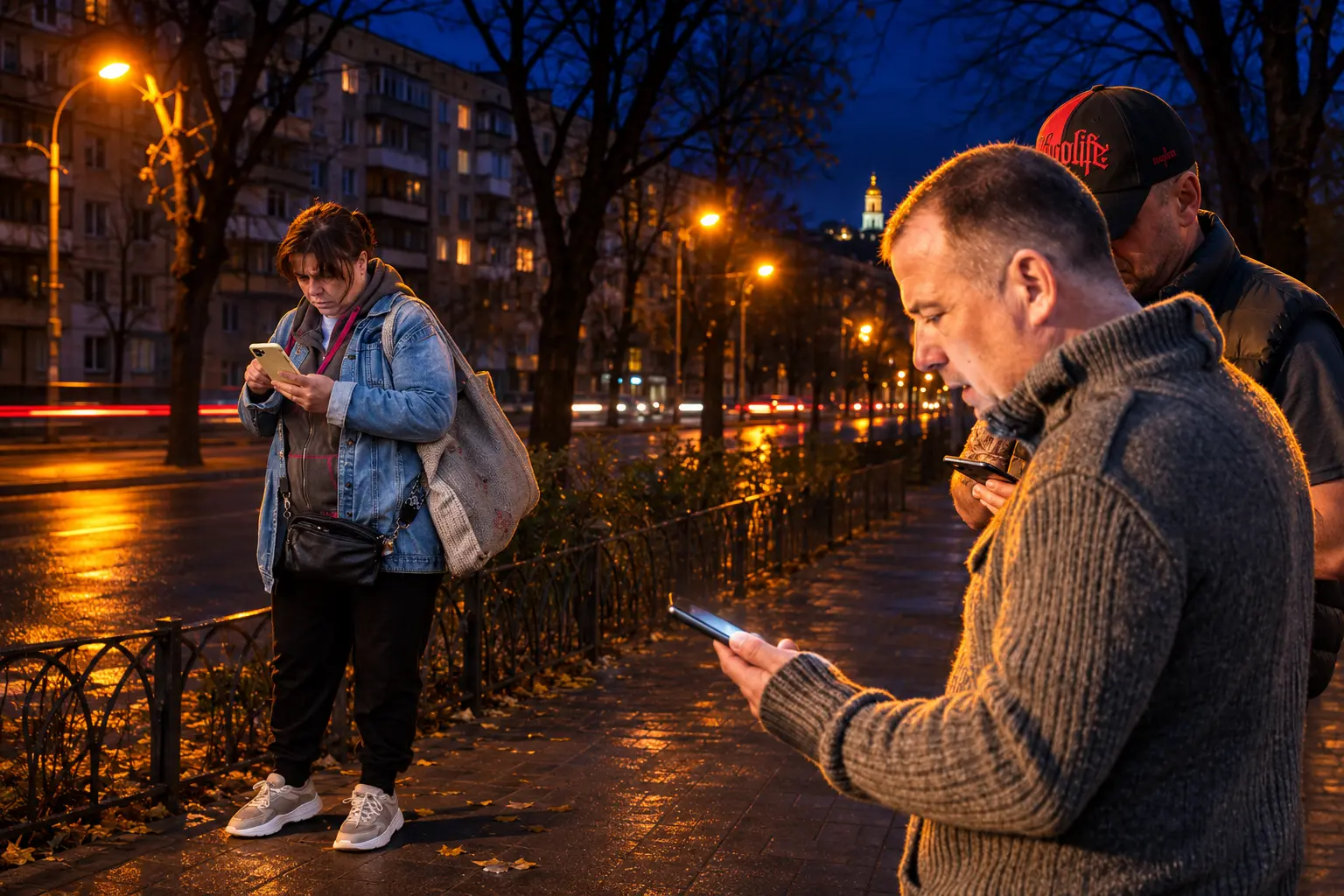
Olena, who lives in Kyiv, said her first thought was that she was prepared for blackouts and for cuts to heat and water, “but not for a nuclear attack.” Other people treated the street-fighting line as a joke in a city whose mayor is a former heavyweight boxer. The gap between those two reactions is the point the hackers bought. Some users will laugh off the next odd ping. Some will delete the app. Some will hesitate when the tone is real.
WHO TOLD THE PUBLIC TO IGNORE THE PINGS
- Air Force: No radiation threat; follow the official Telegram channel.
- SPRAVDI: Russians hacked the app; disregard strange messages.
- Center for Countering Disinformation: Threat levels on the broken app were not true.
- State Emergency Service: By midnight the nationwide system was back to normal; keep listening for loudspeakers and do not spread unverified posts.
- App team: Outside parties interfered; extra security measures are going in.
Herbert Lin, a senior research scholar for cyber policy at Stanford University and a former member of the U.S. Commission on Enhancing National Cybersecurity, called the break “concerning.”
I think it’s the first time it’s happened to an official Ukrainian information app, but I suspect it won’t be the last.
Herbert Lin, senior research scholar, Stanford University
Hawaii’s False Alarm Took 38 Minutes to Retract
On Jan. 13, 2018, at 8:07 a.m. local time, Hawaii’s Emergency Management Agency sent phones, radios, and television a live ballistic-missile warning during a shift-change drill. The text told people to seek shelter. It said this was not a drill. There was no missile. Human error, not a hack, sent it. Officials needed 38 minutes to retract the Hawaii alert through the same wireless system, at 8:45 a.m. The agency later said it understood that false alarms “can erode public confidence in our emergency notification systems.”
Kyiv’s hoax ran on a different clock and a different kind of public. The fake spray lasted 7 minutes. The official all-clear followed in 60. People who have spent years walking to shelters did not empty the streets for a nuclear cartoon. That calm is being read as proof the operation failed. It is also how a warning channel loses its edge: the copy was sloppy, the denial was fast, and the lesson still sitting on the phone is that the official app can lie.
Same-night context did not help. A six-day local ceasefire around occupied Oleshky, the longest pause of the full-scale war, ended on Nov. 1. The two breaches have not been shown to be one job. They do not need to be. Both governments just showed their civilian warning apps can be made to speak in a voice that is not theirs.
The Next Real Alert Has to Outrun This One
Tanasiychuk said the team knew the incident had caused “unnecessary worry and inconvenience.” Some Russian users put it more sharply after they got the warhead ping, asking how an emergencies ministry leaves an app that open, then saying they would not install anything like it again, fake or not. If a slice of those 6.7 million daily users in Ukraine mute alerts, or if Russian users drop Emercom, the next Shahed night or the next missile hour lands on fewer phones.
The first real air raid after the hoax was declared at 12:05 a.m. on Nov. 2, two minutes after the public map was clean. Anyone who had silenced the app in disgust was already in the dark for that one. That is the payload the memes do not cancel.

ADNOC Ship Hit in Hormuz Leaves One Crew Missing

SpiceJet’s Rs 5,500 Crore Plan Follows a Rescue That Failed

Hasina’s Return Fight Sets Fire to Yunus’s Bank

Bancroft Recants the 2018 Inquiry and Names the Team

Adhikari Ties the Saffron Saree Row to School Licences

Clancy Juror Says the Holdout Never Cited Evidence

The iPhone 18 Pro Max Splits Apple’s Fall in Two

OpenAI Calls GPT-6 Astra AGI Then Locks Its Exploits

Trump Claims Hormuz Control as Oil Holds Near $96

Russia Closes the Goethe-Institut Berlin Tried to Save

 NEWS2 months ago
Clancy Juror Says the Holdout Never Cited Evidence
- NEWS3 months ago
The iPhone 18 Pro Max Splits Apple’s Fall in Two
- NEWS3 months ago
OpenAI Calls GPT-6 Astra AGI Then Locks Its Exploits
- BUSINESS3 months ago
Trump Claims Hormuz Control as Oil Holds Near $96
- LIFESTYLE3 months ago
Russia Closes the Goethe-Institut Berlin Tried to Save
- AUTO3 months ago
Volkswagen’s Job Cuts Leave Four Plants Without Cars
- NEWS3 months ago
Dyson Puts Nurovi Robots on Sale Without the UV Flagship
- BUSINESS2 months ago
US Destroys Five Iranian Tankers as the Shock Hits Jordan










