
NEWS
Urda Train Crash Catches Up With Spain’s Signalling Gap
Spain’s second deadly high-speed crash in nine months followed 170 LZB dropouts this year and lands just before a snap election.

A Renfe AVE hit a stopped Iryo train at Urda at 8:53 a.m. on 28 October, killing 69 people. It was the second mass-casualty crash this year on the Madrid-Seville high-speed line, and it landed three weeks before campaigning starts for a snap general election.
Óscar Puente refused to resign on 30 October. He pointed at a controller in Madrid and at a signalling dropout, and he said his duty was to stay and explain.
Seventeen Minutes After the System Went Dark
The crash was a rear-end strike at kilometre 118+800, on track 2 of line 010, at the entrance to Urda station in Toledo province. Spain’s rail accident authority AITAT, in its first 24-hour investigation note, names the trains as Iryo 6076, a Hitachi set with 147 passengers and 5 crew, and Renfe AVE 2080, a Siemens set with 379 passengers and 7 crew. That is 526 passengers and 538 people on board.
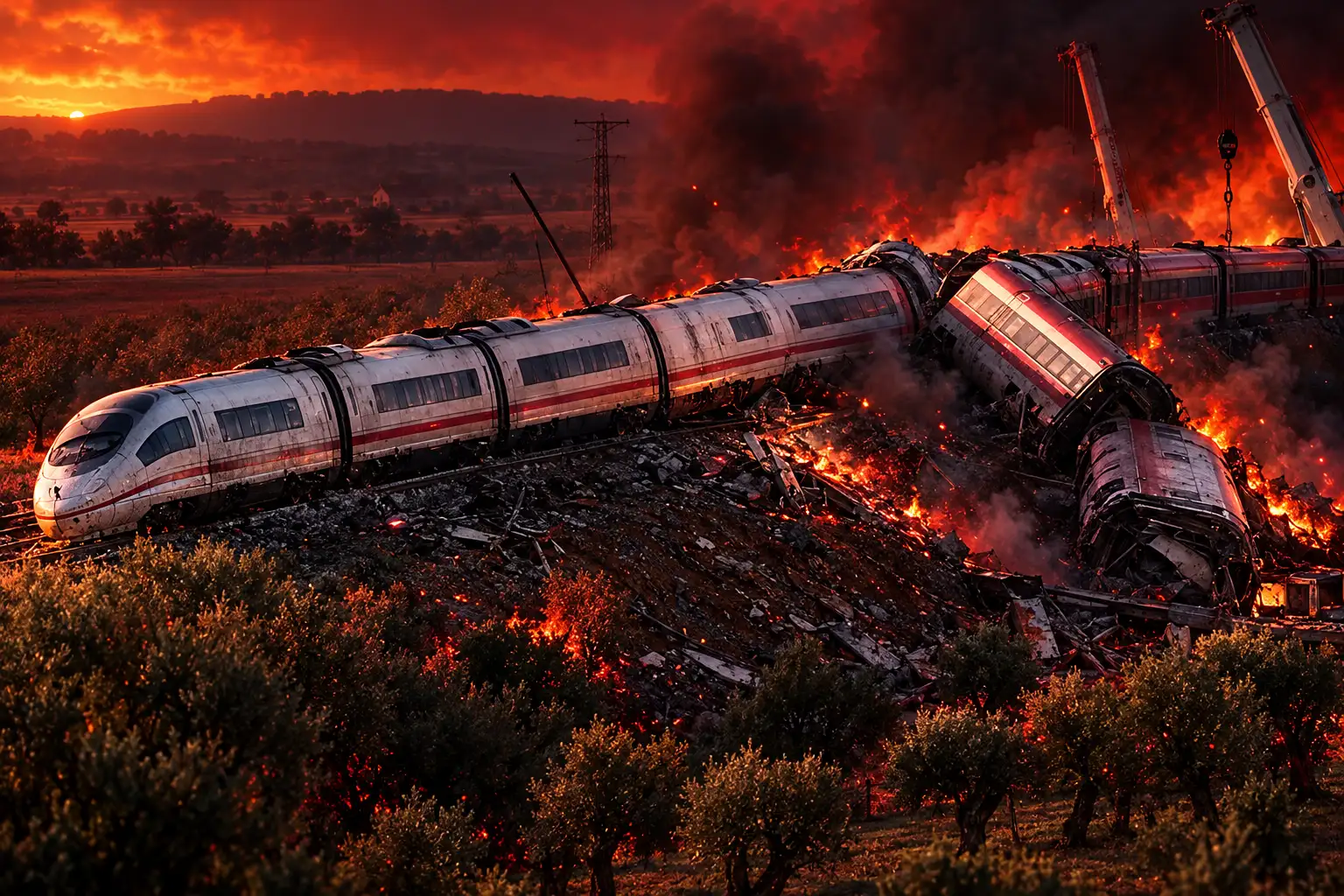
The Iryo was standing at entry signal E242 when the AVE struck it. AITAT puts the impact in a range of 160 to 200 km/h until the on-board recorders are read. The AVE’s leading car buried itself in the Iryo’s rear car. Both ended up twisted at the foot of the embankment, and a deformed rail pierced another AVE coach.
THE MORNING OF 28 OCTOBER
- 8:30 a.m.: The LZB safety system drops out over 63 km and six trains stop.
- 8:36 a.m.: Adif’s Atocha control centre clears the AVE to resume at normal speed.
- 8:41 a.m.: The Iryo is also told to go, but it cannot reset LZB and stays put.
- 8:48 a.m.: The Iryo driver reports that the train cannot move.
- 8:53 a.m.: The AVE hits the Iryo after about 25 km and 17 minutes of running.
Puente said the fallback rule in a dropout is on-sight running, capped at 40 km/h, so a driver can stop for whatever is ahead. The AVE was not held to that cap. Screens and radio in the Madrid control room showed the Iryo still occupying the line, and no stop order followed.
AITAT was told at 9:10 a.m. and had investigators on the ground by 12:15 p.m. A second team went to Adif’s high-speed control centre at Atocha, copied the call log, and listened to the tapes. The Orgaz court, courtroom 2, has the judicial file. AITAT says every cause remains open and that only its final report, due within a year, will stand as the technical finding. More than 200 people were hurt. The death toll of 69 is still not closed.
Puente Calls 170 Dropouts Normal
On 30 October the transport minister came back to the cameras to set out what he called the objective facts. He would not go. The People’s Party has asked for his resignation as a moral step. Puente said his job was to fix the problem and to make people willing to board a train again.
He also put a number on how often LZB had already fallen over in 2026, and he called that number ordinary.
LZB IN 2026
- Yearly dropouts: 170, which Puente said sits inside a usual European band of 150 to 200 and has been stable for six or seven years.
- On this stretch: 13 of those dropouts were on the Urda section, the last on 14 October, 14 days before the crash.
- Outside causes: He said 75 percent came from cable theft, vandalism, works, or weather, not from the logic of the system itself.
- The missed cap: After the 8:30 a.m. dropout, protocol was on-sight at 40 km/h. The AVE was cleared at normal speed.
Calling 170 dropouts normal is how a safety net turns into a weather report. LZB is built to stop trains when the line ahead is occupied. When it dies, people in a room take over, and the 40 km/h cap is the last automatic protection the passenger still has. Skip that cap and a 63 km outage becomes a rear-end crash at high-speed impact.
Adif’s own service alerts had already logged signalling trouble on the Yeles-Urda stretch a year earlier. Drivers and operators who live with the line treat degraded running as a delay-management tool, not as an emergency. That is the habit the 170 figure describes, even before anyone assigns blame to one desk in Atocha.
Adamuz, Urda and One Stretch of Track
On 18 January an Iryo train derailed at Adamuz, in Córdoba province, after a rail broke under it. A Renfe Alvia coming the other way then hit the wreck. 46 people died. Investigators have pointed to a bad aluminothermic weld and a 40-centimetre section of rail that came out. Puente said at the time that the track had been renewed and that the drivers were not at fault.
Both crashes were on the Madrid-Seville high-speed line. Combined they killed 115 people, more than Spain’s deadliest modern rail disaster at Santiago de Compostela in 2013, which killed 79. The mechanisms differ. Adamuz was steel in the track. Urda was a dropout plus an order to run.
TWO CRASHES ON MADRID-SEVILLE
| Crash | Date | Deaths | Immediate trigger |
|---|---|---|---|
| Adamuz | 18 January 2026 | 46 | Broken rail after a faulty weld |
| Urda | 28 October 2026 | 69 | LZB dropout, then a resume order |
Pedro Sánchez went to the Urda command post on the day of the crash and announced three days of official mourning from 29 to 31 October, as the state had done after Adamuz. He said it was unacceptable for Spain to suffer two high-speed accidents in one year, and that if the safety system had failed it would be dealt with in the strongest terms.
It is simply unacceptable for a country like Spain to suffer two high-speed rail accidents in the same year, as we have.
Pedro Sánchez, President of the Government, Urda command post, 28 October 2026
He also said the two crashes likely had different origins. That may be true in the narrow sense. It does not change the fact that the same corridor has now killed 115 people in nine months, and that both files sit with the same minister, the same infrastructure manager, and the same public.
Why the European System Was Still in the Lab
Madrid-Seville was Spain’s first high-speed line, opened in 1992 for the Seville Expo, and it still runs on German LZB. Newer Spanish high-speed routes already use ERTMS, the single European signalling system that the EU wants in place of the patchwork of national kits. Puente said ERTMS hardware on the Andalusia line was finished in June 2026, is in laboratory tests, and should go live in January 2027. An earlier target of 2024 slipped.
THE ERTMS WAIT ON MADRID-SEVILLE
- The old kit: LZB still governs this line, and modern trains read it through a workaround so private operators can run.
- The live lines: Madrid-Barcelona and Madrid-Levante already run ERTMS, which is why new operators opened there first.
- The lag: Puente says the Andalusia install is done and in lab tests, with service due in January 2027 after the 2024 date moved.
- The EU clock: ERTMS is meant to replace national systems across the Union by 2050, so a late Spanish line is not unique, but this is the line that has now crashed twice.
Puente’s defence is that ERTMS drops out too, because it also sits on cables, balises, and computers. That is true as far as it goes. It does not explain why the fallback on 28 October was a normal-speed clearance toward a train that had already said it could not move. A new system is not a charm. The operating rule when the old one dies is the thing that had to work that morning, and it did not.
Drivers Had Already Flagged Degraded Running
The Spanish train drivers’ union SEMAF had called a 24-hour strike for 29 October, the day after Urda, over safety pledges made after Adamuz that it said were still stalled. The strike went ahead. Diego Martín, SEMAF’s secretary general, said LZB had been failing again and again in the days before the crash, and that running on the substitute system must not become the usual way of keeping trains moving.
Operating in degraded mode cannot become a habitual way of operating in the face of breakdowns.
Diego Martín, secretary general, SEMAF
Martín also said the government was too quick to put a single Adif controller in the frame, and that leaked cab tapes should have stayed in the file. The union’s point is structural. If dropouts are weekly, and if the patch is to keep the timetable, then the 40 km/h cap will be the first rule to erode. That reading matches what the Atocha tapes already show: a resume at normal speed, an Iryo that could not restart, and no new order to stop.
In October, before the crash, Iryo’s Spain chief Fabrizio Favara told the Senate that LZB dropouts were frequent and that trains then took a long time to reconnect and get going. That is the same bind the Iryo driver was in at Urda. Private operators and state drivers were describing the same degraded loop while the ministry was still calling the annual count normal.
A Snap Election on Closed Rails
Sánchez dissolved parliament after Congress voted down housing decrees, and the official gazette published the decree on 6 October. It sets elections on 29 November 2026, a 15-day campaign from 13 to 27 November, and a constitutive session of the new Cortes at 10 a.m. on 23 December. The chambers being replaced were elected on 23 July 2023.
Polling Forecast, updated on 31 October from polls through 26 October, puts the People’s Party on 31.1 percent, the Socialists on 27.1, and Vox on 18.9. That projects to 134 seats for the PP and 65 for Vox, or 199 of 350, above the 176 needed for a majority. The same model gives PP and Vox that majority in 99 percent of simulated elections. Those surveys closed before Urda. They already described a government going to the country from behind.
Paco Camas of Ipsos said a second serious accident in a short span eats confidence in the railways and in institutions, and that in Spain the government takes the blame. Pablo Simon of Madrid’s Carlos III University said the Socialists have lost control of the agenda and the feeling of the campaign, and that the mood is of a country that is not working. Alberto Núñez Feijóo’s PP is placed first in the private polls and would need Vox to govern.
At Toledo station, Paloma got off a half-empty train and said she is now scared of the high-speed network. “This crash will change all of our votes, completely,” she said. “We’ll shift from the left wing to the right.” Lucia, who takes the AVE into Madrid each day, put the two crashes together: more than 100 dead, and things have to change.
Small protests led by far-right groups have already appeared in Madrid. Housing costs, a summer surge of arrivals in Ceuta, and corruption claims around the prime minister’s relatives, all denied, were already in the mix when he called the vote. Urda does not create that map. It replaces the campaign’s chosen subject, housing, with wreckage on a line Spain used to sell as a national achievement.
The Madrid-Seville high-speed line remains closed, with no date set to reopen. Campaigning starts on 13 November. The European system on that line is due to go live in January.

ADNOC Ship Hit in Hormuz Leaves One Crew Missing

SpiceJet’s Rs 5,500 Crore Plan Follows a Rescue That Failed

Hasina’s Return Fight Sets Fire to Yunus’s Bank

Bancroft Recants the 2018 Inquiry and Names the Team

Adhikari Ties the Saffron Saree Row to School Licences

Clancy Juror Says the Holdout Never Cited Evidence

The iPhone 18 Pro Max Splits Apple’s Fall in Two

OpenAI Calls GPT-6 Astra AGI Then Locks Its Exploits

Trump Claims Hormuz Control as Oil Holds Near $96

Russia Closes the Goethe-Institut Berlin Tried to Save

 NEWS2 months ago
Clancy Juror Says the Holdout Never Cited Evidence
- NEWS3 months ago
The iPhone 18 Pro Max Splits Apple’s Fall in Two
- NEWS3 months ago
OpenAI Calls GPT-6 Astra AGI Then Locks Its Exploits
- BUSINESS3 months ago
Trump Claims Hormuz Control as Oil Holds Near $96
- LIFESTYLE3 months ago
Russia Closes the Goethe-Institut Berlin Tried to Save
- AUTO3 months ago
Volkswagen’s Job Cuts Leave Four Plants Without Cars
- NEWS3 months ago
Dyson Puts Nurovi Robots on Sale Without the UV Flagship
- BUSINESS2 months ago
US Destroys Five Iranian Tankers as the Shock Hits Jordan










