BUSINESS
Trump Asks if a Reporter Is a Sick Person
Trump called reporter Andrew Feinberg a sick person after a False Claims Act question while a $30,000 cap clashed with his 1% pitch.

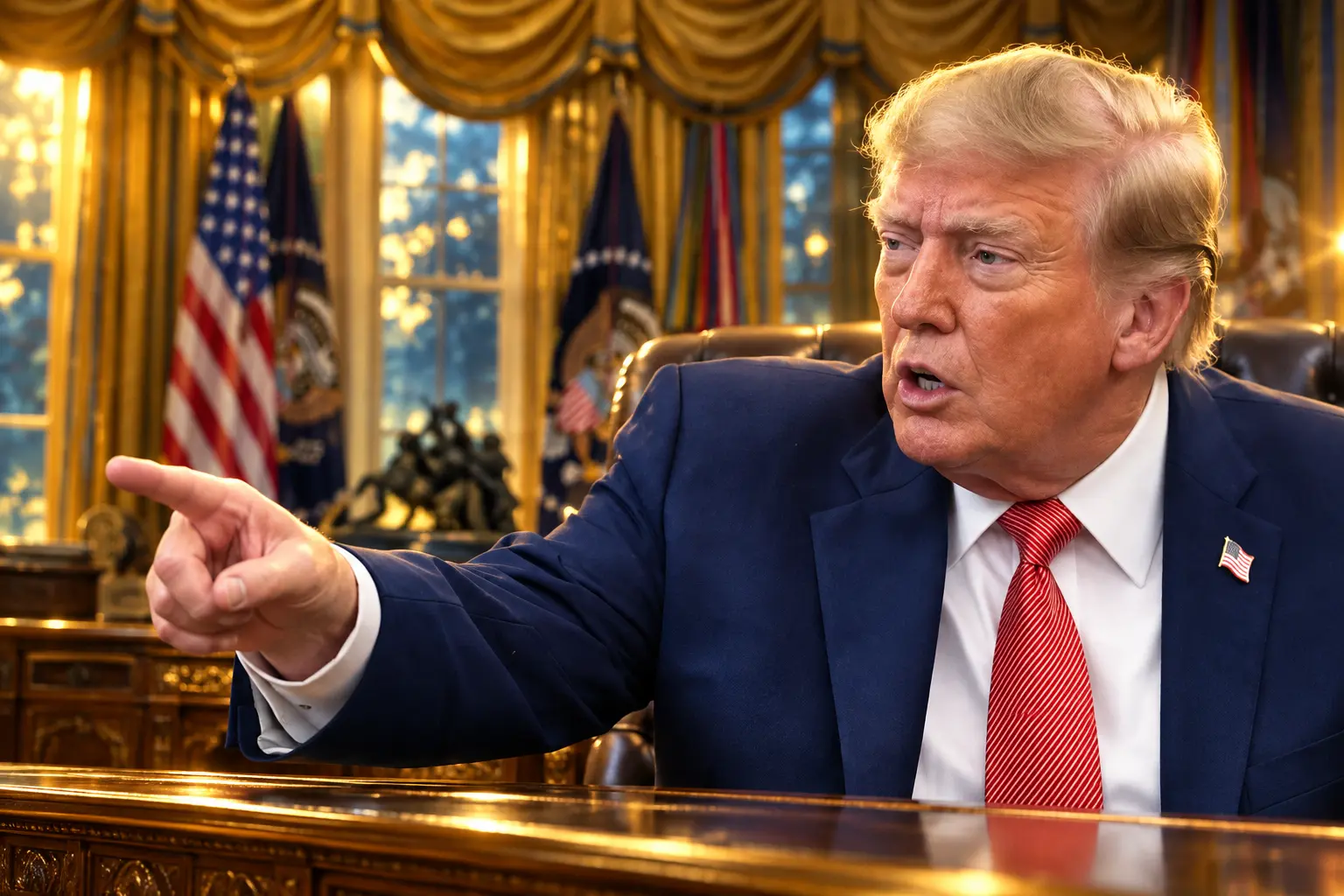
President Donald Trump asked reporter Andrew Feinberg, “Are you a sick person?”, in the Oval Office on October 20. The line landed during a joint appearance with Vice President JD Vance to sell cash bounties for tips on federal fraud.
Feinberg, White House correspondent for The Independent, had just asked why a tipster would use a $30,000 bounty when the False Claims Act already pays a share of what the government recovers. Trump said it was a lot of money. Then he told Feinberg to be quiet.
Quiet, Quiet, and a Medical Insult
Feinberg was in the room as part of the rotating print pool. He had planned other questions, then switched when the White House billed a new tip line with bounties of up to $30,000. He asked the president why anyone with a real fraud case would pick that line over a statute that has paid relators since the Civil War.
Trump’s first answer was, “Because it’s a lot of money.” He added that at 1%, people would make millions of dollars for turning in a crime measured in millions, billions, “actually probably trillions of dollars.” Vance cut in and called Feinberg’s question dishonest. Trump then asked Feinberg who he was, even though Feinberg had already given his name and outlet.
Feinberg tried to get back on his list, including a question about a public golf course in East Potomac Park. He started, “On the golf course, sir, you own a lot of golf cour-” Trump cut him off.
Wait, wait, wait, wait. Quiet, quiet. What’s wrong with you? Are you a sick person? I actually think there’s something wrong with you.
Donald Trump, President, Oval Office, October 20, 2026
“Not that I know of, sir,” Feinberg said. In a first-person account later that day, he wrote that he had an annual physical earlier in October and was in perfect health. He also wrote that Trump told him, “I don’t know who the hell you are, but you better be careful,” not 10 minutes after Feinberg had identified himself. Feinberg has covered Trump in the Oval Office, on Air Force One, and by phone over a decade. He closed the account with a working reporter’s line: he was doing his job, and he would be right back at it the next day.
$10,000 to $30,000 on Paper, 1 Percent in the Room
The political brand for the rollout was the Fraud Whistleblower Incentive Program. White House officials described a $25 million pool and said a tip that led to a fraud conviction or a significant federal enforcement action could pay up to $30,000. Tips were to go in through fraud.gov. The Justice Department would run it. White House spokeswoman Lauren Bis said the Task Force to Eliminate Fraud, which Trump created in March and put Vance over, was “zeroing in on the rampant abuse of taxpayer dollars.”
The written instrument posted the same day is narrower, and blunter about who actually pays. The National Fraud Enforcement Division’s Criminal Tip Rewards Pilot Program is a three-year trial. It offers a defined early-stage reward of $10,000 to $30,000 when a tip leads to criminal charges, paid at or around the time those charges are filed, not after forfeiture and appeals. The department “will approve awards pursuant to the Fraud Rewards Program in its sole discretion and may decline to pay a reward as it deems appropriate.”
Trump described a different machine. He said anyone who turned somebody in and found $1 billion would get a 1% commission, which is $10 million on that example, and that $10 billion, $200 billion, or $400 billion would still pay 1%. He said there was no limit. He said he would be “the arbitrator of all of these decisions,” determine whether a person was “deserving,” and “be very generous, believe me.” He said people would get their money immediately, and that if two people fought over the same tip he would decide the split.
THE PAYOUT THE ROOM HEARD VERSUS THE PAGE
| Version | What it pays | Who decides | When it pays |
|---|---|---|---|
| Justice Department pilot | $10,000 to $30,000 | The department, in its sole discretion | When charges are filed |
| Trump in the Oval Office | 1% of fraud found, no cap | The president as “arbitrator” | “Immediately,” if money is recovered |
| False Claims Act | 15% to 30% of the recovery | The statute and the courts | After a case is resolved |
Those three versions cannot all be true at once. The department’s page does leave a door open that the Oval Office never mentioned: collecting the $10,000 to $30,000 payment does not block a later award under other federal whistleblower programs if a case later produces large penalties or forfeiture. That is a stacking rule, not a 1% of $400 billion rule, and it is not a promise that the president personally writes the check.
Why Use a Tip Line When the False Claims Act Pays More?
Feinberg’s question was not a riddle. The False Claims Act, enacted in 1863 to go after Civil War contractors who cheated the Union, lets a private person file a qui tam suit in the government’s name. If the case succeeds, that person, the relator, typically receives 15% to 30% of the recovery. Feinberg asked why a whistleblower would walk past that cut for a $30,000 tip line. Trump’s “lot of money” answer treated 1% as the competing offer. Vance treated the question as a smear.
The math on a modest case is not close. Fifteen percent of a $1 million recovery is $150,000. The new pilot’s ceiling on the early check is $30,000. The Act also takes years. The pilot’s pitch, on the page if not in Trump’s telling, is speed and certainty: a fixed sum at charging, even if the scheme produced little or no loss, so long as the tip is original, voluntary, truthful, and leads to charges in a covered program.
Covered, for now, means federal health care crimes and fraud against programs at Agriculture, Labor, Health and Human Services, Housing and Urban Development, Education, Veterans Affairs, and the Small Business Administration. Companies cannot collect. People who took a real part in the crime cannot collect. Neither can Justice Department employees or their close relatives. The information has to be original, which in the department’s definition means independent knowledge or analysis that the department did not already have.
That is a tipster program for outsiders with usable facts, not a second False Claims Act. It is also not the unlimited commission described from the Resolute Desk. Feinberg asked the comparison out loud. The written answer sat on a government domain while the president talked about millions and trillions.
Vance Said Over 99% of the Fraud Falls Outside That Law
Vance did give a policy reply, and it is the one the administration will keep using. He said over 99% of the fraud the task force is finding is not covered by the False Claims Act. He also said the new program pays earlier than a civil suit that has to produce large fines. If that 99% figure holds, a $30,000 check for a day-care or hospice tip that never becomes a qui tam case is a different product, not a cheaper copy of the 1863 statute.
The Act is not a museum piece. In the fiscal year that ended September 30, 2025, the department recorded $6.8 billion in False Claims Act recoveries, the highest total in any single year, and whistleblowers filed 1,297 qui tam lawsuits, also a record. Relators still take 15% to 30% when those suits succeed. Congress beefed up the incentives in 1986. The law Feinberg cited is the main civil engine the United States already uses to claw back stolen program money.
FALSE CLAIMS ACT, IN HARD NUMBERS
- $6.8 billion: Settlements and judgments in fiscal 2025, the highest year on the books.
- 1,297 suits: Qui tam cases filed that year, a new filing record.
- 15% to 30%: The typical relator share when a case succeeds.
- 1863: The year Congress first passed the statute, during the Civil War.
Vance can be right that benefit fraud often never becomes a False Claims Act case, and Feinberg can still be right that 15% to 30% of a recovered pile beats $30,000 on the cases that do. Both things can sit in the same room. What did not happen is a straight explanation of how Trump’s 1% with no cap fits on the same page as a $30,000 ceiling the department can refuse to pay.
The Golf Course Question Never Landed
The medical insult did not come on the False Claims Act question. It came when Feinberg tried to turn from the bounty to East Potomac Park. Two days earlier, on October 18, Trump had said the municipal course on Hains Point would close on November 15 and reopen about 15 months later as a championship layout by Tom Fazio, an architect who has designed other courses for the Trump Organization. Feinberg got as far as pointing out that the president owns a lot of golf courses. He did not get to finish the conflict question.
EAST POTOMAC ON THE CLOCK
- October 18, 2026: Trump announces a Tom Fazio championship plan for East Potomac Golf Links and a November 15 closing date.
- October 20, 2026: Feinberg starts a question about the course and Trump’s own golf holdings; Trump tells him to be quiet and asks if he is a sick person.
- November 15, 2026: The date Trump set for the public course to shut for about 15 months of work.
The park fight was already in court, with a federal judge demanding plans and notice before more surprise demolition. A bounty event was an odd venue for that question only if the president was not also the man pushing a Fazio course onto public land. Feinberg tried to ask it in the same gaggle. The answer he got was a diagnosis.
Vance Posted the Insult as a Trophy
After the gaggle, Vance put the clip on the vice president’s official account. He wrote that Trump “eviscerates imbecile ‘journalist’ Andrew Feinberg for misbehaving in the Oval Office,” then quoted the sick-person lines. Feinberg replied that if Vance was going to insult him, he should at least tag the account. Feinberg also wrote that the White House rapid response account called him a “Mongoloid Moron,” a slur he said he would never use.
President Donald J. Trump eviscerates imbecile “journalist” Andrew Feinberg for misbehaving in the Oval Office:
"What's wrong with you? Are you a sick person? I actually think there's something wrong with you." pic.twitter.com/NjowIx8x14
— Vice President JD Vance (@VP) October 20, 2026
Calling a False Claims Act comparison “misbehaving” is the tell. The vice president’s official feed did not post the stacking rule from the Justice Department page, or the $10,000 to $30,000 range, or a clean account of how 1% of $1 billion becomes $10 million under a $30,000 cap. It posted the insult. The argument that followed split the obvious way: one side heard an interrupter getting dressed down in the president’s house, and the other heard an official account cheering a personal attack because a reporter asked how two reward systems fit together. “Eviscerates” is a lot of verb for a medical insult. The clip is not an answer. It is the product the administration chose to ship.
Nick Shirley Got the First Invitation
The model citizen in the room was Nick Shirley, a 24-year-old YouTuber whose videos last year accused Minnesota childcare programs of collecting federal subsidies they had not earned. Vance said Shirley had done more than anybody he had recently met, as a citizen journalist, to uncover the fraud, and that Shirley would get a financial reward. White House officials had billed a $10,000 check. Journalists in the Oval Office did not see one handed over.
Shirley, in Feinberg’s telling, talked as if no one in American history had ever been paid to expose fraud. The False Claims Act, the IRS whistleblower program, and the SEC’s Dodd-Frank awards all exist. The new pilot is built for a thinner file: a person who sees hospice, home health, day care, or “special services” fraud and is willing to put original facts in writing before prosecutors charge anyone.
WHAT THE PILOT SAYS IT WANTS FIRST
- Hospice fraud: A priority subject for the early $10,000 to $30,000 check.
- Home health care: Listed with hospice as a first-wave target.
- Day care: The Minnesota cases that made Shirley the guest of honor.
- Special services: The fourth priority on the department’s own list.
That list is the honest version of the program. It is a bounty for benefit-program tips at the charging door, capped at $30,000, paid only if the department feels like paying, and open to later, larger awards if a case grows teeth. It is not a 1% claim on $400 billion with the president as binding arbitrator. Both descriptions were offered on October 20 in the same room. Only one of them is on the Justice Department’s site.
Feinberg asked which one a serious whistleblower should believe. He got a quiet order, a health question, and a vice-presidential clip calling him an imbecile. The November 15 closing date for East Potomac is still on Trump’s calendar. The $10,000 to $30,000 range is still on the department’s. The 1% commission still has no matching line on that page.

Bulk Scotch Still Faces Full Duty After India’s UK Deal

Typhoon Champi Loops Off Taiwan and Still Injures 527

PM Modi Opens Chinmaya’s AI Guru and Asks for Unity

Mahim Police Hold a JeM Suspect on Enmity Charges

Gold Falls Below $4,000 as Hormuz Oil Hits $117

The iPhone 18 Pro Max Splits Apple’s Fall in Two

OpenAI Calls GPT-6 Astra AGI Then Locks Its Exploits

Clancy Juror Says the Holdout Never Cited Evidence

Trump Claims Hormuz Control as Oil Holds Near $96

Russia Closes the Goethe-Institut Berlin Tried to Save

 NEWS2 months ago
The iPhone 18 Pro Max Splits Apple’s Fall in Two
- NEWS2 months ago
OpenAI Calls GPT-6 Astra AGI Then Locks Its Exploits
- NEWS1 month ago
Clancy Juror Says the Holdout Never Cited Evidence
- BUSINESS2 months ago
Trump Claims Hormuz Control as Oil Holds Near $96
- LIFESTYLE2 months ago
Russia Closes the Goethe-Institut Berlin Tried to Save
- AUTO2 months ago
Volkswagen’s Job Cuts Leave Four Plants Without Cars
- NEWS2 months ago
Dyson Puts Nurovi Robots on Sale Without the UV Flagship
- NEWS2 months ago
The Lincoln’s 286-Day War Cruise Ends at a Thai Pier