
NEWS
Spotify Skip Test Puts Podcast Ads on a Two-Tier Path
Spotify’s Premium Skip Ahead button lets some users bypass publisher podcast ads in one tap, raising revenue fears while the company cites longer listening times.

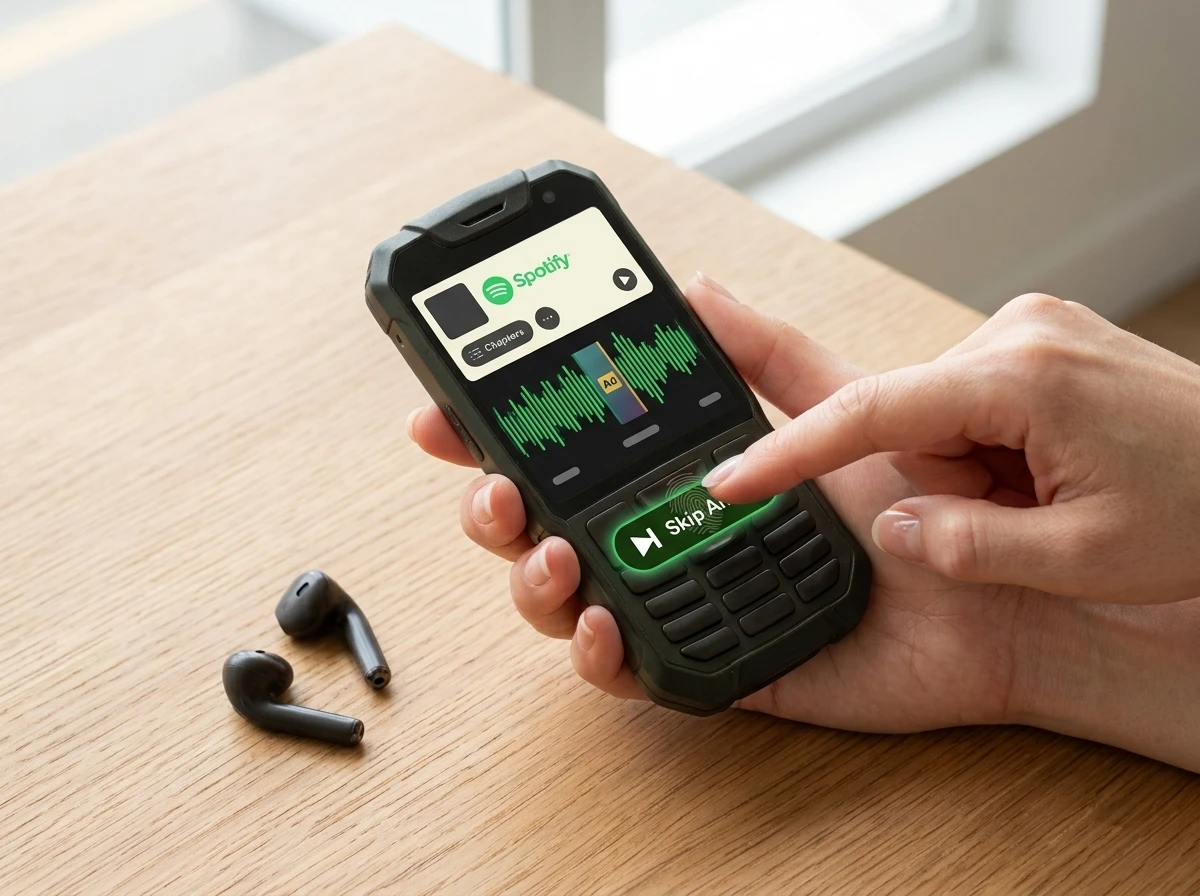
Spotify is testing a one-tap Skip Ahead button that lets some Premium users jump past entire podcast ad breaks, intros and sponsorship messages. The feature, first detailed by Podnews and covered by Semafor, appears only for selected paid subscribers when the app sits open in the foreground.
Publishers immediately flagged the risk to direct-sold ads. Spotify says the test aims to make listening more intuitive and that internal data shows people stay with shows longer.
The early reaction split along familiar lines. Paying listeners saw a cleaner experience. Networks saw a new way for sold inventory to vanish after the file had already been delivered and stitched.
How the Skip Ahead Button Works
A button labeled Skip Ahead pops up the moment an ad break, intro or promo begins. One tap jumps the listener cleanly to the start of the next content section. Podnews calculated that clearing the same break with the ordinary 15-second skip used to take nine taps plus a correction for overshooting.
That gap matters. Nine taps plus a rewind correction creates friction that keeps many listeners inside the break. One tap removes the friction and treats the whole block as optional. The design choice turns a tedious chore into an instant exit.
The tool works on shows carrying ads from Acast, Audacy and The New York Times. It also appeared inside Spotify’s own Bill Simmons Show. That means it can bypass both competitor inventory and some of Spotify’s own sold spots.
- One tap clears an entire ad or promo block
- Foreground only: the button stays hidden during lock-screen or background play
- Premium subset: not every paid account sees it, and free users are excluded
- Early test: Spotify can still pull or reshape it after feedback
Because the control appears only while the app is open and active, it never becomes a lock-screen habit. Background listeners keep using the old 15-second skip. The test therefore measures behavior among engaged Premium users who already have the screen unlocked and the player visible.
A Spotify spokesperson told both Podnews and Semafor the company runs routine tests, some of which become permanent features. The goal is helping Premium subscribers spend more time with podcasts based on observed behavior.
Premium First and the Two-Tier Split
The timing tracks Spotify’s long push toward recurring subscription revenue over pure ad growth. Premium already removes music ads. Podcast ads have remained a friction point because many creators embed their own host-reads and sponsorships before the file reaches Spotify.
Semafor reported that the button currently targets ads not sold directly by Spotify. That creates an immediate two-tier market: inventory Spotify controls stays harder to skip, while publisher-sold spots become trivial to avoid. Free listeners, still the bulk of the platform’s 777 million monthly active users, continue hearing both layers of ads.
The split is structural rather than accidental. Premium subscribers already pay to remove music advertising. Extending an easy exit to third-party podcast ads sharpens the value of the paid tier without immediately gutting Spotify’s own marketplace inventory. Free users, who supply the large majority of the 777 million monthly active base, still receive the full ad load and therefore still underwrite reach for campaigns that need scale.
Spotify has privately told some networks that the feature lifts overall listen time. The company has not released the underlying numbers publicly.
Longer sessions can help completion metrics and recommendation loops even when individual ad exposures fall. The open question is whether the extra minutes compensate sellers who price campaigns on delivered impressions inside those same sessions.
Publishers See Revenue Risk
Podnews called the change a significant threat to ad-funded shows. Several major audio networks contacted Spotify after the reports surfaced, asking how monetization would hold up. One ad company told Podnews the setup could look fraudulent: ads are sold and stitched into the audio, yet the platform hands listeners an easy exit.
| Ad Type | Who Sells It | Skip Ease Under Test | Publisher Control |
|---|---|---|---|
| Host-read direct | Publisher / network | One-tap Skip Ahead | High price, high risk |
| Dynamic third-party | Acast, Audacy, etc. | One-tap Skip Ahead | Medium |
| Spotify Marketplace | Spotify | Harder or blocked | Low for creator |
| Premium upsells | Spotify | Also skippable in tests | N/A |
Bumper analytics data cited by Podnews shows real-world ad-break skip rates below 10 percent when listeners must mash the 15-second button. A single clean button removes that friction and signals the upcoming content is skippable. If enough Premium users take the invitation, rebooking rates for direct campaigns could fall.
Campaign buyers already compare completion and attention across platforms. When one large app makes publisher-sold breaks trivial to clear, the relative value of those breaks drops unless pricing or guarantees adjust. Networks that sell premium host-reads at higher rates face the sharpest exposure because those spots rely on listeners staying through the message.
Crooked Media co-founder Tommy Vietor put the industry mood bluntly in Tommy Vietor’s public rebuke: “Very cool of @Spotify to try and destroy the podcast industry. What a great partner!” The post drew hundreds of thousands of views and replies split between creator alarm and listener cheers.
The fraud concern raised by the ad company rests on a simple mismatch. Inventory is priced and inserted as if it will be heard. The platform then supplies a one-tap path around it for the very subscribers most likely to be valuable to advertisers. That tension sits at the center of the outreach from networks.
Earlier Friction Points With Creators
This is not Spotify’s first clash with podcast makers. The company initially copied audio files in ways that broke dynamic ad insertion, forcing hosts into special pass-through deals. Todd Cochrane wrote in 2024 that trusting Spotify meant accepting a one-sided relationship in which the platform held the power.
- 2019-2020: Early Spotify podcast ingestion broke many dynamic ads; hosts scrambled for passthrough agreements.
- 2025: Public play-count rollout drew creator backlash; Spotify quickly limited exact numbers to broad buckets above 50,000 plays.
- August 2026: Skip Ahead test surfaces in selected Premium accounts and triggers fresh network outreach.
Each episode reinforced the sense that Spotify optimizes for its own metrics and subscription growth first. Creators still chase the audience size, yet they keep discovering new platform levers that reshape how money moves.
The pattern is consistent. Distribution scale arrives first. Control over measurement, ad plumbing and now skip behavior follows. Hosts who need the audience accept the terms, then renegotiate after each new lever appears. The Skip Ahead test fits the same sequence: a product change framed as listener convenience that also reorders which ads remain hard to avoid.
Listeners Already Skip and Want More
On X and in reply threads, many Premium users welcomed the change. They pay monthly fees and still hear podcast ads that music never carries. One common line: people already hammer the 15-second button; the new control simply finishes the job cleanly. Others noted YouTube Premium already lets paying users skip ads on video podcasts.
Very cool of @Spotify to try and destroy the podcast industry. What a great partner!
Tommy Vietor wrote that on X. Replies under the post and similar threads showed the split: creators worried about sponsorship dollars, listeners treating the button as long-overdue product hygiene.
Podnews analysis puts Spotify at least 25.6 percent of global podcast downloads. In many markets it is the largest single app. A feature that makes skipping trivial on that share of listening can move the entire economics even if it starts as a limited test.
Listener expectations now travel across apps. Once a paid tier on video already offers clean ad exits, the same paid tier on audio looks incomplete without a comparable control. Spotify’s test answers that comparison directly for the subset of Premium accounts that receive the button.
The Larger Migration Already Underway
The skip test arrives while podcasting itself is shifting toward video. YouTube has become a major discovery and consumption surface. Netflix and other video platforms are experimenting with the format. Advertisers are comfortable with the familiar 30-second video spot and the measurement systems that surround it.
If direct audio ads become easier to avoid on the biggest audio platform, more networks will accelerate clipping strategies, YouTube-first releases and platform-native ad deals. That is the second-order effect: not just lower CPMs tomorrow, but a faster reordering of where podcasts live and who controls the inventory.
Spotify owns Megaphone, the host and ad-tech firm that itself has served some of the longest preroll blocks. The irony is not lost on industry watchers. At the same time, Spotify’s public stance remains that longer listening helps everyone. The company continues collecting feedback from publishers, advertisers and users while the test runs.
Independent creators who rely on host-read trust still have one durable edge. Many listeners say they tolerate ads from hosts they like even when they skip pre-produced spots. That relationship survives a button more readily than pure inventory volume does. Whether it survives at scale on a platform that now offers a one-tap exit is the open question the test will answer.
Host-Read Trust Meets One-Tap Exits
Host-read spots have long commanded higher rates because the voice delivering the ad is the same voice the audience already chose. The Skip Ahead button does not erase that relationship, yet it changes the default path around it. A listener who once sat through a mid-roll out of inertia can now leave in a single motion.
The surviving advantage is selective. Fans who like the host may still stay. Casual Premium users who treat every break as clutter now have a cleaner tool. Over repeated episodes the mix of those two groups decides whether direct campaigns keep their premium pricing or face pressure to discount.
- Host-reads still ride existing audience goodwill
- Pre-produced and dynamic spots lose the friction that once protected them
- Spotify Marketplace inventory remains comparatively shielded in the test
- Free users, the bulk of 777 million monthly actives, still hear the full load
Networks that lean hardest on personality-driven reads therefore watch the test more closely than pure performance sellers. Their product is trust. The platform now supplies an exit that trust must overcome on every break.
Listen Time Gains Leave Sellers Exposed
Spotify’s private message to some networks is that overall listen time rises with the feature. Longer sessions can improve show-level completion and keep users inside the app. Those outcomes serve subscription retention and engagement charts.
Sellers, however, buy delivered attention inside specific breaks. A longer session that skips every publisher-sold mid-roll still fails the campaign that paid for that mid-roll. The internal data Spotify cites has not been released publicly, so networks cannot yet weigh the claimed lift against the new skip path.
The foreground-only limit further narrows what the test measures. It captures users who already watch the player, not the larger group that listens from the lock screen. Any listen-time gain observed in that engaged slice may not translate evenly once the control, if it expands, reaches more contexts.
For now the feature remains limited, reversible and confined to some Premium accounts in the foreground. Networks that want clearer data on what Spotify shows podcasters about listeners already navigate incomplete dashboards. The Skip Ahead experiment adds another layer of opacity around how ads actually perform once the file leaves the studio.
The one-tap Skip Ahead button details show a clean product improvement for paying users. The same details show a structural nudge that favors Spotify’s own ad products and subscription economics. Podcast advertising as a whole still posts solid growth on IAB digital ad revenue benchmarks, yet the path for independent direct sales just got steeper on the largest audio app.
Spotify can still walk the feature back. Publishers can still move more listening to places where the skip controls stay under their influence. The test simply makes the trade-offs impossible to ignore.

-
 TECH1 year ago
Where Garmin Watches are Made and How They are Assembled
-

 AUTO3 months ago
Tesla’s Roadster Is ‘a Few Weeks Away,’ Says Its Chief Designer
-
 NEWS10 years ago
Samsung Releases Galaxy Note7 TV Ad as Reddit AMA Leaks Specs
-
 NEWS10 years ago
Android 7.0 Nougat Rolls Out To Nexus Devices With New Emoji, Features
-
 FINANCE9 years ago
Cardano Price Surges as ADA Enters the Crypto Top Ten List
-
 NEWS10 years ago
Pre-Order the First Camera Made for Facebook Live Streaming Video
-
 FINANCE1 year ago
Binance Suspends Trading and Withdrawals for a System Upgrade
-
 FINANCE9 years ago
RChain Price Jumps Nearly 150% to a New All-Time High of $2.03