
BUSINESS
Ten Shopian Arrests Point to Terror Cash Inside Jails
Shopian police arrested 10 alleged LeT and TRF financiers on October 30 after tracing payment-app trails to jailed militants and phone supplies.

Shopian police arrested 10 alleged terror financiers on October 30, 2026 after tracing layered payments they say fed Lashkar-e-Taiba and The Resistance Front. Investigators followed money across digital payment platforms and, they said, found links to militants already held in different jails.
The case was built from consumer payment apps, public collections inside Jammu and Kashmir, and supply runs that included smartphones. District Police Shopian registered FIR 231/2026 at Police Station Shopian and said more arrests were likely.
Shopian Police Followed the Payment Apps
Police in Shopian, a south Kashmir district with a long record of Lashkar-e-Taiba activity, did not describe a haul of rifles or a firefight. They described a money trail. A focused probe into suspected financial networks, they said, turned up suspicious online transfers on several payment platforms, then a path that crossed more than one layer before it reached the 10 men now in custody.
The Union Territory already runs on those platforms for ordinary trade, wages and family transfers. That is the shift inside this file. A terror-finance case that once needed hawala couriers or a bag across the Line of Control can now be built from the same rails a grocer uses to collect a bill, if the transfers look wrong long enough for a district team to pull them apart.
District Police Shopian put the bust on the record the same morning, naming LeT and TRF, citing FIR 231/2026, and saying the probe would keep looking for further links.
Shopian Police busted an alleged terror financing network linked to LeT/TRF through suspicious online transactions. Ten accused arrested in FIR No. 231/2026. Investigation is underway to identify further links.#ShopianPolice#JmuKmrPolice @JmuKmrPolice @KashmirPolice@DigSkr pic.twitter.com/JfFhUSMFhr
— DISTRICT POLICE SHOPIAN (@ShopianPolice) October 30, 2026
Police called the 10 men overground workers. These are civilian helpers who move money and supplies while gunmen stay hidden. The handout did not name the apps, the rupee total, or the inmates on the other end of the alleged chain. It did say the accused were collecting money from the public in secret and sending it through established financial links to help LeT and TRF.
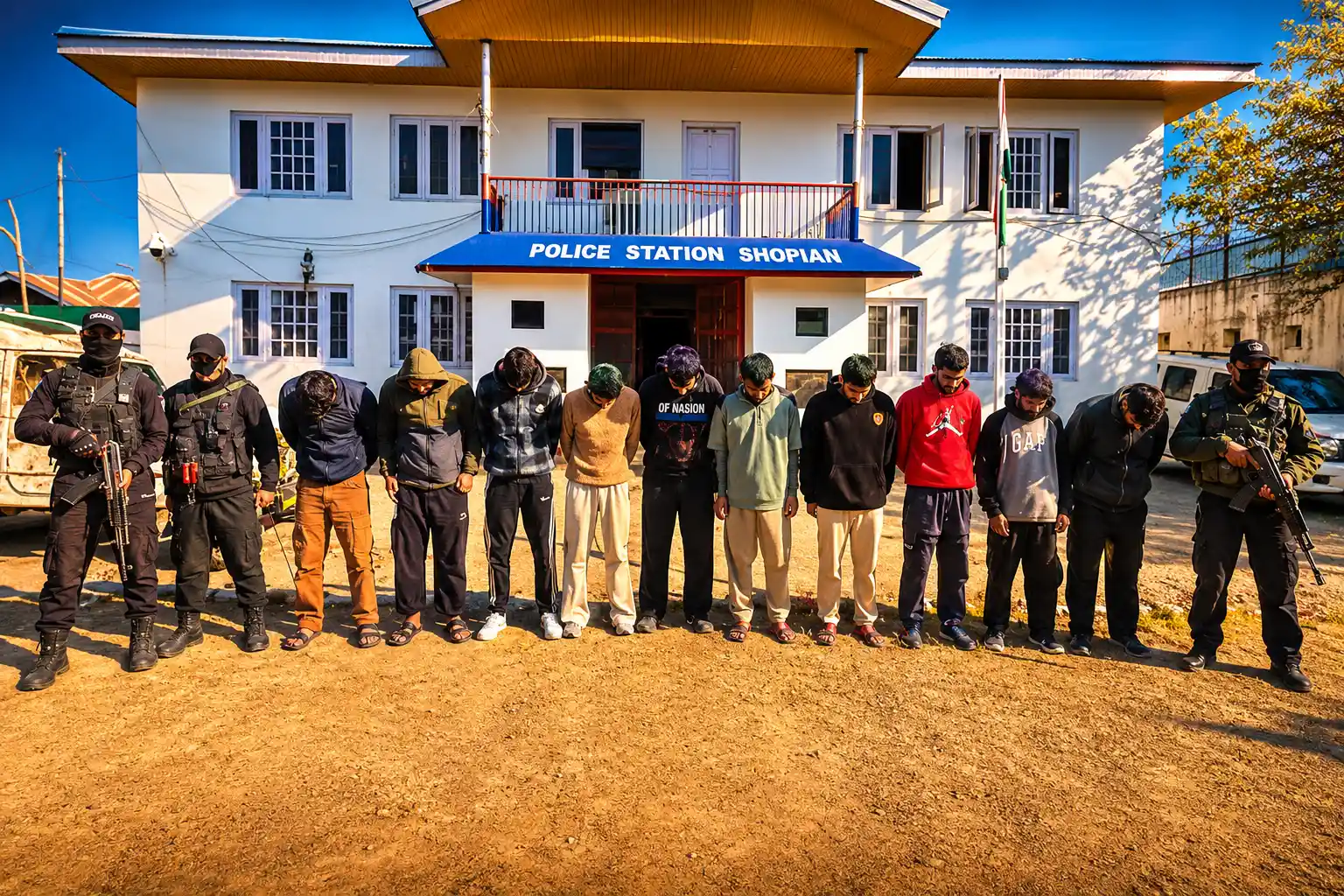
10 Names Across Three Districts
The addresses in the police list run from south Kashmir into the Jammu division. Five of the accused are listed in Shopian district, three in Pulwama, and two in Kathua, which sits on the Jammu side toward the international border. That is three districts and 10 names, not a single mohalla round-up.
THE 10 MEN NAMED IN FIR 231/2026
| Name | Place | District |
|---|---|---|
| Owais Shafi Naikoo | Saidpora Bala | Shopian |
| Tajamul Ahmad Shah | Rawalpora | Shopian |
| Moiz Iqbal | Chitragam Kalan | Shopian |
| Imdad Yousuf Ganie | Chitragam Kalan | Shopian |
| Firdous Thokar | Nadigund, Trenz | Shopian |
| Saqib Zahoor Wani | Murran | Pulwama |
| Liyaqat Nazir Lone | Murran | Pulwama |
| Aamir Ahmad Ganie | Armolah | Pulwama |
| Mohd Hanief | Check Haria | Kathua |
| Kaju | Check Haria | Kathua |
Chitragam Kalan appears twice. Murran in Pulwama appears twice. Check Haria in Kathua appears twice. Police did not describe those pairs as cells or as kin, and the FIR text released in the handout does not spell out who handled which transfer. The geography still does a job the headcount cannot. A collection net that reaches Kathua is already larger than a Shopian street committee.
Eight of the 10 live in the twin south Kashmir districts of Shopian and Pulwama, the belt where LeT and its later fronts have long found local help. The two Kathua names pull the same FIR across the Pir Panjal into Jammu. Police have not said whether money, phones, or instructions travelled that way, only that all 10 sit in the same case.
What the Jail Link Changes About These Arrests
Police say the 10 men had links with terrorists and their aides held in different jails. They have not named those inmates, the prisons, or the messages that supposedly kept the chain alive. Even in that thin form, the claim changes what a terror arrest is for. A gunman who is already inside a prison is supposed to be off the board. This file treats some of those inmates as part of a live finance net.
The investigation revealed a wider network of individuals allegedly involved in terror financing and having links with terrorists and their associates lodged in different jails.
J&K Police spokesperson, Shopian statement, October 30, 2026
That sentence is the load-bearing line in the handout. Everything else, the apps, the public collections, the phones, is the method. The jail clause is the reason a district team is still talking about a wider network after 10 arrests. If aides in custody can still be tied to money on the outside, then body counts in the forests do not close the books.
Jails in the Union Territory have been a known weak point for years because smuggled phones and visitors can reconnect inmates to streets they no longer walk. This statement does not prove that happened here. It does say investigators believe the finance chain was not limited to men who were free on October 30. Until police name the inmates, that part of the case is an allegation with a large hole in the middle.
The honest limit is worth keeping in view. Links are not orders. A call record, a repeated small transfer, or a name in a phone book can look like a network and still fail in court. Police themselves framed the jail finding as the product of an initial probe and said the wider map was still being drawn.
Smartphones on the Logistics Run
Police said the money was not only a fighting fund. It was also being used, they said, to provide supply support, including smartphones, so that terrorist activity could continue. In the Kashmir theatre a phone is not a side gadget. It is how a fighter talks to a handler, checks a map, films a claim, and stays in a group chat that can outlive the man who bought the SIM.
That detail sits beside the payment-app trail for a reason. Cash that stays as cash is hard to follow and easy to spend on food or a ride. Cash that becomes a phone is a durable asset. It can be handed to someone who was never on the original transfer. It can be used from a hide in Shopian or from a ward that is supposed to be offline.
THE ALLEGED COLLECTION PATH
- Public cash: Police said the accused were secretly collecting and raising funds from the general public inside Jammu and Kashmir.
- Layered apps: Suspicious online transfers on various payment platforms were studied, then followed across more than one layer.
- Jail-side names: The probe, police said, showed links to terrorists and their aides held in different jails.
- Phones and supplies: Part of the money was allegedly used for logistics, including smartphones, to help LeT and TRF activity.
No platform was named, which is a gap that matters to anyone who wants to know whether this was UPI, a wallet, or a card trail. No recovery list of handsets was published with the handout. The police claim is still specific enough to be tested: public collections, digital layers, jail links, phones. Each of those can be proved or dropped as the FIR moves.
Lashkar’s 2019 Front on the Indian Ban List
The Home Ministry’s own schedule is blunt about what TRF is. The First Schedule of the Unlawful Activities (Prevention) Act, in the annexure New Delhi still circulates, lists TRF with Lashkar-e-Taiba at serial number 5, together with Pasban-e-Ahle Hadis and “all its manifestations and front organizations.”
That pairing is the legal reason a Shopian FIR can name LeT and TRF in one breath. TRF is not, on the Indian list, a separate political brand. It is written onto Lashkar’s line. The January 2023 gazette that added TRF said the group came into existence in 2019 as a proxy outfit of Lashkar-e-Taiba, recruited online, ran propaganda, and moved weapons and narcotics from Pakistan into Jammu and Kashmir.
THE TRF PAPER TRAIL
- 2019: The Resistance Front comes into existence, the Home Ministry later says, as a proxy outfit of Lashkar-e-Taiba.
- January 5, 2023: Notification S.O. 45(E) inserts TRF and all its manifestations into serial number 5 of the UAPA First Schedule, on the same line as Lashkar-e-Taiba, and records Sheikh Sajjad Gul as a designated terrorist.
- April 22, 2025: TRF claims the Pahalgam attack, which the US State Department later says killed 26 civilians, the deadliest assault on civilians in India since Lashkar’s 2008 Mumbai attacks.
- July 17, 2025: The US State Department adds TRF as a Foreign Terrorist Organization and a Specially Designated Global Terrorist, as an amendment to Lashkar’s own listing.
- October 30, 2026: Shopian Police arrest 10 alleged aides in FIR 231/2026, saying they raised cash and bought phones for LeT and TRF and had links to jailed militants.
Sheikh Sajjad Gul, named in that 2023 notification as a TRF commander, is a designated terrorist under the Act’s fourth schedule. The Shopian handout does not claim the 10 accused took orders from him. It claims they were feeding the same banned brand.
How TRF Stayed Useful After the LeT Ban
TRF was listed by the Home Ministry as a Lashkar proxy that took shape in 2019, banned under UAPA in January 2023, and added by Washington as an FTO in July 2025 after it claimed the Pahalgam attack. The useful trick in the name is political, not military. Lashkar’s own title is openly religious. Resistance is a word that travels better on posters, social feeds, and foreign desks that still hunt for a local face in Kashmir violence.
Indian officials have described TRF as a way to present the same pipeline as indigenous after Lashkar’s branding became a liability. The ministry notification in 2023 already accused the front of online recruitment, infiltration, and psychological operations on social media meant to pull people in Jammu and Kashmir toward terrorist groups. That is the same online layer a district team is now reading as a payments problem.
Washington then designated TRF a foreign terrorist organization and a Specially Designated Global Terrorist, calling it a Lashkar-e-Tayyiba front and proxy and tying the move to the Pahalgam attack. The US also said it had reviewed and kept Lashkar’s own FTO listing. For a Shopian cash case, that diplomatic paper does not add a rupee to the FIR. It does show why police can treat a local collection run as part of a group that New Delhi and Washington both file under Lashkar.
The Shopian accused are not charged, in the public handout, with Pahalgam. They are charged with raising money and supplies for the same banned pair. That is a smaller case with a larger shadow. If the proxy name was meant to hide Lashkar, the finance trail is where the hide fails, because money does not care what the poster says.
An Open File at Shopian Police Station
Police said further investigation was under way to map the wider network, find more financial links, and identify other people in the group, and that more arrests were expected. They have not, in any later public note from the same district handle, added an 11th name to FIR 231/2026 or published a seized-phone inventory.
On November 11, Shopian Police posted about a charas seizure at Keller. On November 12 the same account posted about an illegal mining seizure, a JCB, a dumper and four tractors. Those notes do not close the terror-finance file. They do show that the district’s public feed moved on while the October 30 case still had the same 10 names.
WHAT WE KNOW
- The count: 10 men are under arrest in FIR 231/2026 at Police Station Shopian, named with fathers and villages.
- The method police describe: public collections, layered transfers on payment platforms, alleged jail links, and phones among the supplies.
- The groups named: Lashkar-e-Taiba and The Resistance Front, which India lists together and which the United States now lists as an FTO amendment to Lashkar.
WHAT IS UNCONFIRMED
- The rupee total: police have not published how much was collected, moved, or spent on phones.
- The apps: no platform, wallet, or bank is named in the handout.
- The inmates: the jailed militants and aides are unnamed, as are the prisons and the proof of contact.
- Further arrests: promised on October 30 and not announced through the district’s November posts.
A headcount of 10 is a completed raid. It is not a completed finance map. The unnamed inmates, the unnamed apps, and the missing rupee figure are the parts of this case that will decide whether Shopian caught a local collection crew or a working artery for LeT and TRF.
On November 12, Shopian Police posted about an illegal mining seizure. The terror-finance FIR from October 30 still had the same 10 names.
Disclaimer: This article is news reporting on a police investigation and is for information only. It does not find anyone guilty and does not constitute legal advice. The 10 men named have been arrested on police allegations and have not been convicted by a court. Readers should not treat those allegations as settled fact and should consult a qualified criminal lawyer before acting on any related legal question. Names, charges and case status are those given by police on October 30, 2026, and in later official posts, and they may change as the probe proceeds.

ADNOC Ship Hit in Hormuz Leaves One Crew Missing

SpiceJet’s Rs 5,500 Crore Plan Follows a Rescue That Failed

Hasina’s Return Fight Sets Fire to Yunus’s Bank

Bancroft Recants the 2018 Inquiry and Names the Team

Adhikari Ties the Saffron Saree Row to School Licences

Clancy Juror Says the Holdout Never Cited Evidence

The iPhone 18 Pro Max Splits Apple’s Fall in Two

OpenAI Calls GPT-6 Astra AGI Then Locks Its Exploits

Trump Claims Hormuz Control as Oil Holds Near $96

Russia Closes the Goethe-Institut Berlin Tried to Save

 NEWS2 months ago
Clancy Juror Says the Holdout Never Cited Evidence
- NEWS3 months ago
The iPhone 18 Pro Max Splits Apple’s Fall in Two
- NEWS3 months ago
OpenAI Calls GPT-6 Astra AGI Then Locks Its Exploits
- BUSINESS3 months ago
Trump Claims Hormuz Control as Oil Holds Near $96
- LIFESTYLE3 months ago
Russia Closes the Goethe-Institut Berlin Tried to Save
- AUTO3 months ago
Volkswagen’s Job Cuts Leave Four Plants Without Cars
- NEWS3 months ago
Dyson Puts Nurovi Robots on Sale Without the UV Flagship
- BUSINESS2 months ago
US Destroys Five Iranian Tankers as the Shock Hits Jordan










