
HEALTH
Severe Infections Leave a Two-Year Brain and Mental Health Map
A million-pair JAMA Psychiatry study maps higher psychiatric and neurologic risks after hospital infections.

Hospitalization for a serious infection raises the chance of new psychiatric and neurological diagnoses for up to two years afterward, according to a multicohort analysis of more than one million matched patient pairs. The work maps risks across ten body systems and four age bands, giving clinicians a practical chart of what to watch after discharge.
Adults face the steepest absolute increases. Cognitive problems account for the largest share of extra cases. Brain infections produce the sharpest relative jumps. The study stops short of proving cause, yet the pattern holds after extensive matching.
The clinical value lies in the dual view the authors supply. Relative ratios flag which infection-disorder pairs deserve the closest scrutiny. Absolute risk differences show which pairs will generate the most new cases in ordinary practice. Together those measures turn a broad association into a usable watch list.
A Million Matched Pairs Across 62 Networks
Researchers led by Maxime Taquet at the University of Oxford pulled electronic health records from the TriNetX US Collaborative Network. They examined patients hospitalized between 2014 and 2018, then tracked them for two years. The final sample held 1,062,722 matched pairs. Mean age was 48.4 years. Just over half were women. About 65 percent were White.
Ten infection categories covered the body: infectious encephalitides, meningitides, hepatitides, sexually transmitted infections, plus infections of bone, heart, gastrointestinal tract, respiratory tract, skin and urinary tract. Comparators were people hospitalized for non-infectious reasons and the general population. Propensity-score matching adjusted for sociodemographics, comorbidities, vaccinations and prior psychotropic use.
- 1,062,722 matched pairs analyzed
- 14 psychiatric and neurologic outcomes tracked from month 1 to year 2
- 116 of 140 infection-disorder tests showed elevated risk versus non-infectious hospitalization
- Data drawn from 62 US healthcare organizations
The breadth of the network matters. Sixty-two organizations reduce the chance that any single hospital’s coding habits or case mix drive the signal. Matching on prior psychotropic use and vaccinations further narrows the gap between infected and comparator patients before follow-up begins.
The primary measure was the ratio of restricted mean time lost (RMTL). Absolute risk differences at two years supplied the clinical burden view. Full details appear in the full multicohort analysis in JAMA Psychiatry.
RMTL ratios capture how much earlier diagnoses appear in the infected group across the full observation window. Absolute differences answer a simpler clinic question: how many extra patients will carry a new label by year two. Both metrics are needed because a rare outcome can post a dramatic ratio while adding few cases, and a common outcome can do the reverse.
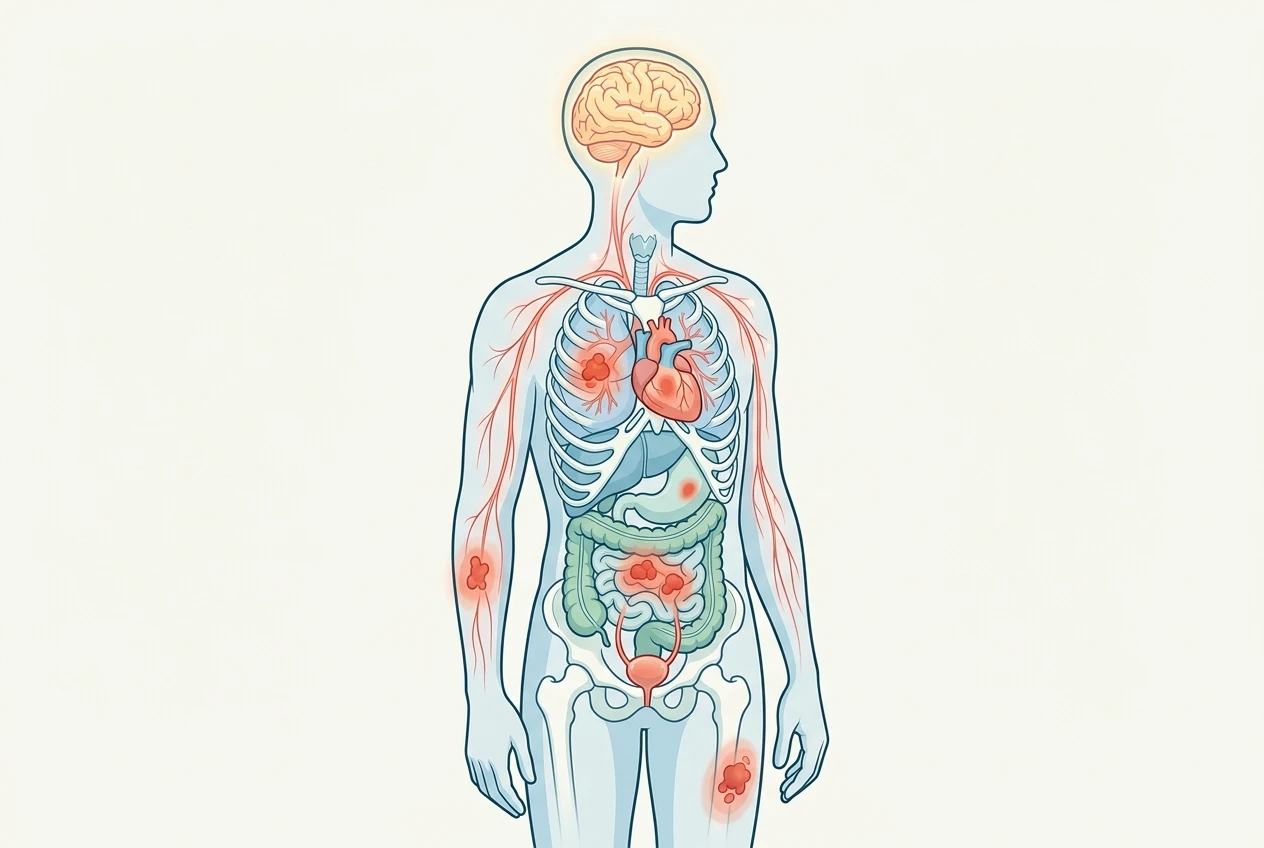
Encephalitis Leads Relative Risk While Cognition Drives Cases
Encephalitis showed the highest relative increase. After cardiac infection the median RMTL ratio reached 6.54. People hospitalized with any infection were roughly five times more likely to receive an encephalitis diagnosis than those admitted for other reasons. Absolute numbers stayed low because the condition is uncommon.
Cognitive deficits produced the biggest absolute rise. Median risk difference hit 8.76 percent. After cardiac infection the gap widened to 12.37 percent (19.08 percent versus 6.71 percent). Anxiety, mood disorders, psychosis, insomnia, dementia, seizures, stroke, brain haemorrhage and peripheral nerve or muscle problems all rose in most comparisons.
| Infection type | Leading associated outcomes | Notable signal |
|---|---|---|
| Infectious encephalitides | 7 of 14 disorders; top-3 for 12 | Highest overall excess risk |
| Meningitides | Cognitive deficits, epilepsy/seizures | Strong absolute cognitive load |
| Sexually transmitted infections | Psychotic disorders, mood disorders, dementia | Disorder-specific leadership |
| Respiratory tract infections | Anxiety disorders, neuromuscular disease | Common hospital pathogen class |
| Cardiac infections | Encephalitis (RMTL 6.54), cognitive deficits (RD 12.37%) | Extreme relative and absolute ends |
Head-to-head infection comparisons confirmed that site matters. The pattern repeated, with higher ratios, when infected patients were set against the general population.
That dual comparator design is useful. Non-infectious hospitalization already carries stress, immobility and possible hypoxia. When infection still elevates risk above that baseline, the surplus points beyond generic hospital effects. The further jump against the general population shows how large the total gap becomes once everyday community risk is the reference.
Cardiac infection occupies both extremes of the spectrum. It posts the highest listed RMTL ratio for encephalitis and the widest absolute gap for cognitive deficits. Clinicians who already monitor heart-infection survivors for cardiac sequelae now have a second domain to track.
Adults Carry the Heavier Load
Risks appeared in every age band, including children 18 and under. Absolute risk differences ran 0.33 percent lower than the overall average in children and 0.42 percent higher in adults 65 and older. Middle-aged and older adults therefore absorb most of the extra diagnoses.
Young adults (19-44) sat between the extremes. The age gradient held after matching, suggesting the finding is not simply residual comorbidity. Older brains and bodies appear more vulnerable to the same infectious insult.
- Children (18 and under): absolute risk differences 0.33 percent below the overall average
- Young adults (19-44): intermediate absolute burden between child and older groups
- Adults 65 and older: absolute risk differences 0.42 percent above the overall average
- All four age bands: elevated risk present after propensity-score matching
The persistence of risk in children shows the association is not confined to aging physiology. The steeper absolute load in older adults still dictates where most new case volume will appear. Discharge planning that ignores age will therefore miss the bulk of preventable delayed diagnoses.
Which Infections Flag Which Disorders?
Infectious encephalitides ranked first for seven outcomes and inside the top three for twelve. That concentration makes brain-invasive infection the clearest red-flag category. Other links were more selective. Sexually transmitted infections led for psychosis, mood disorders and dementia. Respiratory infections led for anxiety and neuromuscular disease. Meningitides led for cognitive problems and seizures.
These pairings give discharge teams a short list. A patient leaving after encephalitis or meningitis warrants closer cognitive and seizure surveillance. Someone recovering from a severe STI may need earlier mood and psychosis screening. The map is probabilistic, not deterministic, yet it sharpens attention where the data concentrate.
An Oxford University summary of the findings underscores the same differential pattern and the stronger adult signal.
Selectivity itself is informative. If every infection raised every disorder by the same margin, the map would collapse into a single generic warning. Instead the data sort pathogens by the psychiatric and neurologic labels that follow them most often. That sorting is what lets a finite clinic schedule its limited follow-up slots.
How Relative and Absolute Signals Guide Priorities
The study’s two metrics pull clinical attention in different directions. High RMTL ratios identify infection-outcome pairs that are unusually tightly linked, even when the outcome is rare. Large absolute risk differences identify pairs that will fill appointment books, even when the ratio looks modest.
Encephalitis after cardiac infection illustrates the first pole: an RMTL ratio of 6.54 flags a striking relative jump, yet the condition’s baseline rarity keeps case counts small. Cognitive deficits after the same infection illustrate the second pole: a 12.37 percent risk difference (19.08 percent versus 6.71 percent) means many extra patients will need assessment.
Across the full set of comparisons the same logic applies. Median cognitive risk difference of 8.76 percent outranks most other absolute gaps. That is why cognition, not the highest-ratio rare events, drives the largest share of extra diagnoses. Clinics that chase only dramatic ratios will under-serve the bulk of new morbidity.
- Month 1 onward: elevated risk already detectable in the tracked window
- Through year 2: absolute differences continue to accumulate for multiple disorders
- After matching: 116 of 140 infection-disorder tests remain elevated versus non-infectious hospitalization
The timeline matters for scheduling. A single post-discharge check at six weeks will miss diagnoses that emerge later in the two-year span. Staggered cognitive, mood and neurologic contacts spread across that window better match the period the data cover.
Association Stops Short of Proof
The authors list several biological routes that could connect infection to later brain diagnoses: direct neural injury, systemic inflammation, blood-brain barrier disruption, vascular damage, immune activation, or the indirect toll of critical illness and hospitalization itself. The study cannot separate these paths. It also cannot prove that the infection caused the later diagnosis.
Electronic health records miss some diagnoses and misclassify others. Residual confounding remains possible even after matching. Only hospitalized cases entered the cohorts, so milder community infections stay outside the map. The 2014-2018 window predates COVID-19, leaving that pathogen for separate work. Reverse causation and overlapping cohorts add further caution.
These findings provide the first map linking infections of different parts of the body with neurological and psychiatric consequences. This map will help prepare for future pandemics and outbreaks, and provides key information for studies aiming to understand the mechanisms by which an infection might have consequences in the brain.
Maxime Taquet, associate professor in the Department of Psychiatry at Oxford and lead author, made that statement. Senior author Paul Harrison added that understanding how and why many infections raise psychiatric risk could open paths to new treatments.
Each listed limitation shapes how the map should be read. Missing milder infections means the findings apply most cleanly to patients sick enough to be admitted. Pre-COVID timing means later pandemic pathogens require their own analyses. Residual confounding means the associations remain associative even after extensive matching. None of those caveats erase the pattern; they bound the claims that can be made from it.
Why Body Site Still Matters After Matching
Propensity-score matching balanced sociodemographics, comorbidities, vaccinations and prior psychotropic use. Yet infection site continued to sort the outcome profile. That residual sorting implies the location of the original insult carries information beyond the shared hospital experience.
Brain-invasive categories concentrate risk across many of the fourteen outcomes. Peripheral categories show narrower leadership: respiratory infections for anxiety and neuromuscular disease, sexually transmitted infections for psychosis, mood disorders and dementia. The contrast suggests more than one pathway is at work, even if the study cannot isolate which pathway dominates any given pair.
For mechanism studies the site map supplies natural contrast groups. Investigators can compare inflammatory or vascular markers after encephalitides versus after skin or urinary infections and ask which signals track the later psychiatric labels. The same contrasts can guide genetic or biomarker work that Paul Harrison noted may eventually point toward treatments.
A Monitoring Map for Clinics and Outbreaks
The practical yield is a surveillance blueprint. Primary care and specialty clinics can schedule earlier cognitive screens, mood checks and neurologic exams for high-risk post-infection patients, especially older adults and those with brain or cardiac infections. Absolute case numbers favor cognitive follow-up even when relative risks look modest.
For pandemic planners the body-system map supplies an early-warning layer. When a novel pathogen preferentially hits lungs, gut or meninges, health systems can pre-position the corresponding psychiatric and neurologic services. That is a second-order use the raw association alone never delivered.
Readers interested in how specific neural structures shape everyday function can explore which brain regions drive most daily actions. The present study sits upstream of that anatomy: it shows which infections most often leave measurable traces on the systems those regions support.
Further work with inflammatory biomarkers, genetics and prospective cohorts will test which mechanisms dominate. Until then the map itself is the tool. Severe infection is not only an acute event. For many patients it marks the start of a two-year window of elevated brain and mental health risk that clinics can now watch with clearer priorities.
Implementation can stay simple. Flag the infection category at discharge. Attach the short list of leading associated disorders. Book the first cognitive or mood contact inside the early months and plan at least one later check before the two-year mark closes. Older adults and those with encephalitides, meningitides or cardiac infections receive the densest schedule. That workflow uses only the rankings the multicohort analysis already supplies.
Frequently Asked Questions
What exact sample size and data source did the study use?
The analysis drew on 1,062,722 propensity-score-matched pairs from the TriNetX US Collaborative Network spanning 62 healthcare organizations, covering hospitalizations from 2014 to 2018 with two-year follow-up.
Does the study prove that infections cause the later disorders?
No. It demonstrates robust associations after matching but cannot establish causation; residual confounding, reverse causation and unmeasured factors remain possible, and the authors state this limit explicitly.
Which age group shows the largest absolute risk increase?
Older adults (65 and above) show absolute risk differences 0.42 percent higher than the overall average, while children show differences 0.33 percent lower; middle-aged adults also carry elevated absolute burdens relative to the young.
What is the single highest relative-risk finding?
Encephalitis after cardiac infection produced a median RMTL ratio of 6.54 (95 percent CI 3.78-11.31); infectious encephalitides overall ranked as the top risk factor for seven of the fourteen outcomes.
Why does cognitive impairment matter more than rarer high-ratio outcomes?
Cognitive deficits generated the largest absolute risk differences (median 8.76 percent, up to 12.37 percent after cardiac infection), so they contribute the greatest number of extra cases even when relative ratios are lower than those for encephalitis.

-
 TECH1 year ago
Where Garmin Watches are Made and How They are Assembled
-

 AUTO3 months ago
Tesla’s Roadster Is ‘a Few Weeks Away,’ Says Its Chief Designer
-
 NEWS10 years ago
Samsung Releases Galaxy Note7 TV Ad as Reddit AMA Leaks Specs
-
 NEWS10 years ago
Android 7.0 Nougat Rolls Out To Nexus Devices With New Emoji, Features
-
 FINANCE9 years ago
Cardano Price Surges as ADA Enters the Crypto Top Ten List
-
 NEWS10 years ago
Pre-Order the First Camera Made for Facebook Live Streaming Video
-
 FINANCE1 year ago
Binance Suspends Trading and Withdrawals for a System Upgrade
-
 FINANCE9 years ago
RChain Price Jumps Nearly 150% to a New All-Time High of $2.03