
NEWS
Realme 16x 5G Trades Screen Sharpness for Two-Day Battery Life
Realme 16x 5G launches in India at Rs 25,999 with a 7000mAh battery and 144Hz display, but the HD+ panel and aging chip reveal the real trade-offs.

Realme launched the 16x 5G in India on August 12 starting at Rs 25,999 for the 4GB+128GB model, pairing a 7000mAh battery and 144Hz display as its core draws. Sale begins August 13 at noon on the Realme site and Flipkart, with launch offers that can drop the entry price to Rs 23,999.
The phone targets buyers who want multi-day runtime more than razor-sharp screens or flagship chips. That choice defines both its strength and its limits.
The pitch is narrow on purpose. Multi-day mixed use, a fast-enough panel for casual scrolling, and a charger in the box matter more here than pixel density or a newer process node. Shoppers who accept that ranking will find the rest of the sheet easier to judge.
What Ships in the Box and on the Shelf
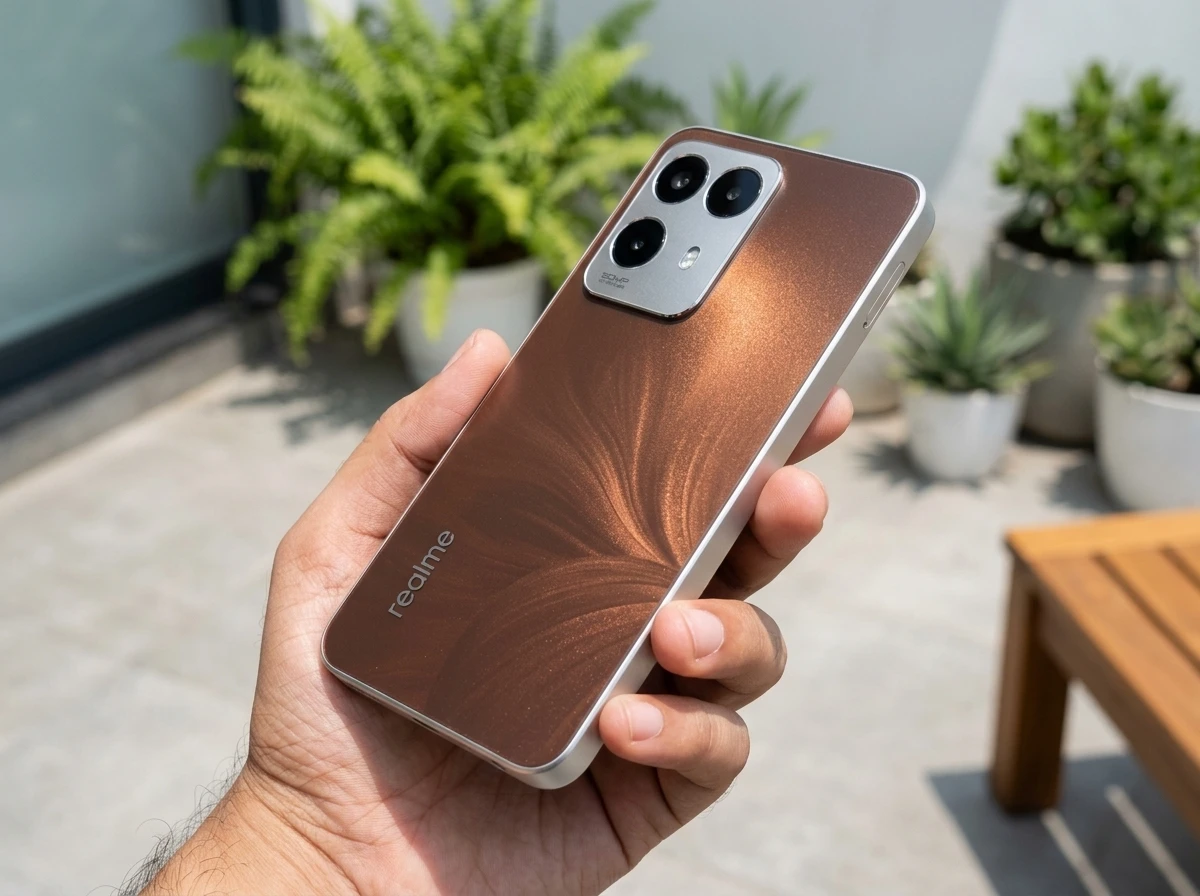
Three variants cover the range. Glory White and Endurance Brown are the only colors. The package includes a 45W charger, cable, case, and SIM tool.
| Variant | Price (Rs) | RAM + Storage |
|---|---|---|
| Base | 25,999 | 4GB + 128GB |
| Mid | 27,999 | 6GB + 128GB |
| Top | 30,999 | 6GB + 256GB |
Official exact dimensions weight and storage options list the handset at about 166.5 × 78.2 × 8.8 mm and 217 g. It uses LPDDR4X RAM, UFS 2.2 storage that expands via microSD, a side fingerprint sensor, and dual nano-SIM 5G. Dynamic RAM expansion reaches higher virtual totals on paper. Android 16 with realme UI 7.0 arrives day one.
The base 4GB configuration leans on that virtual RAM feature to stretch multitasking. The 6GB mid and top trims reduce the need for it in daily app switching. UFS 2.2 keeps sequential speeds modest next to newer storage standards, yet microSD support gives a low-cost path to more local media. At 217 g the phone feels dense in the hand, a direct result of the large cell rather than a metal frame.
Two colors keep the shelf simple. Endurance Brown ties the name to the battery story; Glory White plays the cleaner default. Either way the in-box 45W brick removes the usual hunt for a compatible charger on day one.
The Endurance Numbers Realme Is Selling Hard
The battery is the reason most people will look twice. Realme calls the typical capacity 7000mAh (rated 6820mAh) a Titan cell and pairs it with 45W wired charging, bypass charging, and 6.5W reverse wired charging.
- Lab gaming: up to 12.34 hours
- Online video: up to 20.4 hours
- Music: over 150 hours claimed in one table
- Health target: over 91% capacity after three years under lab cycles, with a six-year health benchmark
Early independent tests line up with the pitch. One review recorded nearly two full days of mixed use and 28 hours 57 minutes on a PCMark Work battery run down to 19%. A five-minute charge is said to deliver roughly 2.4 hours of Instagram time. The 5300 mm² AirFlow vapor chamber keeps the phone only mildly warm under load. These segment-leading 7000mAh Titan Battery claims sit at the center of every Realme slide.
| Use case | Result | Source |
|---|---|---|
| Gaming | Up to 12.34 hours | Realme lab |
| Online video | Up to 20.4 hours | Realme lab |
| Music playback | Over 150 hours | Realme lab |
| Mixed daily use | Nearly two full days | Independent review |
| PCMark Work run | 28 hours 57 minutes to 19% | Independent review |
Bypass charging lets the handset draw from the wall while gaming so the cell itself takes less heat and fewer shallow cycles. Reverse wired charging at 6.5W is modest, enough for earbuds or another phone in a pinch rather than a full handoff. The vapor chamber’s 5300 mm² footprint explains why sustained loads stay only mildly warm instead of throttling early.
The health targets matter as much as the raw hours. A lab claim of over 91% capacity after three years, plus a six-year health benchmark, tells buyers the cell is meant to outlast a typical upgrade cycle. That promise only holds if charging habits stay reasonable and software support does not force an earlier exit.
Where the Smooth Pitch Meets Soft Pixels
The 6.8-inch LCD runs at HD+ (1570 × 720), peaks at 1200 nits HBM, and advertises adaptive 144Hz with 180Hz touch sampling. Scrolling and light gaming feel fluid. Brightness holds up outdoors.
The resolution does not. Text, fine detail in video, and UI elements look softer than FHD+ rivals at the same price. Realme has used this exact trade before on other 16-series models: refresh rate over pixel density. Reviewers note the panel works for casual content yet never looks premium. The Dimensity 6300 (6nm, Mali-G57) is the same story. It handles daily apps, 10 Chrome tabs, and BGMI at default settings without drama. AnTuTu scores around 632,000 in one test. Heavy video editing or high-graphics games expose the two-year-old silicon. Thermal control is good; headroom is not.
Buyers get the runtime they want. They also get the clarity and multi-year performance ceiling they quietly surrender.
Adaptive 144Hz helps the large cell by dropping the rate on static screens and raising it when touch input spikes. The 180Hz touch sampling keeps taps feeling immediate even when the panel itself is not drawing every frame at peak. Outdoors, 1200 nits HBM keeps maps and messages readable, which matters more for commute use than for cinema-grade contrast.
The Dimensity 6300’s age shows in sustained creative work and high-graphics titles. Default BGMI settings and ordinary tab loads stay comfortable. Push into heavier editing or maxed game profiles and the two-year-old 6nm design runs out of spare throughput. The vapor chamber masks heat; it cannot invent extra cores or cache.
Durability Extras That Fit the Everyday Pitch
Realme added practical armor for Indian conditions.
- IP65 dust and water resistance
- MIL-STD-810H shock certification, lab drop claims to 1.8 m
- Rain Touch and glove touch support
- 400% volume boost on the speaker
- Pulse Light notification strip with multiple colors and modes
- Side-mounted fingerprint that doubles as the power key
The blooming rear texture shifts color with angle under a thin shimmer coating. It looks more distinctive than flat glass siblings. The 50MP main camera (f/1.8) plus 8MP front deliver usable daylight shots with AI Ultra Clarity and Eraser tools. Night and zoom stay average. Software brings two Android version upgrades and three years of security patches. Flux Engine tweaks claim snappier animations, yet bloatware (preloads such as games and shopping apps) still appears after setup. That short software window sits awkwardly beside a battery engineered for six-year health.
IP65 and the 1.8 m lab drop claim suit dusty roads, sudden rain, and pocket knocks better than fragile glass flagships. Rain Touch and glove support extend the same idea to wet monsoons and winter commute use. The 400% volume boost helps in traffic or small rooms without a separate Bluetooth speaker.
Camera duty stays honest. Daylight shots with the 50MP f/1.8 main and the AI tools are fine for chats and listings. Night scenes and zoom do not lead the band. The Pulse Light strip adds a small glanceable cue without lighting up a full always-on display that would tax the cell.
Mid-Range Battery Race Already Crowded
The 16x lands beside other endurance plays. The Moto G77 Power also carries 7000mAh (slower 30W charging). Redmi Note 17 variants push 8000mAh silicon-carbon cells. A recent Redmi 17 4G leak with 7500mAh cell shows the direction of travel even on 4G models. Realme answers with faster charging, the 144Hz panel, and the vapor chamber. Camera and display resolution trail some rivals that keep AMOLED or higher pixel counts.
India’s mid-range has also seen aggressive pricing moves. Recent Samsung mid-range price cuts in India keep pressure on every brand below Rs 30,000. Realme’s launch offers (Rs 2,000 flat or up to Rs 3,000 exchange, plus no-cost EMI) aim to win the first week of shelf traffic.
| Model | Battery highlight | Charging note |
|---|---|---|
| Realme 16x 5G | 7000mAh Titan cell | 45W wired, bypass, 6.5W reverse |
| Moto G77 Power | 7000mAh | 30W |
| Redmi Note 17 variants | 8000mAh silicon-carbon | Not the speed focus here |
| Redmi 17 4G (leak) | 7500mAh | Even 4G models chasing capacity |
Capacity alone no longer separates a mid-range phone. Charging speed, thermal hardware, and the panel’s refresh behavior decide how usable that capacity feels. Realme’s 45W brick and vapor chamber are the counters to rivals that simply fit a larger cell. Buyers comparing pure milliamp-hours will still see the Redmi figures first; buyers comparing time back to a usable charge may weigh the 16x differently.
Price cuts elsewhere below Rs 30,000 shrink the room for a soft open. The flat Rs 2,000 cut, exchange up to Rs 3,000, and no-cost EMI exist to clear that first-week hurdle before the broader field resets again.
Early Voices and the Buyer Split
Day-one conversation on X clusters around the battery number and EMI deals that sometimes bundle a free watch. Value-focused posts call it a solid everyday pick. A few users mocked AI-generated ads as wasteful for a device already pushing e-waste concerns. Review consensus is clearer: battery life is excellent for the money, the design stands out, and the display-plus-chip combo is the compromise you accept if you hate chargers more than soft pixels.
When it comes to battery life, the Realme 16x 5G blows its competition out of the water.
That line from a same-day Gadgets 360 hands-on captures the dominant reaction. The same pieces flag the underpowered SoC and low-resolution screen as the lasting limits.
The split is practical rather than tribal. Users who live on messaging, video streams, and light games see the cell as the feature that removes friction. Users who read fine text for work or push graphics settings notice the HD+ panel and Dimensity 6300 within a week. EMI bundles with a free watch tilt the first impression toward value; they do not change the hardware ceiling once the novelty fades.
The Battery Health Claim Outlasts Software Plans
Realme’s lab path points to over 91% capacity after three years and a six-year health benchmark. Software support stops earlier: two Android version upgrades and three years of security patches from the Android 16 base.
That gap shapes ownership math. A cell built to stay healthy for six years will still power a handset whose apps and security model may feel dated after the third year. Flux Engine can keep animations snappy inside the supported window. It cannot extend the OS upgrade count.
Bloatware after setup adds another friction point inside that short window. Preloaded games and shopping apps occupy storage and attention from day one. Buyers who strip them still face the hard stop on major platform versions.
- Cell health target: six-year benchmark, over 91% after three lab years
- OS upgrades: two major Android versions
- Security patches: three years
- Launch base: Android 16 with realme UI 7.0
Rivals in the same band now advertise three or four OS jumps. The 16x concedes that race while leaning harder on runtime and charge speed. Anyone keeping phones past the security window will feel the mismatch first; anyone who upgrades every two to three years may never hit it.
How Charging Habits Shape Daily Runtime
The 45W wired charger, bypass mode, and short top-up claims work together with the 7000mAh cell rather than against it. A five-minute plug-in for roughly 2.4 hours of Instagram time turns brief stops into usable buffer. One review saw about 37% in 30 minutes and a full charge near 98 minutes, so overnight top-ups are optional rather than mandatory.
Bypass charging matters during long gaming or navigation sessions. Power draws from the adapter while the cell avoids constant heat and micro-cycles. The 5300 mm² AirFlow vapor chamber backs that up by spreading what heat remains, which is why the phone stays only mildly warm under load in early checks.
Reverse wired charging at 6.5W is a utility extra, not a headline. It can rescue earbuds or a friend’s handset without a second brick. It will not refill another 7000mAh phone at a useful pace. Paired with IP65 and Rain Touch, the charging set still fits the same everyday brief: fewer dead-battery moments in wet or dusty conditions, and less anxiety when a socket is far away.
Dynamic RAM expansion and the modest AnTuTu result around 632,000 also play into charge habits. Lighter sustained CPU demand means the large cell drains slower in ordinary app use. Heavy creative work or high-graphics games reverse that advantage and expose both the silicon age and the faster drain that comes with it.
Frequently Asked Questions
What are the exact Realme 16x 5G prices and variants in India?
The 4GB+128GB model is Rs 25,999, the 6GB+128GB is Rs 27,999, and the 6GB+256GB is Rs 30,999. Launch offers can reduce the starting price by Rs 2,000 or via exchange up to Rs 3,000, with ten-month no-cost EMI available on some plans.
How long does the 7000mAh battery last and how fast does it charge?
Independent mixed-use tests reach nearly two days; a PCMark run hit almost 29 hours. Realme’s lab lists up to 12.3 hours of gaming and 20.4 hours of video. The 45W charger included in the box reaches roughly 37% in 30 minutes in one review and full charge in about 98 minutes.
How many Android upgrades does the Realme 16x 5G receive?
Realme promises two major Android OS upgrades and three years of security updates from the Android 16 launch base. That is shorter than several competitors now offering three or four OS jumps in the same price band.
Does the Realme 16x 5G have water and drop protection?
It carries an IP65 rating for dust and water resistance plus MIL-STD-810H military-standard shock certification. Realme also advertises Rain Touch for wet fingers and a lab drop height claim of 1.8 meters under controlled conditions.
The Realme 16x 5G will sell on pure battery math for the next few weeks. Whether that math still looks smart after the first software cycle ends is the quieter question buyers will answer with their wallets.
For now the handset draws a clean line. Take the 7000mAh Titan cell, 45W charging, 144Hz LCD, and practical IP65 armor if runtime leads your list. Look elsewhere if sharp text, heavier games, or a longer OS ladder matter more than another day away from the plug.

-
 TECH1 year ago
Where Garmin Watches are Made and How They are Assembled
-
 AUTO3 months ago
Tesla’s Roadster Is ‘a Few Weeks Away,’ Says Its Chief Designer
-
 NEWS10 years ago
Samsung Releases Galaxy Note7 TV Ad as Reddit AMA Leaks Specs
-
 NEWS10 years ago
Android 7.0 Nougat Rolls Out To Nexus Devices With New Emoji, Features
-
 FINANCE9 years ago
Cardano Price Surges as ADA Enters the Crypto Top Ten List
-
 NEWS10 years ago
Pre-Order the First Camera Made for Facebook Live Streaming Video
-
 FINANCE1 year ago
Binance Suspends Trading and Withdrawals for a System Upgrade
-
 FINANCE9 years ago
RChain Price Jumps Nearly 150% to a New All-Time High of $2.03