
NEWS
The People Who Can Restore Jensen Huang Are Not His Staff
Nvidia employees want Jensen Huang back, but Harvey Jones, Colette Kress, a live spy inquiry, and Congress now hold the company he left.

Nvidia staff stacked more than 1,600 comments onto an internal post asking the board to restore Jensen Huang. He had just quit as chief executive and left the board.
The directors who took that resignation are the only people who can reverse it. Colette Kress is running the company as interim chief and still as finance chief, Harvey C. Jones is the first chair Nvidia has ever named, and a national-security inquiry did not travel out the door with Huang.
More Than 1,600 Comments Ask Nvidia to Reverse Course
A longtime engineer filed the suggestion-box post before Huang’s exit and asked directors to weigh staff views before they acted. After the resignation, the thread filled with calls to put him back in the job, and most of the comments ran that way.
If you believe in the mission, bring back THE boss
Anonymous Nvidia employee, internal suggestion box
Another commenter wrote that people make mistakes, that Huang had done so many good things, and that he needed a second chance. A separate staffer sent a companywide note that opened “I stand by Jensen,” argued that fairness did not require standing apart from him, and closed with a line that if America failed the man who helped build its future, the world did not deserve him.
WHAT STAFF DID, AND DID NOT DO
- The suggestion box: More than 1,600 comments stacked onto one pre-resignation post, most of them asking the board to reinstall Huang.
- The public posts: About two dozen employees wrote LinkedIn notes in the hours after the announcement, and no staff posts backing the exit turned up in the same sweep.
- The companywide email: One employee demanded a clearer account of why Huang left while the board inquiry was still young.
- The missing piece: Nobody authenticated a mass threat to resign, and a letter modeled on OpenAI’s 2023 staff ultimatum has circulated without verified signatures.
Work inside the company kept moving through the week, even as people described the exit as a shock. One employee of a couple of years, speaking without permission to use their name, said the wish to bring Huang back felt widespread and put it in a single sentence: Nvidia is Nvidia because of Jensen.
That is loyalty with no leverage. Huang resigned as president and chief executive and as a director, effective immediately, and the company said it would look at insiders and outsiders for a permanent successor. It did not offer him a chair, a founder title, or an advisory seat.
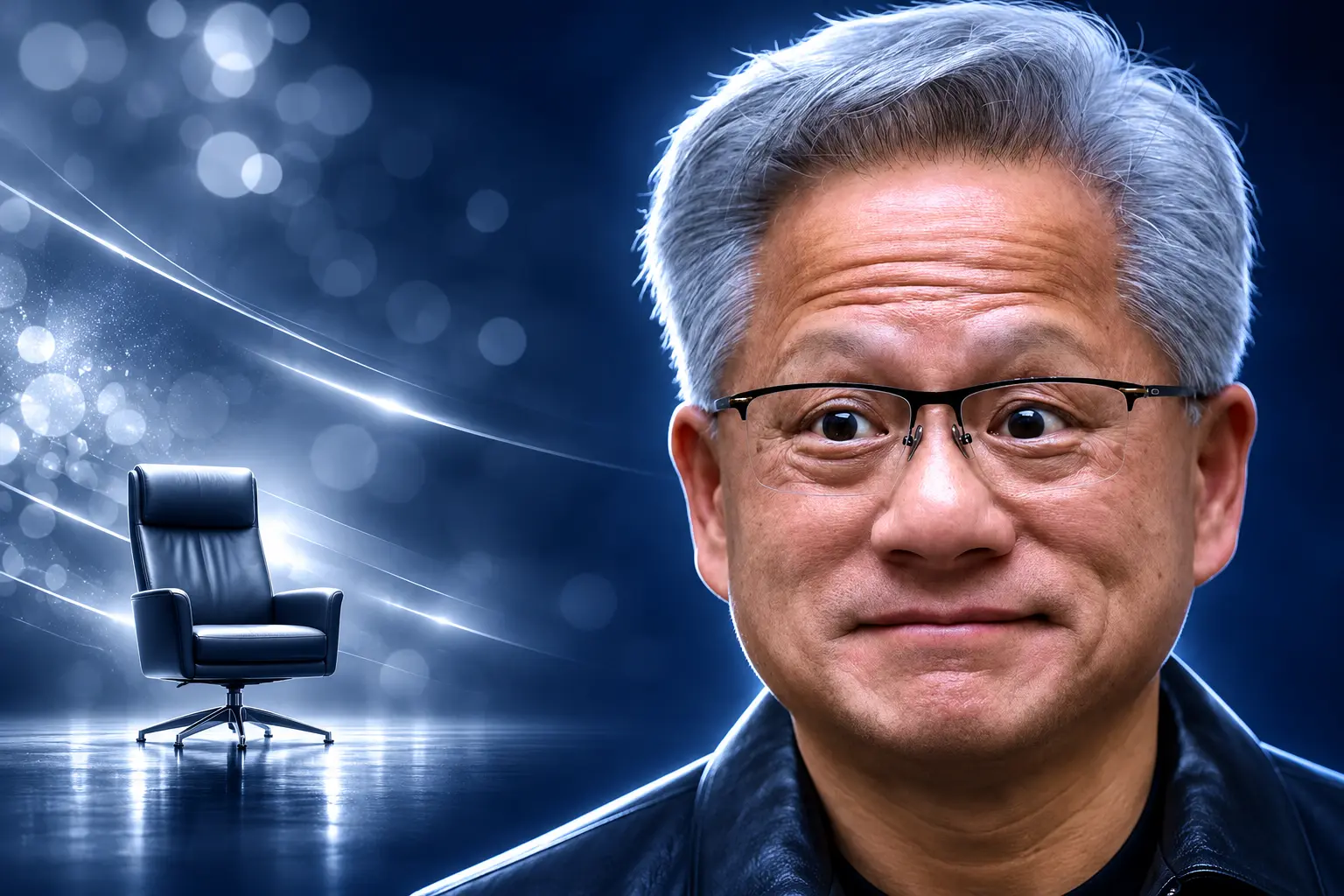
Harvey Jones Holds the First Chair Nvidia Ever Created
Jones has been on this board since 1993, the year the company was founded. The same filing that moved Huang out named the 73-year-old former Synopsys chief as chair, a job Nvidia had never created in 33 years of being a public company with Huang in the building.
In the staff note that followed, Jones said Huang’s contributions were profound, that Nvidia pioneered accelerated computing and defined the modern GPU, and that the board takes seriously its duty as stewards. He also said Kress had been a key architect of the company’s growth and capital strategy across more than 13 years as finance chief, and that the board has full confidence in her.
The Board has full confidence in Colette and the leadership team, and we expect the company’s operations, customer commitments and product roadmap to continue without interruption.
Harvey Jones, Chair of the NVIDIA Board of Directors, November 12, 2026 statement
Jones is managing partner of Square Wave Ventures and has spent more than 30 years as an entrepreneur, technology executive, and venture investor. Creating a chair now splits oversight from day-to-day management on paper. In practice it also names the person who will run a CEO search while a founder’s staff are still asking for the founder.
The company’s Form 8-K says the board accepted Huang’s resignation on November 11. The public statement went out on November 12. Huang is 63. He is no longer in the room where that search is designed.
One Share, One Vote Left Huang Without a Veto
Huang remains the largest individual holder of Nvidia stock, and that fact is doing a lot of work in the staff campaign. It does less work in a vote.
The 2026 proxy lists him as the beneficial owner of 870,604,104 shares as of March 23, 2026, or 3.58% of the common stock. Nvidia has a single class of shares. Stockholders have one vote for each share. There is no super-voting class that would let a founder outvote institutions, and he does not have majority control.
WHO HOLDS NVIDIA NOW
| Person | What they hold | What they do not hold |
|---|---|---|
| Jensen Huang | 3.58% beneficial stake as of March 23, 2026, still the largest individual holder | CEO title, board seat, super-voting shares |
| Colette Kress | Interim chief executive, still executive vice president and CFO | A permanent appointment |
| Harvey C. Jones | First chair of the board, director since 1993 | Day-to-day operations |
| Independent directors | Oversight of the Joon H. Kim inquiry, the CEO search, and the new chair structure | A finished national-security finding |
A large block of that 3.58% sits in trusts and LLCs that Huang shares with his wife, Lori Huang, including a living trust set up in 1995. Shared voting power is not the same thing as a board seat. The staff comments are addressed to directors. He is not one of them anymore.
The Spy Inquiry Did Not Close When He Resigned
On November 8 the board said it was starting an independent investigation of a foreign intelligence effort after reporting that Huang had been a target. A committee of independent directors would oversee it with outside counsel. The board said it had no reason to believe U.S. national security or Nvidia secrets were compromised, and that Huang fully supported the review.
That same day Huang wrote to staff that he owed his family and all of them an apology, that he had been unfaithful to his wife, that his actions hurt her and their children, and that there was no excuse. “I am deeply sorry,” he wrote. He also said he loved the country and the company and would cooperate.
The reporting at the center of the probe named Alice Huang, also known as Huang Le, a Chinese citizen and former executive at Singapore-based Megaspeed, a data-center firm that buys Nvidia chips. U.S. officials have described her as a Chinese intelligence asset. She is not related to Jensen Huang. Separate reporting has tied her to at least $7.5 billion in Nvidia chip shipments toward Chinese firms, and the FBI has been examining whether Huang was targeted.
Those conclusions are not uniform inside the government. Attorney General Todd Blanche said on November 12 that the Justice Department, he, and FBI Director Patel had reached no conclusions about who Alice Huang is or is not. Some officials who have briefed Congress still describe her as an asset. That fight now sits in hearing rooms, not in the suggestion box.
THE WEEK THE BOARD TOOK THE COMPANY
- November 8, 2026: The board opens an independent inquiry. Huang apologizes to staff for being unfaithful to his wife and pledges to cooperate.
- November 10, 2026: Independent directors retain former acting U.S. Attorney Joon H. Kim and Wachtell, Lipton, Rosen & Katz to run the investigation.
- November 11, 2026: The board accepts Huang’s resignation as president, chief executive, and director, names Kress interim CEO, and makes Jones chair.
- November 12, 2026: Nvidia announces the transition. Jones and Kress email staff. Further reporting describes relationships with Nvidia employees, including one who reported to Huang.
- November 17, 2026: Nvidia is due to report third-quarter fiscal 2027 results at about 1:20 p.m. PT, with the earnings call at 2 p.m. PT.
- November 18, 2026: Kress has called a company meeting at 9 a.m. PT to talk about the future together.
Kim’s retention on November 10 matters because it came two days before the resignation notice, not after it. The board did not say the inquiry ended when Huang left. Staffers who wanted the findings shared first, then a formal ask about whether Huang should stay, got the reverse order.
An Interim Chief Who Still Has to Close the Books
Kress is 59. She joined Nvidia in September 2013 after finance jobs at Cisco, Microsoft, and Texas Instruments, and Jones’s note called her a key architect of the capital strategy. She will keep the CFO title while she serves as interim chief, until a permanent successor is named.
In her first staff email she told NVIDIAns she believed deeply in the company and in them, and that the board, the executive staff, and she recognized “an extraordinarily difficult period.” She thanked them for resilience and said they would hear more in the coming days. Then she pointed to the November 18 meeting and asked them to move forward together.
On the record, she said Nvidia’s strength has always come from its people, and that she is committed to building on the foundation Huang created over the last 33 years. She is also the person who has sat beside him on earnings calls for years, which is why the board could put her in the chair without inventing a new public face in a week.
The dual job is the tell. Nvidia did not have a ready chief operating officer to slide over. It had a finance chief the board already trusted with investors, and it left the ledger in her hands so the next four days of earnings prep would not sit in a vacuum.
Nvidia Never Named a Deputy in 33 Years
Huang ran an unusually flat company. Dozens of executives reported straight to him, and people who watch the firm put that number as high as 60 direct reports. He wanted to keep working, and that preference ate the succession plan.
THE HOLE THE BOARD IS NOW FILLING
- No chair for 33 years: Jones is the first person to hold the title, named on the day the founder left.
- No standing deputy: The org chart ran wide to Huang instead of through a second-in-command who had seen the whole map.
- No advisory leftover: The transition statement thanks Huang and does not assign him a continuing role.
- A live search: Internal and external names are both in play, which is another way of saying the board has not already picked Kress as the lasting answer.
In August 2026, Nvidia’s newsroom had highlighted Huang as No. 1 on Glassdoor’s Best CEOs list for the year, a ranking built from employee reviews. That affection is the same current now running through the suggestion box. It is also why a board that had never needed a chair suddenly needed one: the culture still points at one man, and the legal structure no longer does.
A copied OpenAI letter does not change that math. In November 2023 almost all of OpenAI’s 770 employees threatened to leave unless the board quit and Sam Altman returned. Huang resigned. Nvidia’s staff have asked, emailed, and posted. They have not, on the public record, put their badges on the table.
Congress Still Wants Huang in the Hearing Room
Even a restored CEO would walk into oversight that did not exist in that form a month ago. Senate Banking Chair Tim Scott has asked Huang and Commerce Secretary Howard Lutnick to appear, and he has said he would consider a subpoena if Huang does not come voluntarily. Senate Democratic leader Chuck Schumer has said Huang and Nvidia must answer whether America’s security was jeopardized, and that the administration must account for what it did once it learned of the Alice Huang relationship.
Senator Elizabeth Warren put the sharper point on it the day the resignation became public: leaving the job does not wash the company of the questions.
Jensen Huang’s decision to resign from NVIDIA does not absolve him, other executives, or the company as a whole of responsibility for putting our national security at risk or for any potential violations of our laws.
They still owe Congress answers.
— Elizabeth Warren (@SenWarren) November 12, 2026
That is the lock the suggestion box cannot pick. A board that just created its first chair, hired a former Southern District prosecutor, and put the finance chief in the corner office is not choosing between sentiment and a clean personal file. It is choosing whether the most important chip company in the AI buildout can send a founder who just left under a spy inquiry back into rooms where senators are already asking for a subpoena.
Jones and Kress have a staff meeting on November 18. Huang will not be in the chair. The people who can change that are the directors who announced he was gone.

ADNOC Ship Hit in Hormuz Leaves One Crew Missing

SpiceJet’s Rs 5,500 Crore Plan Follows a Rescue That Failed

Hasina’s Return Fight Sets Fire to Yunus’s Bank

Bancroft Recants the 2018 Inquiry and Names the Team

Adhikari Ties the Saffron Saree Row to School Licences

Clancy Juror Says the Holdout Never Cited Evidence

The iPhone 18 Pro Max Splits Apple’s Fall in Two

OpenAI Calls GPT-6 Astra AGI Then Locks Its Exploits

Trump Claims Hormuz Control as Oil Holds Near $96

Russia Closes the Goethe-Institut Berlin Tried to Save

 NEWS2 months ago
Clancy Juror Says the Holdout Never Cited Evidence
- NEWS3 months ago
The iPhone 18 Pro Max Splits Apple’s Fall in Two
- NEWS3 months ago
OpenAI Calls GPT-6 Astra AGI Then Locks Its Exploits
- BUSINESS3 months ago
Trump Claims Hormuz Control as Oil Holds Near $96
- LIFESTYLE3 months ago
Russia Closes the Goethe-Institut Berlin Tried to Save
- AUTO3 months ago
Volkswagen’s Job Cuts Leave Four Plants Without Cars
- NEWS3 months ago
Dyson Puts Nurovi Robots on Sale Without the UV Flagship
- BUSINESS2 months ago
US Destroys Five Iranian Tankers as the Shock Hits Jordan










