
BUSINESS
Bank, Auto and Realty Slip as Inflation Hits 6.09%
Nifty Auto, Bank and Realty fell about 1 percent after October CPI printed 6.09 percent, above the RBI’s 6 percent ceiling and its own quarter call.

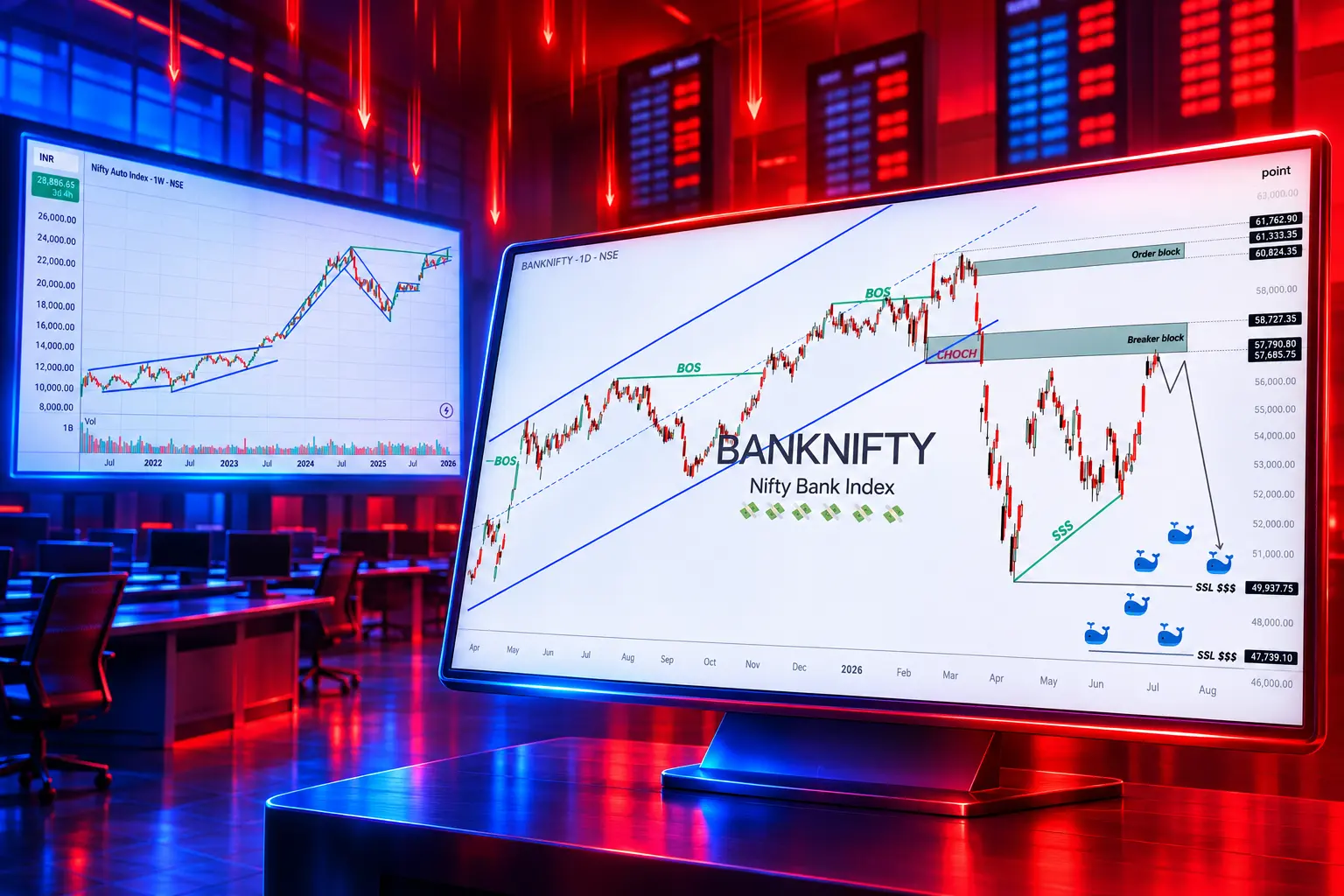
Nifty Auto fell 1.17 percent in early trade on Friday, November 13, after October retail inflation printed at 6.09 percent and broke the Reserve Bank of India’s 6 percent ceiling. Nifty Bank dropped 0.91 percent and Nifty Realty 0.81 percent in the same 9:35 AM IST snapshot, a familiar punch to the three most rate-sensitive corners of the NSE.
Those losses arrived one session after the same groups had been among November’s strongest trades. Nifty Bank closed Thursday at 61,518.50, about 250 points shy of its 52-week high of 61,764.85, and Nifty Realty had gained 14.79 percent in the month through November 12.
Auto, Bank and Realty Slip After a November Surge
Twelve of Nifty Auto’s 15 stocks were lower at 9:35 AM, with Ashok Leyland, Mahindra & Mahindra and Maruti Suzuki down between 1 and 2 percent. Thirteen of Nifty Bank’s 14 members traded red. IndusInd Bank, HDFC Bank, AU Small Finance Bank, Canara Bank and Axis Bank each fell more than 1 percent. Punjab National Bank was the only bank index stock in the green. Nifty Financial Services was down 1 percent beside them.
FRIDAY MORNING ON THE NSE
- Nifty Auto: Down 1.17 percent at 9:35 AM IST, with 12 of 15 members lower.
- Nifty Bank: Down 0.91 percent, with 13 of 14 members lower and PNB the exception.
- Nifty Realty: Down 0.81 percent at the same stamp, after a 4.51 percent jump on Thursday.
- Nifty Financial Services: Down 1 percent in the same window.
The selling held into the afternoon. Near 12:25 IST the Nifty 50 was at 25,107, down 0.76 percent, Nifty Bank was at 60,971.15, down 0.89 percent, and Nifty Realty had widened to a 1.09 percent decline at 924.05. The Sensex was at 81,460.14, down 0.55 percent. India VIX, the NSE’s near-term fear gauge, fell 2.76 percent to 16.16 even as 13 of 14 Bank names stayed red, which is the signature of an orderly book rather than a scramble for protection.
Thursday’s close is the other half of the tape. The Nifty 50 had finished at 25,299.35, up 0.18 percent, and the Sensex at 81,911.01. Nifty Bank had added 726.10 points, or 1.19 percent, to 61,518.50. Auto had already been the odd one out on Thursday, down 1.02 percent, so Friday’s auto drop was a second session of selling, not a sudden reversal.
Onion at 116% Pushed the CPI Through 6%
The Ministry of Statistics and Programme Implementation, in its October consumer price index of 6.09 percent, put combined inflation 0.55 percentage points above September’s final 5.54 percent. It is the first time in two years that the print has sat above the RBI’s 2 to 6 percent tolerance band, and the highest reading since the 2024=100 CPI series began. Rural inflation was 6.63 percent, urban 5.41 percent.
Food did the heavy lifting. The Consumer Food Price Index rose to 8.94 percent from 7.74 percent. Rural food inflation was 9.09 percent and urban food 8.68 percent. Food and beverages, 36.75 percent of the combined basket, inflated 8.51 percent. That group alone added about 3.13 percentage points to the headline.
OCTOBER CPI AGAINST SEPTEMBER
| Measure | September 2026 | October 2026 |
|---|---|---|
| Combined CPI | 5.54% | 6.09% |
| Food (CFPI) | 7.74% | 8.94% |
| Rural CPI | 6.08% | 6.63% |
| Urban CPI | 4.88% | 5.41% |
| Onion, year on year | 108.13% | 116.22% |
Onion recorded the highest item-level inflation at 116.22 percent, up from 108.13 percent, on a basket weight of 0.7006. Garlic followed at 60.74 percent. Lemon rose to 47.30 percent. Ginger eased to 48.32 percent from 62.85 percent, and silver jewellery cooled to 52.39 percent from 87.82 percent, so the spike was not uniform even inside the hot list. Potato prices were still falling, down 14.24 percent, and cauliflower was down 10.57 percent.
Price pressure also showed up off the farm. Restaurants and accommodation services inflated 10.06 percent. Personal care, social protection and miscellaneous goods and services inflated 10.14 percent. Transport was at 5.84 percent. Housing, water, electricity, gas and other fuels, the group that includes rents, was only 2.90 percent, which is why a 1 percent hit in listed developers is a financing story, not a CPI-housing story.
Field staff collected prices from 1,407 urban markets and 1,465 villages. The response rate was 100 percent in both. The combined index rose to 110.05 from 109.49.
Consumer Price Index and Corresponding Inflation for October, 2026 are 110.05 and 6.09% respectively.
Press Release link of CPI for the month of October, 2026: https://t.co/T9f4MetONg
#KnowYourStats #DataForDevelopment #CPI #retailinflation@Rao_InderjitS @_saurabhgarg…
— Ministry of Statistics & Programme Implementation (@GoIStats) November 12, 2026
The RBI Already Started Tightening on October 7
Friday’s tape treated a rate hike as news. The Monetary Policy Committee had already raised the repo rate to 5.50 percent on October 7, a 25-basis-point move from 5.25 percent, and switched its stance to calibrated tightening. It was the first increase since February 2023. The standing deposit facility sits at 5.25 percent. The marginal standing facility and the Bank Rate sit at 5.75 percent.
That hike reversed the last of four cuts in 2025, which had taken the repo rate from 6.50 percent to 5.25 percent, a 125-basis-point easing, before four holds in 2026. The six-member panel under Governor Sanjay Malhotra voted unanimously for the October increase. Dr. Nagesh Kumar and Prof. Ram Singh wanted to keep the stance at neutral and lost 4-2 on that point.
THE REPO PATH BACK TO 5.50 PERCENT
- February 7, 2025: Cuts the repo rate by 25 basis points to 6.25 percent.
- April 9, 2025: Cuts another 25 basis points to 6.00 percent.
- June 6, 2025: Cuts 50 basis points to 5.50 percent.
- December 5, 2025: Cuts 25 basis points to 5.25 percent and then holds for four meetings.
- October 7, 2026: Hikes 25 basis points to 5.50 percent and shifts the stance to calibrated tightening.
- December 4, 2026: Next policy decision, after the meeting on December 2 to 4.
The October resolution had already put third-quarter inflation at 6.0 percent and full-year inflation at 5.2 percent, with the fourth quarter at 5.7 percent and the first quarter of 2027-28 at 5.6 percent. Core inflation for 2026-27 was projected at 4.4 percent. Real GDP for the year was raised to 7.1 percent from 6.7 percent, after a 7.8 percent first-quarter print. October’s 6.09 percent headline is the first month of that third quarter, and it is already above the 6.0 percent quarter call.
It only signals that given the current conditions, rate cuts are off the table in the near term and policy action ahead can only be a rate hike or a pause, depending on the evolving conditions and the outlook.
Reserve Bank of India, Monetary Policy Statement, October 7, 2026
The same statement said food price increases had become more broad based, with notable spikes in sugar and onion, and that a deficient south-west monsoon and El Niño conditions were a risk to agriculture. Recalibrating the policy rate, it said, was imperative once headline inflation was expected to average almost 5.8 percent over the next three quarters.
November’s Winners Were the Same Three Groups
Nifty Bank’s one-month return through the Thursday close was 12.02 percent, and the one-week return was 6.48 percent. The 52-week low on that index is 49,954.85, so the November run sat far from distress. NSE figures through November 12 put Nifty Realty up 14.79 percent in the month, Nifty Financial Services up 13.54 percent, Nifty PSU Bank up 13.01 percent and Nifty Auto up 11.05 percent. Nifty NBFC led the month at 16.97 percent.
On October 7 itself, bank stocks recovered after the hike while Auto and Realty stayed weak, which is the split a tightening cycle usually prints. Banks can take a higher policy rate as a net-interest-margin story. Car loans and housing loans take it as a demand story. Friday was different because all three sold together, which is what you get when the last CPI before a meeting overshoots the central bank’s own quarter number.
Garima Kapoor, deputy head of research and economist at Elara Capital, said inflation is unlikely to cool at once even with crude softer, because earlier cost increases are still passing through. “We expect RBI to hike rates by another 50 bps over next 6 to 9 months,” she said. That path would take the repo rate to 6.00 percent if the next 50 basis points arrive in full.
What Another 25 Bps Does to a Home Loan
A further 25-basis-point move on December 4 would take the repo rate to 5.75 percent. Retail floating-rate loans, including home and auto loans, are tied to external benchmarks, so the October increase is already in the rate cards. From October 15, SBI lifted its external benchmark by 25 basis points, taking EBLR to 8.15 percent plus each loan’s credit and strategy premia, and regular home-loan rates to a 7.50 to 8.80 percent range.
HOW THE OCTOBER HIKE REACHED BORROWERS
- Pass-through lag: Bank of India moved its repo-linked rate on October 7, Bank of Baroda and Punjab National Bank on October 8, Canara Bank on October 9, and SBI on October 15.
- Rupee cost: On a ₹10 lakh loan with 20 years left, priced at repo plus 2.65 points, the 25-basis-point hike adds about ₹156 to the monthly EMI if the bank raises the instalment rather than the tenure.
- Still below 2025: The four 2025 cuts had taken about ₹792 off that same EMI; after October the borrower is still about ₹636 a month lighter, per ₹10 lakh, than in January 2025.
The second wait is the loan’s own reset date, which under RBI rules comes at least once every three months. Union Bank of India resets on the first day of the next calendar quarter, so the October 7 hike reaches those books on January 1, 2027. ICICI Bank resets every three months from the month of first disbursement, which means two borrowers at the same bank can pick up the same RBI move weeks apart. A December hike would travel on the same rails, with the same lags, into housing and vehicle books just as dealers head into the winter selling stretch.
Economists Still Disagree on the Terminal Rate
Aditi Nayar, chief economist at ICRA, said a further 25-basis-point increase in December appears almost certain. ICRA expects CPI to average about 6.2 percent in the October-December quarter, a touch above the MPC’s 6.0 percent, before easing as the adverse base fades, with crude the swing factor for any 2027 tightening. SBI Research on November 13 cut its December call to 25 basis points from 50, put the terminal repo rate around 6 percent with a 50 percent chance of 5.75 percent, and said it does not see a February hike as advisable so close to the Union Budget. It expects inflation to peak at 6.3 percent in November before moderating.
HOW FAR THE HIKE CYCLE RUNS
- December only: SBI Research wants 25 basis points on December 4 and then a pause into the Budget; ICRA also treats 25 basis points in December as the base case.
- Through winter: YES Bank’s Ecologue keeps 25 basis points in December and another 25 in February, for a 6 percent terminal rate. Elara’s Kapoor wants 50 basis points over six to nine months.
- Into spring: Radhika Piplani, chief economist at Motilal Oswal Financial Services, expects 75 basis points more in this cycle, taking the repo rate to 6.25 percent, including a December move she says the market has largely priced. Madhavankutty G, chief economist at Canara Bank, has a 100-basis-point cycle of which 25 is done, 25 is due in December, and the rest spills into the next fiscal year.
Tanay Dalal, who leads business economic research at Axis Bank, expects inflation to stay above 6 percent until June 2027, which in his view raises the risk that policy rates go through a 6 percent neutral estimate. Radhika Rao, senior economist at DBS Bank, said the October print reinforces a second successive hike in December and that inflation has not peaked. The common floor under those notes is December 4. The fight is over whether 5.75 percent is the stop or the first step of a longer climb.
The December meeting will not have November CPI in the pack. MoSPI will publish that reading on December 14, a Monday, 10 days after the policy decision. The 6.09 percent October print, the 8.94 percent food print, and the already-tightened 5.50 percent repo rate are the hard inputs the panel will actually carry into the room. Crude has cooled in recent sessions, which is the relief the rate-sensitive indices were trading in November. Onion at 116.22 percent is the item that pulled the ceiling down on that trade.
Disclaimer: This article is news reporting and analysis of market moves, inflation data and stated policy views. It is informational only and is not investment advice, a recommendation to buy or sell any security, or guidance on home loans, auto loans or deposits. Readers who are considering changes to a loan, a deposit or a portfolio should consult a SEBI-registered investment adviser or their own bank before acting. Figures and trading levels reflect the official releases and market stamps cited above and can change at the next print, the next session and the December 4 policy decision.

ADNOC Ship Hit in Hormuz Leaves One Crew Missing

SpiceJet’s Rs 5,500 Crore Plan Follows a Rescue That Failed

Hasina’s Return Fight Sets Fire to Yunus’s Bank

Bancroft Recants the 2018 Inquiry and Names the Team

Adhikari Ties the Saffron Saree Row to School Licences

Clancy Juror Says the Holdout Never Cited Evidence

The iPhone 18 Pro Max Splits Apple’s Fall in Two

OpenAI Calls GPT-6 Astra AGI Then Locks Its Exploits

Trump Claims Hormuz Control as Oil Holds Near $96

Russia Closes the Goethe-Institut Berlin Tried to Save

 NEWS2 months ago
Clancy Juror Says the Holdout Never Cited Evidence
- NEWS3 months ago
The iPhone 18 Pro Max Splits Apple’s Fall in Two
- NEWS3 months ago
OpenAI Calls GPT-6 Astra AGI Then Locks Its Exploits
- BUSINESS3 months ago
Trump Claims Hormuz Control as Oil Holds Near $96
- LIFESTYLE3 months ago
Russia Closes the Goethe-Institut Berlin Tried to Save
- AUTO3 months ago
Volkswagen’s Job Cuts Leave Four Plants Without Cars
- NEWS3 months ago
Dyson Puts Nurovi Robots on Sale Without the UV Flagship
- BUSINESS2 months ago
US Destroys Five Iranian Tankers as the Shock Hits Jordan










