
BUSINESS
MRF Grows Second-Quarter Sales and Loses 26.6% of Profit
MRF’s Q2 profit fell 26.6% even as sales rose 17.4%, after materials hit 75.7% of revenue with rubber at ₹300 a kg.

MRF’s Q2 results show group net profit down 26.6% to ₹386.99 crore, even as sales rose 17.4%. Revenue from operations was ₹8,660.19 crore in the quarter ended 30 September 2026, against ₹7,378.72 crore a year earlier.
The Chennai tyre maker told exchanges it capitalised on demand from vehicle makers and the replacement market. The same offtake helped send domestic rubber to ₹300 a kilogram, and materials then took 75.7 paise of every sales rupee.
Why MRF Profit Fell in the September Quarter
Group profit after tax was ₹386.99 crore, against ₹527.43 crore in the year-ago quarter. Profit before tax fell 25.5% to ₹521.81 crore from ₹700.45 crore, after a tax charge of ₹134.82 crore. Earnings per share from continuing operations were ₹912.46, against ₹1,243.60.
The cost of materials consumed in the quarter rose to ₹6,552.57 crore from ₹4,577.49 crore, a 43% jump. That bill was 75.7% of revenue from operations, against 62.0% a year earlier, a rise of 13.7 percentage points. Total expenses were ₹8,269.77 crore, against ₹6,788.55 crore.
Derived EBITDA, built from profit before tax minus other income plus finance cost and depreciation, was ₹957.53 crore, down 14.9% from ₹1,125.51 crore. The margin was 11.1%, against 15.2%, a gap of 4.1 percentage points. Other income was ₹131.39 crore. Total income, which adds that line, was ₹8,791.58 crore against ₹7,489.00 crore.
THE SEPTEMBER QUARTER P&L
| Line | Q2 FY27 | Q2 FY26 | Change |
|---|---|---|---|
| Revenue from operations (₹ crore) | 8,660.19 | 7,378.72 | +17.4% |
| Cost of materials consumed (₹ crore) | 6,552.57 | 4,577.49 | +43% |
| Materials as share of revenue | 75.7% | 62.0% | +13.7 pp |
| EBITDA (₹ crore) | 957.53 | 1,125.51 | -14.9% |
| EBITDA margin | 11.1% | 15.2% | -4.1 pp |
| Profit after tax (₹ crore) | 386.99 | 527.43 | -26.6% |
On a standalone basis, net profit was ₹369.15 crore, down 27.8% from ₹511.59 crore, on revenue from operations of ₹8,523.96 crore against ₹7,249.68 crore. For the six months, group revenue from operations rose 13.4% to ₹17,075.69 crore from ₹15,054.36 crore, while net profit fell 14.3% to ₹882.34 crore from ₹1,029.25 crore. The first quarter had still delivered ₹495.35 crore of group profit, so the squeeze deepened as the year went on.
The steep increase in prices of raw materials due to global uncertainties adversely affected profitability during the quarter. Price increase and cost saving measures by the Company helped to mitigate cost pressures.
MRF Limited, exchange press release, 10 November 2026
That is the full extent of the pass-through the company is willing to describe. It did not put a number on the hikes. It did claim strong double digit sales growth from both original-equipment and replacement demand, in the same note that showed conversion getting worse.
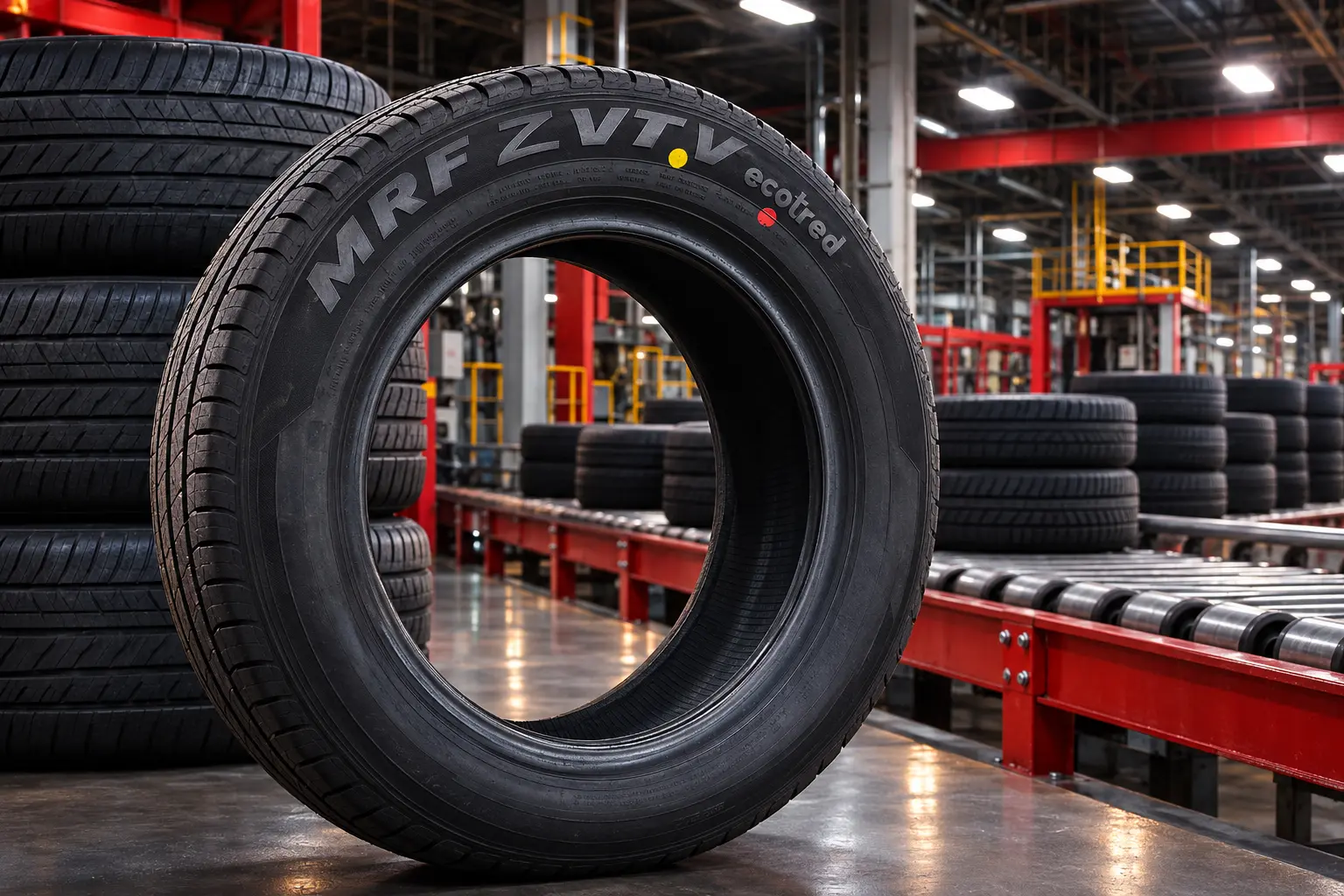
Rubber at ₹300 a Kilogram
Natural rubber is about half the cost of making a tyre, with carbon black, synthetic rubber, steel cord, silica and chemicals filling the rest. The Rubber Board’s domestic RSS4 reference price of ₹300 a kg on 2 November 2026 matches a 62% rise from ₹185 a kilogram in November 2025, per CMIE and Board data. The same Board print put Bangkok RSS4 at ₹266.69 a kilogram, so the Indian sheet was trading at a premium.
Tyre plants kept buying through that move. Unfavourable weather in Kerala and in South-East Asian growing belts tightened sheet supply, while the West Asia war lifted crude-linked inputs and freight. Benchmark Brent for the January contract has been near 105 dollars a barrel, against 65 to 70 dollars when that conflict began, which raises the cost of synthetic rubber and pushes more offtake onto the natural grade.
Jose Kutty Antony, a rubber farmer who runs Thulumpanmakel Rubber Nursery in Kottayam, said rising temperatures and shifting weather have become a major challenge for cultivation, and he put the possible drop in output in a 30% to 36% range. That is one grower’s reading, not a Board census, but it is the supply story buyers have been paying for.
THE RUBBER AND RESULTS CALENDAR
- November 2025: Domestic RSS4 averages ₹185 a kilogram, the base for the later 62% rise.
- 23 October 2026: JK Tyre reports September-quarter results, with management citing a 30% raw-material rise over six months.
- 2 November 2026: The Rubber Board prints RSS4 at ₹300 a kilogram in the domestic market.
- 4 November 2026: Apollo Tyres reports a 13.5% rise in group net profit.
- 10 November 2026: MRF’s board, meeting from 11.00 a.m. in Chennai, clears the September-quarter accounts and a ₹3 interim dividend.
Vinod Kumar, president of the India SME Forum, said the sharpest squeeze is on small makers of hoses, belts, footwear soles and auto parts who had locked a fixed price before rubber moved. Those firms are renegotiating contracts and watching how much stock they hold. The large tyre names at least have list prices they can try to raise.
Apollo Added Profit While JK’s Collapsed
The rubber print hit every large Indian tyre company. It did not hit their profit lines the same way. Apollo Tyres’ group net profit rose 13.5% to about ₹293 crore from ₹258 crore, on revenue from operations of ₹7,968 crore, up 16.6%. That profit includes an estimated pre-tax restructuring cost of ₹26 crore booked as an exceptional item, so the rise came after a charge, not before one.
Apollo said its raw-material basket was about 25% costlier year on year, with crude-linked derivatives up 28% to 35% and steel cord up in the low double digits. Its India EBITDA margin still fell to 11.1% from 15.3%, the same 11.1% MRF printed at group level. Chairman Onkar Kanwar pointed to rural expansion and new commercial-vehicle products in India, and to West Asia as a headwind on inputs and supply chains.
JK Tyre & Industries went the other way. Revenue rose 20% to ₹4,850 crore, which the company called a record quarter, while profit after tax fell 73% to ₹60 crore and EBITDA fell 36% to ₹343 crore. The EBITDA margin was 7.1%, against 13.4% a year earlier. CEAT’s EBITDA slipped 11% to ₹452 crore and profit fell 40% to ₹112 crore.
HOW THE LARGE TYRE MAKERS FARED
| Company | Q2 revenue (₹ crore) | Revenue change | Q2 PAT (₹ crore) | PAT change | EBITDA margin |
|---|---|---|---|---|---|
| MRF | 8,660.19 | +17.4% | 386.99 | -26.6% | 11.1% |
| Apollo Tyres | 7,968 | +16.6% | 293 | +13.5% | 10.8% |
| JK Tyre | 4,850 | +20% | 60 | -73% | 7.1% |
| CEAT | – | – | 112 | -40% | EBITDA ₹452 cr, -11% |
Volume did not decide the ranking. JK grew sales faster than MRF and lost far more of its profit. Apollo grew sales at a similar pace to MRF and still added profit. Mix, export exposure and how fast each name raised prices mattered more than the headline offtake MRF chose to lead with.
Inventories Swelled as Operating Cash Fell
The profit that remains has an inventory assist. The group booked a ₹718.86 crore credit for changes in inventories of finished goods, stock-in-trade and work-in-progress, which lowers the cost line when stock is building. A year earlier that line was a ₹67.54 crore debit. Plants kept running hard enough to put more product into warehouses while rubber was at the top of the range.
THE CASH AND STOCKPILE SHIFT
- Inventory credit: Finished goods, stock-in-trade and work-in-progress reduced the group cost line by ₹718.86 crore in the quarter.
- Stock on the balance sheet: Group inventories were ₹7,163.15 crore on 30 September 2026, against ₹5,416.82 crore on 31 March 2026; standalone inventories were ₹7,083.63 crore against ₹5,337.66 crore.
- Operating cash: Group cash from operations in the first half was ₹634.16 crore, against ₹1,869.48 crore a year earlier.
- Capex: Standalone capital expenditure in the first half was ₹1,001.60 crore, against ₹618.42 crore.
Cash conversion broke while the company was still spending more on plant. Group assets were ₹34,912.31 crore on 30 September 2026, against ₹31,953.51 crore on 31 March 2026, with equity at ₹21,774.07 crore against ₹20,974.75 crore. The extra stock will have to be sold in later months at whatever selling prices the replacement market and the OE contracts will bear.
A ₹3 Cheque on India’s Priciest Stock
The board declared an interim dividend of ₹3 per equity share of ₹10 face value, a 30% payout on par, for the year ending 31 March 2027. The record date is Tuesday, 17 November 2026, with payment on or after 1 December 2026. Paid-up equity is ₹4.24 crore, so the cheque is small next to a ₹386.99 crore quarterly profit.
The stock last closed at ₹1,25,105 on the NSE on 9 November 2026, with a market value of about ₹53,044 crore. It was down 18.15% in the calendar year and up 7.00% over five sessions into the print. A ₹3 interim on that price is a rounding error, which is why the conversion debate, not the dividend, is the live question around the name.
MRF said it anticipates continued disruptions and volatility in commodity markets, with raw material and logistics costs expected to remain elevated, and that it will take measured steps to address those challenges. Measured, after a 4.1 percentage-point margin drop and a first-half cash-from-operations collapse, is a promise to keep nudging prices rather than to freeze volume.
The Next Hike Lands on Replacement Buyers First
Peers have already been more specific than MRF about how far list prices have moved, and how far they still have to go. JK Tyre managing director Anshuman Singhania said the company raised prices about 4% to 5% in the first quarter and 7% sequentially in the second, or 11% to 12% over six months, and that it intends to take another 4% to 5% in the December quarter. Input costs, he said, rose 9% sequentially in the September quarter, with another 4% to 5% in the full raw-material basket still to come.
Sanjeev Aggarwal, JK Tyre’s chief financial officer, said raw-material costs were up 30% over six months because of inflation and supply-chain constraints from the West Asia crisis, and that demand has been strong across segments after GST 2.0. He also said the firm is leaning on premium products and operating efficiencies. CEAT, which produced 4.5 crore tyres in FY26, has the same unfinished pass-through.
Tyre prices have been increased by us progressively in the last six to seven months, but they have not fully compensated the raw material cost increases, and hence our margins have come down. There is still a plan to take our prices further.
Kumar Subbiah, Chief Financial Officer, CEAT
PRICE MOVES ALREADY ON THE TABLE
- JK Tyre: About 4% to 5% in the first quarter, 7% in the second, 11% to 12% over six months, with another 4% to 5% planned in the December quarter.
- CEAT: Progressive hikes over six to seven months that the CFO says have not fully covered the cost surge, with more rises planned.
- MRF: Price increases and cost saves that the company says only helped to mitigate, with no size disclosed in the 10 November note.
Ashim Sharma, senior partner and business unit head at Nomura Research Institute Consulting and Solutions India, said tyre price increases generally begin to be felt in the replacement market, and that vehicles for the festive season would have largely been dispatched, so festive sticker prices for new cars are unlikely to rise on this round. That splits the pain. Fleets and retail buyers who need new rubber now pay first. OE contracts move later, and they move slower, which is one reason a company that just posted 17.4% sales growth can still lose 26.6% of its profit.
MRF ran the plants, filled the yards and took the OE and replacement orders. Rubber growers collected ₹300 a kilogram. Apollo showed that profit can still rise in this tape. JK showed how ugly the other end looks. The Chennai board’s next measured step has to close more of a 43% materials jump than the last one did, or the extra stock becomes a second bill.
Frequently Asked Questions
How Many Shares Does MRF Have Outstanding?
Paid-up equity capital is ₹4.24 crore at a face value of ₹10, which works out to about 42.4 lakh shares. That thin float is why a single share closed at ₹1,25,105 on 9 November 2026, and why a ₹3 interim against that capital base costs the company only about ₹1.27 crore in cash.
What Does RSS4 Mean in Rubber Pricing?
RSS4 is ribbed smoked sheet grade 4, the sheet-rubber grade the Rubber Board quotes as its domestic benchmark in Kottayam and Kochi. Board prints are reference prices and exclude 5% GST plus transport and warehousing, so the landed cost at a tyre plant sits above the posted kilogram rate.
How Much of India’s Rubber Use Is Imported?
The Rubber Board of India puts annual consumption of natural and synthetic rubber at 2.28 million tonnes, of which 35.5%, or 809,000 tonnes, is imported. That import share is why Bangkok quotes, freight and duty still set a floor under Indian sheet even when Kottayam trades at a premium.
How Is India’s Tyre Demand Split Between Replacement, OE and Exports?
A Crisil Ratings note from August 2026 put FY26 industry volumes at 214.6 million units, with replacement about 50%, tyres fitted on new vehicles 25%, and exports 25%. That mix is why a list-price rise shows up first in the aftermarket and only later in contracts with vehicle makers.
Disclaimer: This article is news reporting and analysis of MRF Limited’s unaudited September-quarter results and of related rubber and peer figures. It is informational only and does not constitute investment, trading or tax advice, a recommendation to buy, sell or hold MRF or any other tyre stock, or advice on dividend decisions. Readers should consult a SEBI-registered investment adviser or a qualified financial planner before acting on any security, and should read the company’s exchange filings and their own risk limits. Figures and statuses match the filings and market prints cited here and can change in later sessions, restatements and quarters.

ADNOC Ship Hit in Hormuz Leaves One Crew Missing

SpiceJet’s Rs 5,500 Crore Plan Follows a Rescue That Failed

Hasina’s Return Fight Sets Fire to Yunus’s Bank

Bancroft Recants the 2018 Inquiry and Names the Team

Adhikari Ties the Saffron Saree Row to School Licences

Clancy Juror Says the Holdout Never Cited Evidence

The iPhone 18 Pro Max Splits Apple’s Fall in Two

OpenAI Calls GPT-6 Astra AGI Then Locks Its Exploits

Trump Claims Hormuz Control as Oil Holds Near $96

Russia Closes the Goethe-Institut Berlin Tried to Save

 NEWS2 months ago
Clancy Juror Says the Holdout Never Cited Evidence
- NEWS3 months ago
The iPhone 18 Pro Max Splits Apple’s Fall in Two
- NEWS3 months ago
OpenAI Calls GPT-6 Astra AGI Then Locks Its Exploits
- BUSINESS3 months ago
Trump Claims Hormuz Control as Oil Holds Near $96
- LIFESTYLE3 months ago
Russia Closes the Goethe-Institut Berlin Tried to Save
- AUTO3 months ago
Volkswagen’s Job Cuts Leave Four Plants Without Cars
- NEWS3 months ago
Dyson Puts Nurovi Robots on Sale Without the UV Flagship
- BUSINESS2 months ago
US Destroys Five Iranian Tankers as the Shock Hits Jordan










