
BUSINESS
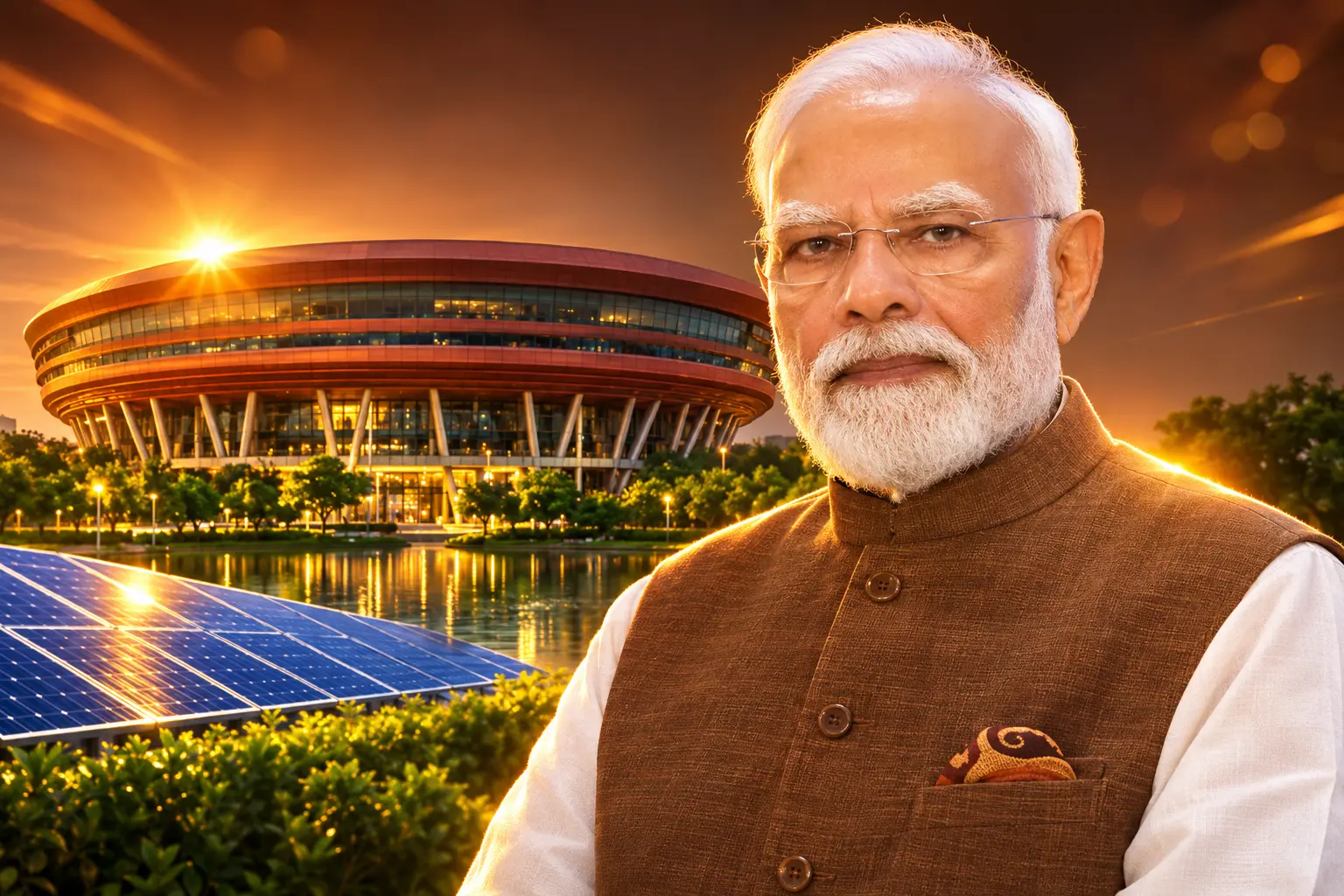
Modi Backs the Joshi-Bloomberg Bet on India’s Solar Boom
Modi amplified a Joshi-Bloomberg essay on India’s solar push, selling rooftop bills and a $220 billion capital need through 2030.

Prime Minister Narendra Modi on November 2 shared a joint essay by Pralhad Joshi and Michael Bloomberg on India’s solar-led power shift. The post went out the same morning he opened a New Delhi summit built to pull in capital, ministers and manufacturers.
Union Minister for New and Renewable Energy Pralhad Joshi and Michael Bloomberg, founder of Bloomberg L.P. and Bloomberg Philanthropies, wrote that solar is cutting household bills, creating jobs and tightening energy security. The numbers they and Joshi used that week are large. The unpaid half of the claim is still sitting in storage tenders, intra-state wires and about 35 lakh roofs that do not yet have panels.
A Joint Byline Timed to Opening Day
Joshi holds the new and renewable energy portfolio and also chairs the International Solar Alliance. On October 14 he spoke at the Bloomberg New Economy Forum on accelerating the renewable age, standing with Ethan Zindler of BloombergNEF, and invited Bloomberg to partner in the Bharat Renewable Energy Summit and Expo at Bharat Mandapam from November 2 to 5.
Nineteen days later the partnership showed up in print. Joshi posted a link to a joint essay with Bloomberg on renewable growth, rooftop solar, storage and transmission. The Prime Minister’s Office quoted that post before noon and put Bloomberg’s handle beside Joshi’s.
India's clean energy transition is gathering pace, with solar power playing a growing role in meeting the country's energy needs.@MikeBloomberg and Union Minister Shri @JoshiPralhad write about the growth of renewable energy, the expansion of rooftop solar and investments in… https://t.co/DpJpKLmpxJ
— PMO India (@PMOIndia) November 2, 2026
Bloomberg already had a formal India climate-finance track. In 2023 his Climate Finance Leadership Initiative India announced climate finance solutions in India with the potential to mobilise more than $6.5 billion across e-mobility, circular economy, green hydrogen and renewables. The November essay is the public-facing version of that pitch, signed by the minister who runs the domestic programmes.
THE PATH TO THE JOINT ESSAY
- February 13, 2024: The government launches PM Surya Ghar: Muft Bijli Yojana, aiming to put rooftop solar on 1 crore homes by 2026-27 with a central outlay of ₹75,021 crore.
- October 14, 2026: Joshi addresses the Bloomberg New Economy Forum, cites 308 GW of non-fossil capacity then on the books, and asks Bloomberg to join the New Delhi summit.
- November 1, 2026: Joshi publishes a signed essay stating that solar has reached 171 GW and that 21 lakh of 65 lakh Surya Ghar homes have a zero electricity bill.
- November 2, 2026: Joshi and Bloomberg publish the joint essay; the PMO shares it; Modi inaugurates the summit around 4:30 pm.
The sequence is a sales calendar, not a coincidence. The government wanted a global byline on the morning investors walked into Bharat Mandapam.
65 Lakh Roofs and 21 Lakh Zero Bills
The household programme is the part of the pitch that can be counted on a meter. Joshi told the summit that PM Surya Ghar had around 3 lakh installations in 2024 and that the tally has crossed 65 lakh in two years, with more than 1 lakh systems added every six days. His November 1 essay said more than 21 lakh of those 65 lakh homes now receive a zero electricity bill.
More than 21 lakh of the 65 lakh homes with PM Surya Ghar rooftop solar have received a zero electricity bill. Life for young Indians, once marked by monthly bills and regular power cuts, has seen a sea change. Now, they ask how an inverter works, what a battery costs, and whether AI can run decentralised solar.
Pralhad Joshi, Union Minister for New and Renewable Energy, signed essay, November 1, 2026
The scheme pays central assistance of ₹30,000 for a 1 kW system, ₹60,000 for 2 kW, and a cap of ₹78,000 for 3 kW and above. A 3 kW kit is designed to generate more than 300 units a month on average, which is also the free-power figure used in the programme’s public brief. The residential target behind those subsidies is 30 GW of rooftop solar.
PM SURYA GHAR ON THE LEDGER
| Metric | Figure | As of |
|---|---|---|
| Households with rooftop solar | 65 lakh | November 2, 2026 (Joshi at the summit) |
| Homes on a zero electricity bill | 21 lakh | November 1, 2026 (Joshi essay) |
| Installations in 2024 | about 3 lakh | Joshi at the summit |
| Recent pace | more than 1 lakh every six days | Joshi at the summit |
| Household target | 1 crore | by 2026-27 |
| Central outlay | ₹75,021 crore | from February 2024 |
| Top central subsidy | ₹78,000 | systems of 3 kW and above |
That still leaves 35 lakh homes against the 1 crore target, with roughly five months of the 2026-27 year remaining after November 2. The 21 lakh zero-bill figure is the political core of the essay Modi chose to share, because a dead monthly bill is easier to explain than a gigawatt chart.
What Joshi and Bloomberg Put on Paper
The joint essay, published November 2, frames electricity demand as a growth problem. Joshi and Bloomberg noted 7.8 percent real GDP growth in the first quarter of 2026-27 and said factories, businesses and homes are pulling more power as the economy expands. PM Surya Ghar, they wrote, has already gone past 6 million homes on the way to 10 million by March 2027, a rounding that matches Joshi’s 65 lakh count.
They gave Bloomberg Philanthropies a line in the same piece. The foundation, they said, has worked with the Ministry of New and Renewable Energy to map rooftop potential in 120 cities with satellite data, train nearly 9,500 vendors and installers, and reach nearly 1.4 million people through outreach. That is the operational footprint behind the co-byline.
International capital followed because the domestic market proved the plan could work.
Michael R. Bloomberg and Pralhad Joshi, joint essay, November 2, 2026
They wrote that India has topped BloombergNEF’s ClimateScope rankings of emerging economies for energy transition investment three years in a row. Joshi’s separate November 1 essay supplied the physical scoreboard behind that ranking: installed solar up by around 6,007 percent, from 2.8 GW in 2014 to 171 GW, with power that sold around ₹8 a unit in 2014-15 now as low as ₹2.15. He added that India is the only G20 country to have met its 2030 target of 50 percent non-fossil capacity five years early.
At the summit he put a second tariff beside that figure. Solar-plus-battery, he said, is as low as ₹2.70 per kWh. The cheaper daytime solar number is the one in the household story. The ₹2.70 number is the one that matters after sunset.
The Summit Opens With a $220 Billion Gap
Modi inaugurated the four-day summit at Bharat Mandapam on November 2. The Press Information Bureau had billed participants from over 130 countries, more than 40 ministers, nine country partners and 13 states and union territories, with an expo of over 400 exhibitors. The theme on the release was “Invest. Innovate. Inspire.”
THREE EVENTS UNDER ONE ROOF
- Bharat RE 2026: Investment, industry and technology sessions aimed at turning pledges into projects.
- 9th ISA Assembly: The alliance’s decision meeting on solar finance and country programmes, using PM Surya Ghar and PM-KUSUM as exportable models.
- 4th International Conference on Green Hydrogen: A parallel track on hydrogen technology, offtake and scale-up.
Country partners listed by the Prime Minister’s Office were Australia, Denmark, the European Union, France, Germany, the Netherlands, Norway, Sweden and the United Kingdom. Partner states named for the floor were Andhra Pradesh, Assam, Bihar, Chhattisgarh, Delhi, Gujarat, Karnataka, Madhya Pradesh, Maharashtra, Odisha, Rajasthan, Uttar Pradesh and West Bengal.
MNRE Secretary Santosh Sarangi, briefing on October 28, said the 500 GW goal will need approximately USD 220 billion in investment between 2027 and 2030, plus faster storage, stronger transmission and more domestic factories. The same briefing cited BloombergNEF for $63.7 billion invested in Indian renewables from July 2024 to June 2026, and ranked India third globally in renewable and solar capacity and fourth in wind.
Joshi, speaking after that window had closed, said the sector had drawn $67 billion (₹6 lakh crore) in the last two years, with foreign direct investment of $6.2 billion. Those two dollar figures are not the same series. BloombergNEF’s $63.7 billion stops at June 2026. Joshi’s $67 billion is his two-year total as of November 2. He also said non-fossil capacity had reached 310 GW, up more than 110 GW in two years from over 200 GW in September 2024.
Modi, opening the hall, tied the build-out to a wider fuel shock. “If India had not invested in clean energy and built new systems over the past decade, our crisis could have been far more serious than that of the rest of the world,” he said. He added that more than 50 percent of installed power capacity is now non-fossil, that India is among the top three countries in solar and renewables, and that energy security now runs through clean power because fossil reserves are finite.
The Grid Bill Inside Green Energy Corridor III
The joint essay’s mention of storage and transmission is the part of the pitch that still has to be built. A written reply in Parliament this year put the Central Electricity Authority’s 2030 need at 41.65 GW of battery storage by 2030, equal to 208 GWh, plus 18.98 GW (128.40 GWh) of pumped storage. MNRE Additional Secretary Mayank Tewari said in mid-October that tenders were already close to 43 GWh and that Green Energy Corridor Phase III would add around 50 GWh more.
The Union Cabinet’s Green Energy Corridor Phase III, cleared at the end of September, is the invoice attached to those sentences.
GREEN ENERGY CORRIDOR PHASE III
| Piece | Outlay | What it is meant to do |
|---|---|---|
| Intra-state transmission | ₹1,36,378 crore | Move up to 135 GW of renewable power by FY2032-33 |
| Battery storage | ₹50,000 crore | Add 50 GWh of BESS, the first storage slice inside the corridor programme |
| Central support | ₹54,082 crore | Offset intra-state transmission charges so the extra wires do not land straight on tariffs |
| Full scheme outlay | ₹1,86,405 crore | Run through FY2032-33 |
Gigawatts already on the system do not automatically become evening power. Rooftop dealers treating Surya Ghar as a lead machine can keep adding kits on sunlit roofs, and they are doing so at more than 1 lakh homes every six days. The grid still has to carry that midday flood, hold some of it, and serve the night peak. That is why the corridor outlay is dated through 2032-33, two years past the 500 GW clock.
Modules at 225 GW, Cells at 45 GW
Joshi used the summit to argue that the factory side of the story has moved faster than the storage side. Solar module making, he said, has gone from 2 GW to 225 GW, and cell making from none to 45 GW. Wind plant rose from 21 GW to 60 GW, and turbine making from 10 GW to 24 GW. Those lines sit beside the 2.8 GW to 171 GW solar jump and are the reason the essays talk about jobs as well as bills.
THE FACTORY SCOREBOARD JOSHI READ OUT
- Solar plant: 2.8 GW in 2014 to 171 GW now, about a 6,007 percent rise.
- Module lines: 2 GW of making capacity to 225 GW.
- Cell lines: from zero to 45 GW.
- Wind plant: 21 GW to 60 GW, with turbine making at 24 GW.
Domestic kit is what lets a rooftop scheme of this size run without waiting on a single import queue. It is also what Bloomberg and Joshi meant when they wrote that capital followed a market that had already been proved at home. The missing piece in that factory list is batteries at the same scale as modules. Module gigawatts can be built in a shed. Grid batteries need chemistry, minerals, safety codes and a buyer who will pay for four hours of stored power, not just a midday kilowatt-hour at ₹2.15.
How Much of 500 GW Is Still Missing?
The 2030 target is 500 GW of non-fossil capacity. Joshi’s November 2 figure of 310 GW leaves 190 GW still to add in a little over four years. The two-year burst of more than 110 GW, if it held, would more than cover that residual on a straight-line count. Capacity arithmetic is the easy half of the 500 GW test.
The harder half is the one the joint essay named and did not price in public: storage, transmission, and the last 35 lakh Surya Ghar roofs. Sarangi’s $220 billion for 2027 to 2030 is the official cost attached to that remainder. Modi’s line that energy security now runs through clean power is the political case for spending it.
Joshi closed his November 1 essay by saying India is raising a first generation of household power producers who will shape the energy economy toward 2047. The November 2 joint essay asked the rest of the world to treat that household build as a template. Between those two pages sits a four-day hall in New Delhi, 65 lakh wired roofs, 21 lakh zero bills, and a corridor bill that runs into the next decade.
Disclaimer: This article is news reporting and analysis of public statements, official releases and published essays. It is for information only and is not investment, financial, energy-procurement or legal advice. Readers considering rooftop solar, power-sector securities, project finance or energy contracts should consult a licensed financial adviser, chartered accountant or energy lawyer who can review their own facts. Installed capacity, household counts, tariffs, outlays and investment totals are those given by the named officials and documents as of November 2, 2026, and they can be revised in later updates.

ADNOC Ship Hit in Hormuz Leaves One Crew Missing

SpiceJet’s Rs 5,500 Crore Plan Follows a Rescue That Failed

Hasina’s Return Fight Sets Fire to Yunus’s Bank

Bancroft Recants the 2018 Inquiry and Names the Team

Adhikari Ties the Saffron Saree Row to School Licences

Clancy Juror Says the Holdout Never Cited Evidence

The iPhone 18 Pro Max Splits Apple’s Fall in Two

OpenAI Calls GPT-6 Astra AGI Then Locks Its Exploits

Trump Claims Hormuz Control as Oil Holds Near $96

Russia Closes the Goethe-Institut Berlin Tried to Save

 NEWS2 months ago
Clancy Juror Says the Holdout Never Cited Evidence
- NEWS3 months ago
The iPhone 18 Pro Max Splits Apple’s Fall in Two
- NEWS3 months ago
OpenAI Calls GPT-6 Astra AGI Then Locks Its Exploits
- BUSINESS3 months ago
Trump Claims Hormuz Control as Oil Holds Near $96
- LIFESTYLE3 months ago
Russia Closes the Goethe-Institut Berlin Tried to Save
- AUTO3 months ago
Volkswagen’s Job Cuts Leave Four Plants Without Cars
- NEWS3 months ago
Dyson Puts Nurovi Robots on Sale Without the UV Flagship
- BUSINESS2 months ago
US Destroys Five Iranian Tankers as the Shock Hits Jordan










