NEWS
Kim Opens a Defense Museum Built Around Untested Missiles
Kim Jong Un put the untested Hwasong-20 in a new defense museum as Trump said he may meet him, turning live missiles into heritage before any talks.

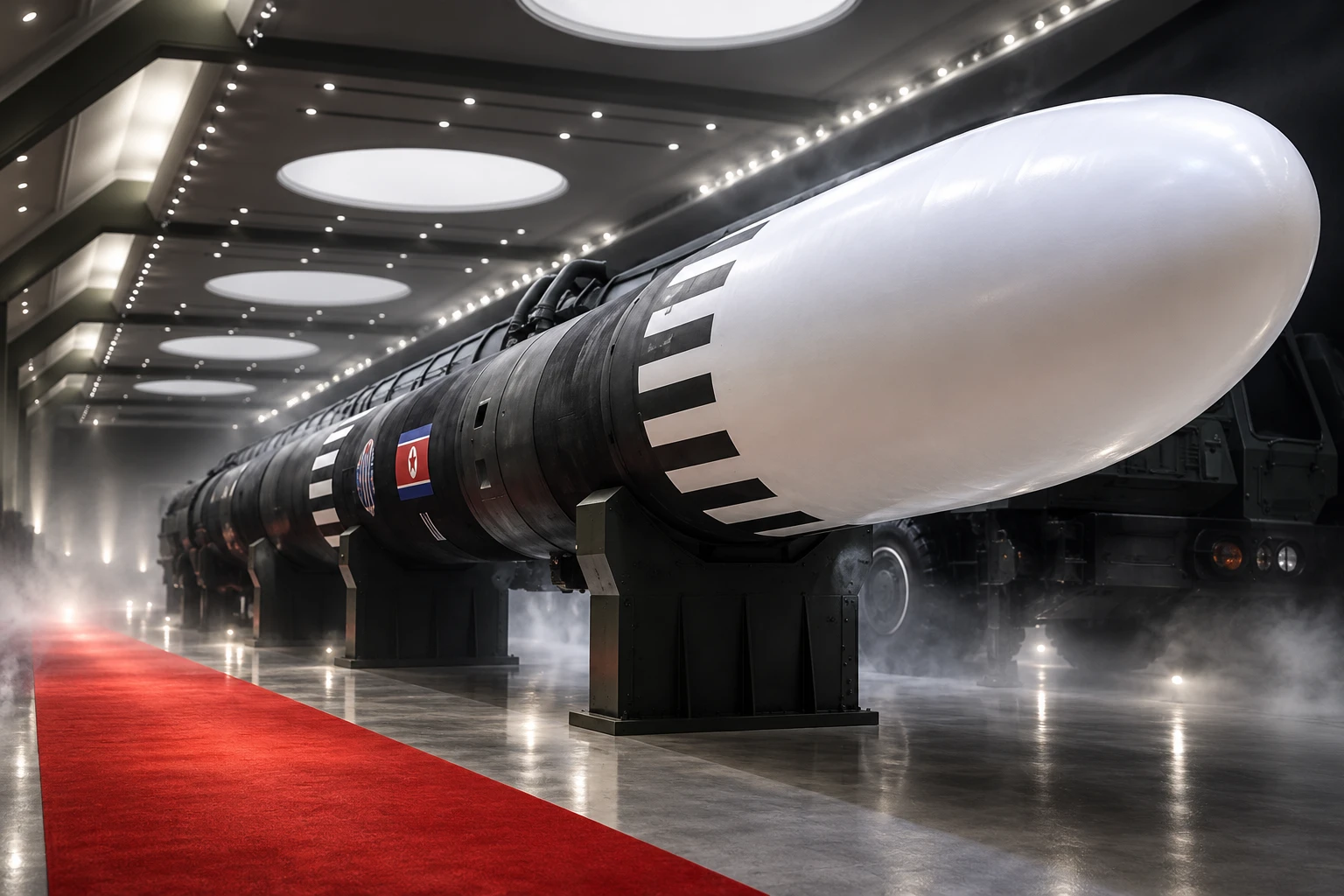
Kim Jong Un opened the National Defense Revolution Museum on Oct. 11 with an untested intercontinental missile on the floor. His daughter Ju Ae toured the hall with him, and the Korean Central News Agency posted the pictures on Oct. 13.
A day after the ribbon cutting, North Korea fired ballistic missiles toward the east. That same Oct. 12, U.S. President Donald Trump said he “I may” meet Kim during a November trip through Asia.
An Untested ICBM Now Has a Museum Gallery
The ceremony was timed to the 81st founding anniversary of the Workers’ Party of Korea, which fell on Oct. 10. KCNA said party secretaries and defense ministry officers walked the galleries with Kim, his wife Ri Sol Ju, and Ju Ae. The party paper Rodong Sinmun also placed Kim Yo-jong, director of the party’s General Affairs Department, at the opening.
The museum sits under the Second Economic Committee, the organ that runs the arms industry. Guests heard the anthem, then watched a video of weapons already issued to the army. Kim Jeong-sik, a first deputy department director of the party Central Committee, gave the commemorative remarks, and Kim cut the ribbon.
State photos show long, tunnel-like rooms packed from rifle sights to the Hwasong-20. Shin Jong-woo, secretary general of the Korea Defence and Security Forum, said a board in front of that launcher appeared to show a multiple-warhead layout and a world map with range rings past the U.S. mainland, out toward the Middle East, Australia, and South America.
WEAPONS ON THE MUSEUM FLOOR
| System | How it was shown | What is confirmed |
|---|---|---|
| Hwasong-20 ICBM | U.S.-range canister, multiple-warhead board | On display, no confirmed flight test |
| New SLBM | Submarine-launched ballistic missile | Displayed at the opening |
| Hwasong-16ma | Hypersonic missile | Displayed at the opening |
| 600 mm launcher | Super-large multiple rocket launcher | Displayed at the opening |
| Badasuri | Anti-ship missile | Displayed at the opening |
That list is the catalog Kim wants treated as inheritance. Several of the pieces, led by the Hwasong-20, have not been shown in a full flight that other governments can measure.
Kim Called the Hall a National Treasure
An immortal archive that shows, concisely and intuitively, how peace on this land was secured, and a national treasure among national treasures.
Kim Jong Un, after cutting the ribbon, per KCNA and Rodong Sinmun
He told the room that building “the world’s strongest defense industry” was the party’s “rightful vocation,” then promised that “powerful Juche weapons will be developed and perfected with even greater vigor.” He added that “the museum’s scale and content will expand and become richer by the day.”
KCNA’s English account also quoted him calling the hall a “revolutionary treasure” only the party can own, and a “precious monument” that only a state strong enough to defend itself could build. He said “juche-based weaponry” would be completed “alongside the scale and contents of the museum,” and that the rooms showed “how the dignity and security of the DPRK and the happiness of its people are defended and how peace of this land is achieved.”
A museum that is already a treasure, and that will keep adding missiles as they are finished, is not a freeze list. It is a claim that the work belongs in history even while the production line is still running.
What Japan Clocked After the Ribbon Cutting
On Oct. 12, a day after the opening, North Korea fired at least two ballistic missiles from inland toward the east. Japan’s defense ministry said the first missile flew about 220 km, peaking near 20 km, after a 9:19 a.m. launch, and that a second round at 9:36 a.m. rose to about 70 km and flew more than 910 km.
Both rounds fell outside Japan’s exclusive economic zone of 200 nautical miles (370 km), the ministry said, with no damage reported to aircraft or ships. Tokyo, Washington, and Seoul are studying whether the longer shot followed an irregular path. Defense Minister Shinjiro Koizumi told a regular briefing on Oct. 13 that the second track might have done so.
KCNA called the work a “tactical” ballistic missile test meant to confirm a technical upgrade to “an important core element.” The Missile Administration said the upgrade was “a big success heralding an important change in improving the performance and sophistication of all offensive weapon systems,” and offered no further detail.
Japan’s defense ministry had already logged 11 launches and 18 missiles for 2026, including the Oct. 12 pair, more than double last year’s launch events and about triple the missile count. Koizumi repeated those figures the next day. Observers said the weapon may have been a Hwasong-11A, also known as a KN-23, a short-range missile that can fly a quasi-ballistic path and is believed able to carry a battlefield nuclear warhead.
THE 72 HOURS AROUND THE OPENING
- Oct. 10, 2026: The Workers’ Party marks its 81st founding anniversary.
- Oct. 11, 2026: Kim opens the National Defense Revolution Museum with Ju Ae and Ri Sol Ju.
- Oct. 12, 2026: North Korea fires at least two ballistic missiles; Trump says he may meet Kim in Asia.
- Oct. 13, 2026: KCNA publishes the museum tour and the tactical-missile claim.
South Korea’s Joint Chiefs said the Oct. 12 shots looked like a reply to Seoul’s first public test of a homegrown hypersonic glide vehicle on Oct. 8, which President Lee Jae Myung attended. They were North Korea’s fourth launch in about a month, after an Oct. 3 intermediate-range firing that Pyongyang said flew 1,000 km, farther than Tokyo and Seoul first estimated. The North has been working on missiles that can perform pull-up moves, which complicates tracking and intercept.
A Daughter on the Defense Floor
Ju Ae has been a regular at launch sites and plants this year, and the museum is the first time those systems are framed as a permanent public collection she is seen walking through. State cameras put her at an Oct. 3 intermediate-range drill with her parents, days before the opening.
JU AE’S RECENT DEFENSE DATES
- Oct. 3, 2026: Attends an intermediate-range missile drill with Kim and Ri Sol Ju, per KCNA.
- April 19, 2026: Observes a tactical ballistic missile firing.
- March 11, 2026: Visits a Second Economic Committee munitions factory.
- 2022: Makes her public debut at an ICBM test.
A running log of her public defense appearances since 2022 now includes soccer matches between missile units as well as factory floors. The new hall folds that tour into a single building. If the rooms are, in Kim’s phrasing, a national treasure, she is being photographed as a visitor who belongs there.
The ‘I May’ Line Meets a Finished Exhibit
Asked on the White House south lawn on Oct. 12 whether he planned to meet Kim on the Asia trip, Trump said, “I may.” He added, “That’ll be exciting, won’t it? But I get along with him.”
He is due in Manila on Nov. 16 for the Association of Southeast Asian Nations gathering, then in Shenzhen on Nov. 18 and 19 for the Asia-Pacific Economic Cooperation summit. In August he said he hoped to meet Kim later in the year. The two met three times in his first term: Singapore in June 2018, Hanoi in February 2019, and the border village of Panmunjom in June 2019.
At an Oct. 3 rally in Ohio he said he gets along “great” with Kim and that it is “nice to get along” when “people have 112 nuclear missiles,” a figure he did not explain. In August he had put North Korea at 57 “very powerful” nuclear weapons, also without a public source. State Department spokesperson Tommy Pigott said Trump does not treat talks with North Korea as a “concession” and will engage if it serves U.S. interests. Pyongyang has not answered the October tease in public.
Personal chemistry is being asked to carry a nuclear file that Kim is now housing under museum lighting. The “I may” clip was received as if getting along were the policy. A meeting sold that way would open against a hall that already files the missiles as finished work.
Still No Flight Test for the Hwasong-20
KCNA first discussed the Hwasong-20 on Sept. 2, 2025. It rolled through Kim Il Sung Square on Oct. 10, 2025, at the party’s 80th anniversary parade, billed as the country’s “most powerful nuclear strategic weapon.” At least three canisters rode 11-axle launchers. A year later the same missile stands in a museum, still without a confirmed flight test.
Researchers tracking the program have pointed to a solid-fuel engine and untested flight record. North Korea has ground-tested a carbon-fiber solid-fuel motor for the new ICBM line and has not put the Hwasong-20 on a full trajectory that other countries can measure. The broader nose and the board in the new museum are being read as a push toward multiple warheads, which would make missile defense harder if the design works.
WHERE ANALYSTS SPLIT
- Summit leverage: Shin Jong-woo said the exhibition looked like an effort to gain an edge before any meeting with Washington.
- Finished legacy: Lim Eul-chul, a professor at Kyungnam University’s Institute for Far Eastern Studies, said a permanent museum turns old pop-up weapons shows into a claim that the nuclear and missile buildup is a completed inheritance.
Both readings fit the same rooms. Kim promised those rooms will grow as new weapons are “developed and perfected.” The Hwasong-20 is already labeled as heritage before it has flown.
Tokyo Counts 18 Missiles This Year
Koizumi said the launches show a harder security setting around Japan and that Tokyo protested through its embassy in Beijing. U.S. Pacific Command also reported two ballistic missiles on Oct. 12. Japan, the United States, and South Korea are still working through the longer shot’s path, including the chance it bent off a normal arc.
The museum does not answer those tracks. It files them. Kim cut a ribbon over an untested ICBM the day before his army fired another pair of ballistic missiles, and the U.S. president answered with a line about getting along. November still has no confirmed meeting, and the gallery will, in Kim’s words, get richer by the day.

Bulk Scotch Still Faces Full Duty After India’s UK Deal

Typhoon Champi Loops Off Taiwan and Still Injures 527

PM Modi Opens Chinmaya’s AI Guru and Asks for Unity

Mahim Police Hold a JeM Suspect on Enmity Charges

Gold Falls Below $4,000 as Hormuz Oil Hits $117

The iPhone 18 Pro Max Splits Apple’s Fall in Two

OpenAI Calls GPT-6 Astra AGI Then Locks Its Exploits

Clancy Juror Says the Holdout Never Cited Evidence

Trump Claims Hormuz Control as Oil Holds Near $96

Russia Closes the Goethe-Institut Berlin Tried to Save

 NEWS2 months ago
The iPhone 18 Pro Max Splits Apple’s Fall in Two
- NEWS2 months ago
OpenAI Calls GPT-6 Astra AGI Then Locks Its Exploits
- NEWS1 month ago
Clancy Juror Says the Holdout Never Cited Evidence
- BUSINESS2 months ago
Trump Claims Hormuz Control as Oil Holds Near $96
- LIFESTYLE2 months ago
Russia Closes the Goethe-Institut Berlin Tried to Save
- AUTO2 months ago
Volkswagen’s Job Cuts Leave Four Plants Without Cars
- NEWS2 months ago
Dyson Puts Nurovi Robots on Sale Without the UV Flagship
- NEWS2 months ago
The Lincoln’s 286-Day War Cruise Ends at a Thai Pier