
NEWS
Jio Seeks Cable Stakes for Its Unlicensed Broadband Radio
Jio is shopping UBR to Comcast and Charter for equity after MTN walked, as U.S. cable looks for a last-mile that skips spectrum auctions and street work.

Jio Platforms has held talks with Comcast and Charter Communications to license its unlicensed band radio, or UBR, for possible stakes in those firms. Two people familiar with the matter said the discussions cover wireless home broadband that runs on free Wi-Fi frequencies rather than bought spectrum, and that there is no timetable for a deal.
The same people said earlier talks with South Africa’s MTN Group broke down over valuation and licensing. That is the part the cable headlines skip. U.S. cable is already losing homes to 5G wireless and fibre, and Jio is trying to sell a last-mile that does not need a spectrum auction or a trench in the street.
Jio Is Asking Cable Companies for Equity
Jio listed in Mumbai in late October 2026 after a $3.2 billion IPO and, in the same stretch, said it wanted 10 to 15 partners for the UBR platform. Managing Director Akash Ambani told analysts on October 31 that the company wants the radios in both rich and poor markets, but will be “very, very selective about the international markets.”
“We want to be a technology-led business there,” he said. He pointed at U.S. 5G home internet and said 3% of customers there clog up 65% of fixed wireless capacity on 5G. “Those are the kind of markets that we have.”
The overseas push is co-led by Dan Bailey, former chairman of Deutsche Bank’s technology, media and telecom practice, appointed in 2026, and long-serving executive Mathew Oommen. A second person said Reliance is talking to everyone, with many players in Europe and the United States. Jio did not answer questions on the talks. Spokespeople for Comcast and Charter declined to comment. MTN said it does not comment on market speculation.
WHAT WE KNOW
- The ask: Jio has discussed licensing UBR in exchange for possible stakes in partner companies, including Comcast and Charter.
- The miss: Talks with MTN ended because the two sides could not agree on valuation and certain licensing terms, and one person said MTN could not get Jio to invest at a price it would accept.
- The clock: The people said there is no timetable with any party named in the discussions.
- The base: Reliance says UBR-powered users now exceed 6.5 million, with nearly 15 million wired broadband users and more than 500 million telecom subscribers.
WHAT IS UNCONFIRMED
- A signed deal: No partner, licence fee, or equity percentage has been announced.
- The U.S. band plan: It is not public which power class, channel width, or frequency Jio would run on American rooftops.
- The cost stack: No full comparison with cable plant, fibre drops, or licensed 5G home internet has been published.
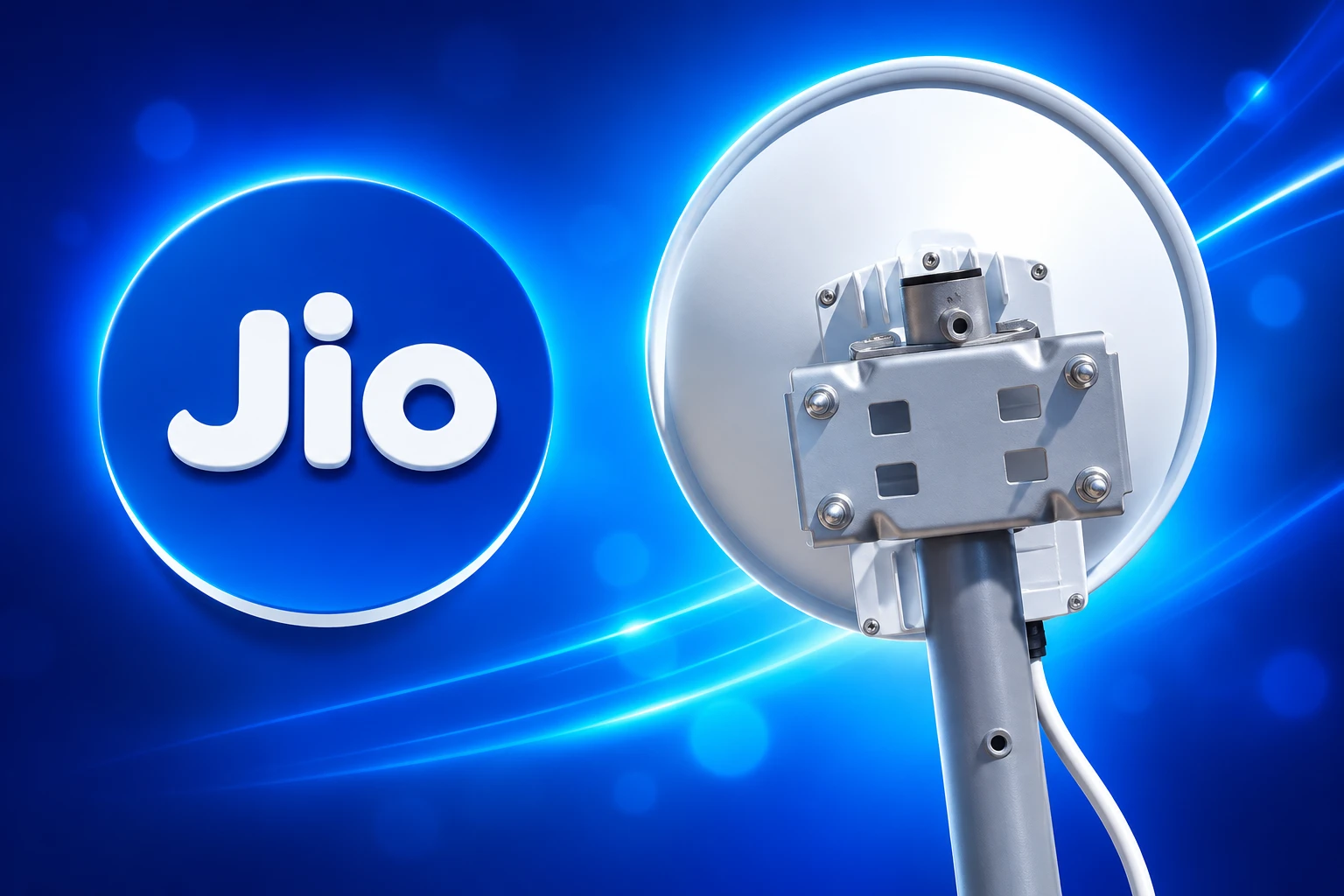
Reliance calls UBR a global first: transmitters on towers or rooftops send high-speed internet over unlicensed Wi-Fi frequencies to receivers on buildings, so the last link is not a cable into every home. People familiar with the strategy have said the radios can deliver about 1 Gbps with quality close to fibre, and may stay up in places where fibre is cut. Those figures are Jio’s claim, not an independent lab result.
Comcast Lost 144,000 Broadband Customers in One Quarter
Comcast ended September 2026 with 28.34 million U.S. residential broadband customers after a net loss of 144,000 in the third quarter, worse than the 91,000 it lost in the same quarter of 2025. The base was 28.90 million a year earlier. Co-chief executive Mike Cavanagh told investors that fixed wireless remains aggressive and continues to take share, while fibre builds stay elevated, with pockets of what he called irrational pricing. He also said satellite providers could eventually win broadband customers.
Charter, which operates Spectrum, had about 29.4 million internet customers in June 2026 and lost 172,000 broadband customers in the second quarter. It has not yet reported the September quarter. On August 20, 2026, Charter closed its $34.5 billion Cox deal, creating a cable group across 45 states. Third-quarter results are due on November 6, 2026.
LAST REPORTED CABLE INTERNET BASES
| Operator | Home internet customers | Latest net loss | Period |
|---|---|---|---|
| Comcast | 28.34 million | 144,000 | Q3 2026, ended September |
| Charter (Spectrum) | 29.4 million | 172,000 | Q2 2026, June base |
S&P Global Market Intelligence put cable at 62% of U.S. residential broadband connections at the end of 2024. The share is still large. The growth engine is not. Opensignal put fixed wireless from the three national carriers at 10.6% of U.S. home broadband at the end of June 2026, up from 8.4% a year earlier. Comcast is taking a $1 billion-plus charge in the fourth quarter as it reworks the connectivity business. That is the pressure sitting behind a call from India about radios that do not use C-band.
Neil Shah, director at Counterpoint Research, said spectrum is scarce and expensive, and that UBR can look attractive to companies such as Comcast and Charter because they can deliver cellular-quality broadband over spectrum they do not have to buy. Ashwinder Sethi, a partner at Analysys Mason, has made the India-side version of the same point: Jio uses the 5 GHz unlicensed band for fixed wireless so it can keep licensed C-band for phones.
How Jio Beams Broadband From a Tower to a Roof
AirFiber is Jio’s home wireless brand. It mixes licensed 5G fixed wireless with UBR. The unlicensed piece is a point-to-multipoint radio: one sector on a tower or a high building talks to many receivers, the way a cell site talks to phones, except the customer box is meant to sit on a structure and stay there.
The planning problem is line of sight. An Esri case study on the rollout says the UBR design needed a clear path between tower gear and the customer site, so Jio could not lean only on ordinary radio-frequency coverage maps. The company mapped over 100 million buildings in India’s top 900 cities and towns, at 98% accuracy and 1 to 2 meters of precision, then sliced each structure into 3-meter meshes so a floor could be scored for signal before a truck rolled.
Jio says it reached 92% accuracy in UBR coverage predictions in Indian cities and, in many cases, same-day installs after a tower went live. The model used more than 300,000 towers, antenna tilt, beam width, building height, and Fresnel zones. That is a software company wrapping a radio company. It is also a reminder that “unlicensed” does not mean “point and shoot.”
Anshuman Thakur, Jio Infocomm’s head of strategy, told analysts in May 2025 that UBR was commercially live, including in some spots without a direct line of sight, and that almost all of the gear is made by Jio. He restated a target of 100 million connected homes through JioFiber and Jio AirFiber, with no date attached.
WHAT THE RADIO STILL NEEDS
- A perch: A tower sector or a rooftop mount with power, backhaul, and the right to be there.
- A path: A usable shot to the customer building, even if Jio now says some non-line-of-sight cases work.
- A box on the wall: A receiver the household accepts, pays for, and lets a technician install.
- Quiet enough air: Unlicensed channels that are not already packed with home Wi-Fi, radars, or other outdoor radios.
- A rulebook: Power limits, outdoor rights, and, in the United States, a live link to an automated frequency database if the radios move into 6 GHz.
Those items are why a licence to Jio’s stack is not the same as a spare modem in a warehouse. Landlords, housing societies, and city rules over rooftops become part of the network, because the street is no longer the only route into the building.
Airtel’s Warning About the Shared Wi-Fi Band
Jio’s India UBR product is built around the unlicensed 5 GHz band, the same air home routers already use. That is the cheap input. It is also the shared one. Bharti Airtel is running its own UBR trials and has been blunter than Jio about what happens in a dense block of flats.
The problem with UBR is interference in crowded areas because it uses the same Wi-Fi band as homes. You may occasionally experience browsing issues at home, which are actually caused by interference in the lower band of the Wi-Fi frequency.
Gopal Vittal, Chief Executive, Bharti Airtel, on an earnings call
Vittal said the trial still has a chance in less populated places, isolated sites, rural areas, and small towns where fibre is thin. That split matters for the Comcast conversation. Akash Ambani is selling UBR into a U.S. market defined by congested 5G home internet in built-up areas. Airtel’s own chief is saying the unlicensed Wi-Fi band gets ugly in crowded areas. Both can be true in different geographies. They are not the same product promise.
The radios are not satellites. They sit on towers and eaves and share the same 5 GHz soup as kitchen routers, which is why a clean rural shot is a different job from a row of apartment decks. People who heard “wireless broadband from India” this week reached for Starlink. The physics are closer to a fixed Wi-Fi sector with a customer box on the wall.
India has not even closed the next band Jio wants. The government opened the lower 6 GHz range earlier in 2026 for licence-free, low-power indoor use and very-low-power outdoor use. In late October 2026, Jio, Airtel, and Vodafone Idea asked the Department of Telecommunications to allow high-power outdoor use of 5925-6425 MHz at 36 dBm. The Cellular Operators Association of India said an expert committee had recommended that standard-power outdoor step. Until that lands, the home-market showcase Jio is taking on the road is a 5 GHz system, not a full 6 GHz one.
The FCC Already Runs Outdoor 6 GHz Under AFC
The United States is not waiting on that Indian file. Outdoor unlicensed 6 GHz is already legal there as standard-power outdoor 6 GHz under AFC, in the U-NII-5 band (5.925-6.425 GHz) and the U-NII-7 band (6.525-6.875 GHz). Access points can run up to 36 dBm EIRP and 23 dBm per MHz of power spectral density if an automated frequency coordination system clears the channel. Fixed client devices, the customer boxes, must sit on a structure, know their location, and follow antenna-angle rules. Outdoor gear is capped at 21 dBm EIRP above 30 degrees of elevation to protect satellites. Devices have to check the database at least every 24 hours or shut down.
That rulebook is older than these talks. Tarana Wireless said on February 19, 2024, that its Gigabit 1 platform was the first FCC-certified outdoor 6 GHz product, cleared for the same UNII-5 and UNII-7 bands at 4 watts EIRP, which is the 36 dBm class. The company said more than 200 internet providers in 21 countries already used its radios in CBRS and unlicensed 5 GHz. A study it ran with Comsearch on 100,000 U.S. tower sites found that 70% of rural locations, and nearly 50% of suburban ones, cannot get the most out of 6 GHz if the radio needs a clean 160 MHz Wi-Fi-style channel.
So the second-order problem for a Jio licence in America is not “does unlicensed outdoor wireless exist.” It does. The questions are whether Jio’s 5 GHz stack, tuned on Indian rooftops and city maps, beats radios that already speak AFC; whether Comcast and Charter want a vendor with 6.5 million live UBR users more than they want another WISP box; and whether they will pay for that with equity after a $3.2 billion listing in Mumbai.
Cable plant still has one asset Jio cannot ship in a crate: the right of way, the existing drops, and the trucks. UBR is a way to add homes those trucks do not want to dig to, or to hold homes that 5G home internet is pulling away. It does not retire the HFC network. It also does not erase Wi-Fi congestion, rooftop leases, or the AFC handshake.
MTN Walked When the Two Sides Priced the License
The MTN breakdown is the only completed international chapter so far, and it did not fail on radio range. The people familiar with the matter said the two sides could not agree on valuation and certain licensing issues. One of them said MTN could not persuade Jio to invest at a satisfactory valuation. The cash terms were not disclosed.
That is a platform argument colliding with a balance-sheet argument. Jio wants to be paid like a technology company, in licences and, in the U.S. cases described, in paper in the partner. A mobile group that already owns towers and customers will only stretch so far for a system it does not control. If the U.S. talks follow the same script, the fight will be over who owns the software, who owns the customer, and what a stake is worth when the radios still need local rooftops and local rules.
Jio’s India scale is the proof it is selling. More than 6.5 million UBR users is a real commercial footprint, not a lab. Nearly 15 million wired broadband lines sit beside it, and fibre remains the preferred path where it already exists. The export model is the reverse of how Jio built India: do not buy spectrum abroad, do not lay the national fibre, do not acquire the customers one by one. Sell the stack to someone who already has those things and is watching them leak.
A Platform Pitch With 10 to 15 Partner Slots
Akash Ambani’s line on October 31 was that Jio will be very, very selective, and that it wants to be a technology-led business overseas. The 10 to 15 partner target is how that sounds in a spreadsheet: several licences, no single-country bet, equity where the partner is large enough to matter. Comcast and Charter are large enough. They are also the incumbents being nipped by T-Mobile, Verizon, AT&T fibre, and, further out, satellite. They do not need another mobile network. They need a cheaper way to keep a home that is looking at a 5G gateway in a window.
THE PATH FROM INDIA TO THESE TALKS
- May 2025: Anshuman Thakur says UBR is commercially live, including some cases without a direct line of sight, and that Jio makes almost all of the equipment.
- August 20, 2026: Charter completes the $34.5 billion Cox Communications transaction and keeps the Spectrum brand in consumer markets.
- Late October 2026: Jio lists in Mumbai after a $3.2 billion IPO and says it wants 10 to 15 global partners for the UBR platform, while Indian operators ask New Delhi for 36 dBm outdoor 6 GHz.
- October 22, 2026: Comcast reports 144,000 residential broadband losses for the third quarter and a 28.34 million home internet base, with Cavanagh still flagging aggressive fixed wireless.
- October 31, 2026: Akash Ambani tells analysts Jio will take UBR to developed and developing markets, stay selective, and chase places where a thin slice of 5G home users soaks most of the capacity.
- November 3, 2026: People familiar with the matter describe Comcast and Charter talks on licences for possible stakes, and say the MTN discussions already died on price.
Charter still has to print its own September-quarter broadband number on November 6. Comcast is deep in a cost reset. Jio has a listed currency and a radio it says already serves more than 6.5 million homes. That is not a contract. The larger shift on offer is simpler than the equity term sheet: the last meter of urban broadband does not have to be a trench if a roof, a tower, and a free channel will do. Whether Comcast or Charter will pay for that in stock, after MTN would not meet Jio’s price, is the only open line that counts.

ADNOC Ship Hit in Hormuz Leaves One Crew Missing

SpiceJet’s Rs 5,500 Crore Plan Follows a Rescue That Failed

Hasina’s Return Fight Sets Fire to Yunus’s Bank

Bancroft Recants the 2018 Inquiry and Names the Team

Adhikari Ties the Saffron Saree Row to School Licences

Clancy Juror Says the Holdout Never Cited Evidence

The iPhone 18 Pro Max Splits Apple’s Fall in Two

OpenAI Calls GPT-6 Astra AGI Then Locks Its Exploits

Trump Claims Hormuz Control as Oil Holds Near $96

Russia Closes the Goethe-Institut Berlin Tried to Save

 NEWS2 months ago
Clancy Juror Says the Holdout Never Cited Evidence
- NEWS3 months ago
The iPhone 18 Pro Max Splits Apple’s Fall in Two
- NEWS3 months ago
OpenAI Calls GPT-6 Astra AGI Then Locks Its Exploits
- BUSINESS3 months ago
Trump Claims Hormuz Control as Oil Holds Near $96
- LIFESTYLE3 months ago
Russia Closes the Goethe-Institut Berlin Tried to Save
- AUTO3 months ago
Volkswagen’s Job Cuts Leave Four Plants Without Cars
- NEWS3 months ago
Dyson Puts Nurovi Robots on Sale Without the UV Flagship
- BUSINESS2 months ago
US Destroys Five Iranian Tankers as the Shock Hits Jordan










