
BUSINESS
Jio’s Afterglow Lifts Sensex While Foreign Money Chases Chips
Sensex and Nifty rose in early trade as Jio jumped over 5% to ₹1,490, a bounce that still sits on a year of FII outflows and $114 oil.

The BSE Sensex climbed 245.43 points, or 0.34%, to 73,491.46 in early Thursday trade. The NSE Nifty 50 added 62.55 points, or 0.28%, to 22,761.40, with Jio Platforms, listed a day earlier, jumping over 5% to ₹1,490.
Overseas funds bought Indian shares on Wednesday, and that print is being read as support. It still sits on a year in which those same funds have taken ₹3.08 lakh crore out, while Brent costs $114.13 a barrel and Korean memory stocks keep pulling the global bid.
Early Trade Rises on a Narrow Set of Names
Wednesday’s close had been ugly. The Sensex had fallen 352.64 points to 73,246.03, and the Nifty 50 had dropped 50.90 points to 22,698.85. Thursday’s bounce recovered most of that Nifty loss before lunch, and it did so on a short list of large stocks rather than a broad tape.
Adani Ports was the biggest gainer among Sensex members, up 3% after its September-quarter profit. Reliance Industries, Tata Consultancy Services, Infosys, State Bank of India, ITC, Hindustan Unilever, Power Grid, NTPC, Kotak Mahindra Bank and Titan also traded higher. Trent, Maruti Suzuki India, Asian Paints, Bajaj Finserv, Larsen & Toubro, Tata Steel, HDFC Bank, Eternal and UltraTech Cement lagged.
THURSDAY MORNING LEVELS
| Name | Level | Move |
|---|---|---|
| BSE Sensex | 73,491.46 | +245.43 (0.34%) |
| NSE Nifty 50 | 22,761.40 | +62.55 (0.28%) |
| Jio Platforms | ₹1,490 | over 5% |
| Adani Ports | Sensex member | +3% |
| Brent crude | $114.13 a barrel | -1.03% |
| Kospi (10:52 a.m. Seoul) | 5,827.60 | -184.84 (3.07%) |
Sachin Gupta, VP of Technical Research at Choice Broking, said buying by both foreign and domestic institutions “provided broad-based institutional support to the market.” The support is real for one session. It is also thin once the year is put next to the day.
What Jio’s Second Session Did to the Benchmarks
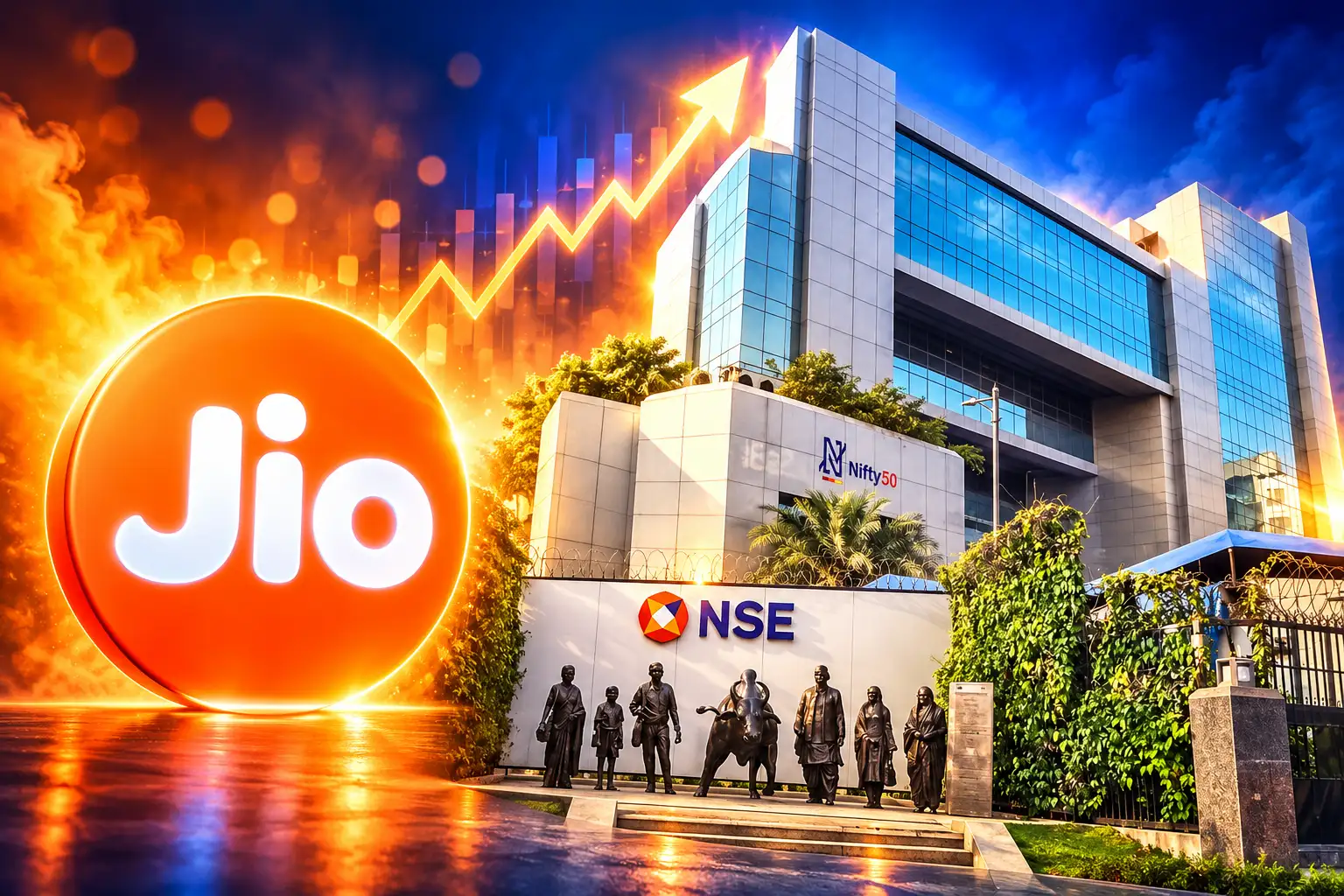
Jio Platforms jumped over 5% to ₹1,490 in Thursday’s early trade, taking its market value to ₹13,72,145.59 crore, and that second-day squeeze is the move other stocks are trading around. The new shares are not in the Sensex or the Nifty 50 yet, so the index lift is coming through parent Reliance Industries, which also traded higher, and through a risk appetite that still has the listing in its bloodstream.
The stock had listed on Wednesday at ₹1,358, a 21.36% premium to the ₹1,119 issue price of a ₹30,213 crore ($3.2 billion) fresh issue, India’s largest IPO. It closed that first session at ₹1,417.50 on the NSE, 26.68% above the issue price, after opening as the country’s second-most valuable listed firm behind Reliance, then worth about ₹16.15 lakh crore, and ahead of Bharti Airtel at about ₹12.18 lakh crore.
THE JIO LISTING WEEK
- October 19, 2026: Jio allots shares to 212 anchor investors, raising ₹8,109.85 crore at ₹1,119 a share.
- October 21 to 22, 2026: The public issue runs and is subscribed 22.19 times, with qualified institutions bidding 70.55 times their quota, non-institutional buyers 14.09 times and retail investors 2.72 times. More than 13.8 million people apply.
- October 28, 2026: Shares list at ₹1,358 on the BSE and NSE and close at ₹1,417.50 on the NSE.
- October 29, 2026: The stock extends for a second session, trading at ₹1,490 in the morning.
Akash Ambani, managing director of Jio Platforms, told the listing hall that its platforms serve more than 540 million customers. He also set a target that is larger than a domestic telecom multiple.
My dream is that one day, when the world counts its great technology companies, one of them will be from India, and that company will be called Jio Platforms Limited.
Akash Ambani, Managing Director, Jio Platforms, at the listing ceremony
The company made ₹300.5 billion in profit on revenue of ₹1.47 trillion in the year ended March 2026, both up about 15%. Up to ₹275 billion of the IPO cash is earmarked to repay debt at Reliance Jio Infocomm; borrowings were ₹613.7 billion as of June 30. Reliance still owns more than 66%, with Meta’s Jaadhu Holdings near 10% and Google International at 7.7%, and none of those 2020 investors sold in the fresh issue.
The listing ceremony is the event the second day is still pricing.
Bell-ringing ceremony marks the stock market debut of Jio Platforms Limited pic.twitter.com/Hd8ntOzcyK
— Reliance Industries Limited (@RIL_Updates) October 28, 2026
Missed-IPO buying and a coming index-fund squeeze explain more of Thursday’s bid than a new foreign allocation to India. Once Jio enters the Nifty 50 and the Sensex, passive money will have to own it. That is a local mechanical bid, and it is already in the price.
Foreign Buying Follows a Year of Outflows
Foreign institutional investors bought equities worth ₹871.83 crore on Wednesday, October 28, and domestic institutions bought ₹643.35 crore, according to exchange data. Add them and you get ₹1,515.18 crore of net institutional demand for one session. That is the number being used to explain Thursday morning.
OVERSEAS EQUITY FLOW IN 2026
- 2026 so far: Foreign portfolio investors have pulled ₹3.08 lakh crore from Indian shares, per Central Depository Services data compiled through late October.
- Full year 2025: The same investors had withdrawn ₹1.66 lakh crore across the whole of last year, a total 2026 has already passed.
- October to October 25: Outflows were ₹48,056 crore for the month before Wednesday’s purchase.
- October 28: FIIs bought ₹871.83 crore and DIIs bought ₹643.35 crore.
A one-day purchase does not reverse a year like that. Selling had already eased in the week ended October 23, when US 10-year yields moved down from 5.36% toward 5% and the rupee firmed, and V. K. Vijayakumar, Chief Investment Strategist at Geojit Investments, had flagged that shift. Wednesday’s print fits that pause. It does not rewrite the 2026 ledger.
The rupee closed at 95.1150 per dollar on October 27 after a Jio-linked bounce that had taken it as far as 94.33, from 96.73 on October 9, close to the 96.96 record low of May. Former Reserve Bank of India governor Raghuram Rajan said the central bank has spent around $80 billion to support the rupee since June. Dollar demand from oil companies is still in that market.
The Crude Bill Rose Even When Volumes Barely Moved
Brent, the global oil benchmark, fell 1.03% to $114.13 a barrel in Thursday’s tape. That dip is small against the price India has been paying for the same barrels all half.
The Petroleum Planning and Analysis Cell’s snapshot for April to September shows the crude import bill at $90.6 billion, against $61.9 billion a year earlier. Import volumes rose from 121.8 million tonnes to 122.7 million tonnes, a 0.74% increase, so almost the entire $28.7 billion extra spend is price. The Indian basket averaged $116.09 a barrel in September, against $69.61 a year earlier. Dependence stayed high at 88.1% in April to August.
INDIA’S CRUDE IMPORT BILL
| Period | Import bill | Import volume |
|---|---|---|
| April to September 2025 | $61.9 billion | 121.8 million tonnes |
| April to September 2026 | $90.6 billion | 122.7 million tonnes |
PPAC’s own crude import volumes for April to September are the volume side of that bill. Vijayakumar’s warning follows from those tonnes: with crude elevated for long, trade and current-account deficits widen, the rupee weakens, and imported inflation feeds a monsoon that is already short. Rainfall in the third week of October was 28% below the long-period average, after a first week of October that was 58% below.
Shanghai’s SSE Composite Index was down 1% in the same Asian morning, with Hong Kong’s Hang Seng and Japan’s Nikkei 225 flat. US equities had finished higher on Wednesday. None of that reprices a $90.6 billion half-year oil invoice.
The Fed Pause Leaves Treasury Yields Near 5 Percent
The Federal Open Market Committee, voting 10-2 on Wednesday, decided to maintain the target range for the federal funds rate at 3.75 to 4 percent. Lisa D. Cook and Beth M. Hammack wanted a quarter-point increase. The Board kept the rate paid on reserve balances at 3.90 percent, effective October 29, which is the “about 3.9%” figure in the morning wrap.
The statement said economic activity is expanding at a strong pace, jobs have kept up with the workforce, and “Inflation remains elevated.” Chairman Warsh, at the press conference, pointed to a first-half GDP revision from 1.8% to 2.4% and said the third quarter looked faster still. He offered little on the next move. For Indian equities, a hold is not a cut, and it does not pull the 10-year US yield far from 5%.
The Fed holding rates as expected is mildly positive for equity markets globally. However, from the Indian perspective, the headwinds continue to be strong. The 10-year US bond yield continues to hover around 5%, and there are no signs of easing of the crude prices.
V. K. Vijayakumar, Chief Investment Strategist, Geojit Investments Limited
He added that chip-shortage reports running to 2030 have pulled interest back into chip stocks and the AI trade in South Korea and Taiwan, “which means that foreign money will continue to chase AI and AI-related stocks, ignoring India.” Thursday morning is the first India session after that Fed hold. The indices went up anyway, because Jio and Adani Ports were going up.
Memory Stocks Keep the Real Foreign Bid in Seoul
SK hynix, the world’s second-largest memory maker and a supplier of high-bandwidth memory to Nvidia, told investors on Wednesday that it expects the structure in which demand exceeds supply through 2030. Leading-edge processes are hard to scale, and a new plant takes years. The company has long-term deals covering more than half of planned output for 2027 and 2028.
The same quarter produced record sales of 104.6 trillion won and operating profit of 83.3 trillion won, an 80% operating margin. That is the cash flow global funds are paying for. The Kospi closed Wednesday at 6,012.44, up 374.10 points, or 6.63%, with Samsung Electronics up 9.01% and SK hynix up 10.89%. Foreigners bought about 822.9 billion won of Kospi shares that day.
Thursday morning reversed the index without reversing the chip bid. By 10:52 a.m. in Seoul the Kospi was at 5,827.60, down 184.84 points, or 3.07%, after touching 6,100.11. Decliners outnumbered advancers 775 to 111. Foreigners were still net buyers of 412.8 billion won, including 435.9 billion won of SK hynix and 42 billion won of Samsung Electronics, while retail and institutions sold. The foreign money that India is counting as a turn is, in the same hours, still concentrating in Korean memory on a down day for the rest of that market.
Adani Ports Posted the Quarter the Index Needed
Adani Ports and Special Economic Zone, reporting on Wednesday for the quarter ended September 30, 2026, gave the Sensex a stock that could rise on its own numbers. Consolidated profit rose 18% to ₹3,682 crore from ₹3,120 crore. Revenue rose 24% to ₹11,340 crore, and EBITDA rose 23% to ₹6,807 crore. Domestic cargo was 118 million tonnes. International volumes rose to 24 million tonnes from 10 million a year earlier.
The company raised its FY27 revenue and EBITDA guidance by ₹1,000 crore each, to ₹44,000 to ₹46,000 crore and ₹26,000 to ₹27,000 crore, and lifted capex guidance by ₹3,000 crore to ₹15,000 to ₹17,000 crore. Ashwani Gupta, whole-time director and CEO, said domestic ports still anchor earnings while international ports, logistics and marine scale as extra engines, and that net debt-to-EBITDA was 1.8 times after ₹30,346 crore of capex over two years.
APSEZ’S SEPTEMBER QUARTER
- Profit: ₹3,682 crore, up 18% from ₹3,120 crore.
- Revenue: ₹11,340 crore, up 24% from ₹9,167 crore.
- International ports: Revenue ₹1,839 crore, volumes 24 million tonnes against 10 million a year earlier.
- FY27 guide: Revenue ₹44,000 to ₹46,000 crore and EBITDA ₹26,000 to ₹27,000 crore, each raised by ₹1,000 crore.
Logistics, which had been hit in the first quarter by the West Asia fighting that is also holding crude up, recovered enough in the second quarter for Gupta to call out the rebound. That is the other half of Thursday’s tape: a port group earning more from cargo while the country pays $90.6 billion for almost the same oil it bought last year.
Early Thursday priced a listing hangover and a ports earnings pop. It did not price a turn in overseas allocations, and it did not price oil at $114.13 as a problem that has gone away.
Disclaimer: This article is news reporting and analysis of market moves, company results and policy statements, and it is for information only. It is not investment advice, a recommendation to buy or sell any share, index, commodity or currency, or a solicitation to enter any trade. Readers should consult a SEBI-registered investment adviser or other qualified financial professional before acting on any figure or view here. Levels, flows and corporate numbers reflect the cited filings, exchange prints and official statements as of the dates given and can change in later sessions.

ADNOC Ship Hit in Hormuz Leaves One Crew Missing

SpiceJet’s Rs 5,500 Crore Plan Follows a Rescue That Failed

Hasina’s Return Fight Sets Fire to Yunus’s Bank

Bancroft Recants the 2018 Inquiry and Names the Team

Adhikari Ties the Saffron Saree Row to School Licences

Clancy Juror Says the Holdout Never Cited Evidence

The iPhone 18 Pro Max Splits Apple’s Fall in Two

OpenAI Calls GPT-6 Astra AGI Then Locks Its Exploits

Trump Claims Hormuz Control as Oil Holds Near $96

Russia Closes the Goethe-Institut Berlin Tried to Save

 NEWS2 months ago
Clancy Juror Says the Holdout Never Cited Evidence
- NEWS3 months ago
The iPhone 18 Pro Max Splits Apple’s Fall in Two
- NEWS3 months ago
OpenAI Calls GPT-6 Astra AGI Then Locks Its Exploits
- BUSINESS3 months ago
Trump Claims Hormuz Control as Oil Holds Near $96
- LIFESTYLE3 months ago
Russia Closes the Goethe-Institut Berlin Tried to Save
- AUTO3 months ago
Volkswagen’s Job Cuts Leave Four Plants Without Cars
- NEWS3 months ago
Dyson Puts Nurovi Robots on Sale Without the UV Flagship
- BUSINESS2 months ago
US Destroys Five Iranian Tankers as the Shock Hits Jordan










