NEWS
Apple’s Touch MacBook Pro Puts OLED Ahead of M6 Chips
Apple’s first touchscreen MacBook Pro starts at $2,899 with M5 chips and tandem OLED, sold beside a $1,999 M6 model and a shrinking mini-LED line.

Apple opened pre-order starting October 28 for its first touchscreen MacBook Pro, a tandem OLED model that starts at $2,899 and still uses the M5 Pro chip. The laptop ships on November 6 in 14-inch and 16-inch sizes, and it sits in the store next to a new 14-inch MacBook Pro with an M6 chip that starts at $1,999 and has no touch display at all.
That split is the launch. Touch is real, and it is optional. The expensive machine is the panel.
Apple Now Sells Three 14-Inch MacBook Pros
The new computer is named MacBook Pro with PROLED XDR Display, and it does not replace the mini-LED MacBook Pro that already uses M5 Pro and M5 Max. Apple’s own store now stacks that OLED line above a Liquid Retina XDR line that can be configured with M6, M5 Pro, or M5 Max. For anyone shopping a 14-inch chassis, there are three different starting points.
THREE 14-INCH MACBOOK PRO STARTING POINTS
| Line | Chip | Panel | Touch | US start |
|---|---|---|---|---|
| PROLED XDR | M5 Pro or M5 Max | Tandem OLED, 2000 nits peak | Yes | $2,899 |
| Liquid Retina XDR, M5 Pro | M5 Pro or M5 Max | Mini-LED, 1600 nits peak | No | $2,499 |
| Liquid Retina XDR, M6 | M6 | Mini-LED | No | $1,999 |
The OLED 14-inch with M5 Max starts at $4,499. The 16-inch OLED starts at $3,399 with M5 Pro and $4,799 with M5 Max. Against the mini-LED M5 Pro that remains on sale, the new 14-inch is a $400 step-up; against the M6 it is a $900 step-up. Education receipts knock $150 to $300 off those OLED list prices, depending on the chip.
Apple cut weight while it added the glass. The 14-inch OLED model is 3 pounds, half a pound lighter than the 3.5-pound mini-LED 14-inch, and the 16-inch OLED model is 4 pounds, 0.7 pounds lighter than before. Both come in space black and silver. Ports stay familiar: three Thunderbolt 5 ports, HDMI, an SDXC slot, MagSafe, and a headphone jack. Unified memory still tops out at 128GB. Storage on M5 Max now reaches 16TB.
The Touch Layer Lives Inside the Panel
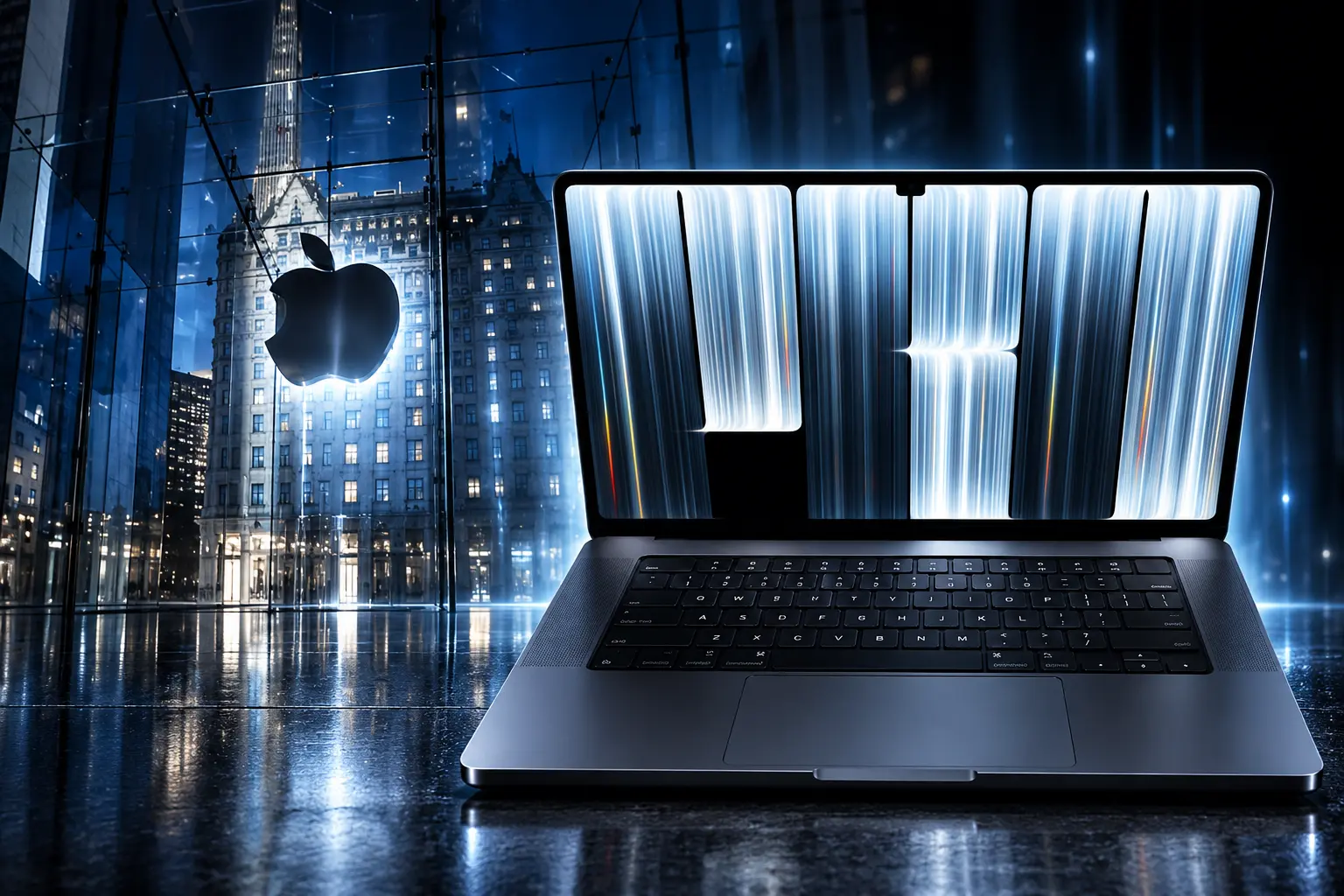
Apple built the touch sensor into the OLED stack instead of laminating a separate sheet on top, which is how it claims lower latency. macOS 27 turns many taps into ordinary clicks, so older apps do not have to be rewritten to register a finger. A newly stiffened hinge is there because a vertical slab still moves when you poke it. The camera applies extra stabilization on video calls for the same reason.
Johny Srouji, Apple’s chief hardware officer, put the display in front of the input change when he introduced the machine in Los Angeles.
PROLED XDR is the world’s best laptop display. It pairs state-of-the-art tandem OLED technology with advanced algorithms in our display engine to deliver the kind of visual fidelity pros have been dreaming of.
Johny Srouji, chief hardware officer, Apple newsroom
Everyday gestures are the ones iPad owners already have. Scroll a page with a swipe, pinch a photo, drag a slide between decks, double-tap a window to fill the screen. Graphic work can use the whole panel as a canvas rather than the trackpad’s rectangle. Musicians can play software instruments on the glass. Developers can test how iPhone and iPad apps behave under a finger without leaving the Mac.
WHAT TOUCH DOES ON THIS MAC
- Daily gestures: Swipe, pinch, drag, and double-tap are mapped in macOS 27, and many existing apps receive those taps as clicks.
- Pro canvases: Logic Pro can put instruments and drum pads on the display, and editors can nudge clips in Final Cut Pro or grade in DaVinci Resolve by hand.
- Finger-sized chrome: Menu items and the red, yellow, and green window buttons enlarge when a finger approaches, which is how Apple avoids redrawing the whole desktop for fat targets.
- Dynamic Island: Spotlight, Live Activities, and Siri AI sit in the pill at the top, and a tap can pause a song or accept an AirDrop.
Apple Executive Chairman Tim Cook posted the launch film the same afternoon with a four-word caption that treated touch as the headline, not the panel.
We brought Touch to the Mac!
From the all-new iPad mini to the 14-inch MacBook Pro and iMac… and now MacBook Pro with PROLED XDR Display and Touch, creators have new tools to do their best work yet. pic.twitter.com/6oJlc1vaUR
— Tim Cook (@tim_cook) October 28, 2026
The machine is still a clamshell. Demo footage showed people reaching up to a screen that stays upright. There is no fold into tablet mode. The six-speaker system is rated for 50 percent deeper bass, the webcam is a 12MP Center Stage unit, and battery life is listed at up to 24 hours. Nano-texture glass is an extra if you work under lights that turn the panel into a mirror.
Why This MacBook Pro Still Uses M5 Chips
The M6 chip arrived in other Macs, including the 14-inch Liquid Retina MacBook Pro that starts at $1,999, on October 27. The OLED touch model announced a day later stays on M5 Pro and M5 Max, the same silicon Apple already sold in the mini-LED Pro. Apple still calls those two chips its most powerful for a pro laptop. The display engine that drives PROLED XDR is built into them, with per-pixel compensation for content, temperature, and wear.
Skipping a process node on the halo SKU is a tell. The money went into two self-illuminating OLED layers, a factory calibration pipeline, a thinner lid, and a hinge that does not bounce. Thermal ducts now route heat away from the glass so a finger does not land on a warm panel. Srouji has said the custom silicon, the touch stack, and the display were the hard parts, and that he wants engineers gated by physics rather than by a ship date.
A 14-inch M5 Pro OLED configuration in Apple’s store starts with a 15-core CPU, a 16-core GPU, 24GB of memory, and 1TB of storage. M5 Pro storage stops at 4TB. The 16TB ceiling is reserved for M5 Max. The cheaper M6 14-inch starts with 16GB of memory and Thunderbolt 4, and it drives fewer external displays. Buyers who want the new glass are not buying the new chip.
Samsung Display Took the Whole Order
Apple has spent years spreading panel risk across vendors. For this laptop it did not. Kim Jun-ho, an analyst at UBI Research, said Samsung Display was the only company with both the process and the capital to make the new MacBook Pro panels at Apple’s brightness, thinness, and touch spec. Industry estimates circulating around the launch put the order at about 2.5 million units through 2027.
Samsung committed 4.1 trillion won ($3.1 billion) in 2023 to an 8.6-generation OLED plant in Asan, South Chungcheong Province, and mass production for these panels is said to have started in July. The larger glass sheet cuts more laptop panels per load than a phone line. LG Display already builds tandem OLED for iPad Pro on sixth-generation tools and, per people in that chain, is unlikely to join this MacBook run before 2029. BOE’s competing 8.6-generation line has had substrate-crack problems that held down yields.
THE PANEL BET BEHIND THE $2,899 SKU
- Exclusive run: Industry sources describe Samsung Display as the sole initial supplier, with about 2.5 million panels booked through 2027.
- Factory: Asan’s 8.6-generation line, funded at 4.1 trillion won ($3.1 billion), uses glass about 2.25 times the area of a sixth-generation sheet.
- Share: Omdia puts Samsung Display at 87.7 percent of laptop OLED in the third quarter, and at about 88.3 percent in the fourth as Apple volume lands.
- Demand risk: UBI Research counted 6.3 million OLED iPad Pro panels in 2024, about 30 percent below early forecasts, a miss Kim said suppliers could repeat if MacBook reorders stay thin.
David Naranjo, associate director at Counterpoint Research, argued that once Apple takes OLED, capacity, yields, and panel prices move for everyone else, the same way they did in phones. That is the part of the launch that outlives the event video. Charles Hur, a Samsung Display executive vice president, already warned on Samsung’s July earnings call that fixed costs on the new line would weigh on near-term profit.
WHERE ANALYSTS SPLIT ON THE PREMIUM
- The demand risk: Kim Jun-ho said buyers may see a better picture and still refuse to pay more, which is the same bind Apple hit on the first OLED iPad Pro.
- The pro case: Independent financial analyst Neil Cybart said working professionals will spend when the hardware changes the job, which is the bet Apple is making at $2,899.
Naranjo also said tandem OLED, touch, extra brightness, and the lighter body give Apple a way to defend a higher average selling price while memory and NAND stay expensive. The company is not asking the mini-LED Pro to carry that argument. It built a second product.
What the iPad Pro Keeps After Touch Comes to Mac
The 13-inch iPad Pro starts at $1,499 and uses the same family of tandem OLED. The 14-inch MacBook Pro with PROLED XDR starts $1,400 higher. Both panels run from 10Hz to 120Hz. The Mac is brighter at peak (2000 nits for HDR and for SDR outdoors), adds Adobe RGB next to P3, and quotes a 10,000,000:1 contrast ratio. Pixel density still favors the tablet, at 264 pixels per inch on a 2752-by-2064 panel versus 254 on the Mac’s 14.2-inch 3024-by-1986 tandem OLED.
IPAD PRO AND MACBOOK PRO, SIDE BY SIDE
| Spec | 13-inch iPad Pro | 14-inch MacBook Pro PROLED |
|---|---|---|
| Starting price | $1,499 | $2,899 |
| Panel | Tandem OLED | Tandem OLED |
| Peak brightness | Lower than the Mac’s 2000 nits | 2000 nits HDR and SDR |
| Color | P3 | P3 and Adobe RGB |
| Pencil | Apple Pencil Pro and USB-C | Not listed |
| Default input | Touch, then keyboard | Keyboard and trackpad, then touch |
Apple Pencil Pro and Apple Pencil (USB-C), including hover, stay on the iPad. They are absent from the MacBook Pro spec sheet. Memory on the 14-inch OLED Mac starts at 24GB, which is already above the iPad Pro’s typical ceiling, and the laptop keeps a full port row. Greg Joswiak, Apple’s senior vice president of worldwide marketing, said most pros already own an iPad and almost every pro owns an iPhone, and that younger people on MacBook Pro expect to touch. He was describing a habit. He was not describing a tablet that runs macOS.
People who bought an iPad Pro and a Magic Keyboard as a laptop stand-in now face a Mac that accepts a finger and still runs Logic, Final Cut, and full desktop Chrome. The remaining reasons to stay on iPad are the pencil, cellular, the weight of a slab you can pick up with one hand, and software that was drawn for touch first. Those reasons did not vanish. They got narrower.
Mini-LED Laptop Panels Face a Forecast Collapse
Apple introduced mini-LED Liquid Retina XDR on the redesigned 14-inch and 16-inch MacBook Pro in 2021. Five years later it is still selling that stack, and it is also selling a tandem OLED that quotes ten times the contrast (10,000,000:1 against 1,000,000:1) and 400 extra nits at peak HDR (2000 against 1600). Asus, Lenovo, HP, and Dell already shipped OLED notebooks. Apple’s volume is what changes the cost curve those brands buy against.
COUNTERPOINT’S LAPTOP PANEL FORECAST
| Category | 2026 vs 2025 | 2027 vs 2026 |
|---|---|---|
| OLED laptop panels | +50% | +24% |
| Mini-LED laptop panels | -38% | -60% |
| All laptop displays | -3% | Not given |
Counterpoint Research, in its premium IT display work, has OLED laptop panels to rise 50 percent this year and 24 percent next year, with Apple’s MacBook Pro among the drivers. Mini-LED laptop panel shipments are forecast to fall 38 percent this year and 60 percent the year after, which leaves 2027 volume at 24.8 percent of the 2025 level. The firm still has the overall laptop display market shrinking 3 percent this year, so the OLED gain is a mix shift, not a bigger PC cycle. Sigmaintell has already counted laptop OLED shipments moving from 2.1 million in the first quarter of 2025 to 4.3 million in the second quarter of 2026, with Samsung Display above 70 percent of the panels used by major laptop brands.
Windows makers who used OLED as a way to look ahead of Apple lose that talking point the week Apple ships. They gain a supplier that has an Apple-sized line to amortize. That is a poor trade if your pitch was the screen, and a better one if your pitch was price.
Ternus Stopped Short of Promising an Air
Steve Jobs dismissed touch laptops in 2010, 16 years before this ship date. “Touch surfaces don’t want to be vertical, and it gives a great demo but after a short period of time, you start to fatigue, and after an extended period of time, your arm wants to fall off. It doesn’t work, it’s ergonomically terrible,” he said. In 2015 Phil Schiller, then head of worldwide product marketing, said Apple’s tests still found that reaching up from a fixed keyboard was uncomfortable, and that macOS and iOS should stay different on purpose. John Ternus, who became chief executive on September 1, 2026, had himself said in 2021 that the Mac was optimized for indirect input and that Apple had not felt a reason to change that.
FROM A VERTICAL NO TO A $2,899 YES
- 2010: Jobs says vertical touch fails user tests and tires the arm.
- 2015: Apple drops the glowing lid logo, and Schiller repeats the ergonomic no.
- September 1, 2026: Ternus becomes CEO; Srouji becomes chief hardware officer.
- October 27, 2026: Apple sells a 14-inch MacBook Pro with M6 and no touch, from $1,999.
- October 28, 2026: Apple unveils the PROLED touch model from $2,899, with the lid logo lit again.
- November 6, 2026: First OLED touch units are due in stores.
Ternus now describes the Mac as first of all a trackpad-and-keyboard machine that can take a touch when it is handy. He said Apple waited until adding a finger did not make the laptop heavier or thicker, and that the OLED panel is what made that possible.
We needed to get to a point where adding touch didn’t make the product lesser in any way. It didn’t make it heavier. It didn’t make it thicker.
John Ternus, chief executive, interview
Asked whether touch would come to cheaper MacBook Airs and iMacs, Ternus would not answer. The Jobs objection still fits a clamshell that does not fold. Apple’s reply is a lighter lid, a stiffer hinge, oleophobic glass, and software that inflates targets, not a 2-in-1 that lays the screen in your lap. That is a product choice. It is also why a 2010 clip still travels with every hands-on video of someone reaching up to tap a window button.
Stores are due to get the first units on November 6, in 30 countries and regions at launch, with the Apple logo on the lid lit once more.
Frequently Asked Questions
How Much Does the Touchscreen MacBook Pro Cost With Education Pricing?
Apple’s education prices are $2,749 for the 14-inch M5 Pro, $3,199 for the 16-inch M5 Pro, $4,199 for the 14-inch M5 Max, and $4,499 for the 16-inch M5 Max, which is $150 to $300 below the matching list prices. Those cuts apply to the OLED touch line only as published; the $1,999 M6 14-inch is a separate, non-touch configuration.
Does the New MacBook Pro Use Apple’s M6 Chip?
No. PROLED XDR models use M5 Pro and M5 Max. The M6 chip is in the 14-inch Liquid Retina XDR MacBook Pro that starts at $1,999, with Thunderbolt 4 and a 16GB memory floor, whereas the 14-inch M5 Pro OLED starts at 24GB and uses Thunderbolt 5.
Does the Touchscreen MacBook Pro Work With Apple Pencil?
No. Apple Pencil Pro and Apple Pencil (USB-C), including hover, are listed for iPad Pro and do not appear in the MacBook Pro with PROLED XDR Display specifications, which name Multi-Touch gestures only.
Is the MacBook Pro With PROLED XDR a Convertible Laptop?
No. Apple kept a standard clamshell with no 360-degree hinge and no detachable keyboard. The new hinge is specced to be stiffer so the panel flexes less when a finger lands on it, which is the opposite of a tablet fold.

ADNOC Ship Hit in Hormuz Leaves One Crew Missing

SpiceJet’s Rs 5,500 Crore Plan Follows a Rescue That Failed

Hasina’s Return Fight Sets Fire to Yunus’s Bank

Bancroft Recants the 2018 Inquiry and Names the Team

Adhikari Ties the Saffron Saree Row to School Licences

Clancy Juror Says the Holdout Never Cited Evidence

The iPhone 18 Pro Max Splits Apple’s Fall in Two

OpenAI Calls GPT-6 Astra AGI Then Locks Its Exploits

Trump Claims Hormuz Control as Oil Holds Near $96

Russia Closes the Goethe-Institut Berlin Tried to Save

 NEWS2 months ago
Clancy Juror Says the Holdout Never Cited Evidence
- NEWS3 months ago
The iPhone 18 Pro Max Splits Apple’s Fall in Two
- NEWS3 months ago
OpenAI Calls GPT-6 Astra AGI Then Locks Its Exploits
- BUSINESS3 months ago
Trump Claims Hormuz Control as Oil Holds Near $96
- LIFESTYLE3 months ago
Russia Closes the Goethe-Institut Berlin Tried to Save
- AUTO3 months ago
Volkswagen’s Job Cuts Leave Four Plants Without Cars
- NEWS3 months ago
Dyson Puts Nurovi Robots on Sale Without the UV Flagship
- BUSINESS2 months ago
US Destroys Five Iranian Tankers as the Shock Hits Jordan