
BUSINESS
Jaishankar Lowers the China Bar and Names the Trade Fight
Jaishankar lowered India’s China bar to border peace, then named a $112 billion trade gap as the fight that remains.

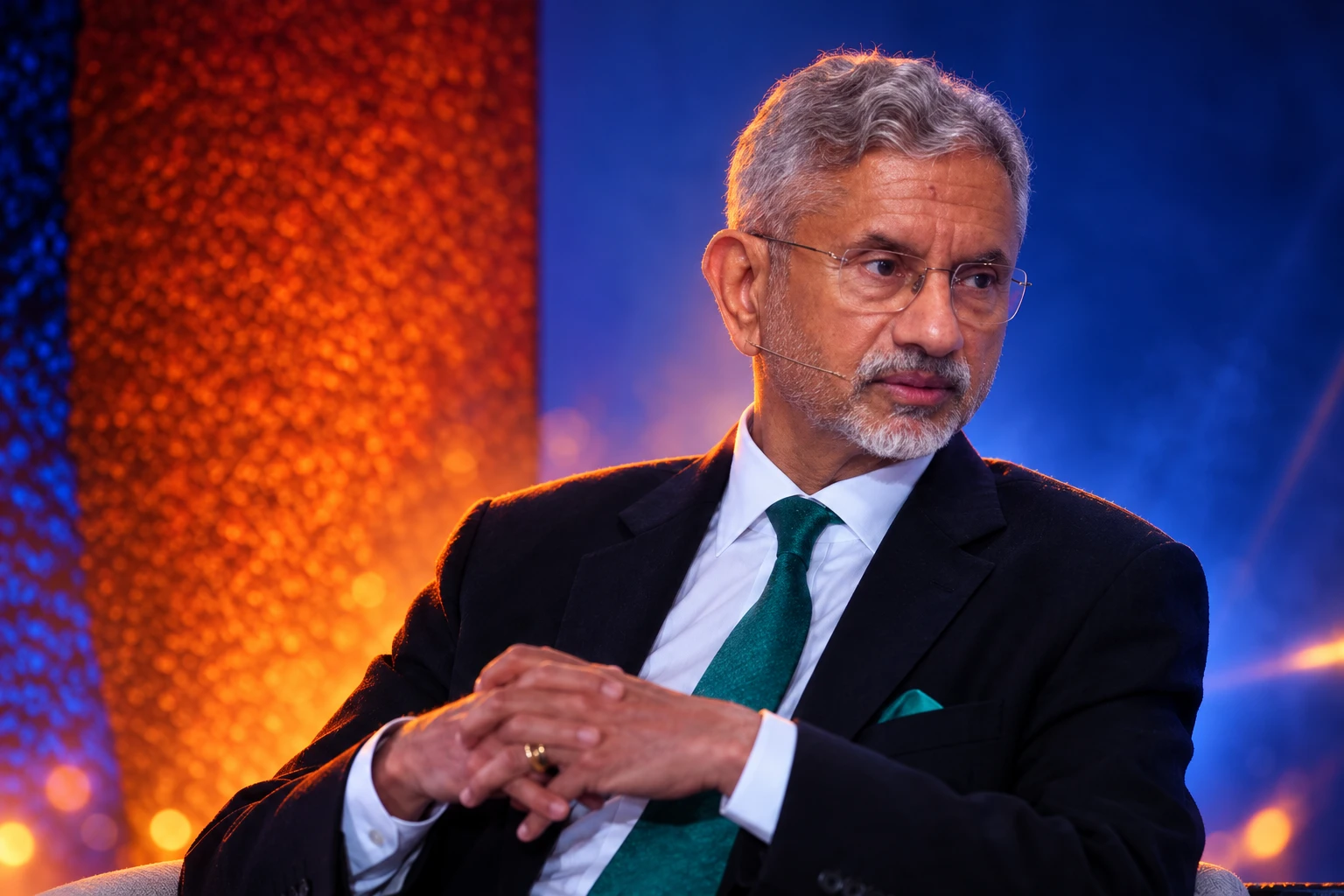
S. Jaishankar said on October 13 that peace on the China border, not a final map, is now the bar for doing business. Speaking with John Micklethwait at the Bloomberg New Economy Forum in New Delhi, he also said the trade relationship remains extremely one-sided.
The political thaw since 2024 is real enough for him to unbundle commerce from a settled boundary. The live argument he then named is older, and larger, than that thaw: Indian firms still do not get the market access China already has in India.
The Bar Is Now Peace, Not a Settled Line
External Affairs Minister S. Jaishankar told Micklethwait that India and China have no agreed border, a dispute that has run for decades along a line he put at about 3,500 kilometres. From 1975 until 2020, he said, no blood was shed on that border, and the relationship still grew. Then came the 2020 clash, which he called a profound departure from the 1975-to-2020 calm.
If peace in the border areas is disturbed, he said, the relationship will have consequences. Those consequences, in his account, ran for five years, while the talks that restored quiet took four years. He said the border areas have settled down to a great extent since 2024, and that the rest of the relationship is moving toward normalcy in step with that quiet.
Micklethwait asked whether India would allow more Chinese investment if the two sides reached an early harvest on the boundary. Jaishankar refused to hitch the two files together.
We are not insisting that you have to solve the boundary issue in order to do business. What we are saying is: the bar is lower. The bar is: please maintain peace and tranquillity.
S. Jaishankar, External Affairs Minister, at the Bloomberg New Economy Forum in New Delhi
He posted the conversation himself the same afternoon.
In conversation with John Micklethwait, Editor in Chief, @Bloomberg News at the @BBGNewEconomy Forum, New Delhi. https://t.co/aGPbKygdTH
— Dr. S. Jaishankar (@DrSJaishankar) October 13, 2026
He added that he would not link an early harvest to anything other than the boundary question. Business, market access, and investment, he said, will be dealt with separately.
Early Harvest Talks Are Still Writing Their Own Rules
Early harvest, in this file, means drawing some stretches of the boundary first and leaving the harder sectors for later. Jaishankar said the two sides have been tossing those ideas back and forth, including whether the whole line can be done at one go, and that it is an active conversation.
National Security Advisor Ajit Doval and Chinese Foreign Minister Wang Yi, the Special Representatives on the boundary, already put that language on paper. After the 25th round of Special Representatives talks in Beijing on August 25, the two governments issued eight points of outcomes. Point three says the Expert Group on Boundary Delimitation and the Working Group on Border Management, both under the Working Mechanism for Consultation and Coordination, will advance discussions on an early and substantial harvest of delimitation and of border management. Their first task is to agree on their own terms of reference.
A year after those groups were set up, they are still at the instruction-writing stage. The same eight-point text does record quieter, practical work on the line itself.
THE UNFINISHED BORDER WORK
- Terms of reference: Both new groups must still agree the rules before they can draw any stretch of the map.
- Two extra meeting points: The two sides added venues for senior military commander meetings to the existing western-sector channel.
- Two extra hotlines: New military phone links were agreed for the eastern and middle sectors.
- Next political round: The 26th Special Representatives meeting is due in India in 2027.
The eight points also note the reopening of three designated border trading posts and more batches of the official Indian pilgrimage to Mount Gang Renpoche and Lake Mapam Yun Tso. Those are confidence steps. They are not a boundary.
Exports Rose Fast, and the Deficit Still Set a Record
After drawing that firewall, Jaishankar turned to money. The trade balance, he said, is completely tilted and extremely one-sided. In sectors where Indian firms have done well with the rest of the world, they have not had market access or a successful run in China. India, he said, is not getting a level playing field in the manner in which it has given one to Chinese firms.
Department of Commerce figures for 2025-26 put that tilt in hard currency. India exported $19.47 billion of goods to China and imported $131.63 billion, a record deficit of $112.16 billion on $151.10 billion of two-way trade. Exports did jump 36.6 percent from $14.25 billion the year before. Imports still overwhelmed the gain.
The complaint is not new, which is why restating it a month after President Xi Jinping left Delhi carries weight. In March 2018 the two countries agreed to prepare a roadmap to cut the imbalance, including faster Chinese access for Indian rice, oil meals, fruit, vegetables, bovine meat, and medicines. The deficit then was $63.05 billion. In 2025-26 it was $49.11 billion larger.
Assume, as a thought experiment, that imports stay at $131.63 billion. The exports India would need from China just to dent the gap are brutal.
WHAT IT WOULD TAKE TO CUT THE DEFICIT
| Cut in the $112.16 billion gap | Extra Indian exports required | Shipments to China would need to reach |
|---|---|---|
| 10 percent | $11.22 billion | $30.69 billion (up 58 percent) |
| 25 percent | $28.04 billion | $47.51 billion (up 144 percent) |
| Half | $56.08 billion | $75.55 billion (nearly four times) |
A 36.6 percent export rise, from a small base, does not get near those rungs. That is the second file Jaishankar opened after he lowered the first.
Galwan Broke a 45-Year Silence
The reason the political bar ever rose so high sits in a single night in eastern Ladakh. Jaishankar did not name the valley. He did not need to. He said a series of border issues during the Covid lockdown culminated in a clash in which soldiers were killed on either side.
FROM TULUNG LA TO THE LOWER BAR
- 1975: Four Assam Rifles soldiers are killed in an ambush at Tulung La in Arunachal Pradesh, the last fatalities Jaishankar cited before 2020.
- June 15-16, 2020: Indian and Chinese troops clash in Galwan Valley. The Indian Army later said 20 Indian soldiers were killed in action, 17 of them after they succumbed to injuries in sub-zero high altitude.
- October 2024: After more than four years of military and diplomatic talks, Prime Minister Narendra Modi and Xi meet at the BRICS summit in Kazan. Patrolling arrangements follow at the Depsang and Demchok friction points.
- December 2024: Special Representatives talks resume after a five-year gap.
- August 19, 2025: Doval and Wang, meeting in New Delhi, agree to form an expert group to explore an early harvest in boundary delimitation.
- August 25, 2026: The 25th Special Representatives round in Beijing upgrades that language to an early and substantial harvest and adds hotlines and meeting points, while leaving terms of reference still to be written.
- September 12, 2026: Xi meets Modi in New Delhi on the sidelines of the BRICS summit, his first visit to India in seven years.
- October 13, 2026: Jaishankar tells the New Delhi forum that the bar for doing business is peace, not a settled map, and that the economic field is still not level.
The 2005 Agreement on Political Parameters and Guiding Principles remains the written frame for a fair, reasonable, and mutually acceptable settlement. Peace on the line is the condition India now says is enough to let the rest of the relationship move. A drawn border is not.
What Modi and Xi Put on Paper in September
The ministry’s readout of the September 12 meeting already contained the split Jaishankar voiced a month later. The two leaders welcomed progress since their last meeting in Tianjin in August 2025, said differences should not become disputes, and committed themselves to a fair, reasonable, and mutually acceptable resolution of the boundary question. Modi underlined the need to observe existing border agreements.
On trade, they went further than a slogan. The same readout recorded a need to address each other’s concerns, including the structural trade imbalance named in September, supply-chain issues, and facilitation of meaningful and predictable market access.
That sentence is the economic half of Jaishankar’s October 13 message, written while Xi was still in Delhi. The foreign minister’s job, a month on, was to say the bar on the ridge had come down and the bar in the marketplace had not.
Indian Medicine Holds 0.2 Percent of China’s Drug Imports
If the level-playing-field charge needs one specimen, pharmaceuticals are the cleanest. India is a large supplier of generic medicines to Africa, the United States, and the United Kingdom. China is a large buyer of drugs. The two facts barely meet.
NITI Aayog, using international trade data, put China’s pharmaceutical import demand at $40.4 billion in 2025. India’s share of that market was 0.2 percent.
THE PHARMA SPLIT
- China’s import market: $40.4 billion of pharmaceutical products in 2025, per NITI Aayog.
- India’s share: 0.2 percent, even though Indian firms supply large generic volumes elsewhere.
- The reverse flow: NITI Aayog’s Trade Watch Quarterly found India still sources about 65 percent of critical active pharmaceutical ingredients, key starting materials, and intermediates from China.
Indian companies buy the ingredients in bulk, then cannot sell the finished medicine back in any serious volume. Jaishankar’s line about sectors that work with the rest of the world and stall in China is that pattern in one sentence. Rice, oil meals, fruit, and vegetables were on the 2018 access list too. The test of the present thaw is whether those goods actually enter, not whether another communique repeats “market access.”
The 2018 Roadmap Left a Larger Gap
Lowering the political bar is a choice with a consequence. It lets flights, pilgrimage, and investment talks restart without a map. It also strips New Delhi of the old demand that the boundary be solved first, and it leaves the trade ledger as the remaining public pressure point.
That ledger has moved the wrong way since the last time the two governments promised to fix it. The Expert Group still has to write its terms of reference. The 26th round of Special Representatives talks is due in India in 2027.

Bulk Scotch Still Faces Full Duty After India’s UK Deal

Typhoon Champi Loops Off Taiwan and Still Injures 527

PM Modi Opens Chinmaya’s AI Guru and Asks for Unity

Mahim Police Hold a JeM Suspect on Enmity Charges

Gold Falls Below $4,000 as Hormuz Oil Hits $117

The iPhone 18 Pro Max Splits Apple’s Fall in Two

OpenAI Calls GPT-6 Astra AGI Then Locks Its Exploits

Clancy Juror Says the Holdout Never Cited Evidence

Trump Claims Hormuz Control as Oil Holds Near $96

Russia Closes the Goethe-Institut Berlin Tried to Save

 NEWS2 months ago
The iPhone 18 Pro Max Splits Apple’s Fall in Two
- NEWS2 months ago
OpenAI Calls GPT-6 Astra AGI Then Locks Its Exploits
- NEWS1 month ago
Clancy Juror Says the Holdout Never Cited Evidence
- BUSINESS2 months ago
Trump Claims Hormuz Control as Oil Holds Near $96
- LIFESTYLE2 months ago
Russia Closes the Goethe-Institut Berlin Tried to Save
- AUTO2 months ago
Volkswagen’s Job Cuts Leave Four Plants Without Cars
- NEWS2 months ago
Dyson Puts Nurovi Robots on Sale Without the UV Flagship
- NEWS2 months ago
The Lincoln’s 286-Day War Cruise Ends at a Thai Pier










